
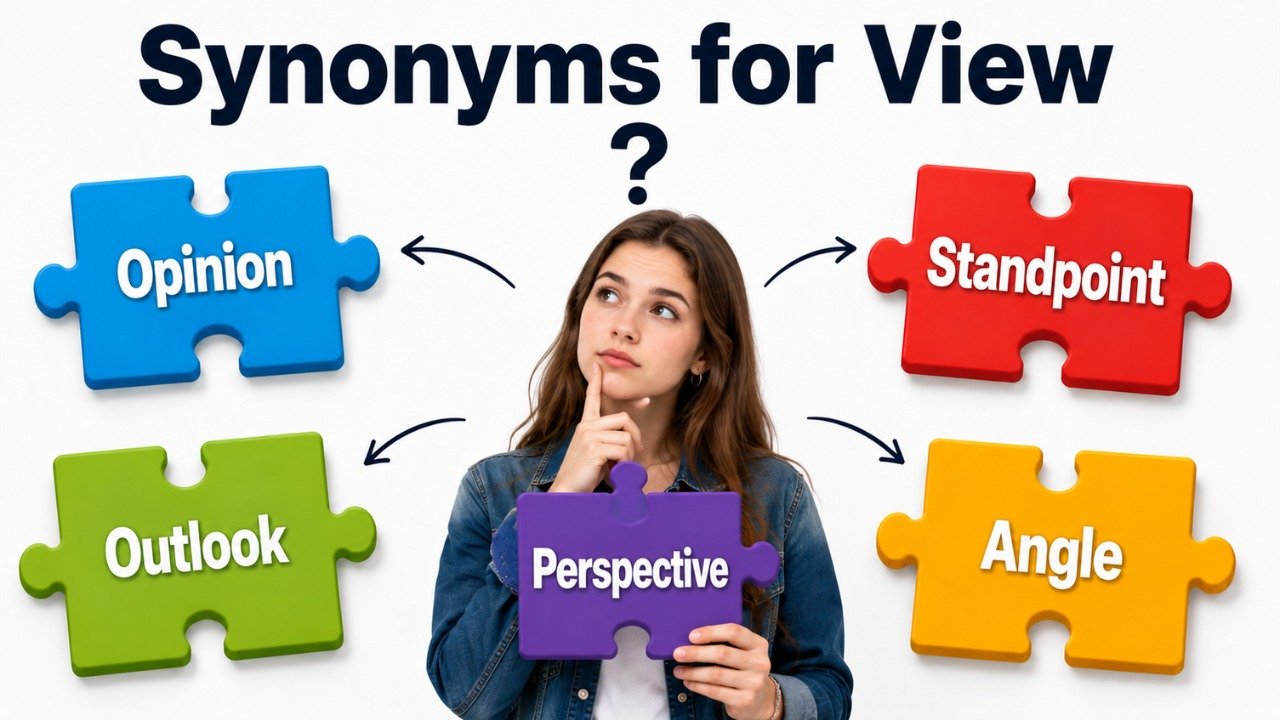
Quick Answer: Synonyms for view include opinion, perspective, outlook, belief, standpoint, scene, sight, panorama, observe, and examine. Use opinion for a personal judgment, perspective for a particular way of understanding something, and standpoint for a position in a discussion. Choose scene, sight, or panorama when referring to something visible. Use observe, inspect, or examine when view functions as a verb meaning to look at something carefully.
Pronunciation and Word Details
Word: View
Pronunciation: /vjuː/
Part of Speech: Noun and verb
Meaning: View means an opinion, a visible scene, a way of understanding something, or the act of looking at something.
US Pronunciation:
UK Pronunciation:
What Does “View” Mean?
View means an opinion, perspective, visible scene, or act of looking at something. It can function as both a noun and a verb.
As a noun, view may describe what someone thinks about a subject. In the sentence “Her view on education changed,” the word means opinion or belief.
View can also describe what can be seen from a particular place. In “The room has a beautiful view of the valley,” it refers to a scene, sight, or panorama.
As a verb, view means to look at, watch, examine, or consider something. In “The committee viewed the proposal carefully,” it suggests that the members examined or considered the proposal.
The correct synonym depends on whether view refers to an opinion, visual scene, mental perspective, or act of observation.
Meaning, Tone, and Context of “View”
View is a neutral and flexible word used in formal, academic, professional, and conversational language. Its tone changes according to context.
In discussions, essays, and debates, view usually means opinion, position, belief, or perspective. This use can sound neutral or formal.
In travel, photography, property descriptions, and everyday conversation, view often refers to a visible scene. Words such as panorama, outlook, and vista may create a more descriptive or emotional tone.
As a verb, view can sound more formal than see or watch. Examine, inspect, and observe suggest greater attention, while consider emphasizes thought rather than sight.
Because view has several meanings, writers should choose synonyms carefully. Replacing it with the wrong word may change the intended message.
When and How to Use “View”
For Personal Opinions: Use view when describing what someone thinks about an issue.
Example: His view on remote work is generally positive.
For Perspectives: Use view when explaining how a person understands a situation.
Example: The experience changed her view of success.
For Visible Scenes: Use view when referring to what can be seen from a location.
Example: The balcony offers a peaceful view of the garden.
For Observation: Use view as a verb when someone looks at an object, image, document, or event.
Example: Visitors can view the collection during opening hours.
For Consideration: Use view when describing how someone judges or interprets a person, idea, or action.
Example: Many residents view the new policy as beneficial.
For Visual Media: Use view when someone watches or examines visual material.
Example: The students viewed the presentation before discussing it.
Best Synonyms for View
Opinion: A personal belief or judgment about a subject.
Example: Everyone was invited to share an opinion.
Perspective: A particular way of understanding or considering something.
Example: Travel gave her a broader perspective on culture.
Outlook: A general attitude toward life or a particular situation.
Example: His optimistic outlook encouraged the entire team.
Standpoint: A position from which someone considers an issue.
Example: From a financial standpoint, the plan is practical.
Scene: A place or situation that can be seen.
Example: The peaceful woodland scene appeared in the painting.
Sight: Something visible or worth seeing.
Example: The waterfall was an unforgettable sight.
Panorama: A wide and impressive view of an area.
Example: The hilltop revealed a panorama of fields and villages.
Observe: To watch something carefully.
Example: Scientists observe changes in the environment.
Examine: To look at or study something closely.
Example: The editor examined every section of the report.
Consider: To think carefully about something or regard it in a particular way.
Example: The committee will consider every suggestion.
50 Synonyms for View with Short Meanings
- Opinion: A personal judgment or belief.
- Perspective: A particular way of understanding something.
- Outlook: A general attitude or way of thinking.
- Standpoint: A position from which an issue is considered.
- Position: A stated attitude toward a subject.
- Belief: An idea accepted as true.
- Judgment: An opinion formed after consideration.
- Attitude: A settled way of thinking or feeling.
- Perception: The way something is understood or noticed.
- Interpretation: An explanation of what something means.
- Understanding: Knowledge or awareness of a subject.
- Impression: An idea or feeling formed about something.
- Conception: A mental idea of what something is like.
- Notion: A belief or idea about a subject.
- Assessment: A judgment based on careful evaluation.
- Evaluation: A considered judgment of quality or value.
- Stance: A clear position on an issue.
- Angle: A particular approach to a topic.
- Approach: A way of considering or handling something.
- Mindset: An established way of thinking.
- Scene: A place or situation visible to the eye.
- Sight: Something that can be seen.
- Vista: A pleasing distant view.
- Panorama: A broad and extensive scene.
- Prospect: A view of a surrounding area.
- Outlook: A visible scene from a particular place.
- Landscape: The visible features of an area.
- Scenery: Attractive natural surroundings.
- Spectacle: An impressive or striking sight.
- Picture: A visual appearance or representation.
- Vision: Something seen or imagined.
- Aspect: A particular visible side or feature.
- Appearance: The way someone or something looks.
- Glimpse: A brief or partial look.
- Observation: The act of watching carefully.
- Look: An act of directing the eyes toward something.
- Inspection: A careful examination of something.
- Examination: A detailed study or visual check.
- Survey: A broad examination of an area or subject.
- Review: A careful consideration or examination.
- Observe: To watch attentively.
- Watch: To look at something for a period of time.
- See: To notice something with the eyes.
- Examine: To inspect something closely.
- Inspect: To check something carefully.
- Study: To look at or consider something attentively.
- Consider: To think carefully about something.
- Regard: To think of something in a particular way.
- Perceive: To notice or understand something.
- Contemplate: To look at or think about something deeply.
Read Also:
Synonyms for Context
Synonyms for View by Context
When View Means Opinion
Opinion, belief, stance, position, judgment, and standpoint work when view refers to what someone thinks about an issue.
Example: Her view on the proposal was positive.
Alternative: Her opinion on the proposal was positive.
Opinion is the most general replacement. Stance and position suggest a firmer or more publicly expressed belief. Judgment often implies that the idea was formed after evaluating facts.
When View Means Perspective
Perspective, outlook, perception, interpretation, angle, and mindset describe how someone understands a situation.
Example: The discussion changed my view of the problem.
Alternative: The discussion changed my perspective on the problem.
Perspective is useful when experience affects understanding. Outlook often describes a broad attitude, while perception refers to how something appears or is understood.
When View Means a Visible Scene
Scene, sight, vista, panorama, prospect, scenery, and landscape describe something visible from a place.
Example: We enjoyed the view from the hill.
Alternative: We enjoyed the panorama from the hill.
Vista and panorama are especially suitable for wide or impressive scenes. Scenery refers more generally to the natural features of an area.
When View Means to Look At
Observe, watch, examine, inspect, study, see, and survey work when view is used as a verb.
Example: The doctor viewed the image carefully.
Alternative: The doctor examined the image carefully.
Observe suggests focused attention. Examine and inspect imply careful checking, while watch usually describes looking at movement over time.
When View Means to Consider
Consider, regard, perceive, interpret, and assess fit situations in which view describes a mental judgment.
Example: Residents view the change as an improvement.
Alternative: Residents regard the change as an improvement.
Regard is a close formal replacement. Perceive emphasizes personal understanding, while assess suggests a more deliberate evaluation.
Another Word for View
The best single replacement for view is often perspective when the word describes a way of thinking. Opinion is better for a direct personal belief, while scene is more suitable for something visible. When view functions as a verb, observe or examine may be more precise.
Original: Her view of leadership changed over time.
Better Option: Her perspective on leadership changed over time.
Original: The room provides a view of the lake.
Better Option: The room provides a panorama of the lake.
Original: The manager viewed the results carefully.
Better Option: The manager examined the results carefully.
Original: Most people view honesty as an important quality.
Better Option: Most people regard honesty as an important quality.
When Not to Use “View”
View may sound vague when a more specific word would explain whether you mean an opinion, visual scene, observation, or judgment.
Avoid repeating view several times in the same paragraph. Use perspective, opinion, scene, examine, or regard when they express the intended meaning more accurately.
Weak: My view is that her view of the issue presents a useful view.
Better: My opinion is that her perspective on the issue presents a useful interpretation.
View may also be too general in technical or analytical writing.
Weak: The researcher viewed the results.
Better: The researcher examined the results.
Do not replace view with watch when no movement or continuing activity is involved.
Weak: She watched the photograph closely.
Better: She examined the photograph closely.
Avoid panorama when describing an opinion because panorama refers to a wide visual scene or broad overview.
Weak: His panorama on the policy was clear.
Better: His position on the policy was clear.
Words Commonly Confused With View
View vs Opinion: View can mean an opinion, a visible scene, or an act of looking. Opinion refers only to a belief or judgment.
View vs Perspective: View is broader, while perspective often describes the particular experiences or position that shape understanding.
View vs Outlook: View may refer to one specific belief. Outlook usually describes a broader attitude toward life, the future, or a situation.
View vs Scene: View is what can be seen from a particular location. Scene is the place, event, or arrangement being observed.
View vs Sight: A view usually covers an area seen from a position. A sight is any visible object, person, place, or event.
View vs Vision: View refers to something seen or believed. Vision may describe eyesight, an imagined future, or a strong mental picture.
View vs Observe: View can mean to look at something generally. Observe suggests careful, deliberate, or continued attention.
View vs Examine: View is neutral and broad. Examine means to study something closely for details, problems, or evidence.
Which Synonym Should You Choose?
Choose opinion when expressing a personal belief or judgment.
Choose perspective when explaining a particular way of understanding a topic.
Choose standpoint when discussing the position from which a person considers an issue.
Choose stance when describing a firm or public position.
Choose outlook when referring to a general attitude toward life or the future.
Choose scene when describing a place or situation that is visible.
Choose sight when referring to something noticeable or memorable.
Choose vista when describing an attractive distant scene.
Choose panorama when describing a wide and impressive visual area.
Choose observe when someone watches carefully or gathers information.
Choose inspect when checking an object for quality, damage, or problems.
Choose examine for detailed academic, medical, technical, or professional study.
Choose regard when explaining how someone thinks about a person, idea, or action.
Choose consider when thoughtful evaluation is more important than physical sight.
Real Life Examples of “View” in Sentences
Original: She shared her view during the discussion.
Better Option: She shared her opinion during the discussion.
Original: The experience changed his view of responsibility.
Better Option: The experience changed his perspective on responsibility.
Original: The apartment has a beautiful view of the river.
Better Option: The apartment has a beautiful vista of the river.
Original: We stopped to admire the view from the mountain.
Better Option: We stopped to admire the panorama from the mountain.
Original: The technician viewed the damaged part.
Better Option: The technician inspected the damaged part.
Original: The students viewed the experiment carefully.
Better Option: The students observed the experiment carefully.
Original: The editor viewed the document before publication.
Better Option: The editor examined the document before publication.
Original: Many people view kindness as a sign of strength.
Better Option: Many people regard kindness as a sign of strength.
Original: The report presents a different view of the situation.
Better Option: The report presents a different interpretation of the situation.
Original: From my view, the decision was reasonable.
Better Option: From my standpoint, the decision was reasonable.
Synonym Groups and Usage Differences
Opinion Group
Opinion, belief, judgment, stance, and position describe what a person thinks. Opinion is neutral, while stance and position often suggest a stronger commitment.
Example: Her stance on environmental protection remained firm.
Perspective Group
Perspective, perception, angle, outlook, and mindset describe the mental position from which something is understood.
Example: The book offers a fresh perspective on personal growth.
Visual Scene Group
Scene, sight, vista, panorama, prospect, landscape, and scenery refer to visible surroundings.
Example: A magnificent panorama appeared beyond the trees.
Observation Group
Observe, watch, inspect, examine, study, and survey describe different ways of looking.
Example: The engineer inspected the equipment before use.
Consideration Group
Consider, regard, assess, interpret, and perceive describe mental evaluation rather than simple eyesight.
Example: The community regarded the project as a positive development.
Antonyms of View
The opposites of view depend on whether the word means an opinion, visible scene, awareness, or act of observation.
Disregard: A lack of attention or consideration.
Ignore: To deliberately avoid noticing something.
Overlook: To fail to notice or consider something.
Neglect: To give insufficient attention to something.
Blindness: An inability to see, either physically or figuratively.
Unawareness: A lack of knowledge or recognition.
Misunderstanding: An incorrect interpretation of something.
Uncertainty: A lack of a settled belief or position.
Concealment: The act of keeping something out of sight.
Obstruction: Something that blocks a visible scene.
Comparison: View vs Related Words
View vs Opinion
View has several meanings, including opinion and visible scene. Opinion refers specifically to a personal belief or judgment.
Example With View: Her view on the subject became more balanced.
Example With Opinion: She expressed her opinion during the meeting.
View vs Perspective
View can describe any belief or way of seeing something. Perspective often reflects the experiences, position, or circumstances that shape understanding.
Example With View: His view of the decision was negative.
Example With Perspective: His professional experience gave him a different perspective.
View vs Outlook
View may describe one specific idea. Outlook usually refers to a general attitude toward life, events, or the future.
Example With View: Her view on the rule was clear.
Example With Outlook: Her positive outlook helped her face difficulties.
View vs Scene
View describes what a person can see from a particular place. Scene describes the place or situation itself.
Example With View: The window provides a view of the forest.
Example With Scene: The forest scene looked peaceful in the morning light.
View vs Panorama
View is a general word for anything visible from a position. Panorama describes a wide, continuous, and often impressive scene.
Example With View: We had a clear view of the town.
Example With Panorama: The tower offered a sweeping panorama of the town.
View vs Observe
View means to look at or consider something. Observe suggests close, careful, or continued attention.
Example With View: Visitors viewed the display.
Example With Observe: Researchers observed the animals for several hours.
View vs Examine
View can describe casual or general looking. Examine means to inspect something closely and carefully.
Example With View: She viewed the document on the desk.
Example With Examine: She examined the document for errors.
Common Phrases and Expressions With “View”
Point of View: A particular opinion or way of understanding something.
In My View: A phrase used to introduce a personal opinion.
From My Point of View: According to one person’s perspective.
With a View To: With the intention or purpose of achieving something.
In Full View: Completely visible to others.
Come Into View: To become visible.
Out of View: No longer visible.
Bird’s Eye View: A broad view seen from above.
Take the Long View: To consider future effects rather than immediate results.
View With Concern: To consider something with worry or anxiety.
Common Mistakes to Avoid
One common mistake is using view without making its meaning clear. Readers may not know whether it refers to an opinion, a visible scene, or an act of examination. Add context or select a more precise synonym.
Avoid using “in my personal view” when “in my view” already communicates that the opinion is personal.
Do not confuse point of view with physical eyesight. Point of view usually describes an opinion, narrative position, or perspective.
Writers should also avoid replacing view with opinion in visual contexts.
Incorrect: The hotel room has a wonderful opinion of the coast.
Correct: The hotel room has a wonderful view of the coast.
Do not use watch as a replacement when referring to a still object that is examined closely.
Unnatural: The editor watched the written report.
Natural: The editor examined the written report.
Avoid unnecessary repetition by alternating view with perspective, opinion, scene, observe, examine, or regard when appropriate.
Conclusion
Synonyms for view change according to meaning and context. Opinion, belief, stance, and standpoint describe personal judgments, while perspective and outlook explain ways of thinking. Scene, vista, sight, and panorama work for visible surroundings. When view functions as a verb, observe, inspect, examine, consider, and regard may provide greater precision. Choosing the right alternative makes sentences clearer, avoids repetition, and helps readers understand whether you mean an idea, a visual scene, an observation, or a thoughtful judgment.
FAQs About Synonyms for View
What Is the Best Synonym for View?
Perspective is a strong general synonym when view means a way of understanding something. Opinion is better for a personal belief, while scene is suitable for visible surroundings.
What Is Another Word for View as an Opinion?
Opinion, belief, standpoint, stance, position, and judgment can replace view when it refers to what someone thinks.
What Is Another Word for a Beautiful View?
Vista, panorama, scenery, landscape, prospect, and sight can describe a beautiful or impressive visible scene.
What Is a Formal Synonym for View?
Perspective, standpoint, assessment, regard, and interpretation are useful formal alternatives. The best choice depends on the sentence.
What Is a Synonym for View as a Verb?
Observe, examine, inspect, watch, study, consider, and regard can replace view as a verb.
Are View and Perspective the Same?
They can have similar meanings, but perspective often emphasizes the experiences or position that shape someone’s understanding. View is broader and may also describe a visible scene.
Can Scene Replace View?
Scene can replace view when referring to visible surroundings, but not when view means opinion or consideration.
