
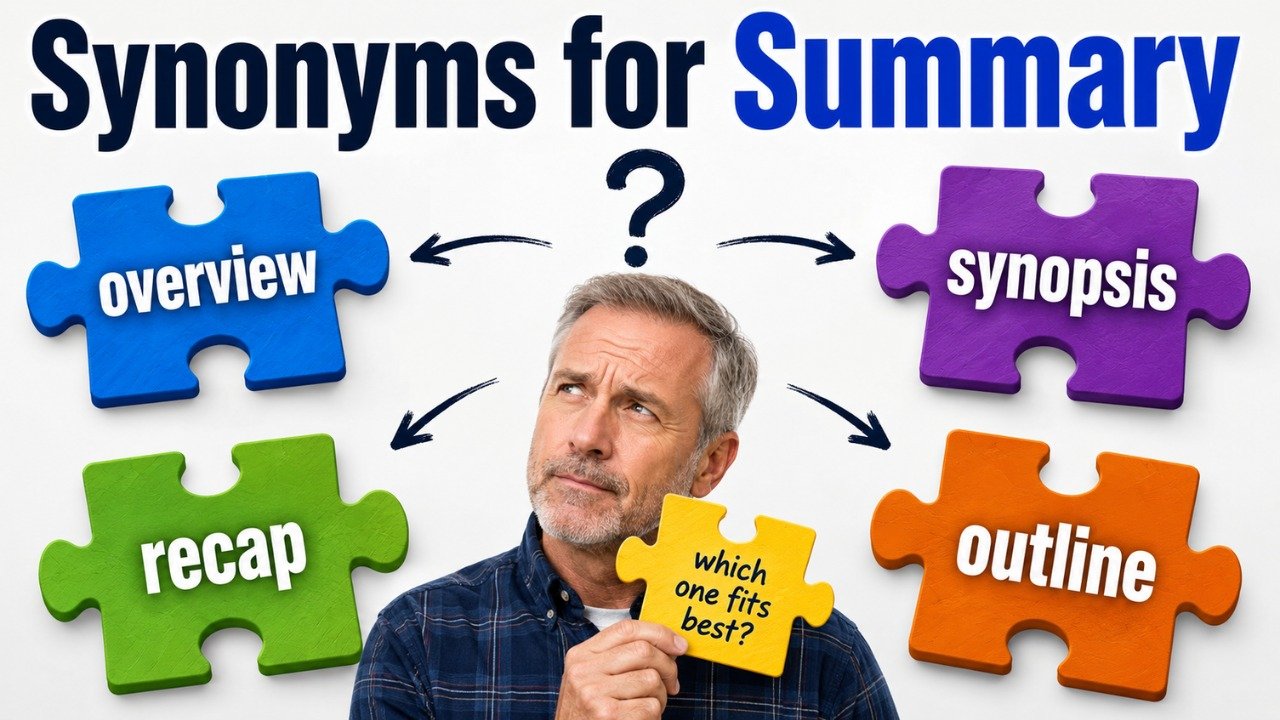
Quick Answer: Common synonyms for summary include overview, synopsis, abstract, précis, digest, outline, recap, brief, rundown, and summation. Use overview for a general explanation, synopsis for the main events of a story, abstract for academic research, recap for casual speech, brief for professional communication, and summation for a final conclusion. The best choice depends on whether you are condensing a document, reviewing a meeting, describing a story, or presenting key findings.
Pronunciation and Word Details
Word: Summary.
Pronunciation: /ˈsʌməri/.
Part of Speech: Noun and adjective.
Meaning: A short statement that presents the main ideas or important facts of something longer.
US Pronunciation:
UK Pronunciation:
What Does “Summary” Mean?
A summary is a short version of a longer text, discussion, event, report, or idea. It includes the most important information while leaving out minor details.
As a noun, summary refers to the shortened account itself.
Example: The manager read a summary of the monthly sales report.
As an adjective, summary describes something completed quickly or presented without extensive detail.
Example: The committee conducted a summary review of the proposal.
The word can be used in academic writing, business reports, meetings, books, articles, presentations, legal discussions, and everyday conversations. Its purpose is usually to help readers understand the central message without reading or hearing every detail.
Meaning, Tone, and Context of “Summary”
Summary is generally a neutral and widely accepted word. It works in formal, academic, professional, and conversational situations.
In academic writing, a summary explains the central argument, evidence, or findings of a source. It should remain objective and should not include unnecessary opinions.
In professional writing, a summary may present the main results of a report, meeting, project, or business plan. An executive summary is often used to help decision makers understand a longer document quickly.
In casual conversation, summary can describe a short explanation of what happened.
Example: Give me a quick summary of the movie.
The word is clear and flexible, but a more specific synonym may sometimes communicate the intended meaning better. Abstract is more suitable for research, synopsis is stronger for stories, recap fits recent events, and outline focuses on structure rather than complete meaning.
When and How to Use “Summary”
For Condensing Long Text
Use summary when you want to present the central ideas of a book, article, essay, or document in fewer words.
Example: The student wrote a summary of the chapter.
For Academic Writing
A summary can explain the main argument, evidence, and conclusion of an academic source without copying its complete wording.
Example: Her assignment included a summary of the research findings.
For Business Reports
Use summary to present the most important results, recommendations, or decisions from a longer professional document.
Example: The report begins with a summary of the company’s financial performance.
For Meetings
A meeting summary records the main topics, decisions, responsibilities, and future actions.
Example: Please send the team a summary of today’s discussion.
For Stories and Events
Summary can provide the main events of a story, movie, experience, or situation without describing every detail.
Example: He gave us a short summary of the ceremony.
For Final Review
Use summary when restating important information at the end of a lesson, speech, report, or presentation.
Example: The final paragraph provides a useful summary of the main arguments.
Best Synonyms for Summary
Overview
Meaning: A general explanation of the main parts of a subject.
Example: The introduction provides an overview of the entire course.
Synopsis
Meaning: A short description of the main events or ideas in a story, book, or plan.
Example: The publisher requested a synopsis of the novel.
Abstract
Meaning: A formal summary of an academic paper, study, or research project.
Example: The abstract explains the purpose and results of the study.
Précis
Meaning: A clear and carefully shortened version of a written passage.
Example: The class prepared a précis of the historical essay.
Digest
Meaning: A collection or condensed presentation of important information.
Example: The weekly digest included the most important industry updates.
Outline
Meaning: A structured list of the main points or sections.
Example: She created an outline before writing the full report.
Recap
Meaning: A brief review of recent events, information, or discussions.
Example: The presenter began with a recap of the previous lesson.
Brief
Meaning: A concise statement containing essential facts or instructions.
Example: The director received a brief about the proposed project.
Rundown
Meaning: A quick and usually informal explanation of important details.
Example: Can you give me a rundown of what happened at the meeting?
Summation
Meaning: A final statement that brings together the main ideas or evidence.
Example: His closing remarks offered a clear summation of the argument.
50 Synonyms for Summary With Short Meanings
- Overview: A general explanation of the main parts.
- Synopsis: A short account of a story, plan, or subject.
- Abstract: A formal summary of research or academic writing.
- Précis: A clear and carefully shortened piece of writing.
- Digest: A condensed collection of important information.
- Outline: A structured presentation of main points.
- Recap: A short review of recent information or events.
- Review: A reconsideration of the main details.
- Condensation: A shorter form of something longer.
- Abridgment: A shortened version that preserves the main content.
- Summation: A final statement of the central ideas.
- Recapitulation: A restatement of the principal points.
- Epitome: A brief representation of essential qualities or ideas.
- Compendium: A concise collection of information about a subject.
- Brief: A short statement of essential information.
- Rundown: A quick explanation of important facts.
- Account: A description of an event or situation.
- Report: An organized presentation of information or findings.
- Sketch: A short and general description.
- Survey: A broad examination of a subject.
- Encapsulation: A compact expression of the central idea.
- Distillation: The most important ideas separated from extra detail.
- Restatement: The main information expressed again.
- Extract: A selected portion containing useful information.
- Excerpt: A short passage taken from a longer work.
- Snapshot: A quick view of a situation at a particular time.
- Briefing: A concise presentation of essential facts or instructions.
- Wrap up: A final review of the main information.
- Executive summary: A concise overview of a longer professional report.
- Short version: A reduced form containing the essential content.
- Condensed version: A shorter presentation of the original material.
- Concise account: A brief but informative description.
- Brief account: A short explanation of an event or subject.
- General overview: A broad presentation of central information.
- General outline: A basic structure of the main points.
- Main points: The most important ideas in a text or discussion.
- Key points: The details that readers most need to remember.
- Core ideas: The central concepts within a subject.
- Essential facts: The information needed for basic understanding.
- Central message: The primary idea communicated by a text or speech.
- Quick recap: A short review of what recently happened.
- Final overview: A concluding presentation of the main ideas.
- Closing summary: A short restatement provided at the end.
- Synoptic view: A broad view showing the main parts together.
- Thumbnail sketch: A very brief description of a person, idea, or situation.
- Short description: A limited explanation containing major details.
- Compressed account: An account expressed in fewer words.
- Digest version: A shortened form containing selected information.
- Summary statement: A sentence or paragraph presenting the main conclusion.
- Content overview: A brief explanation of what a document contains.
Read Also:
Synonyms for Positive Attitude
Synonyms for Summary by Context
When Summary Means a General View
Overview, survey, sketch, snapshot, and general view are useful when presenting a broad understanding of a subject.
Overview is the strongest general alternative because it introduces major parts without requiring extensive detail.
Example: The first chapter gives an overview of modern architecture.
Survey often suggests a broad examination of several areas within a subject.
Example: The course offers a survey of European literature.
Snapshot presents a quick view of a situation at a particular moment.
Example: The report provides a snapshot of current customer preferences.
When Summary Means a Shortened Text
Précis, abridgment, condensation, digest, and short version describe material that has been reduced in length.
A précis is usually carefully written and preserves the original meaning.
Example: Her précis captured every major argument in one paragraph.
An abridgment is a shortened version of a larger published work.
Example: He read an abridgment of the lengthy historical account.
A digest organizes important information into an easier form.
Example: The monthly digest contains selected news and analysis.
When Summary Means a Story Description
Synopsis, outline, account, and sketch are suitable for explaining the main events or structure of a story.
Synopsis is especially useful for novels, plays, movies, and scripts.
Example: The synopsis reveals the central conflict without giving every detail.
Outline focuses more on sequence and structure.
Example: The writer submitted an outline of the planned story.
When Summary Means an Academic Explanation
Abstract, précis, overview, and research summary work well in academic contexts.
Abstract is the standard choice for a formal research paper because it presents the purpose, method, findings, and conclusion.
Example: The abstract helped readers evaluate the relevance of the study.
Précis is useful when shortening another writer’s argument while preserving its meaning and tone.
Example: The assignment required a précis of the assigned article.
When Summary Means a Review of Events
Recap, rundown, briefing, and account are useful for meetings, discussions, lessons, and recent events.
Recap is neutral but slightly conversational.
Example: Let us begin with a recap of yesterday’s discussion.
Rundown is more informal and often includes practical details.
Example: She gave me a rundown of the changes.
Briefing is more formal and often prepares someone to make a decision or take action.
Example: The team attended a briefing before the project began.
When Summary Means a Final Statement
Summation, conclusion, recapitulation, wrap up, and closing statement are useful at the end of an argument, speech, lesson, or report.
Summation brings several arguments or facts together.
Example: The final section is a powerful summation of the evidence.
Recapitulation repeats important points in an organized way.
Example: The lecture ended with a recapitulation of the central principles.
Another Word for Summary
Overview is often the best general replacement for summary because it works in academic, professional, and everyday contexts. However, the strongest alternative depends on what is being shortened or reviewed.
Use synopsis for a story, abstract for research, recap for previous events, and brief for essential professional information.
Original: The document gives a summary of the new policy.
Better Option: The document gives an overview of the new policy.
Original: I read a summary of the novel.
Better Option: I read a synopsis of the novel.
Original: The meeting started with a summary of yesterday’s decisions.
Better Option: The meeting started with a recap of yesterday’s decisions.
Original: The research paper includes a summary at the beginning.
Better Option: The research paper includes an abstract at the beginning.
When Not to Use “Summary”
Do not use summary when a more specific term would make your meaning clearer.
When Referring to Academic Research
Abstract is usually more precise for the formal opening section of a research paper.
Weak: The study begins with a summary.
Better: The study begins with an abstract.
When Describing a Story
Synopsis is often clearer when discussing the central plot of a novel, play, or movie.
Weak: Please submit a summary of your screenplay.
Better: Please submit a synopsis of your screenplay.
When Showing Structure
An outline shows organization and sequence, while a summary explains meaning.
Weak: I prepared a summary before writing the essay.
Better: I prepared an outline before writing the essay.
When Reviewing a Recent Discussion
Recap sounds more natural for a quick review of a meeting, lesson, or event.
Weak: Let us begin with a summary of our last conversation.
Better: Let us begin with a recap of our last conversation.
When Detailed Analysis Is Required
A summary is not a replacement for full explanation, evidence, interpretation, or evaluation.
Weak: The report needs a summary of every cause and effect.
Better: The report needs a detailed analysis of every cause and effect.
When the Word Becomes Repetitive
Using summary repeatedly can make writing sound mechanical.
Weak: The summary provides a summary of the report before the final summary.
Better: The overview presents the report’s main findings before the final conclusion.
Words Commonly Confused With Summary
Summary vs Synopsis: A summary can shorten almost any information, while a synopsis usually presents the plot or structure of a story, book, play, or plan.
Summary vs Abstract: A summary is a general term, while an abstract is a formal and structured overview of academic research.
Summary vs Outline: A summary explains central meaning, while an outline arranges topics and supporting points in a planned order.
Summary vs Review: A summary reports the main content objectively, while a review may include evaluation, criticism, or personal judgment.
Summary vs Conclusion: A summary restates important information, while a conclusion explains the final judgment, result, or implication.
Summary vs Paraphrase: A summary reduces a longer source to its main ideas, while a paraphrase rewrites a particular passage in different words without necessarily making it much shorter.
Summary vs Analysis: A summary tells what a source says, while an analysis explains how, why, or whether its ideas are important.
Which Synonym Should You Choose?
Choose overview when you need a broad introduction to a subject, document, course, or plan.
Choose synopsis when describing the major events of a novel, movie, play, script, or narrative.
Choose abstract when presenting the purpose, method, results, and conclusion of academic research.
Choose précis when creating an accurate and carefully shortened version of a written passage.
Choose digest when organizing selected information from several sources into a convenient format.
Choose outline when showing the structure and sequence of planned ideas.
Choose recap when reviewing a previous lesson, meeting, conversation, event, or episode.
Choose brief when providing essential facts, instructions, or recommendations in a professional setting.
Choose rundown when giving an informal but useful explanation of important details.
Choose summation when bringing together arguments, facts, or evidence at the end of a discussion.
Choose snapshot when presenting a quick view of current conditions, performance, or progress.
Choose executive summary when introducing the major findings and recommendations of a long professional report.
Real Life Examples of “Summary” in Sentences
Original: The teacher gave us a summary of the previous chapter.
Better Option: The teacher gave us a recap of the previous chapter.
Original: The report contains a summary of current market conditions.
Better Option: The report contains an overview of current market conditions.
Original: She wrote a summary of the novel for her assignment.
Better Option: She wrote a synopsis of the novel for her assignment.
Original: The paper begins with a summary of the research.
Better Option: The paper begins with an abstract of the research.
Original: Can you give me a summary of the meeting?
Better Option: Can you give me a rundown of the meeting?
Original: The director requested a summary of the proposal.
Better Option: The director requested a brief on the proposal.
Original: His final paragraph offered a summary of the argument.
Better Option: His final paragraph offered a summation of the argument.
Original: The website provides a summary of recent developments.
Better Option: The website provides a digest of recent developments.
Original: We reviewed a summary of the project’s current condition.
Better Option: We reviewed a snapshot of the project’s current condition.
Original: The first page contains a summary of the entire document.
Better Option: The first page contains an executive summary of the entire document.
Synonym Groups and Usage Differences
General Understanding Group
Overview, survey, sketch, and snapshot present the main features of a subject.
Overview is neutral and widely useful. Survey suggests broad coverage. Sketch is brief and less detailed. Snapshot shows conditions at one particular moment.
Example: The report offers a snapshot of employment levels during the first quarter.
Condensed Writing Group
Précis, condensation, abridgment, digest, and short version describe information reduced in length.
Précis emphasizes accuracy. Abridgment often describes a shortened book. Digest organizes selected information. Condensation emphasizes the process of reducing content.
Example: The student created a concise précis of the original essay.
Academic Group
Abstract, research summary, précis, and overview are common in academic writing.
Abstract is the most formal and specialized. Overview is broader. Précis summarizes another author’s argument. Research summary explains the main findings in accessible language.
Example: Readers can examine the abstract before reading the complete study.
Story Group
Synopsis, outline, account, and sketch can describe narratives.
Synopsis explains major plot developments. Outline shows planned structure. Account reports events. Sketch gives a brief impression.
Example: The author sent a synopsis of the novel to the editor.
Conversational Group
Recap, rundown, wrap up, and quick review are natural in speech and informal writing.
Recap reviews what happened. Rundown provides practical details. Wrap up closes a conversation or activity.
Example: Give me a quick rundown before the next meeting begins.
Professional Group
Brief, briefing, executive summary, report, and overview are suitable for workplace communication.
A brief provides essential information. A briefing prepares people for action. An executive summary condenses a long report for decision makers.
Example: The executive summary highlights the project’s costs, risks, and expected benefits.
Conclusion Group
Summation, recapitulation, conclusion, and closing summary appear near the end of a text or discussion.
Summation combines the main evidence. Recapitulation repeats major points. Conclusion presents the final result or judgment.
Example: Her final statement was a convincing summation of the entire case.
Antonyms of Summary
Summary does not have one perfect opposite in every context. Its opposites generally refer to complete, detailed, or expanded information.
Full account: A complete description containing all relevant events and details.
Detailed explanation: A thorough clarification of a subject.
Expansion: Additional information that develops an idea further.
Elaboration: A fuller explanation containing supporting details.
Complete text: The entire original work without shortening.
Full version: The complete form rather than a reduced form.
Transcript: A complete written record of spoken words.
Unabridged version: A work presented without omitted sections.
Exhaustive report: A document covering a subject in extensive detail.
Detailed analysis: A close examination of causes, evidence, relationships, and meaning.
Complete narrative: A story that includes the full sequence of events.
Extended discussion: A lengthy examination involving several explanations and viewpoints.
Comparison: Summary vs Related Words
Summary vs Overview
A summary condenses the main content of something longer. An overview gives a broad introduction and may not represent every major argument or event.
Example With Summary: Her summary explained the article’s main argument and conclusion.
Example With Overview: The guide offers an overview of the available courses.
Summary vs Synopsis
A summary can describe any kind of content. A synopsis is most commonly used for a story, book, play, movie, or proposed creative work.
Example With Summary: He wrote a summary of the scientific report.
Example With Synopsis: She submitted a synopsis of her mystery novel.
Summary vs Abstract
A summary is a general shortened explanation. An abstract is a formal section of an academic paper that usually states its purpose, method, results, and conclusion.
Example With Summary: The student prepared a summary of the article.
Example With Abstract: The abstract explains how the researchers conducted the study.
Summary vs Outline
A summary explains the meaning of completed content. An outline shows the planned structure and order of ideas.
Example With Summary: The final paragraph provides a summary of the discussion.
Example With Outline: The writer created an outline before drafting the discussion.
Summary vs Recap
A summary can describe any information, while a recap usually reviews something that happened or was discussed earlier.
Example With Summary: The document contains a summary of the new regulations.
Example With Recap: The host gave a recap of the previous discussion.
Summary vs Review
A summary focuses on the central content without evaluation. A review often includes opinions, judgments, strengths, and weaknesses.
Example With Summary: His summary explains the book’s central argument.
Example With Review: His review evaluates the book’s argument and evidence.
Summary vs Conclusion
A summary restates the major information. A conclusion explains what the information ultimately means or what should happen next.
Example With Summary: The section repeats the report’s main findings.
Example With Conclusion: The conclusion recommends further investigation.
Summary vs Paraphrase
A summary shortens a complete source to its central ideas. A paraphrase rewrites a specific part in new language while preserving its original level of detail.
Example With Summary: She reduced the ten page chapter to one paragraph.
Example With Paraphrase: She rewrote the author’s explanation in her own words.
Common Phrases and Expressions With “Summary”
In Summary: A phrase used before stating the main conclusion or central points.
Brief Summary: A very short presentation of the essential information.
Concise Summary: A clear summary expressed without unnecessary words.
Executive Summary: A professional overview of a longer report or proposal.
Summary Report: A document presenting major results without every supporting detail.
Summary Statement: A sentence or paragraph expressing the central message.
Summary Paragraph: A paragraph that restates the most important ideas.
Summary of Findings: A condensed presentation of research or investigation results.
Summary of Events: A short account of what happened.
Summary of Evidence: A condensed explanation of the information supporting an argument.
Summary Table: A table that organizes important figures or results for quick understanding.
Final Summary: A concluding review of the main ideas or decisions.
Common Mistakes to Avoid
Including Too Many Details
A summary should focus on essential ideas. Minor examples, repeated explanations, and background details can make it almost as long as the original.
Advice: Identify the central message, major supporting points, and final result before writing.
Leaving Out the Main Idea
Some writers include several details but fail to explain the source’s primary purpose.
Advice: State the main idea early so readers immediately understand the subject.
Adding Personal Opinions
A neutral summary should represent the original content accurately. Personal evaluation belongs in a review or analysis.
Advice: Separate what the source says from what you think about it.
Copying the Original Wording
A summary should normally be expressed in fresh wording rather than copying complete sentences.
Advice: Read the original, identify its key meaning, and explain that meaning clearly in your own language.
Confusing a Summary With an Outline
An outline lists the structure of ideas, while a summary explains their meaning and relationship.
Advice: Use an outline for planning and a summary for condensing completed content.
Using an Inaccurate Synonym
Abstract, synopsis, recap, and outline are not interchangeable in every situation.
Advice: Choose abstract for research, synopsis for stories, recap for previous events, and outline for structure.
Repeating the Word Too Often
Frequent use of summary can make a paragraph sound dull or mechanical.
Advice: Use relevant alternatives such as overview, recap, synopsis, brief, or summation when they accurately fit the context.
Making the Summary Too Vague
A statement such as “The article discusses many important things” does not communicate meaningful information.
Advice: Name the actual subject, central claim, and most important result.
Changing the Original Meaning
Removing too much context can create an inaccurate impression.
Advice: Preserve the author’s central argument, purpose, tone, and conclusion.
Conclusion
The best synonyms for summary include overview, synopsis, abstract, précis, digest, outline, recap, brief, rundown, and summation. Choose overview for general information, synopsis for a story, abstract for research, recap for previous events, and brief for professional communication. A strong summary presents the central message clearly without unnecessary detail or personal opinion. Understanding these synonyms for summary helps you select precise vocabulary for essays, reports, meetings, presentations, and everyday conversations.
FAQs About Synonyms for Summary
What Is the Best Synonym for Summary?
Overview is the best general synonym because it works in academic, professional, and everyday contexts. The ideal choice still depends on what you are describing.
What Is a Formal Synonym for Summary?
Abstract, précis, summation, and executive summary are formal alternatives. Abstract is best for research, while executive summary is suitable for professional reports.
What Is an Informal Synonym for Summary?
Recap and rundown are common informal alternatives. Recap reviews previous information, while rundown provides important practical details.
What Is Another Word for a Short Summary?
Brief, précis, digest, snapshot, and quick recap can describe a short summary. Brief is especially useful in professional communication.
Is a Synopsis the Same as a Summary?
A synopsis is a type of summary, but it is most commonly used for stories, books, plays, movies, and creative proposals.
What Is the Difference Between an Abstract and a Summary?
An abstract follows a formal academic structure and normally presents a study’s purpose, method, results, and conclusion. Summary is a broader term that can shorten almost any content.
Can Overview Replace Summary?
Overview can replace summary when presenting a broad understanding of a topic. It may not be suitable when referring specifically to research, story events, or a final conclusion.
