
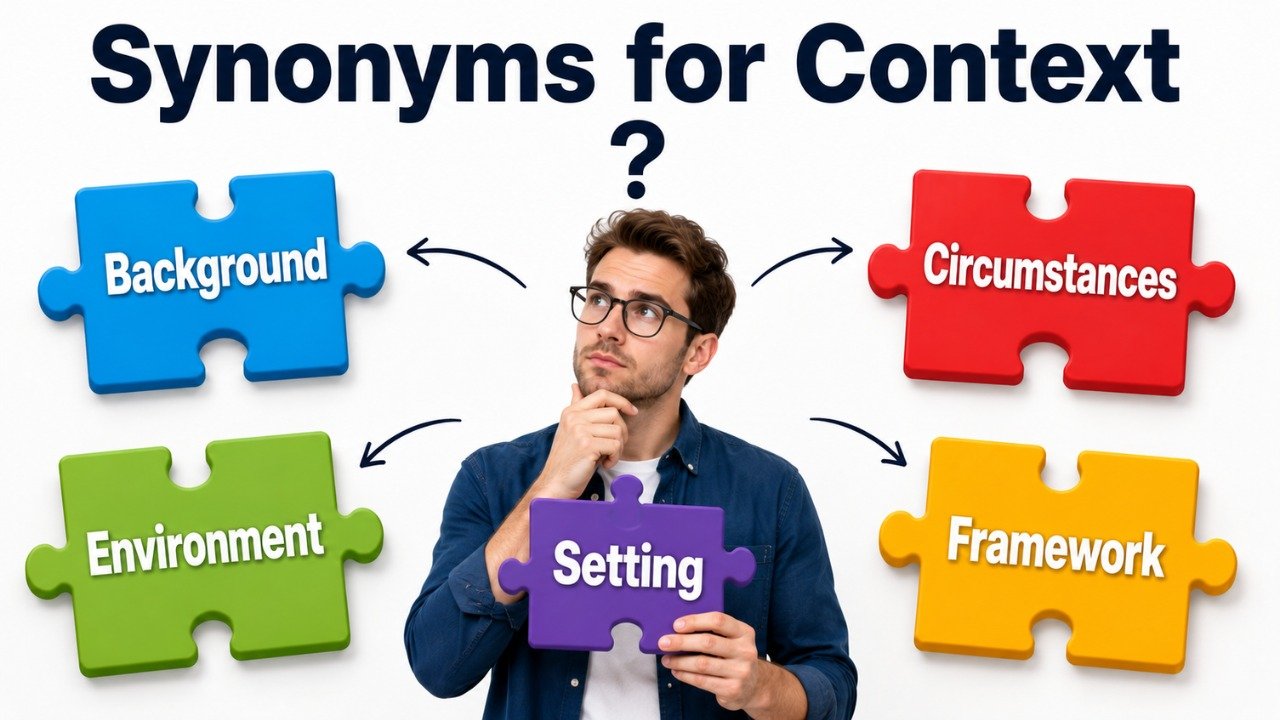
Quick Answer: The best synonyms for context include background, circumstances, setting, situation, environment, framework, conditions, perspective, surroundings, and backdrop. Use background when referring to earlier information that helps explain something. Circumstances and situation suit events or personal experiences. Setting works for stories, places, and time periods. Environment and surroundings describe physical or social conditions. Framework suits organized ideas or systems, while perspective describes a particular way of understanding an issue. The most accurate choice among synonyms for context depends on whether you mean supporting information, location, conditions, structure, or viewpoint.
Pronunciation and Word Details
Word: Context.
Pronunciation: /ˈkɑːntekst/.
Part of Speech: Noun.
Meaning: The information, circumstances, or surroundings that help explain the meaning of an event, statement, idea, or action.
US Pronunciation:
UK Pronunciation:
What Does “Context” Mean?
Context means the information, circumstances, setting, or conditions that help someone understand the meaning of something.
As a noun, context often refers to the words surrounding a particular word or sentence. These surrounding words may help readers understand the intended meaning. For example, an unfamiliar word can sometimes be understood from its context.
Context can also describe the circumstances surrounding an event, decision, action, or conversation. A comment may sound rude when repeated alone, but its meaning may become reasonable when the full context is explained.
In literature, context may include the time, place, culture, social conditions, and historical events connected with a story. In academic writing, it often refers to the background information needed to understand an argument, theory, study, or result.
The word may also describe a larger framework. A business decision can be considered within an economic context, while a historical event can be studied within its political and cultural context.
Context is therefore essential for accurate interpretation. Without it, words, actions, statistics, and events may be misunderstood.
Meaning, Tone, and Context of “Context”
Context is a neutral and widely used word. It appears in everyday conversation, education, literature, research, history, communication, psychology, law, business, and professional writing.
In casual conversation, context usually means the background or circumstances needed to understand a statement or event. Someone may say, “You need to know the context,” when part of a story has been presented without enough supporting information.
In academic writing, context has a more analytical tone. Researchers may discuss the social context of behavior, the historical context of a movement, or the cultural context of a tradition. In these examples, context refers to the wider conditions that influence meaning.
In language study, context refers to the words, sentences, and situation surrounding a particular expression. The same word can have different meanings in different contexts.
In literature, context may include the setting, historical period, author’s environment, and social values connected with a text. These details help readers interpret characters, themes, and events more accurately.
Context is also important in professional communication. Instructions, data, and decisions are easier to understand when relevant circumstances and goals are clearly explained.
When and How to Use “Context”
For Background Information
Use context when referring to earlier facts or details that help explain an idea, event, or statement.
Example: The introduction provides context for the discussion that follows.
For Understanding Words
Use context when surrounding words or sentences help reveal the meaning of an expression.
Example: Readers can understand the unfamiliar term from its context.
For Explaining a Situation
Use context when circumstances affect how an event, action, or decision should be understood.
Example: His response seems reasonable when considered in context.
For Historical Discussion
Use context when discussing the political, cultural, economic, or social conditions of a past period.
Example: The speech should be studied within its historical context.
For Literary Analysis
Use context when explaining the setting, culture, period, or circumstances connected with a story.
Example: The novel becomes more meaningful when readers understand its cultural context.
For Research
Use context when describing the conditions in which information was collected, observed, or interpreted.
Example: The findings must be examined in the context of the study’s limitations.
For Communication
Use context when a message requires supporting details to prevent misunderstanding.
Example: Please provide more context before asking the team to make a decision.
For Behavior
Use context when environmental, emotional, or social conditions influence how a person behaves.
Example: The child’s behavior should be considered within the context of the stressful situation.
Best Synonyms for Context
Background: Earlier information or surrounding facts that help explain something.
Example: The report begins with background about the organization’s development.
Circumstances: Conditions or events surrounding a situation.
Example: The decision was understandable under the circumstances.
Setting: The place, time, and conditions in which something happens.
Example: The story takes place in a peaceful rural setting.
Situation: A particular set of conditions at a specific time.
Example: The manager carefully evaluated the situation before responding.
Environment: The physical, social, or cultural conditions surrounding someone or something.
Example: Children often learn more effectively in a supportive environment.
Framework: A structure of ideas, rules, or principles used to understand something.
Example: The theory provides a useful framework for analyzing behavior.
Conditions: The circumstances that affect an event, activity, or result.
Example: The plants grow well under warm and humid conditions.
Perspective: A particular way of viewing or understanding something.
Example: The discussion helped everyone see the problem from a new perspective.
Surroundings: The people, objects, and physical features around a person or place.
Example: The peaceful surroundings helped her concentrate.
Backdrop: The situation, setting, or conditions behind an event.
Example: The negotiations occurred against a backdrop of economic uncertainty.
50 Synonyms for Context with Short Meanings
- Background: Information or events that help explain something.
- Circumstances: Conditions surrounding an event or situation.
- Setting: The place, time, and conditions in which something occurs.
- Situation: A particular combination of events and conditions.
- Environment: The physical, social, or cultural conditions surrounding something.
- Framework: A structure of ideas used to organize understanding.
- Conditions: Factors that influence an event, action, or result.
- Perspective: A particular way of seeing or interpreting something.
- Surroundings: The people, places, and objects around something.
- Backdrop: The wider setting behind an event or situation.
- Scene: The place or situation in which an event occurs.
- Atmosphere: The general mood or feeling surrounding a situation.
- Climate: The general social, political, or emotional conditions of a period.
- Milieu: The social or cultural environment in which someone lives.
- Setting information: Details about the place, time, or circumstances.
- Background information: Supporting facts that make something easier to understand.
- Frame of reference: A set of ideas or experiences used for interpretation.
- Point of view: A position or way of looking at an issue.
- Viewpoint: A particular opinion or angle of interpretation.
- Standpoint: A position from which something is considered.
- Angle: A particular approach to understanding a subject.
- Reference frame: A system used to measure or interpret something.
- Structure: The organized arrangement of connected parts or ideas.
- System: A set of related elements working together.
- Basis: The main foundation for an idea or judgment.
- Foundation: The underlying information or principles supporting something.
- Groundwork: Preliminary information or preparation for later understanding.
- Contextual information: Details that explain surrounding meaning or conditions.
- Surrounding information: Words or facts placed around a central idea.
- Supporting information: Additional facts that make a subject clearer.
- Relevant information: Facts directly connected with the subject.
- Related circumstances: Events or conditions connected with a situation.
- State of affairs: The general condition of a situation at a particular time.
- Position: The circumstances or condition in which someone is placed.
- Case: A particular situation requiring consideration.
- Scenario: A real or imagined set of circumstances.
- Instance: A specific example or occurrence of something.
- Occasion: A particular time or event surrounding an action.
- Contexture: The arrangement or connection of related parts.
- Textual environment: The words and sentences surrounding an expression.
- Linguistic environment: The language surrounding a word or statement.
- Discourse: Connected spoken or written communication.
- Passage: A section of text surrounding a word or idea.
- Wording: The particular words used to express an idea.
- Narrative setting: The time, place, and conditions of a story.
- Historical setting: The period and circumstances surrounding a past event.
- Cultural setting: The beliefs, customs, and values surrounding something.
- Social setting: The relationships and social conditions around an event.
- Broader picture: The larger situation needed for complete understanding.
- Overall situation: The complete set of circumstances surrounding something.
Read Also:
Synonyms for Define
Synonyms for Context by Meaning
When Context Means Background Information
When context means information that helps explain a subject, use background, background information, supporting information, relevant information, foundation, groundwork, or broader picture.
Background: The most natural general alternative for earlier or supporting details.
Example: The teacher provided background before introducing the new topic.
Supporting Information: Facts that strengthen understanding of a central idea.
Example: The report includes supporting information about recent changes.
Foundation: The underlying information or principles needed for understanding.
Example: Basic grammar provides a foundation for advanced writing.
Groundwork: Preliminary preparation or information that supports later work.
Example: The opening chapter lays the groundwork for the main argument.
Broader Picture: An informal expression for the larger situation surrounding a detail.
Example: Looking at the broader picture helped the team understand the decision.
When Context Means Circumstances
When context refers to the conditions surrounding an event or action, use circumstances, situation, conditions, state of affairs, case, scenario, or occasion.
Circumstances: Describes the events or conditions affecting a situation.
Example: Her choice was reasonable under the circumstances.
Situation: A broad and flexible alternative for a particular set of conditions.
Example: The situation improved after everyone communicated openly.
State of Affairs: Describes the general condition of a complex situation.
Example: The report presents an accurate account of the current state of affairs.
Scenario: Refers to a real, possible, or imagined set of circumstances.
Example: The team prepared a response for each possible scenario.
Case: Describes a particular situation being discussed or examined.
Example: In this case, a direct apology would be appropriate.
When Context Means Setting
When context means the place, time, or surroundings of an event, use setting, environment, surroundings, scene, backdrop, atmosphere, or milieu.
Setting: Best for stories, events, conversations, and physical locations.
Example: The quiet setting was ideal for the discussion.
Environment: Describes physical, social, educational, or professional conditions.
Example: Employees perform well in a respectful environment.
Backdrop: Refers to the wider setting against which something happens.
Example: The election took place against a backdrop of public uncertainty.
Atmosphere: Describes the emotional feeling or mood surrounding an event.
Example: The warm atmosphere made visitors feel welcome.
Milieu: A formal word for a person’s social or cultural surroundings.
Example: The artist developed her style within a creative urban milieu.
When Context Means Perspective
When context refers to a way of seeing or interpreting something, use perspective, viewpoint, standpoint, point of view, angle, or frame of reference.
Perspective: The strongest general alternative for a particular way of understanding an issue.
Example: Historical knowledge gives readers a clearer perspective on the event.
Viewpoint: Refers to an opinion or position on a subject.
Example: The article presents the issue from a scientific viewpoint.
Standpoint: Emphasizes the position from which someone considers a matter.
Example: From a financial standpoint, the proposal is practical.
Angle: A particular approach or focus used to discuss a topic.
Example: The writer examines the problem from a cultural angle.
Frame of Reference: A set of ideas, experiences, or standards used for interpretation.
Example: Personal experience shapes each person’s frame of reference.
When Context Means a Framework
When context describes an organized system of ideas, use framework, structure, system, basis, foundation, or reference frame.
Framework: Best for theories, rules, plans, and organized methods.
Example: The model offers a framework for evaluating performance.
Structure: Refers to the arrangement of connected ideas or parts.
Example: The argument has a clear logical structure.
System: Describes related elements that function together.
Example: The legal system provides rules for resolving disputes.
Basis: Refers to the main reason, principle, or foundation for something.
Example: Evidence should form the basis of the conclusion.
Reference Frame: A technical term for a system used to understand position, movement, or meaning.
Example: The result changes when viewed from a different reference frame.
When Context Means Surrounding Words
When context refers to language around a word or sentence, use textual environment, linguistic environment, discourse, passage, wording, or surrounding information.
Textual Environment: The written material surrounding a particular word or phrase.
Example: The textual environment reveals the intended meaning of the expression.
Linguistic Environment: The language features surrounding an expression.
Example: Pronunciation can change according to the linguistic environment.
Discourse: Connected written or spoken language considered as a complete unit.
Example: The phrase has a specialized meaning within academic discourse.
Passage: A section of text containing or surrounding an idea.
Example: Read the entire passage before answering the question.
Wording: The particular choice and arrangement of words.
Example: The wording of the sentence changes its emotional effect.
Another Word for Context
Background is the best general replacement for context when referring to information that helps explain a subject. However, the most accurate synonym depends on the meaning.
Use circumstances for events, setting for stories or places, environment for surrounding conditions, framework for organized ideas, and perspective for a way of understanding something.
Original: The article provides context for the debate.
Better Option: The article provides background for the debate.
Original: His comment sounds different when you know the context.
Better Option: His comment sounds different when you know the circumstances.
Original: The story must be understood in its cultural context.
Better Option: The story must be understood within its cultural setting.
Original: The theory should be considered in a wider context.
Better Option: The theory should be considered within a broader framework.
When Not to Use “Context”
Avoid context when a more specific word can explain exactly what you mean. Context is broad and may sound vague if the reader does not know whether you mean background, circumstances, setting, or perspective.
Weak: The report explains the context.
Better: The report explains the historical background.
Do not use context when you simply mean location. Setting, place, surroundings, or environment may be clearer.
Weak: The meeting occurred in a quiet context.
Better: The meeting occurred in a quiet setting.
Avoid context when discussing a person’s opinion. Perspective, viewpoint, or standpoint is more accurate.
Weak: From her context, the decision seemed fair.
Better: From her perspective, the decision seemed fair.
Do not use context when you mean a specific current problem or event.
Weak: We need to improve the context.
Better: We need to improve the current situation.
Avoid repeating context several times in the same paragraph.
Weak: The historical context explains the political context and cultural context of the event.
Better: The historical background explains the political conditions and cultural setting of the event.
Do not say that a word has no meaning outside context when you simply mean that its meaning changes. Many words have a general meaning but develop a more precise meaning within a sentence or situation.
Words Commonly Confused With Context
Context vs Background: Context includes all surrounding information and circumstances. Background usually refers to earlier facts or history that help explain something.
Context vs Setting: Context is broad and may include ideas, history, language, and circumstances. Setting mainly refers to place, time, and surrounding conditions.
Context vs Situation: Context helps explain a situation, while situation refers to the actual set of events or conditions being experienced.
Context vs Environment: Context may be informational or conceptual. Environment usually refers to physical, social, cultural, or professional surroundings.
Context vs Perspective: Context is the surrounding information. Perspective is the particular way someone views or interprets that information.
Context vs Framework: Context provides surrounding meaning, while a framework organizes ideas, rules, or methods into a structure.
Context vs Circumstances: Context may include language, history, setting, and background. Circumstances mainly refer to conditions affecting an event or action.
Context vs Atmosphere: Context explains meaning, while atmosphere describes the emotional mood or feeling of a place or event.
Context vs Discourse: Context includes everything surrounding communication. Discourse refers to connected spoken or written language.
Which Synonym Should You Choose?
Choose background when giving earlier information that helps readers understand a subject.
Choose circumstances when discussing the conditions surrounding an event, choice, or action.
Choose setting for the time, place, and environment of a story or event.
Choose situation for a particular combination of events or conditions.
Choose environment for physical, social, educational, cultural, or workplace surroundings.
Choose framework for organized systems of ideas, principles, rules, or methods.
Choose perspective when describing a particular way of understanding something.
Choose viewpoint for a personal opinion or position.
Choose standpoint when emphasizing the position from which an issue is considered.
Choose atmosphere when discussing the mood or emotional quality of a place.
Choose backdrop for wider events or conditions behind a central event.
Choose scenario for an imagined, possible, or planned set of circumstances.
Choose state of affairs for a complex current situation.
Choose frame of reference for the experiences or standards used to interpret information.
Choose textual environment when discussing the words and sentences surrounding an expression.
Choose discourse in academic writing about connected language and communication.
Choose historical setting when discussing the period surrounding a past event.
Choose cultural setting when focusing on customs, beliefs, and shared values.
Choose broader picture when you want an informal expression for the complete situation.
Real Life Examples of “Context” in Sentences
Original: The teacher gave context before explaining the poem.
Better Option: The teacher gave background before explaining the poem.
Original: His words sound rude without context.
Better Option: His words sound rude without the surrounding circumstances.
Original: The novel reflects the context of the period.
Better Option: The novel reflects the historical setting of the period.
Original: The decision should be considered in context.
Better Option: The decision should be considered within the overall situation.
Original: The chart makes sense when viewed in context.
Better Option: The chart makes sense when viewed within the broader framework.
Original: The word has a different meaning in this context.
Better Option: The word has a different meaning in this passage.
Original: The behavior must be understood in its social context.
Better Option: The behavior must be understood within its social environment.
Original: The statement needs more context.
Better Option: The statement needs more supporting information.
Original: The event happened in a difficult political context.
Better Option: The event happened in a difficult political climate.
Original: Consider the issue in the context of recent changes.
Better Option: Consider the issue against the backdrop of recent changes.
Synonym Groups and Usage Differences
Background Group
Background, background information, supporting information, relevant information, groundwork, and foundation provide details needed for understanding.
Background is the broadest choice. Groundwork emphasizes preparation, while foundation refers to essential underlying knowledge.
Example: The first chapter provides essential background for the rest of the book.
Circumstance Group
Circumstances, situation, conditions, state of affairs, case, scenario, and occasion describe events or conditions surrounding an action.
Circumstances often explain why something happened. Situation describes what is currently happening, while scenario may be real or imagined.
Example: The team developed a plan for every likely scenario.
Setting Group
Setting, environment, surroundings, scene, atmosphere, milieu, and backdrop describe places and surrounding conditions.
Setting suits stories and events. Atmosphere emphasizes mood, while milieu focuses on social and cultural surroundings.
Example: The peaceful environment encouraged thoughtful conversation.
Perspective Group
Perspective, viewpoint, standpoint, angle, point of view, and frame of reference describe different ways of understanding something.
Perspective is broad and neutral. Standpoint emphasizes position, while frame of reference includes personal knowledge and experience.
Example: The issue appears different from a legal standpoint.
Structure Group
Framework, structure, system, basis, foundation, and reference frame organize information and ideas.
Framework provides a method for understanding. Structure refers to arrangement, while basis means the main supporting principle.
Example: The theory provides a clear framework for further study.
Language Group
Textual environment, linguistic environment, discourse, passage, wording, and surrounding information refer to language around a word or statement.
Passage is common in reading tasks. Discourse is more academic, while wording focuses on the exact choice of words.
Example: The meaning becomes clear when the complete passage is read.
Historical and Cultural Group
Historical setting, cultural setting, social setting, climate, backdrop, and milieu describe wider conditions influencing events and ideas.
Historical setting emphasizes time and events. Cultural setting focuses on shared beliefs, customs, and traditions.
Example: The tradition developed within a distinctive cultural setting.
Antonyms of Context
The opposite of context depends on whether the word refers to information, surroundings, relevance, or connection.
Isolation: Separation from surrounding information or circumstances.
Detachment: Lack of connection with a wider situation.
Disconnection: Absence of a meaningful relationship with surrounding details.
Irrelevance: Lack of connection with the subject being discussed.
Abstraction: An idea considered apart from specific circumstances.
Vacuum: A situation considered without outside influences or information.
Ambiguity: Uncertainty caused by unclear meaning.
Confusion: Lack of clear understanding.
Fragment: A small part separated from a larger whole.
Excerpt: A section removed from a complete text.
Misplacement: Positioning something where it does not properly belong.
Decontextualization: Removal of information from its original circumstances.
Distortion: A misleading change in meaning or presentation.
Generalization: A broad statement that ignores specific circumstances.
Unrelatedness: Lack of a meaningful connection between ideas or events.
Comparison of Context and Related Words
Context vs Background
Context includes all information, conditions, and surroundings that influence meaning. Background mainly refers to earlier facts or history.
Example With Context: The statement must be understood in its political context.
Example With Background: The introduction provides background about the political movement.
Context vs Circumstances
Context is the wider information needed for interpretation. Circumstances are the particular conditions surrounding an event or action.
Example With Context: The quotation appears misleading without context.
Example With Circumstances: She made the best decision possible under the circumstances.
Context vs Setting
Context may include history, language, perspective, and circumstances. Setting usually refers to place, time, and environment.
Example With Context: The law should be examined in its historical context.
Example With Setting: The story has a rural setting.
Context vs Situation
Context explains why a situation should be understood in a particular way. Situation refers to the actual condition or event.
Example With Context: Additional context explains the manager’s response.
Example With Situation: The manager handled the difficult situation calmly.
Context vs Environment
Context may be informational or conceptual. Environment refers to surrounding physical, social, or cultural conditions.
Example With Context: The comment makes sense in the context of the earlier discussion.
Example With Environment: The school provides a safe learning environment.
Context vs Perspective
Context is the surrounding information. Perspective is the viewpoint used to interpret that information.
Example With Context: The full context changed the meaning of the statement.
Example With Perspective: Her perspective changed after hearing both sides.
Context vs Framework
Context gives surrounding meaning. Framework provides an organized structure for understanding or acting.
Example With Context: The data must be considered in its economic context.
Example With Framework: The model offers a framework for evaluating the data.
Common Phrases and Expressions With Context
In Context: Considered with the surrounding information included.
Example: The statement sounds reasonable when read in context.
Out of Context: Presented without the information needed for accurate understanding.
Example: The quotation was taken out of context.
Historical Context: The events and conditions of a particular period.
Example: Students studied the document within its historical context.
Cultural Context: The customs, beliefs, and values surrounding something.
Example: The gesture has a different meaning in another cultural context.
Social Context: The social relationships and conditions affecting an event or behavior.
Example: Language changes according to its social context.
Political Context: The political conditions surrounding an event, policy, or statement.
Example: The decision should be examined within its political context.
Broader Context: The larger situation beyond a single detail.
Example: The numbers become more meaningful in the broader context.
Immediate Context: The words, events, or conditions directly surrounding something.
Example: The immediate context reveals who the speaker was addressing.
Provide Context: Give background or supporting information.
Example: The introduction provides context for the main argument.
Context Clues: Words or details that help reveal meaning.
Example: The reader used context clues to understand the unfamiliar word.
Common Mistakes to Avoid
Do not use context as a vague replacement for every type of background or situation. Select a more precise word when the meaning is clear.
Avoid quoting a statement without enough context. A shortened quotation may create a meaning that the original speaker did not intend.
Do not confuse context with content. Context means surrounding information, while content means the actual material, ideas, or information being presented.
Avoid saying “according to the context” when “in this context” or “within this situation” would sound more natural.
Do not use context when you only mean place. Setting, location, surroundings, or environment may be more accurate.
Avoid repeating context in every sentence of an academic paragraph. Use background, conditions, framework, setting, or perspective where appropriate.
Do not assume that historical and cultural context are identical. Historical context concerns a period and its events, while cultural context concerns beliefs, customs, language, and values.
Be careful with “out of context.” It means that important surrounding information has been removed, not simply that a statement is incorrect.
Do not write “contexts” unnecessarily when discussing one general situation. Use the plural only when referring to several distinct settings or conditions.
Conclusion
The best synonyms for context depend on what kind of surrounding information you mean. Background and supporting information explain earlier details, while circumstances and situation describe conditions around an event. Setting, environment, and surroundings suit places or social conditions. Framework describes an organized structure, and perspective expresses a way of interpreting something. Passage and textual environment are useful for language analysis. Choosing precise synonyms for context helps readers understand relationships, circumstances, meanings, and ideas without unnecessary confusion.
FAQs About Synonyms for Context
What Is the Best Synonym for Context?
Background is the best general synonym when context means supporting information. Circumstances, setting, environment, and framework are better in more specific situations.
What Is Another Word for Context in Writing?
Useful alternatives include background, setting, framework, passage, discourse, surrounding information, and textual environment.
What Is a Formal Synonym for Context?
Framework, circumstances, milieu, discourse, frame of reference, contextual information, and state of affairs are formal alternatives.
Are Context and Background the Same?
They overlap, but context is broader. Background mainly refers to earlier information, while context can include circumstances, language, setting, culture, and perspective.
What Is Another Word for Historical Context?
Historical setting, period background, political climate, social conditions, and historical circumstances can replace historical context.
What Does “Out of Context” Mean?
Out of context means that words, actions, or information have been separated from the circumstances needed to understand them correctly.
What Is the Opposite of Context?
Possible opposites include isolation, irrelevance, disconnection, abstraction, ambiguity, and decontextualization.
