
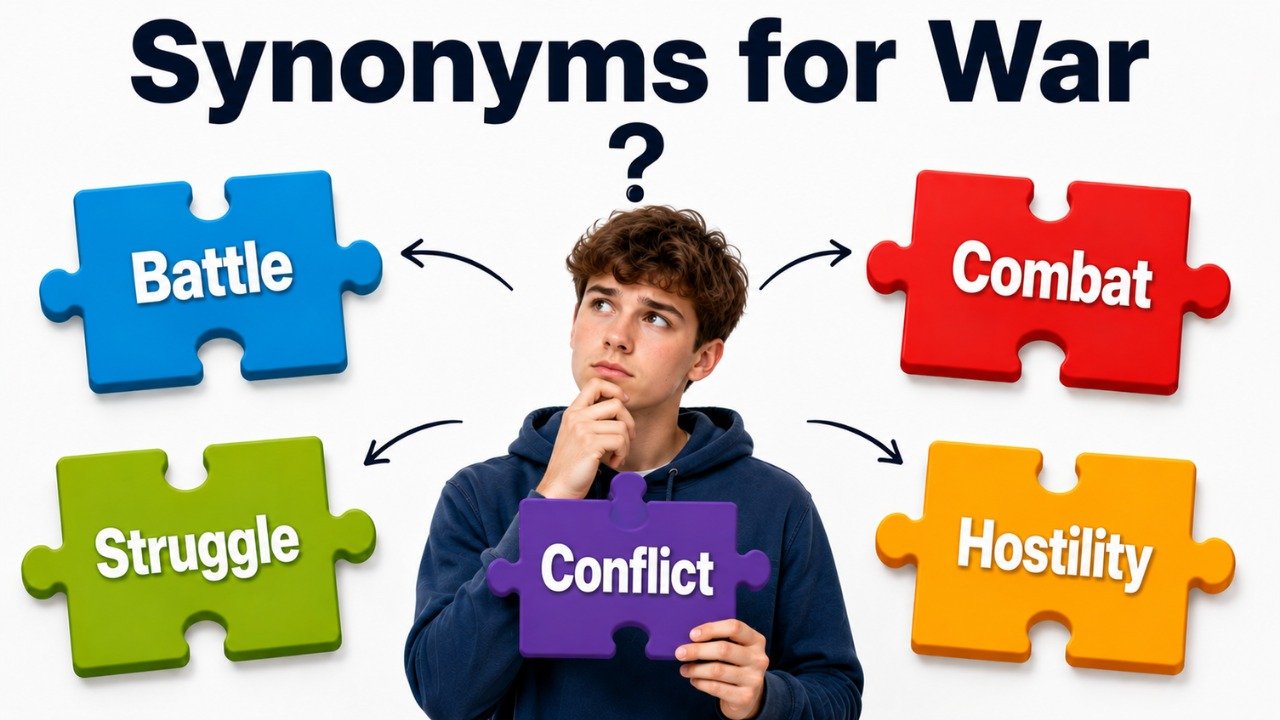
Quick Answer: The best synonyms for war include conflict, warfare, hostilities, combat, battle, fighting, military campaign, armed conflict, struggle, and confrontation. Use conflict as the broadest neutral alternative. Warfare describes the methods and activity of war, while hostilities refers to active fighting between opposing sides. Combat suits direct military action, and battle describes a particular period of fighting. Military campaign works for an organized series of operations. Struggle and confrontation are useful for figurative disagreements that do not involve armed violence.
Pronunciation and Word Details
Word: War.
Pronunciation: /wɔːr/.
Part of Speech: Noun and verb.
Meaning: A state of organized armed conflict between countries, groups, or opposing forces.
US Pronunciation:
UK Pronunciation:
What Does “War” Mean?
War means organized armed conflict between nations, governments, communities, or opposing groups.
As a noun, war usually describes a serious and extended period of military fighting. In the sentence “The war lasted several years,” the word refers to sustained violence involving organized forces.
War can also describe an intense struggle against a problem. People may speak about a war against disease, poverty, crime, or misinformation. In these cases, war is used figuratively to emphasize determination and urgency.
As a verb, war means to engage in conflict or struggle. This use is less common in everyday conversation but may appear in historical, literary, or formal writing.
The word carries strong emotional meaning because it is associated with danger, destruction, loss, political disagreement, military action, and social change. Writers should choose alternatives carefully according to whether they mean armed conflict, a particular battle, political tension, or a figurative struggle.
Meaning, Tone, and Context of “War”
War is a strong, serious, and emotionally charged word. It is commonly used in history, politics, international relations, literature, journalism, military discussion, and public debate.
In historical writing, war describes organized fighting between political powers or groups. The word may refer to a complete period of conflict or to a named historical event.
In political and military contexts, more precise alternatives include armed conflict, hostilities, warfare, military campaign, offensive, and operation. Each term describes a different part or form of war.
In everyday conversation, war may be used figuratively. Someone might describe a difficult disagreement as a war of words or a long campaign as a war against injustice. These expressions add intensity, but they should not be used when a calmer word such as disagreement, effort, or struggle would be more accurate.
In literature, war may symbolize fear, ambition, sacrifice, resistance, division, courage, or social collapse. Its emotional weight can influence the entire tone of a sentence or passage.
When and How to Use “War”
For Armed Conflict
Use war when countries, governments, or organized groups are engaged in sustained military fighting.
Example: The war changed the political structure of the region.
For Historical Events
Use war when discussing a major period of conflict in history.
Example: The historian examined the economic causes of the war.
For Military Activity
Use war when referring broadly to armed forces, strategy, weapons, and military operations.
Example: New technology changed the nature of war.
For Political Struggle
Use war when political groups are involved in intense and continuing opposition.
Example: The parties entered a public war over the proposed reforms.
For Figurative Struggles
Use war when describing a determined effort against a serious problem.
Example: Health workers continued their war against preventable disease.
For Personal Conflict
Use war carefully when describing a serious disagreement between people or groups.
Example: The two departments were at war over limited resources.
For Competition
Use war figuratively when competition becomes unusually aggressive or intense.
Example: The companies became involved in a price war.
For Inner Struggle
Use war in literary or emotional writing when a person experiences powerful opposing feelings.
Example: He felt as though hope and fear were at war within him.
Best Synonyms for War
Conflict: A serious disagreement or struggle between opposing sides.
Example: The conflict continued despite several attempts at negotiation.
Warfare: The methods, practices, and activity of military fighting.
Example: Advances in communication changed modern warfare.
Hostilities: Active fighting or aggressive actions between opposing sides.
Example: Both groups agreed to suspend hostilities.
Combat: Direct physical fighting between armed forces.
Example: The soldiers received training for difficult combat conditions.
Battle: A particular period or event of organized fighting.
Example: The battle lasted until the following morning.
Fighting: Physical or military action between opposing sides.
Example: The fighting forced many residents to leave the area.
Armed Conflict: Organized violence involving weapons and opposing forces.
Example: The region suffered from years of armed conflict.
Military Campaign: A planned series of military operations with a particular goal.
Example: The military campaign continued throughout the season.
Struggle: A determined effort against opposition or difficulty.
Example: Their struggle for equal treatment lasted many years.
Confrontation: A direct and often hostile meeting or disagreement.
Example: Leaders worked to prevent the dispute from becoming a confrontation.
50 Synonyms for War with Short Meanings
- Conflict: A serious struggle or disagreement between opposing sides.
- Warfare: The activity and methods of conducting war.
- Hostilities: Active fighting or aggressive actions.
- Combat: Direct fighting between armed forces.
- Battle: A specific period of organized fighting.
- Fighting: Physical or military action against an opponent.
- Armed Conflict: Organized violence involving weapons.
- Military Campaign: A planned series of military operations.
- Struggle: A determined effort against opposition.
- Confrontation: A direct and hostile encounter.
- Clash: A brief or sudden conflict between opposing sides.
- Engagement: A particular military encounter or battle.
- Skirmish: A short and limited episode of fighting.
- Campaign: An organized series of actions toward a military or political goal.
- Military Action: The use of armed forces to achieve an objective.
- Military Operation: A planned action carried out by armed forces.
- Offensive: An organized attack against an opposing force.
- Defensive Action: Military activity intended to resist an attack.
- Invasion: The entry of armed forces into another territory.
- Occupation: Control of an area by foreign or opposing forces.
- Siege: The surrounding of a place to force surrender.
- Assault: A forceful and organized attack.
- Attack: An aggressive action intended to cause harm or gain control.
- Onslaught: A powerful and intense attack.
- Raid: A sudden and usually brief attack.
- Intervention: Involvement in a conflict to influence its outcome.
- Aggression: Hostile action taken against another side.
- Resistance: Opposition to control, attack, or occupation.
- Insurgency: An organized rebellion against authority.
- Rebellion: Armed or active resistance against a government or ruler.
- Revolt: An attempt to reject or overthrow authority.
- Uprising: Organized resistance by a group of people.
- Revolution: A major struggle intended to change a political system.
- Insurrection: A violent attempt to oppose established authority.
- Mutiny: Rebellion by soldiers or sailors against their leaders.
- Crusade: A determined campaign for a cause.
- Feud: A long and bitter dispute between people or groups.
- Rivalry: Continuing competition between opposing sides.
- Contention: Strong disagreement or competition.
- Dispute: A disagreement that may become serious.
- Contest: A struggle for control, victory, or advantage.
- Competition: A situation in which sides seek the same goal.
- Power Struggle: A conflict over authority or control.
- Showdown: A decisive confrontation between opponents.
- Standoff: A situation in which neither side will give way.
- Bloodshed: Violence involving injury or death.
- Violence: Physical force intended to harm or destroy.
- Hostility: Unfriendly or aggressive opposition.
- War Effort: Organized national or group activity supporting a war.
- Campaigning: Sustained organized action against an opponent or problem.
Read Also:
Synonyms for View
Synonyms for War by Context
When War Means Armed Conflict
When war refers to organized military fighting, use armed conflict, warfare, hostilities, combat, fighting, military action, or military operation.
Armed Conflict: A neutral and formal term for organized violence involving weapons.
Example: The agreement was designed to end the armed conflict.
Warfare: Focuses on the methods, technology, strategy, and activity involved in war.
Example: The course examines changes in naval warfare.
Hostilities: Describes active violence between opposing sides.
Example: Negotiators called for an immediate end to hostilities.
Combat: Refers to direct fighting between armed forces.
Example: Several units were sent into combat.
Military Action: A broad term for force used by an army or government.
Example: Leaders debated whether military action was necessary.
When War Means a Military Campaign
When war refers to planned operations, use campaign, military campaign, operation, offensive, assault, invasion, raid, or siege.
Military Campaign: Describes a connected series of operations designed to achieve a major objective.
Example: The campaign focused on controlling important transport routes.
Offensive: An organized effort to attack and advance.
Example: The forces launched an offensive early in the morning.
Operation: A planned military action with a specific purpose.
Example: The operation aimed to protect the surrounding area.
Invasion: Describes armed forces entering another territory.
Example: The invasion led to a wider regional conflict.
Siege: Refers to surrounding a place and restricting supplies until it surrenders.
Example: The city survived a long siege.
When War Means a Battle
When war refers to a particular event of fighting, use battle, engagement, clash, skirmish, assault, attack, or showdown.
Battle: The strongest general word for a major military encounter.
Example: The battle became a turning point in the conflict.
Engagement: A formal military term for direct contact between forces.
Example: The engagement lasted several hours.
Clash: Suggests a sudden or limited conflict.
Example: A clash occurred near the border.
Skirmish: Describes a small and brief episode of fighting.
Example: The skirmish ended before larger forces arrived.
Showdown: Refers to a final or decisive confrontation.
Example: Both sides prepared for a political showdown.
When War Means Rebellion
When war involves resistance against a government or authority, use rebellion, uprising, revolt, revolution, insurgency, insurrection, mutiny, or resistance.
Rebellion: A broad word for organized opposition against authority.
Example: The rebellion spread across several regions.
Uprising: Often describes collective resistance by ordinary people.
Example: The uprising began after years of public anger.
Revolution: Refers to a struggle intended to create major political or social change.
Example: The revolution transformed the structure of government.
Insurgency: A formal term for organized armed resistance against established authority.
Example: The government struggled to contain the insurgency.
Mutiny: Specifically describes rebellion within military or naval forces.
Example: The officers acted quickly to prevent a mutiny.
When War Means Political Conflict
When war describes intense political opposition, use conflict, confrontation, power struggle, rivalry, contention, dispute, standoff, or hostility.
Conflict: The broadest and most neutral replacement.
Example: The political conflict continued for several months.
Power Struggle: Describes competition for authority or influence.
Example: A power struggle developed within the leadership group.
Confrontation: Suggests direct and serious opposition.
Example: Both parties tried to avoid an open confrontation.
Standoff: Describes a situation in which neither side is willing to compromise.
Example: The negotiations ended in a prolonged standoff.
Rivalry: Refers to continuing competition between opponents.
Example: The rivalry shaped national politics for years.
When War Means a Figurative Struggle
When war is used figuratively for a difficult effort, use struggle, campaign, crusade, contest, fight, effort, competition, or resistance.
Struggle: The most flexible alternative for a difficult effort against opposition.
Example: The community continued its struggle against poverty.
Campaign: Best for organized and sustained action toward a goal.
Example: The campaign focused on improving public safety.
Crusade: Describes an energetic and determined effort for a moral or social cause.
Example: She began a crusade for better working conditions.
Contest: Emphasizes competition between opposing sides.
Example: The election became a close contest.
Resistance: Describes opposition to pressure, control, or harmful change.
Example: Local resistance delayed the proposed development.
Another Word for War
Conflict is the best general replacement for war because it can describe armed fighting, political disagreement, social tension, or personal opposition. However, the strongest alternative depends on the context.
Use warfare for military methods, battle for one episode of fighting, hostilities for active violence, and struggle for figurative use.
Original: The war continued for several years.
Better Option: The conflict continued for several years.
Original: New weapons changed the nature of war.
Better Option: New weapons changed the nature of warfare.
Original: The war near the border ended quickly.
Better Option: The fighting near the border ended quickly.
Original: They began a war against corruption.
Better Option: They began a campaign against corruption.
When Not to Use “War”
Avoid war when the situation involves only a mild disagreement. The word may sound exaggerated or unnecessarily dramatic.
Weak: The two friends began a war over where to eat.
Better: The two friends had a disagreement over where to eat.
Do not use war when describing a single military event. Battle, clash, raid, or engagement may be more accurate.
Weak: The war lasted only two hours.
Better: The battle lasted only two hours.
Avoid war in formal writing when a precise military term is available.
Weak: The country began a war operation near the border.
Better: The country began a military operation near the border.
Do not use war casually for every effort against a social problem. Campaign, initiative, struggle, or program may sound more thoughtful.
Weak: The school announced a war on poor attendance.
Better: The school announced a campaign to improve attendance.
Avoid war when discussing competition that remains peaceful and ordinary.
Weak: The shops are at war for customers.
Better: The shops are competing for customers.
Use the word carefully in emotional or promotional writing because it can reduce the seriousness of real armed conflict.
Words Commonly Confused With War
War vs Conflict: War usually involves organized armed violence. Conflict is broader and can include political, personal, social, or military disagreement.
War vs Warfare: War is the overall state of armed conflict. Warfare refers to the methods, strategies, and activity used to conduct it.
War vs Battle: War is an extended period of conflict. A battle is one specific episode within a war.
War vs Combat: War describes the wider conflict. Combat refers to direct fighting between opposing forces.
War vs Hostilities: War may include planning, politics, and military operations. Hostilities specifically refers to active aggressive actions or fighting.
War vs Campaign: War is the complete conflict. A campaign is an organized series of actions designed to achieve a particular goal.
War vs Invasion: War is broad. An invasion is the entry of armed forces into another territory and may begin or form part of a war.
War vs Rebellion: War may occur between states or groups. Rebellion involves resistance against an established ruler or government.
War vs Revolution: War focuses on armed conflict. Revolution seeks major political, social, or economic change and may or may not involve war.
Which Synonym Should You Choose?
Choose conflict as the broadest neutral alternative for war.
Choose warfare when discussing military methods, weapons, strategy, or technology.
Choose hostilities when referring specifically to active fighting.
Choose combat for direct physical fighting between armed forces.
Choose battle for one major episode within a larger conflict.
Choose engagement for a formal description of a military encounter.
Choose skirmish for a brief and limited clash.
Choose military campaign for an organized series of operations.
Choose offensive for a planned effort to attack and advance.
Choose invasion when forces enter another territory.
Choose siege when a place is surrounded and isolated.
Choose rebellion when people resist established authority.
Choose uprising for collective public resistance.
Choose insurgency for sustained armed opposition against a government.
Choose revolution for a struggle seeking major political or social change.
Choose power struggle for competition over leadership or authority.
Choose standoff when neither side is willing to compromise.
Choose struggle for figurative, social, emotional, or personal conflict.
Choose campaign for organized action against a problem.
Choose rivalry for continuing competition that does not necessarily involve violence.
Real Life Examples of “War” in Sentences
Original: The war affected trade throughout the region.
Better Option: The conflict affected trade throughout the region.
Original: The book examines how war changed over time.
Better Option: The book examines how warfare changed over time.
Original: The war stopped after both sides signed an agreement.
Better Option: The hostilities stopped after both sides signed an agreement.
Original: The soldiers experienced war for the first time.
Better Option: The soldiers experienced combat for the first time.
Original: A short war occurred near the border.
Better Option: A short clash occurred near the border.
Original: The government planned a war against the opposing force.
Better Option: The government planned a military campaign against the opposing force.
Original: The workers began a war for safer conditions.
Better Option: The workers began a campaign for safer conditions.
Original: A war developed between the two political leaders.
Better Option: A power struggle developed between the two political leaders.
Original: The groups remained at war over the proposal.
Better Option: The groups remained in conflict over the proposal.
Original: She was fighting a private war against fear.
Better Option: She was facing a private struggle against fear.
Synonym Groups and Usage Differences
Military Conflict Group
War, armed conflict, warfare, hostilities, combat, and fighting describe organized violence.
Armed conflict is formal and neutral. Warfare focuses on methods, while combat refers to direct action.
Example: Modern warfare depends heavily on communication and planning.
Battle Group
Battle, engagement, clash, skirmish, assault, and showdown describe particular encounters.
Battle is broad and serious. Skirmish is smaller, while showdown emphasizes a decisive confrontation.
Example: The skirmish ended before the main forces arrived.
Campaign Group
Campaign, military campaign, operation, offensive, invasion, raid, and siege describe planned actions.
Campaign covers a series of operations. A raid is brief, while a siege may continue for a long period.
Example: The military campaign had several separate objectives.
Rebellion Group
Rebellion, revolt, uprising, revolution, insurgency, insurrection, and mutiny involve opposition to authority.
Rebellion is general. Insurgency is organized and sustained, while mutiny occurs within armed forces.
Example: The uprising attracted support from several communities.
Political Disagreement Group
Conflict, confrontation, rivalry, dispute, contention, standoff, and power struggle describe strong opposition without necessarily involving armed violence.
Conflict is neutral. Standoff means neither side will move, while power struggle focuses on control.
Example: The leadership dispute developed into a serious power struggle.
Figurative Struggle Group
Struggle, campaign, crusade, contest, competition, and resistance describe determined efforts or opposition.
Struggle emphasizes difficulty. Campaign suggests organization, while crusade carries strong moral commitment.
Example: Their campaign against unfair treatment gained public support.
Violence Group
Bloodshed, violence, aggression, attack, assault, and onslaught emphasize force and harm.
Bloodshed focuses on injury and death. Onslaught describes an especially powerful attack.
Example: Negotiators worked urgently to prevent further bloodshed.
Antonyms of War
The opposite of war depends on whether the word refers to armed conflict, political hostility, or personal struggle.
Peace: A condition without war or serious violence.
Harmony: A state of friendly agreement and cooperation.
Truce: An agreement to stop fighting temporarily.
Ceasefire: An official suspension of armed fighting.
Reconciliation: The restoration of a peaceful relationship.
Agreement: A shared decision or understanding.
Cooperation: People or groups working together.
Unity: A condition of being joined and supportive.
Stability: A condition of calm and reliable order.
Calm: An absence of disturbance or violence.
Friendship: A positive and supportive relationship.
Alliance: A partnership formed for mutual support.
Diplomacy: The peaceful management of international relations.
Settlement: An agreement that ends a dispute.
Nonviolence: The rejection of physical force as a method of change.
Comparison of War and Related Words
War vs Conflict
War usually involves organized armed violence, while conflict can describe any serious opposition.
Example With War: The war caused widespread destruction.
Example With Conflict: The workplace conflict was resolved through discussion.
War vs Warfare
War is the complete state of conflict. Warfare is the activity and method of fighting.
Example With War: The war lasted five years.
Example With Warfare: Technology transformed aerial warfare.
War vs Battle
War is an extended conflict. A battle is one military encounter within that conflict.
Example With War: The war affected several countries.
Example With Battle: The battle ended before sunset.
War vs Combat
War includes politics, strategy, and many military actions. Combat refers to direct fighting.
Example With War: The government prepared for war.
Example With Combat: The unit was trained for combat.
War vs Hostilities
War describes the full condition of conflict. Hostilities means active aggressive actions between sides.
Example With War: The war changed the national economy.
Example With Hostilities: Hostilities resumed after the talks failed.
War vs Rebellion
War may involve separate countries or organized groups. Rebellion is resistance against established authority.
Example With War: The neighboring states entered a war.
Example With Rebellion: The ruler struggled to end the rebellion.
War vs Revolution
War focuses on armed conflict. Revolution focuses on major political or social transformation.
Example With War: The war damaged several cities.
Example With Revolution: The revolution replaced the old political system.
Common Phrases and Expressions With War
At War: Engaged in armed conflict or intense opposition.
Example: The two sides remained at war for several years.
Go to War: Begin armed conflict.
Example: The leaders hoped negotiation would prevent them from going to war.
Declare War: Officially announce the beginning of armed conflict.
Example: The government refused to declare war.
War Zone: An area where active military fighting occurs.
Example: Families were moved away from the war zone.
War Effort: Organized work and resources used to support military action.
Example: Factories increased production to support the war effort.
War of Words: A public exchange of angry statements or accusations.
Example: The disagreement developed into a war of words.
Price War: Intense competition in which sellers repeatedly lower prices.
Example: The price war reduced profits across the industry.
Civil War: Armed conflict between groups within the same country.
Example: The civil war divided communities and families.
Cold War: A prolonged period of hostility without continuous direct warfare.
Example: The countries remained involved in a cold war for decades.
War Against Something: A determined campaign to defeat a serious problem.
Example: The organization continued its war against hunger.
Common Mistakes to Avoid
Do not treat war, battle, and combat as exact synonyms. War is broad, battle is a single encounter, and combat is direct fighting.
Avoid using war for minor arguments or ordinary competition. Disagreement, rivalry, debate, or dispute may be more accurate.
Do not confuse warfare with a particular war. Warfare refers to the methods and activity of fighting.
Avoid describing every political dispute as war. The word may exaggerate the seriousness of the situation.
Do not use invasion when no territory has been entered by armed forces. Attack or military action may be more accurate.
Be careful with civil war. It specifically describes organized armed conflict within one country or political community.
Avoid using crusade casually when the historical or emotional associations could distract from your meaning. Campaign or effort may be clearer.
Do not write “war between against.” Use “war between two sides” or “war against an opponent.”
Use war as a countable noun for separate conflicts, as in “several wars.” Use warfare as an uncountable noun when discussing military activity generally.
Conclusion
The best synonyms for war depend on the scale, type, and purpose of the conflict. Conflict and armed conflict are broad alternatives, while warfare describes military methods. Battle, combat, engagement, and skirmish refer to direct fighting. Campaign, offensive, invasion, and siege describe planned military actions. Rebellion, uprising, and insurgency suit resistance against authority. For figurative writing, struggle, rivalry, confrontation, or campaign may sound more accurate. Choosing precise synonyms for war helps writers communicate seriousness without exaggeration or confusion.
FAQs About Synonyms for War
What Is the Best Synonym for War?
Conflict is the best general synonym for war. Armed conflict is more formal, while warfare focuses on military activity and methods.
What Is a Formal Synonym for War?
Armed conflict, hostilities, warfare, military campaign, military action, and confrontation are formal alternatives.
Are War and Battle the Same?
No. War is a long or broad conflict, while a battle is one specific episode of fighting within a war.
What Is Another Word for a Small War?
Clash, skirmish, engagement, uprising, or limited conflict may describe a smaller episode of fighting.
What Is a Synonym for War in Figurative Writing?
Struggle, campaign, rivalry, confrontation, contest, crusade, and power struggle are useful figurative alternatives.
What Is the Opposite of War?
Peace is the clearest opposite. Other antonyms include harmony, truce, ceasefire, reconciliation, cooperation, and diplomacy.
What Is the Difference Between War and Warfare?
War is the overall condition of armed conflict. Warfare refers to the methods, strategies, technology, and activity used during war.
