
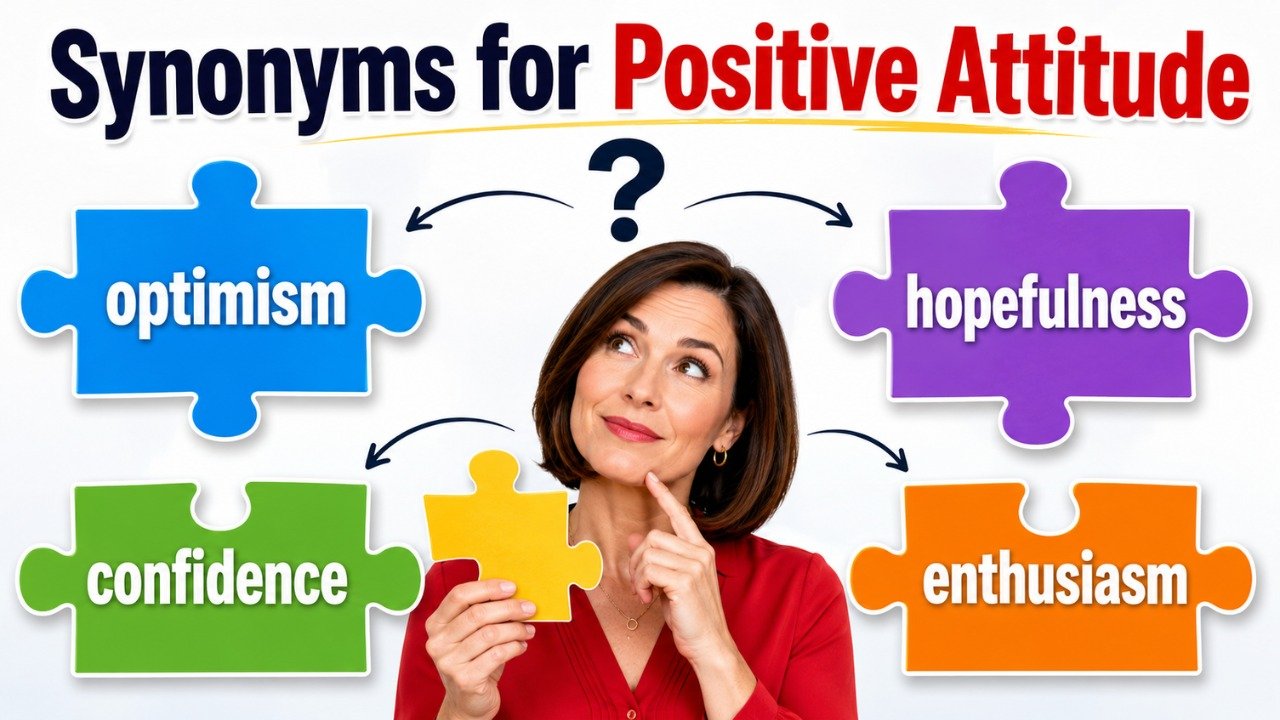
Quick Answer: The best synonyms for positive attitude include positivity, optimism, positive outlook, constructive mindset, hopeful attitude, confidence, enthusiasm, resilience, growth mindset, and can do attitude. Use optimism when emphasizing hope for a good result, confidence when describing belief in ability, resilience when discussing recovery from difficulty, and constructive mindset when focusing on solutions. Positive outlook is the most natural general replacement in professional, academic, and everyday contexts.
Pronunciation and Word Details
Word: Positive attitude.
Pronunciation: /ˈpɑːzətɪv ˈætɪtuːd/.
Part of Speech: Noun phrase.
Meaning: A hopeful, constructive, and confident way of thinking about people, situations, or future results.
US Pronunciation:
UK Pronunciation:
What Does “Positive Attitude” Mean?
A positive attitude means approaching life, work, challenges, and relationships with hope, confidence, and a willingness to find helpful solutions.
Positive attitude is a noun phrase. The word positive describes the noun attitude, which refers to a person’s way of thinking or feeling about something.
A positive attitude does not mean ignoring problems or pretending that every situation is perfect. It means recognizing difficulties while believing that improvement, learning, or progress is possible.
Personal Context: She maintained a positive attitude during a difficult period.
Work Context: His positive attitude helped the team remain motivated.
Learning Context: A positive attitude can make unfamiliar tasks feel more manageable.
Social Context: Her positive attitude made others feel comfortable and encouraged.
The phrase can describe a temporary response to one situation or a general way of approaching life.
Meaning, Tone, and Context of “Positive Attitude”
Positive attitude has an approving, encouraging, and generally neutral tone. It is common in formal writing, professional communication, education, personal development, and everyday conversation.
In professional settings, the phrase often describes cooperation, adaptability, motivation, and a willingness to solve problems. In personal contexts, it may refer to hope, gratitude, confidence, or emotional strength.
Formal Context: The candidate demonstrated a positive attitude toward learning.
Professional Context: A positive attitude helped the group manage unexpected changes.
Academic Context: Students with a positive attitude may be more willing to ask questions and correct mistakes.
Conversational Context: I admire her positive attitude about the situation.
Emotional Context: He kept a positive attitude even when progress was slow.
The phrase is encouraging, but it should not be used to dismiss genuine pain, stress, disappointment, or practical concerns.
When and How to Use “Positive Attitude”
For Hope and Optimism
Use: Positive attitude can describe someone who expects improvement or believes that a good result remains possible.
Example: She maintained a positive attitude while waiting for the final decision.
For Workplace Behavior
Use: The phrase can describe cooperation, professionalism, motivation, and willingness to help.
Example: His positive attitude made him a valuable member of the project team.
For Difficult Situations
Use: Positive attitude can show that someone remains constructive without denying the seriousness of a problem.
Example: They approached the unexpected delay with a positive attitude.
For Learning and Growth
Use: The phrase can describe openness to feedback, practice, and improvement.
Example: A positive attitude helped her learn from every correction.
For Personal Confidence
Use: Positive attitude can express belief in one’s ability to handle a task or challenge.
Example: He entered the interview with a positive attitude and clear preparation.
For Supporting Others
Use: The phrase can describe an encouraging presence that improves the mood of a group.
Example: Her positive attitude encouraged everyone to continue working.
For Adapting to Change
Use: Positive attitude can describe willingness to accept and manage a new situation.
Example: The employees showed a positive attitude toward the updated process.
Best Synonyms for Positive Attitude
Positivity
Synonym: A hopeful and constructive way of thinking or behaving.
Example: Her positivity helped the group remain calm and focused.
Optimism
Synonym: The belief that good results are likely or possible.
Example: His optimism remained strong despite the early difficulties.
Positive Outlook
Synonym: A generally hopeful view of life, events, or the future.
Example: She has a positive outlook on the changes ahead.
Constructive Mindset
Synonym: A way of thinking that focuses on improvement and useful solutions.
Example: A constructive mindset helped them resolve the disagreement.
Hopeful Attitude
Synonym: A feeling or belief that circumstances can improve.
Example: He maintained a hopeful attitude throughout the recovery process.
Confidence
Synonym: Belief in one’s abilities, choices, or chance of success.
Example: She spoke with confidence during the presentation.
Enthusiasm
Synonym: Strong interest, excitement, and willingness to participate.
Example: His enthusiasm inspired others to join the project.
Resilience
Synonym: The ability to recover and continue after difficulty.
Example: Her resilience helped her adapt to the unexpected change.
Growth Mindset
Synonym: The belief that skills and abilities can improve through effort and learning.
Example: A growth mindset encouraged him to view mistakes as lessons.
Can Do Attitude
Synonym: A confident willingness to attempt tasks and solve problems.
Example: Her can do attitude impressed the entire team.
50 Synonyms for Positive Attitude with Short Meanings
- Positivity: A constructive and hopeful way of thinking.
- Optimism: Belief that good outcomes are possible.
- Positive Outlook: A hopeful view of life or future events.
- Constructive Mindset: Thinking that focuses on solutions and improvement.
- Hopeful Attitude: An expectation that circumstances can improve.
- Upbeat Spirit: A cheerful and energetic emotional state.
- Confidence: Belief in personal ability or future success.
- Enthusiasm: Strong interest, excitement, and willingness.
- Cheerfulness: A naturally happy and encouraging manner.
- Resilience: The ability to recover from difficulty.
- Can Do Attitude: A confident willingness to attempt challenges.
- Growth Mindset: Belief that ability can improve through effort.
- Open Mindedness: Willingness to consider new ideas or possibilities.
- Positive Thinking: The habit of focusing on useful and hopeful possibilities.
- Bright Outlook: An optimistic view of the present or future.
- Hopefulness: A feeling that a desired result may happen.
- Good Spirits: A cheerful and emotionally positive mood.
- High Morale: Strong confidence, enthusiasm, and group motivation.
- Inner Confidence: Quiet belief in one’s own strength or ability.
- Mental Strength: The ability to remain focused during difficulty.
- Emotional Strength: The ability to manage feelings and continue forward.
- Determination: Firm intention to reach a goal.
- Motivation: The desire and energy to take action.
- Eagerness: Excited willingness to begin or participate.
- Readiness: Willing preparation to act or respond.
- Willingness: Openness to doing or accepting something.
- Receptiveness: Willingness to listen, learn, or accept ideas.
- Gratitude: Appreciation for what is good or valuable.
- Appreciation: Recognition of value, effort, or kindness.
- Contentment: Peaceful satisfaction with one’s situation.
- Joyfulness: A state of happiness and positive energy.
- Buoyancy: The ability to remain cheerful during difficulty.
- Good Humor: A pleasant and cheerful manner.
- Faith: Trust that something good or meaningful is possible.
- Trust: Confidence in a person, process, or outcome.
- Assurance: Calm confidence that something can be handled.
- Courage: Strength to face fear, difficulty, or uncertainty.
- Perseverance: Continued effort despite obstacles.
- Persistence: Determination to keep working toward a result.
- Adaptability: Willingness and ability to adjust to change.
- Resourcefulness: Ability to find useful solutions with available resources.
- Calmness: A peaceful and controlled emotional state.
- Composure: The ability to remain calm under pressure.
- Patience: Willingness to wait or continue without frustration.
- Acceptance: Willingness to recognize reality and move forward.
- Purposefulness: Acting with clear intention and direction.
- Forward Thinking: Considering future opportunities and improvements.
- Solution Focused Thinking: Concentrating on answers rather than only problems.
- Constructive Approach: A practical method aimed at improvement.
- Positive Frame of Mind: A hopeful and helpful mental state.
Read Also:
Synonyms for Smooth
Synonyms for Positive Attitude by Context
When Positive Attitude Means Optimism
Optimism, hopefulness, bright outlook, positive outlook, and hopeful attitude describe an expectation that circumstances can improve.
Example With Positive Attitude: She maintained a positive attitude about the future.
Example With Optimism: She maintained her optimism about the future.
Example With Hopefulness: Her hopefulness helped her continue making plans.
Optimism is the strongest choice when the focus is a favorable future result. Hopefulness sounds more emotional and personal.
When Positive Attitude Means Confidence
Confidence, assurance, inner confidence, courage, and self belief describe trust in one’s abilities or decisions.
Example With Positive Attitude: He approached the examination with a positive attitude.
Example With Confidence: He approached the examination with confidence.
Example With Assurance: He answered each question with calm assurance.
Confidence is more precise when the sentence focuses on personal ability rather than general optimism.
When Positive Attitude Means Enthusiasm
Enthusiasm, eagerness, motivation, willingness, and readiness describe energetic interest in an activity or opportunity.
Example With Positive Attitude: She showed a positive attitude toward the new assignment.
Example With Enthusiasm: She showed enthusiasm for the new assignment.
Example With Eagerness: She accepted the new assignment with eagerness.
Enthusiasm emphasizes excitement. Willingness emphasizes cooperation, even when strong excitement is not present.
When Positive Attitude Means Resilience
Resilience, perseverance, persistence, mental strength, and emotional strength describe the ability to continue during difficulty.
Example With Positive Attitude: His positive attitude helped him recover from the setback.
Example With Resilience: His resilience helped him recover from the setback.
Example With Perseverance: His perseverance kept him working after the setback.
Resilience focuses on recovery. Perseverance focuses on continued effort.
When Positive Attitude Means Constructive Thinking
Constructive mindset, constructive approach, solution focused thinking, forward thinking, and growth mindset describe practical thinking aimed at improvement.
Example With Positive Attitude: The manager encouraged a positive attitude during the discussion.
Example With Constructive Mindset: The manager encouraged a constructive mindset during the discussion.
Example With Solution Focused Thinking: Solution focused thinking helped the group identify the next step.
Constructive mindset works well in professional and academic writing because it emphasizes useful thought rather than simple cheerfulness.
When Positive Attitude Means Cheerfulness
Cheerfulness, good spirits, joyfulness, upbeat spirit, buoyancy, and good humor describe a pleasant and encouraging mood.
Example With Positive Attitude: Her positive attitude made the room feel more welcoming.
Example With Cheerfulness: Her cheerfulness made the room feel more welcoming.
Example With Good Humor: She handled the minor inconvenience with good humor.
Cheerfulness describes visible happiness. Good humor often describes a pleasant response to inconvenience or difficulty.
When Positive Attitude Means Openness
Open mindedness, receptiveness, willingness, adaptability, and acceptance describe readiness to consider ideas or adjust to change.
Example With Positive Attitude: He showed a positive attitude toward feedback.
Example With Receptiveness: He showed receptiveness to feedback.
Example With Open Mindedness: His open mindedness allowed him to consider a different method.
Receptiveness is especially useful when discussing advice, feedback, or suggestions.
Another Word for Positive Attitude
Positive outlook is the best general replacement for positive attitude because it naturally expresses a hopeful and constructive view. However, the strongest alternative depends on whether the sentence emphasizes hope, confidence, energy, resilience, or problem solving.
Original: Her positive attitude helped everyone remain hopeful.
Better Option: Her positive outlook helped everyone remain hopeful.
Original: He brought a positive attitude to every challenge.
Better Option: He brought a constructive mindset to every challenge.
Original: She maintained a positive attitude after the setback.
Better Option: She demonstrated resilience after the setback.
Original: The applicant showed a positive attitude during the interview.
Better Option: The applicant showed confidence and enthusiasm during the interview.
When Not to Use “Positive Attitude”
Positive attitude can sound vague when a more specific quality would explain exactly how someone behaved. It may also sound repetitive when used several times in the same paragraph.
When You Mean Confidence
Weak: She had a positive attitude before speaking to the audience.
Better: She spoke with confidence before the audience.
Confidence directly describes belief in personal ability.
When You Mean Enthusiasm
Weak: He showed a positive attitude toward joining the project.
Better: He showed enthusiasm for joining the project.
Enthusiasm more clearly expresses excitement and interest.
When You Mean Resilience
Weak: Her positive attitude helped her return after the disappointment.
Better: Her resilience helped her recover from the disappointment.
Resilience emphasizes recovery after difficulty.
When You Mean Cooperation
Weak: The employee had a positive attitude about the revised schedule.
Better: The employee showed willingness to follow the revised schedule.
Willingness explains the behavior more precisely.
When You Mean Problem Solving
Weak: The team used a positive attitude to address the issue.
Better: The team used a constructive approach to address the issue.
Constructive approach is clearer in formal and professional writing.
When the Phrase Dismisses Real Feelings
Positive attitude should not be used to suggest that someone must ignore grief, stress, fear, or disappointment.
Weak: You only need a positive attitude, so stop worrying.
Better: Your concern is understandable, and we can look for a practical next step.
The improved sentence recognizes the emotion while still encouraging action.
Words Commonly Confused With Positive Attitude
Positive Attitude vs Positivity: Positive attitude describes a person’s approach to a situation. Positivity is the broader quality of being hopeful, encouraging, or constructive.
Positive Attitude vs Optimism: Positive attitude includes behavior, effort, and approach. Optimism mainly refers to expecting a favorable result.
Positive Attitude vs Confidence: Positive attitude is a broad constructive mindset. Confidence is belief in one’s ability, judgment, or likelihood of success.
Positive Attitude vs Enthusiasm: Positive attitude can be calm and steady. Enthusiasm involves visible excitement, energy, or strong interest.
Positive Attitude vs Motivation: Positive attitude describes how someone thinks or responds. Motivation is the desire or reason to take action.
Positive Attitude vs Cheerfulness: Positive attitude can exist even when someone is serious or concerned. Cheerfulness is a visibly happy or pleasant mood.
Positive Attitude vs Resilience: Positive attitude is a hopeful approach. Resilience is the ability to recover from hardship or adapt to difficult circumstances.
Positive Attitude vs Growth Mindset: Positive attitude is a broad expression. Growth mindset specifically means believing that abilities can improve through practice, learning, and effort.
Positive Attitude vs Gratitude: Positive attitude describes a general approach. Gratitude specifically means recognizing and appreciating what is valuable or helpful.
Which Synonym Should You Choose?
Choose positivity when referring to a generally hopeful and constructive quality.
Choose optimism when discussing expectations about the future or a possible result.
Choose positive outlook when you need a natural general replacement for positive attitude.
Choose constructive mindset for formal writing about problem solving, improvement, or workplace behavior.
Choose confidence when the focus is belief in personal ability or judgment.
Choose enthusiasm when describing excitement, energy, or strong interest.
Choose resilience when discussing recovery from failure, stress, or difficulty.
Choose perseverance when someone continues working despite obstacles.
Choose growth mindset when discussing learning, feedback, practice, and skill development.
Choose willingness when describing cooperation or readiness to participate.
Choose receptiveness when someone listens to feedback or considers new ideas.
Choose adaptability when the sentence focuses on adjusting to change.
Choose cheerfulness when describing a pleasant, visibly happy mood.
Choose gratitude when the focus is appreciation rather than hope or confidence.
In essays and reports, constructive mindset, optimism, resilience, adaptability, and positive outlook usually provide greater precision. In emails and everyday conversation, positivity, confidence, enthusiasm, and good spirits often sound more natural.
Real Life Examples of “Positive Attitude” in Sentences
Original: She maintained a positive attitude during the difficult project.
Better Option: She maintained an optimistic outlook during the difficult project.
Original: His positive attitude helped him learn from criticism.
Better Option: His growth mindset helped him learn from criticism.
Original: The new employee brought a positive attitude to the office.
Better Option: The new employee brought enthusiasm and good humor to the office.
Original: She showed a positive attitude after the unexpected change.
Better Option: She showed resilience after the unexpected change.
Original: The students had a positive attitude toward the new lesson.
Better Option: The students showed enthusiasm for the new lesson.
Original: He approached the interview with a positive attitude.
Better Option: He approached the interview with confidence.
Original: Their positive attitude helped them identify a solution.
Better Option: Their constructive mindset helped them identify a solution.
Original: She kept a positive attitude while learning a difficult skill.
Better Option: She remained patient and determined while learning a difficult skill.
Original: The group showed a positive attitude toward feedback.
Better Option: The group showed receptiveness to feedback.
Original: His positive attitude helped him adjust to the new routine.
Better Option: His adaptability helped him adjust to the new routine.
Synonym Groups and Usage Differences
Hope and Expectation Group
Optimism, hopefulness, hopeful attitude, bright outlook, and positive outlook express belief that a situation can improve.
Example: Her optimism helped her remain focused on future opportunities.
Confidence Group
Confidence, assurance, courage, inner confidence, and trust express belief in ability, judgment, or support.
Example: He accepted the responsibility with quiet confidence.
Energy and Interest Group
Enthusiasm, eagerness, motivation, readiness, and willingness describe energy or desire to participate.
Example: The volunteers showed enthusiasm for the community project.
Strength During Difficulty Group
Resilience, perseverance, persistence, mental strength, and emotional strength describe the ability to continue or recover.
Example: Her resilience became clear when she returned to the task.
Constructive Thinking Group
Constructive mindset, growth mindset, solution focused thinking, forward thinking, and constructive approach describe practical thought aimed at progress.
Example: A constructive approach allowed both sides to discuss possible solutions.
Cheerful Mood Group
Cheerfulness, joyfulness, good spirits, buoyancy, upbeat spirit, and good humor describe a happy or encouraging emotional state.
Example: His good humor reduced the tension in the room.
Openness and Flexibility Group
Open mindedness, receptiveness, acceptance, willingness, and adaptability describe readiness to learn or adjust.
Example: Her receptiveness to advice helped her improve quickly.
Appreciation and Satisfaction Group
Gratitude, appreciation, and contentment describe recognition of value and satisfaction with what is present.
Example: He expressed gratitude for the support he had received.
Antonyms of Positive Attitude
The opposite of positive attitude depends on whether the sentence focuses on hope, motivation, behavior, confidence, or willingness.
Negativity: A tendency to focus mainly on problems or unfavorable possibilities.
Pessimism: The expectation that negative outcomes are likely.
Hopelessness: A feeling that improvement is impossible.
Defeatism: Acceptance of failure before making a full effort.
Cynicism: Distrust of people’s motives or positive claims.
Discouragement: Loss of confidence, energy, or hope.
Apathy: Lack of interest, concern, or motivation.
Reluctance: Unwillingness or hesitation to act.
Resistance: Refusal or unwillingness to accept change.
Doubt: Lack of confidence or certainty.
Resentment: Persistent anger about unfair treatment or disappointment.
Hostility: Unfriendly or aggressive behavior.
Despair: Complete loss of hope.
Low Morale: Weak confidence, enthusiasm, or group motivation.
Closed Mindedness: Unwillingness to consider unfamiliar ideas or information.
Comparison of Positive Attitude and Related Words
Positive Attitude vs Optimism
Positive attitude describes a broad way of thinking and behaving. Optimism specifically describes the expectation that good results are possible.
Example With Positive Attitude: She approached the challenge with a positive attitude.
Example With Optimism: She remained optimistic that the challenge could be overcome.
Positive Attitude vs Positivity
Positive attitude usually refers to a person’s response to a particular situation. Positivity refers to the broader quality of hopeful or constructive thought.
Example With Positive Attitude: His positive attitude impressed the interviewers.
Example With Positivity: His positivity improved the mood of the group.
Positive Attitude vs Confidence
Positive attitude may include hope, cooperation, and persistence. Confidence mainly describes belief in one’s ability or judgment.
Example With Positive Attitude: She maintained a positive attitude throughout the course.
Example With Confidence: She answered the questions with confidence.
Positive Attitude vs Enthusiasm
Positive attitude can be quiet and thoughtful. Enthusiasm is usually energetic, visible, and connected to strong interest.
Example With Positive Attitude: He accepted the task with a positive attitude.
Example With Enthusiasm: He accepted the task with enthusiasm.
Positive Attitude vs Resilience
Positive attitude describes a constructive outlook. Resilience describes the capacity to recover after stress, failure, or disappointment.
Example With Positive Attitude: She kept a positive attitude during the delay.
Example With Resilience: Her resilience helped her recover after the plan failed.
Positive Attitude vs Growth Mindset
Positive attitude is a general hopeful approach. Growth mindset is the specific belief that skills and intelligence can improve through effort and learning.
Example With Positive Attitude: He remained positive about the difficult lesson.
Example With Growth Mindset: His growth mindset encouraged him to practice until he improved.
Positive Attitude vs Motivation
Positive attitude refers to a way of thinking. Motivation refers to the desire, reason, or energy needed to act.
Example With Positive Attitude: Her positive attitude helped her view the task calmly.
Example With Motivation: Her motivation helped her complete the task.
Common Phrases and Expressions With “Positive Attitude”
Maintain a Positive Attitude: Continue thinking and responding constructively.
Keep a Positive Attitude: Remain hopeful during a challenge or delay.
Develop a Positive Attitude: Gradually build a more constructive way of thinking.
Show a Positive Attitude: Demonstrate optimism, cooperation, or willingness through behavior.
Have a Positive Attitude: Possess a generally hopeful or helpful outlook.
Bring a Positive Attitude: Contribute constructive energy to a group or situation.
Positive Attitude Toward Work: A willing, responsible, and constructive approach to professional duties.
Positive Attitude Toward Change: Openness and adaptability when circumstances become different.
Positive Mental Attitude: A hopeful and confident way of interpreting situations.
Can Do Attitude: A willingness to attempt difficult tasks and find solutions.
Attitude of Gratitude: A habit of noticing and appreciating positive aspects of life.
Positive Frame of Mind: A hopeful and emotionally constructive mental state.
Common Mistakes to Avoid
Treating Every Pleasant Emotion as a Positive Attitude
Happiness, excitement, confidence, and positive attitude are related, but they are not identical.
Unclear: She had a positive attitude because she laughed at the joke.
Clear: She was cheerful and laughed at the joke.
Using the Phrase Too Repeatedly
Repeating positive attitude can make writing sound general and monotonous.
Repetitive: Her positive attitude improved the meeting. Her positive attitude encouraged the staff. Her positive attitude solved problems.
Improved: Her optimism improved the meeting, her enthusiasm encouraged the staff, and her constructive mindset supported problem solving.
Choosing a Synonym That Changes the Meaning
Optimism does not always imply action, and enthusiasm does not always imply confidence.
Incorrect: His resilience made him excited about the concert.
Correct: His enthusiasm made him excited about the concert.
Confusing Confidence With Optimism
Confidence concerns ability, while optimism concerns expected results.
Unclear: She felt optimism in her ability to speak clearly.
Clear: She felt confident in her ability to speak clearly.
Using Positive Attitude to Dismiss Problems
A positive attitude should not replace honest discussion, emotional support, preparation, or practical action.
Weak: Keep a positive attitude and ignore the problem.
Better: Remain hopeful while examining the problem and planning a practical response.
Using Unnatural Phrasing
Use have, maintain, show, develop, bring, or keep with positive attitude.
Unnatural: She performed a positive attitude.
Natural: She showed a positive attitude.
Assuming Positive Means Constantly Cheerful
Someone can have a positive attitude while feeling disappointed, worried, or serious. Positivity may involve patience, courage, acceptance, or problem solving rather than visible happiness.
Using a Broad Phrase When Precision Is Needed
In reports, evaluations, and formal communication, explain the specific behavior.
Vague: The employee has a positive attitude.
Precise: The employee accepts feedback, supports colleagues, and adapts well to change.
Conclusion
Synonyms for positive attitude include positivity, optimism, positive outlook, constructive mindset, confidence, enthusiasm, resilience, and growth mindset. Positive outlook is the strongest general replacement, while optimism emphasizes hope, confidence expresses self belief, and enthusiasm shows energetic interest. Resilience is best for recovery from difficulty, and constructive mindset suits formal discussions of improvement and problem solving. Choosing the most precise alternative makes your writing clearer and shows exactly how a person thinks, feels, or responds.
FAQs About Synonyms for Positive Attitude
What Is the Best Synonym for Positive Attitude?
Positive outlook is the best general synonym. It naturally describes a hopeful and constructive view of life or a situation.
What Is a Formal Synonym for Positive Attitude?
Constructive mindset is a strong formal alternative. Optimism, resilience, adaptability, and positive outlook also work well in professional writing.
What Is Another Word for a Positive Person?
An optimistic, cheerful, encouraging, hopeful, or upbeat person may be described as a positive person.
Is Optimism the Same as a Positive Attitude?
Not exactly. Optimism is the expectation of a good outcome, while a positive attitude also includes constructive behavior, effort, flexibility, and cooperation.
What Is a Synonym for Positive Attitude at Work?
Professional alternatives include constructive mindset, enthusiasm, adaptability, willingness, high morale, and can do attitude.
What Is a Synonym for Staying Positive During Difficulty?
Resilience is the most precise choice. Perseverance, hopefulness, courage, and emotional strength are also suitable.
How Can I Describe a Positive Attitude in Writing?
Use a specific word that matches the behavior. Choose confidence for self belief, enthusiasm for energy, resilience for recovery, or receptiveness for openness to feedback.
