
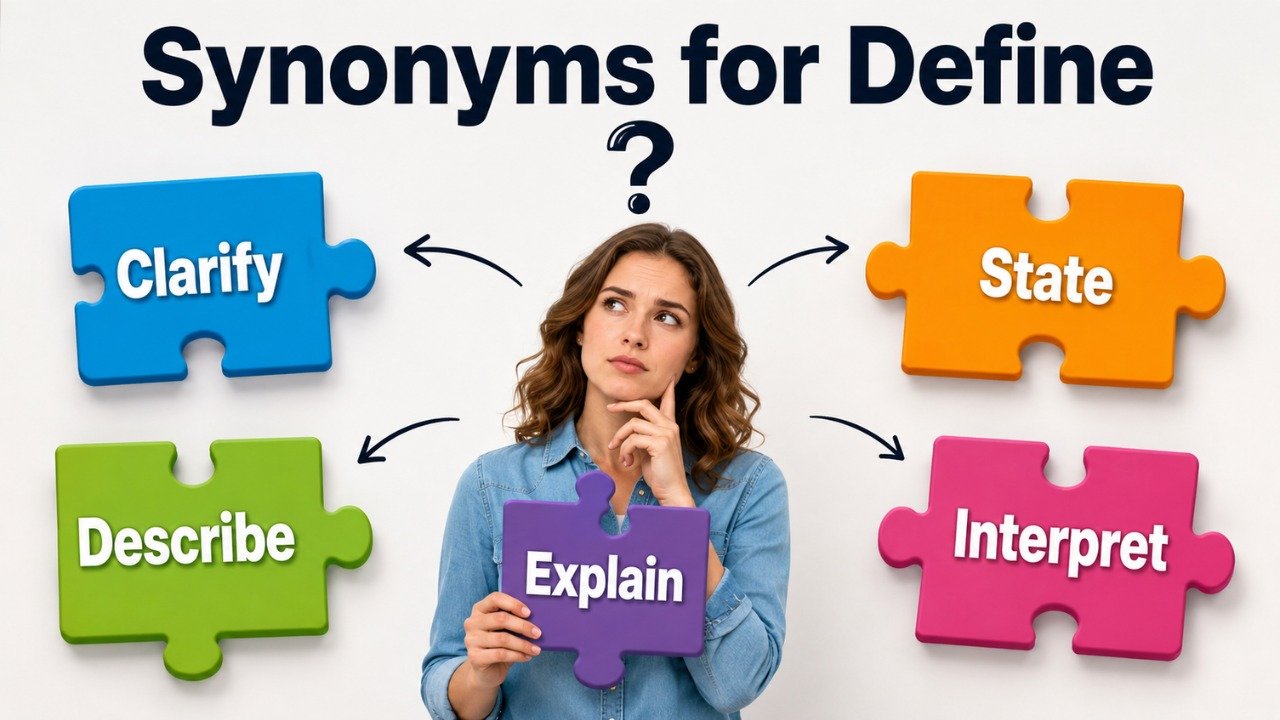
Quick Answer: The best synonyms for define include explain, describe, clarify, specify, identify, characterize, determine, establish, outline, and delineate. Use explain when making a meaning easier to understand, describe when presenting qualities or features, and clarify when removing confusion. Specify is best for exact details, while identify names a person, object, or idea. Characterize describes distinctive qualities. Determine and establish suit rules, results, standards, or limits. Outline gives the main points, while delineate formally marks boundaries or explains precise differences.
Pronunciation and Word Details
Word: Define.
Pronunciation: /dɪˈfaɪn/.
Part of Speech: Verb.
Meaning: To explain the meaning of something, describe its essential qualities, or establish its exact limits.
US Pronunciation:
UK Pronunciation:
What Does “Define” Mean?
Define means to explain the meaning, nature, purpose, or limits of a word, idea, object, role, or situation.
As a verb, define often appears in educational, academic, professional, technical, and everyday contexts. In the sentence “Please define the term,” the word means to state clearly what the term means.
Define can also mean to describe the essential qualities of someone or something. For example, “Kindness defines her character” means kindness is one of her most important qualities.
The word may also refer to setting boundaries, rules, responsibilities, or standards. A project manager might define the scope of a project, while an agreement may define the responsibilities of each person.
In mathematics, science, law, research, and business, define often requires accuracy. The writer or speaker must make the meaning clear enough that readers understand exactly what is included, excluded, required, or intended.
Meaning, Tone, and Context of “Define”
Define is a neutral and moderately formal word. It is common in education, research, dictionaries, instructions, reports, essays, meetings, policies, and professional communication.
In academic writing, define often introduces the meaning of an important term or concept. A writer may define a technical word before discussing a complex argument. This helps readers understand how the word will be used.
In everyday conversation, define may sound more formal than explain or describe. A person is more likely to say “Can you explain that?” than “Can you define that?” unless the question concerns the exact meaning of a word.
Define also carries a precise tone when used for boundaries and responsibilities. Expressions such as “define the scope,” “define the role,” and “define the rules” suggest that clear limits must be established.
The word can also sound expressive when describing identity or character. A person may say that one mistake does not define someone. In this context, define means determine or represent the person’s entire identity.
When and How to Use “Define”
For Explaining Meaning
Use define when stating what a word, phrase, idea, or concept means.
Example: The teacher asked the students to define the word compassion.
For Describing Essential Qualities
Use define when explaining the main characteristics of a person, object, style, or situation.
Example: Clear communication defines an effective leader.
For Giving Exact Details
Use define when information must be specific and unambiguous.
Example: The instructions clearly define the requirements for the assignment.
For Setting Boundaries
Use define when establishing where something begins, ends, applies, or does not apply.
Example: The agreement defines the boundaries of the property.
For Establishing Responsibilities
Use define when explaining what a person, team, or organization is expected to do.
Example: The manager defined each employee’s role before the project began.
For Determining Identity
Use define when a quality, experience, or decision strongly shapes how someone or something is understood.
Example: Her patience and honesty define her approach to leadership.
For Clarifying a Problem
Use define when identifying the exact nature of an issue before seeking a solution.
Example: The team must define the problem before proposing changes.
For Setting Goals
Use define when expressing a desired result in a clear and measurable way.
Example: The group defined its main objective during the first meeting.
Best Synonyms for Define
Explain: Make an idea, meaning, or process easier to understand.
Example: The instructor explained the difficult concept in simple language.
Describe: Give details about the qualities, appearance, or nature of something.
Example: She described the building as spacious and modern.
Clarify: Remove uncertainty or confusion from an idea or statement.
Example: The speaker clarified what she meant by long term success.
Specify: State an exact detail, condition, number, or requirement.
Example: The instructions specify the documents that applicants must provide.
Identify: Recognize or name a particular person, object, issue, or quality.
Example: The report identifies the main causes of the problem.
Characterize: Describe the distinctive qualities of someone or something.
Example: Honesty and patience characterize his leadership style.
Determine: Decide or establish something through evidence, rules, or careful consideration.
Example: The results will determine whether the plan is effective.
Establish: Set, prove, or make something clear and accepted.
Example: The policy establishes clear standards for professional conduct.
Outline: Present the main features, stages, or points without every detail.
Example: The guide outlines the steps required to complete the task.
Delineate: Describe or mark the exact boundaries, differences, or features of something.
Example: The document delineates the responsibilities of each department.
50 Synonyms for Define with Short Meanings
- Explain: Make the meaning of something clear.
- Describe: Give details about the nature or qualities of something.
- Clarify: Remove confusion or uncertainty.
- Specify: State something in exact detail.
- Identify: Recognize or name something accurately.
- Characterize: Describe the distinctive qualities of something.
- Determine: Decide or establish something through evidence or judgment.
- Establish: Set or make something clear and accepted.
- Outline: Present the main points or boundaries.
- Interpret: Explain the meaning or significance of something.
- State: Express something clearly in words.
- Express: Communicate an idea, meaning, or feeling.
- Articulate: Communicate an idea clearly and effectively.
- Formulate: Develop and express something carefully.
- Delineate: Describe exact features, limits, or differences.
- Demarcate: Mark or establish a boundary.
- Distinguish: Show how one thing differs from another.
- Classify: Place something into a group based on shared qualities.
- Categorize: Arrange something according to type or class.
- Label: Give a descriptive name or category.
- Name: State what someone or something is called.
- Designate: Officially name or assign a purpose.
- Denote: Be the exact meaning or sign of something.
- Signify: Represent or communicate a meaning.
- Mean: Have a particular meaning or intention.
- Indicate: Point out or show something.
- Represent: Stand for or express a particular idea.
- Convey: Communicate a meaning, feeling, or message.
- Embody: Represent a quality or idea in a clear form.
- Symbolize: Serve as a sign or representation of something.
- Detail: Provide specific facts or information.
- Summarize: State the main points briefly.
- Illustrate: Explain something through an example or image.
- Elaborate: Add more detail or explanation.
- Elucidate: Make a difficult subject clearer.
- Explicate: Explain an idea or text in careful detail.
- Paraphrase: Restate something using different words.
- Spell out: Explain something clearly and directly.
- Set forth: Present an idea, rule, or condition formally.
- Pinpoint: Identify something with great accuracy.
- Fix: Establish an exact position, amount, or limit.
- Set: Establish a rule, standard, value, or boundary.
- Limit: Establish the greatest allowed amount or extent.
- Bound: Establish the limits of an area or idea.
- Circumscribe: Restrict or mark the limits of something.
- Frame: Shape the way an idea, question, or issue is presented.
- Shape: Influence the form, nature, or identity of something.
- Mark: Show a boundary, quality, or distinction.
- Qualify: Add conditions that make a meaning more precise.
- Prescribe: Establish officially what should be done or allowed.
Read Also:
Synonyms for Reduce
Synonyms for Define by Context
When Define Means Explain a Meaning
When define means making a word, phrase, concept, or process understandable, use explain, clarify, interpret, elucidate, explicate, paraphrase, articulate, or spell out.
Explain: The most natural general replacement when helping someone understand an idea.
Example: Please explain the meaning of this expression.
Clarify: Best when the original meaning is confusing or uncertain.
Example: The author clarified the purpose of the final chapter.
Interpret: Useful when explaining the significance of a statement, symbol, event, or result.
Example: Researchers interpreted the findings in several different ways.
Elucidate: A formal word for making a difficult subject clearer.
Example: The diagram helps elucidate the relationship between the two systems.
Explicate: Common in academic analysis when explaining a text, theory, or argument in detail.
Example: The essay explicates the central theme of the poem.
When Define Means Describe
When define means presenting important qualities or features, use describe, characterize, detail, illustrate, portray, outline, or articulate.
Describe: Gives information about appearance, condition, function, or qualities.
Example: The witness described the vehicle in detail.
Characterize: Focuses on the distinctive qualities of a person, period, object, or style.
Example: Simplicity characterizes the design.
Detail: Provides exact facts and supporting information.
Example: The report details every stage of the investigation.
Illustrate: Explains through examples, comparisons, or visual information.
Example: This example illustrates how the rule works.
Outline: Presents the main points without discussing every detail.
Example: The introduction outlines the goals of the study.
When Define Means Specify
When define means giving exact information, use specify, state, identify, pinpoint, designate, name, label, or set forth.
Specify: Best for exact conditions, measurements, requirements, or instructions.
Example: The form specifies which documents are required.
State: A direct word for expressing a fact, opinion, rule, or condition.
Example: The contract states the final payment date.
Identify: Best when naming a person, issue, object, cause, or feature.
Example: The study identifies several possible risks.
Pinpoint: Suggests highly accurate identification.
Example: The technician pinpointed the source of the error.
Set forth: A formal expression for presenting principles, conditions, or rules.
Example: The policy sets forth the responsibilities of each employee.
When Define Means Set Boundaries
When define means establishing limits, use delineate, demarcate, bound, limit, circumscribe, fix, set, frame, or establish.
Delineate: Clearly explains the boundaries, roles, or differences involved.
Example: The agreement delineates the authority of each partner.
Demarcate: Often refers to physically or formally marking a boundary.
Example: The fence demarcates the edge of the property.
Limit: Establishes how far something may extend or how much is allowed.
Example: The rules limit the number of entries per person.
Circumscribe: A formal word meaning to restrict something within set limits.
Example: The law circumscribes the powers of the committee.
Establish: Creates a rule, standard, boundary, or accepted fact.
Example: The guidelines establish clear limits for acceptable conduct.
When Define Means Determine
When define means deciding the nature, result, or identity of something, use determine, establish, shape, fix, prescribe, govern, or influence.
Determine: Best when evidence, rules, or circumstances decide an outcome.
Example: The final score will determine the winner.
Establish: Suitable when making a fact, rule, or identity clear.
Example: The evidence established the order of events.
Shape: Describes the influence that creates or changes identity.
Example: Childhood experiences can shape adult behavior.
Fix: Means to establish a particular amount, position, or time.
Example: The committee fixed the date of the meeting.
Prescribe: Describes officially establishing what is required or permitted.
Example: The regulations prescribe the correct procedure.
When Define Means Represent
When define means communicating or standing for a quality, idea, or identity, use represent, symbolize, embody, signify, denote, convey, or express.
Represent: Means to stand for or serve as an example of something.
Example: The image represents hope and renewal.
Symbolize: Describes something serving as a symbol of an idea.
Example: The open door symbolizes opportunity.
Embody: Means to express a quality in a complete and visible form.
Example: Her actions embody courage and compassion.
Signify: Indicates a particular meaning, importance, or result.
Example: The change may signify a new stage of development.
Convey: Communicates a meaning, emotion, or message.
Example: The speech conveyed a strong sense of optimism.
Another Word for Define
Explain is the best general replacement for define when the purpose is to make a meaning easier to understand. However, the most accurate alternative depends on the sentence.
Use describe for qualities, specify for exact details, determine for results, establish for rules, and delineate for boundaries.
Original: Please define this technical term.
Better Option: Please explain this technical term.
Original: The report defines the responsibilities of each team.
Better Option: The report specifies the responsibilities of each team.
Original: These values define the organization’s culture.
Better Option: These values characterize the organization’s culture.
Original: The agreement defines the limits of the project.
Better Option: The agreement delineates the limits of the project.
When Not to Use “Define”
Avoid define when the sentence requires a more specific action. The word can be too broad when you really mean explain, identify, describe, classify, or establish.
Weak: The report defines several risks.
Better: The report identifies several risks.
Do not use define when you only want a general description. Define often suggests an exact meaning, while describe may include appearance, qualities, condition, and context.
Weak: Define what the garden looked like.
Better: Describe what the garden looked like.
Avoid define when discussing detailed instructions. Specify, state, or spell out may communicate the intended action more clearly.
Weak: The guide defines what applicants must submit.
Better: The guide specifies what applicants must submit.
Do not use define when a result is decided by evidence or calculation. Determine is usually more natural.
Weak: The test will define whether the material is safe.
Better: The test will determine whether the material is safe.
Avoid repeatedly using define in academic writing. Alternate with explain, describe, establish, characterize, identify, or clarify according to the intended meaning.
Weak: The author defines the term, defines its purpose, and defines its effect.
Better: The author explains the term, describes its purpose, and evaluates its effect.
Words Commonly Confused With Define
Define vs Explain: Define gives the exact meaning of a word or concept. Explain provides reasons, details, or steps that make something easier to understand.
Define vs Describe: Define states what something means or what its essential nature is. Describe gives information about appearance, qualities, behavior, or condition.
Define vs Identify: Define explains meaning or limits. Identify recognizes, names, or points out a particular person, object, quality, or problem.
Define vs Specify: Define may explain a broad concept. Specify gives exact details, conditions, amounts, or requirements.
Define vs Determine: Define states meaning or establishes limits. Determine decides a result through evidence, calculation, rules, or judgment.
Define vs Characterize: Define explains what something is. Characterize describes the qualities that make it distinctive.
Define vs Outline: Define gives meaning or boundaries. Outline presents the main points or structure of a subject.
Define vs Delineate: Define is broad and common. Delineate is more formal and emphasizes exact boundaries, distinctions, or responsibilities.
Define vs Classify: Define explains meaning. Classify places something into a category based on shared qualities.
Which Synonym Should You Choose?
Choose explain when making an idea, term, process, or instruction easier to understand.
Choose describe when discussing appearance, features, behavior, condition, or qualities.
Choose clarify when removing confusion, doubt, or misunderstanding.
Choose specify when exact dates, amounts, measurements, conditions, or requirements are needed.
Choose identify when naming a cause, person, object, problem, risk, or feature.
Choose characterize when describing the qualities that distinguish a person, style, period, or situation.
Choose determine when evidence, calculation, or judgment decides a result.
Choose establish when creating or proving a rule, fact, standard, relationship, or boundary.
Choose outline when giving only the main stages, points, or features.
Choose delineate in formal writing about exact roles, limits, duties, or distinctions.
Choose demarcate when marking a physical, legal, or conceptual boundary.
Choose interpret when explaining the significance of a result, statement, symbol, or event.
Choose articulate when expressing a complex idea clearly and effectively.
Choose elucidate when making a difficult academic or technical subject clearer.
Choose classify when placing something into an established group.
Choose designate when officially naming a person, place, role, or purpose.
Choose represent when something stands for an idea, group, quality, or concept.
Choose embody when a person or object strongly displays a quality.
Choose prescribe when rules or authorities officially state what must be done.
Real Life Examples of “Define” in Sentences
Original: The teacher asked the class to define the word justice.
Better Option: The teacher asked the class to explain the word justice.
Original: The report defines the main causes of the problem.
Better Option: The report identifies the main causes of the problem.
Original: The contract defines the duties of each party.
Better Option: The contract specifies the duties of each party.
Original: Her confidence defines her leadership style.
Better Option: Her confidence characterizes her leadership style.
Original: The results will define whether the treatment worked.
Better Option: The results will determine whether the treatment worked.
Original: The map defines the border between the two areas.
Better Option: The map delineates the border between the two areas.
Original: The guide defines each step of the process.
Better Option: The guide outlines each step of the process.
Original: The opening paragraph defines the writer’s main argument.
Better Option: The opening paragraph states the writer’s main argument.
Original: One mistake does not define a person.
Better Option: One mistake does not determine a person’s identity.
Original: These symbols define the values of the community.
Better Option: These symbols represent the values of the community.
Synonym Groups and Usage Differences
Explanation Group
Explain, clarify, interpret, elucidate, explicate, elaborate, paraphrase, and spell out help readers understand meaning.
Explain is the most flexible choice. Clarify removes confusion, while elucidate and explicate are more formal and academic.
Example: The professor elucidated the relationship between language and identity.
Description Group
Describe, characterize, detail, outline, illustrate, articulate, and formulate present the qualities or structure of something.
Describe is broad. Characterize emphasizes distinctive traits, while outline gives only the main points.
Example: The report characterizes the region as economically diverse.
Precision Group
Specify, identify, pinpoint, state, name, label, designate, and set forth provide exact information.
Specify is best for requirements and conditions. Pinpoint suggests exceptional accuracy, while designate often involves an official choice.
Example: The instructions specify the correct format for each section.
Boundary Group
Delineate, demarcate, bound, limit, circumscribe, fix, set, and establish create or describe limits.
Delineate suits responsibilities and conceptual boundaries. Demarcate commonly refers to physical or official dividing lines.
Example: The agreement demarcates the area each group may use.
Meaning Group
Mean, denote, signify, indicate, represent, convey, embody, and symbolize communicate meaning.
Denote gives a direct or dictionary meaning. Signify often suggests importance, while symbolize involves a symbolic connection.
Example: A red light commonly signifies that a person should stop.
Classification Group
Classify, categorize, label, distinguish, qualify, name, and designate organize or separate ideas and objects.
Classify and categorize place items into groups. Distinguish explains differences, while qualify adds limiting conditions.
Example: Researchers classified the responses according to age group.
Determination Group
Determine, establish, prescribe, fix, set, frame, and shape decide or influence outcomes.
Determine focuses on a result. Establish creates an accepted fact or rule, while shape describes gradual influence.
Example: Several factors shape the final decision.
Antonyms of Define
The opposite of define depends on whether the word means explain, identify, specify, or establish limits.
Confuse: Make something difficult to understand.
Obscure: Hide or make a meaning unclear.
Blur: Make a distinction, image, or boundary less clear.
Vague: Lacking exact or clear meaning.
Generalize: Speak broadly without giving precise details.
Misinterpret: Understand or explain something incorrectly.
Misrepresent: Present something inaccurately or unfairly.
Distort: Change a meaning or fact so that it becomes misleading.
Complicate: Make something harder to understand or manage.
Conceal: Keep information, identity, or meaning hidden.
Ignore: Give no attention to an important detail or issue.
Overlook: Fail to notice or identify something.
Merge: Combine things so their separate boundaries disappear.
Unsettle: Prevent a matter from becoming fixed or established.
Broaden: Make a limit, meaning, or category less narrow.
Comparison of Define and Related Words
Define vs Explain
Define states the meaning or essential nature of something. Explain gives reasons, details, or examples that help someone understand it.
Example With Define: Define the term renewable energy.
Example With Explain: Explain how renewable energy is produced.
Define vs Describe
Define tells what something is. Describe tells what it looks like, feels like, does, or contains.
Example With Define: Define a triangle as a shape with three sides.
Example With Describe: Describe the triangle’s size and color.
Define vs Specify
Define may express a broad meaning or purpose. Specify provides exact details or conditions.
Example With Define: The policy defines acceptable behavior.
Example With Specify: The policy specifies which actions are prohibited.
Define vs Identify
Define explains a meaning or boundary. Identify recognizes or names something.
Example With Define: Define the term environmental risk.
Example With Identify: Identify the environmental risks in the area.
Define vs Determine
Define explains meaning or establishes limits. Determine decides a result or conclusion.
Example With Define: The rules define the scoring system.
Example With Determine: The final score determines the winner.
Define vs Characterize
Define explains the essential meaning of something. Characterize describes the traits that make it distinctive.
Example With Define: The article defines leadership as responsible guidance.
Example With Characterize: Patience and honesty characterize her leadership.
Define vs Delineate
Define is a broad and common word. Delineate is more formal and emphasizes precise boundaries, roles, or differences.
Example With Define: The agreement defines each person’s role.
Example With Delineate: The agreement delineates the exact responsibilities of each person.
Common Phrases and Expressions With Define
Define a Word: State the meaning of a word clearly.
Example: The learner was asked to define the word empathy.
Define a Term: Explain the accepted meaning of a technical or important term.
Example: The introduction defines every technical term used in the report.
Define the Scope: Establish what a project, study, or discussion will include.
Example: The team met to define the scope of the research.
Define the Problem: Identify the exact nature and causes of an issue.
Example: A successful solution begins when you define the problem clearly.
Define a Role: Explain a person’s responsibilities, authority, and expected tasks.
Example: The manager must define each team member’s role.
Define Success: Establish the standards used to judge a successful result.
Example: The group defined success through measurable improvements.
Define a Boundary: Establish where something begins, ends, or applies.
Example: The agreement defines a clear boundary between the properties.
Define an Objective: State a goal in clear and specific language.
Example: The first step is to define the main objective.
Define a Concept: Explain the meaning and essential qualities of an idea.
Example: The chapter defines the concept of social responsibility.
Define the Relationship: Explain how two or more people, ideas, or factors are connected.
Example: The study defines the relationship between sleep and concentration.
Common Mistakes to Avoid
Do not use define when you mean describe. Define gives meaning, while describe provides qualities, features, appearance, or condition.
Avoid giving a definition that repeats the original word. A useful definition should explain the concept through clearer language.
Do not make definitions unnecessarily complicated. Use direct wording, familiar vocabulary, and only the details needed to distinguish the concept.
Avoid definitions that are too broad. A definition should clearly separate the word from related ideas.
Do not confuse define with determine. Define explains or establishes meaning, while determine decides a result.
Avoid using define repeatedly in the same paragraph. Replace it with explain, establish, specify, characterize, identify, or delineate when appropriate.
Do not use a vague synonym in technical writing. Specify, identify, delineate, and classify may provide greater accuracy.
Remember that define is followed directly by its object. Write “Define the term,” rather than “Define about the term.”
Conclusion
The best synonyms for define depend on whether you are explaining meaning, describing qualities, giving exact details, setting boundaries, or determining an outcome. Explain and clarify make ideas easier to understand. Describe and characterize present important qualities. Specify and identify provide precision, while establish, delineate, and demarcate set clear limits. Determine suits results, and represent or symbolize expresses meaning. Choosing the right alternative from these synonyms for define will make your writing clearer, more accurate, and better suited to each context.
FAQs About Synonyms for Define
What Is the Best Synonym for Define?
Explain is the best general synonym when define means making a word or concept understandable. Specify is better for exact details.
What Is a Formal Synonym for Define?
Delineate, elucidate, explicate, articulate, establish, characterize, and demarcate are formal alternatives for different meanings of define.
Are Define and Explain the Same?
They are related but not identical. Define states what something means, while explain gives additional details, reasons, examples, or steps.
What Is Another Word for Clearly Define?
You can use clarify, specify, delineate, articulate, spell out, establish, or state precisely.
What Is a Synonym for Define a Problem?
Identify, clarify, pinpoint, characterize, describe, or outline can replace define when discussing a problem.
What Is a Synonym for Define a Boundary?
Delineate, demarcate, establish, mark, limit, bound, or circumscribe can describe setting a boundary.
What Is the Opposite of Define?
Common opposites include confuse, obscure, blur, generalize, misinterpret, conceal, and distort.
