
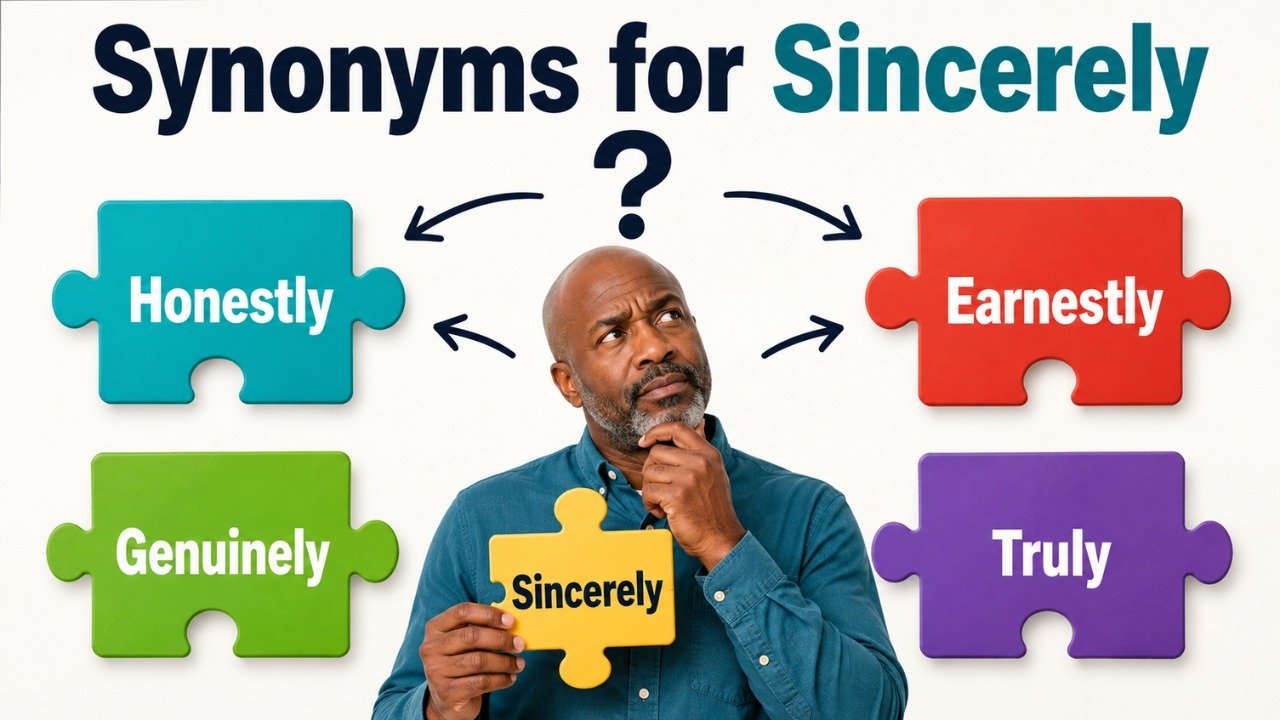
Quick Answer: Common synonyms for sincerely include genuinely, honestly, truly, earnestly, wholeheartedly, candidly, faithfully, warmly, respectfully, and from the heart. Use genuinely for real feelings, honestly for truthful statements, earnestly for serious intentions, and wholeheartedly for complete emotional commitment. Faithfully, warmly, cordially, and respectfully work well as formal letter closings, while from the heart suits personal gratitude, sympathy, apologies, and affection.
Pronunciation and Word Details
Word: Sincerely.
Pronunciation: /sɪnˈsɪr.li/
Part of Speech: Adverb.
Meaning: In an honest, genuine, serious, or heartfelt manner.
US Pronunciation:
UK Pronunciation:
What Does “Sincerely” Mean?
Sincerely means speaking, acting, or feeling in a genuine, honest, and serious way. It is an adverb formed from the adjective sincere.
The word can describe an honest statement, a genuine emotion, a serious promise, or a respectful letter closing.
Honest Statement: She sincerely explained what had happened.
Genuine Feeling: We sincerely appreciate your kindness.
Serious Intention: He sincerely wants to improve his work.
Heartfelt Apology: I sincerely apologize for the misunderstanding.
Formal Closing: Sincerely is commonly placed before a name at the end of a professional or respectful letter.
The exact meaning depends on the sentence. It may emphasize truthfulness, emotional depth, seriousness, respect, or genuine intention.
Meaning, Tone, and Context of “Sincerely”
Sincerely usually has a positive, respectful, and genuine tone. It tells the reader or listener that the speaker is not pretending, exaggerating, or being sarcastic.
In everyday speech, sincerely emphasizes honest feelings.
Example: I sincerely hope you feel better soon.
In formal writing, sincerely can strengthen an apology, expression of gratitude, promise, or request.
Example: We sincerely regret the inconvenience.
In professional letters, sincerely is a polite and neutral closing.
Example: Sincerely, followed by the writer’s name.
In emotional writing, sincerely may communicate deep concern, appreciation, sympathy, or affection.
Example: She sincerely thanked everyone who had helped her.
Formal Tone: Sincerely is suitable for professional letters, applications, requests, and apologies.
Conversational Tone: It may be used in speech when someone wants to emphasize genuine feeling.
Emotional Tone: It can make gratitude, hope, sympathy, or regret sound more heartfelt.
Serious Tone: It shows that a promise, opinion, or intention deserves to be taken seriously.
Polite Tone: It adds respect and consideration to personal and professional communication.
When and How to Use “Sincerely”
For Genuine Appreciation
Use sincerely when expressing gratitude that is honest and deeply felt.
Example: I sincerely appreciate the time you spent helping me.
For an Honest Apology
Use sincerely when you want an apology to sound serious and genuine.
Example: We sincerely apologize for the error in your order.
For Heartfelt Hope
Use sincerely when expressing a real wish for someone’s success, health, or happiness.
Example: I sincerely hope your interview goes well.
For Serious Intentions
Use sincerely when someone truly means to take an action or make a change.
Example: She sincerely intends to complete the project on time.
For Truthful Speech
Use sincerely when emphasizing that a statement is honest.
Example: He sincerely believes that the plan will benefit everyone.
For Formal Letters
Use sincerely as a respectful closing when writing to someone by name.
Example: Sincerely, followed by your full name.
For Sympathy
Use sincerely when expressing real concern for someone experiencing loss, disappointment, or hardship.
Example: We sincerely share your sadness during this difficult time.
For Promises
Use sincerely when emphasizing that a promise is made with honest intention.
Example: I sincerely promise to correct the mistake.
Best Synonyms for Sincerely
Genuinely
Synonym: Genuinely means in a real, honest, and unaffected manner.
Example: She was genuinely pleased with the results.
Honestly
Synonym: Honestly means truthfully and without deception.
Example: He honestly admitted that he needed more time.
Truly
Synonym: Truly means in a real, sincere, or complete way.
Example: We are truly grateful for your support.
Earnestly
Synonym: Earnestly means with serious and sincere intention.
Example: She earnestly asked the committee to reconsider its decision.
Wholeheartedly
Synonym: Wholeheartedly means with complete sincerity, enthusiasm, or commitment.
Example: I wholeheartedly support your decision.
Candidly
Synonym: Candidly means honestly, openly, and directly.
Example: He candidly discussed the challenges facing the team.
Faithfully
Synonym: Faithfully means with loyalty, sincerity, and reliability.
Example: She faithfully carried out every responsibility.
Warmly
Synonym: Warmly means in a friendly, affectionate, and sincere manner.
Example: The guests were warmly welcomed.
Respectfully
Synonym: Respectfully means with politeness, consideration, and regard.
Example: I respectfully request a review of the decision.
From the Heart
Synonym: From the heart means with deep and genuine emotion.
Example: Her words of gratitude came from the heart.
50 Synonyms for Sincerely with Short Meanings
- Genuinely: In a real and honest manner.
- Honestly: In a truthful way without deception.
- Truly: With real feeling or complete sincerity.
- Earnestly: With serious and sincere intention.
- Wholeheartedly: With complete commitment and enthusiasm.
- Truthfully: In a way that accurately expresses the truth.
- Candidly: Openly and honestly without hiding thoughts.
- Frankly: In a direct and honest manner.
- Authentically: In a way that reflects genuine character or feeling.
- Seriously: With genuine intention rather than as a joke.
- Faithfully: With loyalty, honesty, and commitment.
- Warmly: With friendly and sincere feeling.
- Cordially: In a polite, warm, and respectful manner.
- Respectfully: With consideration and proper regard.
- Affectionately: With genuine love, care, or fondness.
- Heartily: With sincere enthusiasm or approval.
- Deeply: With strong and genuine emotion.
- Fervently: With intense and sincere feeling.
- Solemnly: With serious and honest intention.
- Devoutly: With deep sincerity and dedication.
- Passionately: With powerful and genuine emotion.
- Openly: Without secrecy or concealment.
- Plainly: In a clear and honest manner.
- Straightforwardly: Directly and without misleading language.
- Conscientiously: With honesty, care, and responsibility.
- Loyally: With faithful commitment to someone or something.
- Devotedly: With strong dedication and affection.
- Unreservedly: Without hesitation, doubt, or limitation.
- Gratefully: With sincere appreciation.
- Appreciatively: In a way that shows genuine gratitude.
- Kindly: With sincere care and consideration.
- Graciously: With warmth, kindness, and politeness.
- Compassionately: With genuine concern for another person’s suffering.
- Sympathetically: With sincere understanding and concern.
- In Good Faith: With honest intentions and no desire to deceive.
- In Earnest: With serious and genuine intention.
- From the Heart: With deep and authentic emotion.
- With All My Heart: With complete emotional sincerity.
- With Genuine Feeling: With real and honest emotion.
- With Honest Intent: With truthful and sincere purpose.
- With Complete Honesty: Without hiding or changing the truth.
- Without Pretense: Without pretending or creating a false impression.
- Without Deception: Without misleading or dishonest behavior.
- With Conviction: With firm and sincere belief.
- Without Reservation: With complete willingness and certainty.
- With Deep Feeling: With powerful and genuine emotion.
- With Real Concern: With honest care for someone’s situation.
- Yours Truly: A polite and traditional letter closing.
- Sincerely Yours: A respectful closing expressing genuine regard.
- With Respect: A formal closing that communicates consideration.
Read Also:
Synonyms for Gloomy

Synonyms for Sincerely by Context
When Sincerely Means Genuinely
Use genuinely, truly, authentically, wholeheartedly, or from the heart when describing real feelings.
Example With Sincerely: She sincerely appreciated their kindness.
Example With Genuinely: She genuinely appreciated their kindness.
Genuinely is often the closest general replacement because it communicates that a feeling or reaction is real rather than performed.
Truly adds emotional emphasis, while authentically highlights natural and unaffected behavior.
When Sincerely Means Honestly
Use honestly, truthfully, candidly, frankly, plainly, or straightforwardly when discussing truthful speech.
Example With Sincerely: He sincerely explained why the project was delayed.
Example With Honestly: He honestly explained why the project was delayed.
Honestly emphasizes truth. Candidly suggests openness about a difficult or sensitive subject. Frankly sounds direct and may sometimes appear blunt.
When Sincerely Means Earnestly
Use earnestly, seriously, solemnly, fervently, or with conviction when someone has a serious intention.
Example With Sincerely: She sincerely requested another opportunity.
Example With Earnestly: She earnestly requested another opportunity.
Earnestly is especially suitable for requests, appeals, promises, and efforts. Solemnly works well for serious promises or declarations.
When Sincerely Expresses Gratitude
Use gratefully, appreciatively, warmly, wholeheartedly, or with deep feeling.
Example With Sincerely: We sincerely thank you for your assistance.
Example With Gratitude: We gratefully thank you for your assistance.
Gratefully focuses on thankfulness. Appreciatively emphasizes recognition of another person’s effort or kindness.
When Sincerely Expresses Apology
Use genuinely, deeply, honestly, earnestly, or from the heart.
Example With Sincerely: I sincerely apologize for my careless comment.
Example With Genuinely: I genuinely apologize for my careless comment.
Deeply emphasizes the strength of regret. Genuinely emphasizes that the apology is real.
When Sincerely Expresses Hope
Use truly, earnestly, genuinely, fervently, or with all my heart.
Example With Sincerely: I sincerely hope your journey is safe.
Example With Truly: I truly hope your journey is safe.
Truly sounds natural in personal speech. Fervently expresses a powerful or intense hope.
When Sincerely Is a Letter Closing
Use sincerely yours, yours truly, with respect, respectfully, warmly, or cordially.
Example With Sincerely: Sincerely, Daniel.
Example With Respect: With respect, Daniel.
Sincerely is neutral and professional. Warmly sounds friendlier, while respectfully is useful for formal requests or disagreements.
Another Word for Sincerely
Genuinely is usually the best single replacement for sincerely because both words describe honest feelings, intentions, or reactions. However, the best alternative depends on the sentence.
Use honestly for truth, earnestly for serious intention, wholeheartedly for complete commitment, and warmly for friendly communication.
Original: I sincerely appreciate your advice.
Better Option: I genuinely appreciate your advice.
Original: She sincerely asked for another chance.
Better Option: She earnestly asked for another chance.
Original: We sincerely support the new proposal.
Better Option: We wholeheartedly support the new proposal.
Original: He sincerely admitted his mistake.
Better Option: He honestly admitted his mistake.
When Not to Use “Sincerely”
Sincerely can sound repetitive, overly formal, vague, or unnatural when another word describes the intended meaning more precisely.
When the Sentence Already Expresses Sincerity
Avoid adding sincerely when the surrounding words already make the genuine feeling clear.
Weak: I sincerely and genuinely appreciate your honest assistance.
Better: I genuinely appreciate your assistance.
When Direct Truth Is Intended
Use honestly, truthfully, or candidly when the main point is truthful communication.
Weak: She sincerely described every detail of the incident.
Better: She truthfully described every detail of the incident.
When Complete Agreement Is Intended
Use wholeheartedly or fully when describing strong support.
Weak: I sincerely agree with the recommendation.
Better: I wholeheartedly agree with the recommendation.
When Intense Regret Is Intended
Use deeply or genuinely when emphasizing the strength of regret.
Weak: We sincerely regret your loss.
Better: We deeply regret your loss.
When the Tone Is Casual
Sincerely may sound too formal in relaxed conversation.
Weak: I sincerely enjoyed our walk this afternoon.
Better: I truly enjoyed our walk this afternoon.
When Closing a Friendly Message
Warmly, affectionately, or with appreciation may sound more natural than sincerely in a personal message.
Weak: Sincerely, your closest friend.
Better: With affection, your closest friend.
When the Meaning Is Unclear
Sincerely does not explain whether the person is being truthful, grateful, apologetic, or serious.
Weak: He spoke sincerely about the matter.
Better: He spoke candidly about the difficulties involved.
Words Commonly Confused With Sincerely
Sincerely vs Genuinely: Sincerely emphasizes honest feeling or intention. Genuinely emphasizes that something is real, natural, and not false.
Sincerely vs Honestly: Sincerely relates to genuine emotion or intention. Honestly relates more directly to truthfulness.
Sincerely vs Earnestly: Sincerely describes genuine feeling. Earnestly emphasizes seriousness, effort, or urgency.
Sincerely vs Truly: Sincerely is slightly more formal. Truly is flexible and often sounds natural in conversation.
Sincerely vs Frankly: Sincerely communicates genuine feeling. Frankly introduces a direct opinion that may be uncomfortable or blunt.
Sincerely vs Candidly: Sincerely focuses on honest intention. Candidly focuses on open and direct communication.
Sincerely vs Wholeheartedly: Sincerely shows genuine feeling. Wholeheartedly shows complete enthusiasm, agreement, or commitment.
Sincerely vs Faithfully: Sincerely describes honesty and genuineness. Faithfully emphasizes loyalty, reliability, and continued commitment.
Sincerely vs Respectfully: Sincerely communicates genuine intent. Respectfully communicates politeness and regard, even when disagreement exists.
Which Synonym Should You Choose?
Choose genuinely when describing real emotions, reactions, appreciation, or interest.
Choose honestly when emphasizing truth or admitting a fact.
Choose truthfully when accuracy and freedom from deception are important.
Choose earnestly for serious requests, appeals, efforts, and intentions.
Choose wholeheartedly when expressing complete agreement, enthusiasm, or commitment.
Choose candidly when discussing a sensitive subject openly.
Choose frankly when introducing a direct and possibly uncomfortable opinion.
Choose authentically when describing natural behavior or genuine personal expression.
Choose truly for warm, simple, and conversational emphasis.
Choose deeply when expressing powerful gratitude, regret, concern, or sympathy.
Choose fervently when describing an intense hope, belief, wish, or desire.
Choose solemnly for serious promises, declarations, or ceremonies.
Choose respectfully in formal requests, professional disagreements, and polite closings.
Choose warmly for friendly letters, greetings, and expressions of appreciation.
Choose cordially for polite and formal communication.
Choose affectionately for personal messages involving love or fondness.
Choose gratefully when the main emotion is thankfulness.
Choose from the heart when writing personal apologies, thanks, sympathy, or affection.
In essays and reports, genuinely, honestly, authentically, and earnestly are usually clear choices.
In professional emails, sincerely, respectfully, cordially, and with appreciation are appropriate.
In casual conversation, truly, honestly, and genuinely usually sound most natural.
Real Life Examples of “Sincerely” in Sentences
Original: I sincerely appreciate your thoughtful guidance.
Better Option: I genuinely appreciate your thoughtful guidance.
Original: She sincerely wanted the team to succeed.
Better Option: She earnestly wanted the team to succeed.
Original: We sincerely apologize for the delay.
Better Option: We deeply apologize for the delay.
Original: He sincerely admitted that he had made a mistake.
Better Option: He honestly admitted that he had made a mistake.
Original: I sincerely agree with your conclusion.
Better Option: I wholeheartedly agree with your conclusion.
Original: They sincerely welcomed the new members.
Better Option: They warmly welcomed the new members.
Original: She sincerely discussed her concerns with the manager.
Better Option: She candidly discussed her concerns with the manager.
Original: I sincerely hope you recover soon.
Better Option: I truly hope you recover soon.
Original: He sincerely promised to fulfill his responsibilities.
Better Option: He solemnly promised to fulfill his responsibilities.
Original: We sincerely thank everyone who contributed.
Better Option: We gratefully thank everyone who contributed.
Synonym Groups and Usage Differences
Honesty Group
This group includes honestly, truthfully, candidly, frankly, plainly, and straightforwardly.
These words focus on truthful and direct communication. Honestly is the broadest choice. Candidly suggests openness about sensitive information, while frankly may introduce a strong or uncomfortable opinion.
Example: She candidly explained why the original plan had failed.
Genuine Feeling Group
This group includes genuinely, truly, authentically, deeply, and from the heart.
These alternatives show that an emotion is real. Genuinely is neutral and flexible. Deeply emphasizes emotional strength, while from the heart creates a warm and personal tone.
Example: His words of appreciation came from the heart.
Serious Intention Group
This group includes earnestly, seriously, solemnly, fervently, and with conviction.
These words describe strong intentions, promises, appeals, or beliefs. Earnestly suits serious requests. Solemnly is appropriate for important promises, while fervently communicates emotional intensity.
Example: She earnestly appealed for additional time.
Complete Commitment Group
This group includes wholeheartedly, unreservedly, devotedly, loyally, and without reservation.
These words express total agreement, dedication, or support. Wholeheartedly is natural for enthusiastic approval. Unreservedly shows that no doubt or limitation exists.
Example: The committee unreservedly accepted the recommendation.
Gratitude Group
This group includes gratefully, appreciatively, graciously, and with appreciation.
These alternatives focus on thankfulness and recognition. Gratefully communicates personal thanks, while appreciatively highlights awareness of another person’s effort.
Example: She gratefully accepted the assistance.
Care and Sympathy Group
This group includes compassionately, sympathetically, kindly, warmly, and with real concern.
These words express genuine care for another person. Compassionately suits suffering or hardship, while warmly creates a friendly and welcoming tone.
Example: The counselor compassionately listened to his concerns.
Formal Closing Group
This group includes sincerely yours, yours truly, respectfully, cordially, warmly, and with respect.
Sincerely yours and yours truly are traditional closings. Respectfully suits formal requests or disagreements. Warmly is more personal and friendly.
Example: With respect, followed by the writer’s name.
Antonyms of Sincerely
The opposite of sincerely may describe dishonesty, false emotion, weak commitment, mockery, or hidden intention.
Insincerely: Without genuine feeling or honest intention.
Dishonestly: In a deceptive or untruthful manner.
Falsely: In a way that does not reflect the truth.
Deceptively: In a manner intended to mislead someone.
Pretentiously: In a way designed to create a false impression.
Artificially: Without natural or genuine feeling.
Hypocritically: In a way that conflicts with one’s real beliefs or behavior.
Sarcastically: With words that communicate mockery rather than literal meaning.
Mockingly: In a disrespectful manner intended to ridicule.
Halfheartedly: Without complete interest, enthusiasm, or commitment.
Superficially: Without deep or genuine feeling.
Reluctantly: Without willingness or enthusiasm.
Secretively: In a way that hides thoughts or intentions.
Misleadingly: In a manner that creates an incorrect impression.
Disingenuously: Without honesty or genuine intention.
Comparison: Sincerely vs Related Words
Sincerely vs Genuinely
Sincerely emphasizes honest emotion, belief, or intention. Genuinely emphasizes that something is real rather than artificial or performed.
Example With Sincerely: She sincerely thanked the volunteers.
Example With Genuinely: She was genuinely surprised by their generosity.
Sincerely vs Honestly
Sincerely relates to genuine intention or emotion. Honestly focuses on truth and freedom from deception.
Example With Sincerely: I sincerely hope you reconsider.
Example With Honestly: I honestly do not remember the conversation.
Sincerely vs Earnestly
Sincerely describes honest feeling. Earnestly adds seriousness, effort, or urgency.
Example With Sincerely: He sincerely wanted to help.
Example With Earnestly: He earnestly appealed for permission to help.
Sincerely vs Truly
Sincerely sounds respectful and slightly formal. Truly is more flexible and conversational.
Example With Sincerely: We sincerely appreciate your patience.
Example With Truly: We are truly delighted by the result.
Sincerely vs Wholeheartedly
Sincerely communicates genuineness. Wholeheartedly communicates complete enthusiasm, agreement, or commitment.
Example With Sincerely: I sincerely support the proposal.
Example With Wholeheartedly: I wholeheartedly support the proposal.
Sincerely vs Candidly
Sincerely focuses on honest intent. Candidly focuses on speaking openly without concealing important information.
Example With Sincerely: She sincerely expressed her concern.
Example With Candidly: She candidly described the problems within the department.
Sincerely vs Respectfully
Sincerely emphasizes genuine feeling. Respectfully emphasizes politeness and consideration.
Example With Sincerely: I sincerely disagree with the conclusion.
Example With Respectfully: I respectfully disagree with the conclusion.
Common Phrases and Expressions With “Sincerely”
Sincerely Apologize: Offer a genuine and serious apology.
Sincerely Appreciate: Express honest gratitude for something.
Sincerely Hope: Communicate a real and heartfelt wish.
Sincerely Believe: Hold an honest and serious opinion.
Sincerely Regret: Feel genuine sadness or remorse.
Sincerely Thank: Express heartfelt gratitude.
Sincerely Yours: End a letter with respectful and genuine regard.
Most Sincerely: Emphasize honesty or warmth in a formal closing.
Quite Sincerely: Stress that a statement is being made honestly.
Very Sincerely: Add emphasis to a genuine feeling or letter closing.
Common Mistakes to Avoid
Overusing Sincerely
Repeating sincerely can make writing sound forced or overly emotional.
Repetitive: I sincerely thank you and sincerely hope you sincerely understand my gratitude.
Improved: I genuinely thank you and hope you understand how grateful I am.
Confusing Sincerity With Truth
A person may sincerely believe something that is not factually correct. Sincerely describes honest belief, not proven accuracy.
Unclear: She sincerely stated the correct answer.
Clearer: She accurately stated the correct answer.
Using Sincerely for Complete Agreement
Wholeheartedly is often stronger when expressing total support.
Weak: We sincerely approve of the proposal.
Better: We wholeheartedly approve of the proposal.
Using Frankly for Warm Emotion
Frankly can sound blunt and is not always suitable for gratitude or sympathy.
Incorrect: I frankly appreciate your kindness.
Correct: I genuinely appreciate your kindness.
Using Earnestly for Casual Enjoyment
Earnestly usually communicates serious effort or intention.
Awkward: We earnestly enjoyed the picnic.
Natural: We truly enjoyed the picnic.
Choosing an Unsuitable Letter Closing
Sincerely may sound too formal in an affectionate personal message, while affectionately may sound too personal in a professional letter.
Professional: Sincerely or respectfully.
Personal: Warmly or affectionately.
Adding Unnecessary Intensifiers
Phrases such as very sincerely and extremely sincerely may sound unnatural when used repeatedly.
Weak: I very sincerely apologize.
Better: I sincerely apologize.
Using Sincerely Without Genuine Intent
The word loses its effect when the surrounding statement sounds exaggerated, sarcastic, or dishonest. Keep the wording direct and believable.
Weak: I sincerely promise that everything will always be completely perfect.
Better: I genuinely intend to improve the situation.
Conclusion
The most useful synonyms for sincerely depend on the intended meaning. Choose genuinely for real feelings, honestly for truthful speech, earnestly for serious intention, and wholeheartedly for complete commitment. Warmly and cordially suit friendly communication, while respectfully works well in formal requests or disagreements. Deeply and from the heart strengthen apologies, gratitude, and sympathy. Selecting a precise alternative makes your writing sound more natural, expressive, and appropriate for its audience.
FAQs About Synonyms for Sincerely
What Is the Best Synonym for Sincerely?
Genuinely is the best general synonym because it describes real feelings, reactions, and intentions.
What Is a Formal Synonym for Sincerely?
Earnestly, respectfully, cordially, faithfully, and genuinely are suitable formal alternatives.
What Can I Use Instead of Sincerely in a Letter?
You can use respectfully, warmly, cordially, yours truly, with appreciation, or with respect.
Is Honestly a Synonym for Sincerely?
Yes. Honestly is a suitable synonym when sincerely refers to truthfulness, but it does not always express warmth or emotional depth.
What Is Another Word for Sincerely Apologize?
You can say genuinely apologize, deeply apologize, earnestly apologize, or apologize from the heart.
What Is Another Word for Sincerely Thank You?
You can say genuinely thank you, gratefully thank you, deeply appreciate you, or offer heartfelt thanks.
What Is the Difference Between Sincerely and Genuinely?
Sincerely emphasizes honest feeling or intention. Genuinely emphasizes that something is real, natural, and not artificial.
