
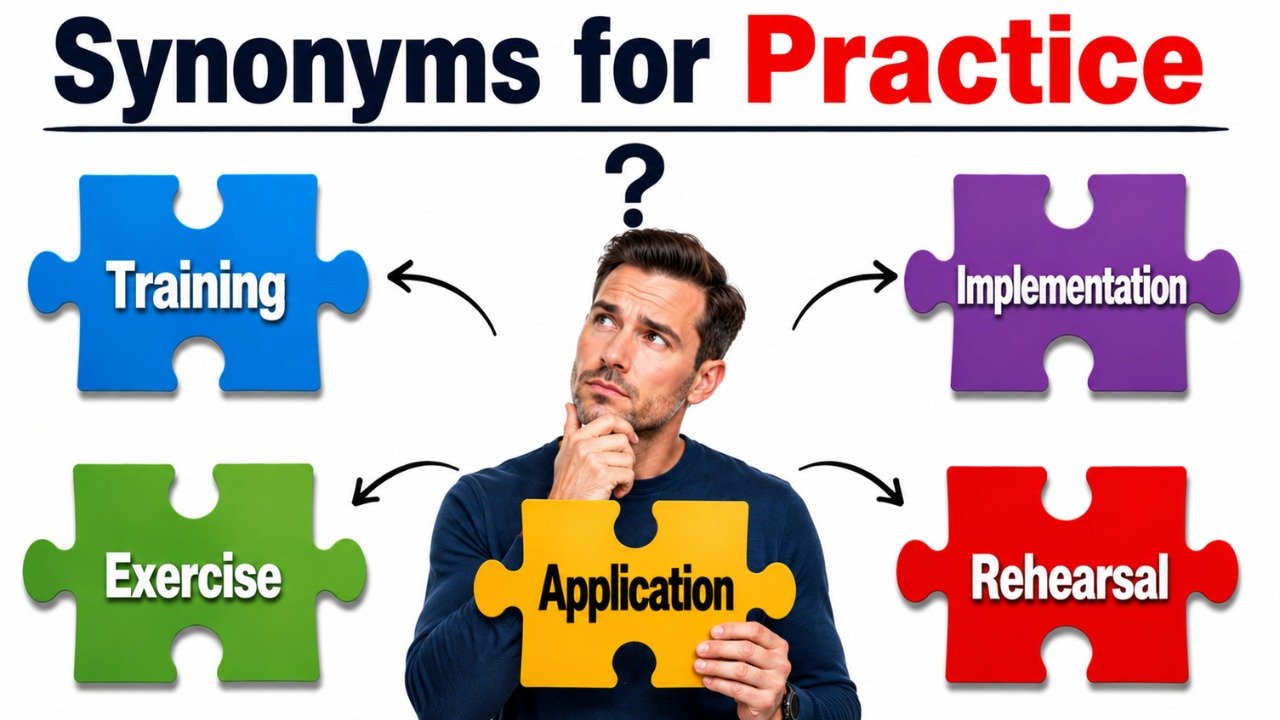
Quick Answer: The best synonyms for practice include training, rehearsal, exercise, drill, repetition, application, implementation, custom, habit, and profession. Use training for developing abilities, rehearsal for preparing a performance, exercise for improving a specific skill, and drill for repeated instruction. Application and implementation describe putting knowledge or plans into action. Custom, habit, and routine refer to repeated behavior, while profession describes practice as specialized work.
Pronunciation and Word Details
Word: Practice.
Pronunciation: /ˈpræk.tɪs/
Part of Speech: Noun and verb.
Meaning: Practice means repeated activity that improves a skill, the practical use of knowledge, an established way of doing something, or professional work.
US Pronunciation:
UK Pronunciation:
What Does “Practice” Mean?
Practice means repeatedly performing an activity to improve skill, knowledge, confidence, or performance.
As a noun, practice can describe a training activity, an established custom, a professional business, or the practical application of an idea. A musician may attend a practice, a workplace may follow a safety practice, and a doctor may operate a private practice.
As a verb, practice means to perform an activity regularly in order to improve. Someone may practice speaking, writing, playing an instrument, or delivering a presentation.
The meaning depends on the sentence. In educational contexts, practice usually means training or exercise. In professional contexts, it may mean a method, procedure, or occupation. In discussions about ideas, it can mean application or implementation.
Meaning, Tone, and Context of “Practice”
Practice is a neutral and widely used word. It appears naturally in formal writing, everyday conversation, education, sports, professional communication, and technical instructions.
Educational Tone: Practice refers to exercises that help learners develop knowledge or ability.
Professional Tone: Practice may describe an accepted method, workplace procedure, or specialized profession.
Conversational Tone: People use practice casually when discussing repeated attempts to improve at something.
Formal Tone: In reports and policies, practice often means an established procedure, method, or standard.
Practical Context: Practice can describe the real use of an idea instead of its theoretical explanation.
Behavioral Context: The word may refer to a custom, habit, tradition, or regular routine.
Although practice is generally neutral, its synonym can change the tone. Drill sounds strict and repetitive, rehearsal suggests preparation, implementation sounds formal, and habit focuses on repeated personal behavior.
When and How to Use “Practice”
For Skill Development: Use practice when someone repeats an activity to become better at it.
Example: Regular practice improved her public speaking skills.
For Performance Preparation: Use practice when preparing for a speech, concert, play, match, or presentation.
Example: The performers scheduled an additional practice before the event.
For Practical Application: Use practice when an idea, rule, or theory is being used in a real situation.
Example: The new teaching method worked well in practice.
For Established Customs: Use practice for an accepted or repeated way of behaving.
Example: Greeting every visitor politely is a common practice in the office.
For Professional Work: Use practice to describe work performed by a doctor, lawyer, consultant, or another specialist.
Example: She opened her own legal practice after gaining several years of experience.
For Repeated Behavior: Use practice when an action becomes a routine or habit.
Example: Daily reading became a regular practice in their home.
Best Synonyms for Practice
Training: Repeated instruction or activity that develops knowledge, strength, or skill.
Example: The employees completed safety training before starting work.
Rehearsal: A preparation session before a performance, speech, or planned event.
Example: The final rehearsal helped the actors feel more confident.
Exercise: An activity designed to develop a particular ability.
Example: This vocabulary exercise will improve your word choice.
Drill: Repeated and structured practice intended to make a response automatic.
Example: The class completed a pronunciation drill.
Repetition: The act of doing or saying something again to improve memory or performance.
Example: Repetition helped him remember the difficult sequence.
Application: The practical use of knowledge, ideas, methods, or rules.
Example: The course focuses on the application of grammar rules.
Implementation: The process of putting a plan, system, or decision into action.
Example: Successful implementation required clear instructions.
Custom: A traditional or commonly accepted way of behaving.
Example: Removing shoes before entering was a local custom.
Habit: A repeated personal behavior that often happens automatically.
Example: Reviewing her notes every evening became a useful habit.
Profession: A specialized type of work requiring knowledge, education, or skill.
Example: Teaching is a profession that requires patience and preparation.
50 Synonyms for Practice With Short Meanings
- Training: Instruction and repeated activity used to build skill.
- Rehearsal: Preparation before a performance or important event.
- Exercise: An activity performed to develop a particular ability.
- Drill: Strict and repeated training for fast, accurate performance.
- Preparation: Work completed before an activity or event.
- Repetition: Doing something again to improve memory or ability.
- Study: Focused learning intended to develop knowledge.
- Coaching: Personal guidance that improves skill or performance.
- Instruction: Teaching that explains how to perform an activity.
- Discipline: Regular and controlled effort used to develop ability.
- Application: The practical use of knowledge, rules, or ideas.
- Implementation: The act of putting a plan or method into operation.
- Execution: The act of carrying out a plan, method, or task.
- Use: The act of applying something for a purpose.
- Employment: The use of a method, tool, or technique.
- Performance: The act of carrying out an activity or skill.
- Method: A particular way of completing a task.
- Procedure: An established series of steps for doing something.
- Technique: A skilled or specialized way of performing an activity.
- Approach: A chosen way of dealing with a task or situation.
- System: An organized method of performing repeated activities.
- Process: A series of actions that produces a result.
- Routine: A regular and repeated pattern of activity.
- Habit: A behavior repeated regularly or automatically.
- Custom: A commonly accepted or traditional way of behaving.
- Convention: A generally accepted social or professional practice.
- Tradition: A practice passed from one generation to another.
- Usage: An accepted way of using a word, method, or object.
- Observance: The practice of following a custom, rule, or ceremony.
- Ritual: A repeated action performed in a fixed manner.
- Conduct: A person’s usual way of behaving or acting.
- Behavior: The way a person regularly acts.
- Activity: Something done for learning, work, or improvement.
- Action: The process of doing something rather than discussing it.
- Work: Effort or activity performed for a purpose.
- Profession: Specialized work requiring knowledge or training.
- Occupation: A person’s regular type of employment.
- Career: Long term professional work in a chosen field.
- Business: Professional services offered as an occupation.
- Craft: A skilled activity developed through repeated effort.
- Art: A field or ability requiring creativity and skill.
- Pursuit: An activity followed regularly or seriously.
- Experience: Practical knowledge gained by performing an activity.
- Apprenticeship: A period of practical learning under an expert.
- Internship: Temporary professional experience used for learning.
- Session: A planned period devoted to training or preparation.
- Workout: A structured period of physical practice or exercise.
- Simulation: A controlled imitation used for training or testing.
- Dry Run: A trial completed before the real activity or event.
- Run Through: A complete rehearsal or review of planned actions.
Read Also:
Synonyms for Supported
Synonyms for Practice by Context
When Practice Means Skill Development
Training, exercise, drill, repetition, study, coaching, instruction, and discipline describe activities used to improve knowledge or ability.
Training is broad and may include lessons, guidance, and practical activities. Exercise usually refers to one specific learning task. Drill emphasizes strict repetition, while coaching involves guidance from another person.
Example: Daily pronunciation practice improved his spoken English.
With a Synonym: Daily pronunciation training improved his spoken English.
When Practice Means Rehearsal
Rehearsal, preparation, run through, dry run, simulation, and session describe preparation before a performance or important activity.
Rehearsal is best for plays, speeches, concerts, and presentations. A dry run is an informal trial before the real event. Simulation is more technical and recreates realistic conditions for training.
Example: The team held a practice before the final presentation.
With a Synonym: The team held a rehearsal before the final presentation.
When Practice Means Practical Application
Application, implementation, execution, use, employment, action, and performance describe putting knowledge, plans, or methods into action.
Application works well when knowledge or rules are used practically. Implementation is more formal and commonly refers to plans, policies, systems, and strategies. Execution emphasizes how effectively something is carried out.
Example: The theory seemed simple, but it was difficult in practice.
With a Synonym: The theory seemed simple, but it was difficult in application.
When Practice Means a Custom
Custom, convention, tradition, usage, observance, ritual, habit, and routine describe repeated or accepted behavior.
Custom and tradition often relate to communities or cultures. Convention describes accepted social or professional behavior. Habit usually refers to an individual, while routine describes an organized sequence of repeated actions.
Example: Sending a written confirmation is standard practice.
With a Synonym: Sending a written confirmation is standard procedure.
When Practice Means Professional Work
Profession, occupation, career, business, craft, art, pursuit, and work describe a field of skilled activity.
Profession is the strongest general alternative. Business may refer to the commercial side of professional work. Craft and art emphasize skill, experience, judgment, and technique.
Example: She plans to establish her own consulting practice.
With a Synonym: She plans to establish her own consulting business.
Another Word for Practice
Training is often the best general replacement for practice when the sentence discusses learning or improving a skill. However, the best alternative depends on whether practice means rehearsal, application, custom, method, or professional work.
Original: Consistent practice helped her improve her writing.
Better Option: Consistent training helped her improve her writing.
Original: We completed one final practice before the presentation.
Better Option: We completed one final rehearsal before the presentation.
Original: The company introduced a safer practice.
Better Option: The company introduced a safer procedure.
Original: The idea sounds effective, but it must work in practice.
Better Option: The idea sounds effective, but it must work in application.
When Not to Use “Practice”
Avoid practice when a more precise word would make the meaning clearer. Practice can refer to training, customs, procedures, professional work, or practical application, so vague sentences may confuse readers.
Use rehearsal when preparing for a performance. Use habit for repeated personal behavior. Use procedure for an official series of steps. Use implementation when describing a plan being put into action.
In British English, practice is normally the noun, while practise is the verb. This spelling distinction does not apply in American English, where practice is used as both a noun and a verb.
Weak: The team completed some practice for the event.
Better: The team completed a full rehearsal for the event.
Weak: Checking every document is our practice.
Better: Checking every document is our standard procedure.
Weak: The practice of the new policy began immediately.
Better: The implementation of the new policy began immediately.
Weak: Drinking water after waking is her practice.
Better: Drinking water after waking is her daily habit.
Words Commonly Confused With Practice
Practice vs Practise: Practice is used as both a noun and a verb in American English. In British English, practice is the noun and practise is the verb.
Practice vs Training: Practice focuses on repeated activity, while training may include instruction, guidance, exercises, and evaluation.
Practice vs Exercise: Practice is the broader process of improvement. An exercise is one particular activity within that process.
Practice vs Rehearsal: Practice can develop any skill, while rehearsal specifically prepares someone for a performance or planned event.
Practice vs Habit: Practice is usually intentional and connected with improvement. A habit is a repeated behavior that may happen automatically.
Practice vs Application: Practice may mean repeated training or real world action. Application specifically means using knowledge, ideas, or rules.
Practice vs Procedure: Practice can be informal or flexible. A procedure is usually an established and ordered set of steps.
Which Synonym Should You Choose?
Choose training when discussing broad skill development, workplace learning, sports, or professional preparation.
Choose exercise when referring to one specific task designed to improve an ability.
Choose drill when repetition must create a fast, accurate, or automatic response.
Choose rehearsal when preparing for a speech, performance, ceremony, presentation, or planned event.
Choose application when knowledge, rules, or ideas are being used in a real situation.
Choose implementation when a plan, policy, strategy, or system is being introduced formally.
Choose procedure when describing official steps or an established workplace method.
Choose habit when discussing repeated personal behavior.
Choose custom or tradition when describing accepted cultural or community behavior.
Choose profession or business when practice refers to specialized work.
Real Life Examples of “Practice” in Sentences
Original: Daily practice helped her speak more confidently.
Better Option: Daily training helped her speak more confidently.
Original: The band has practice after school.
Better Option: The band has rehearsal after school.
Original: Complete this practice before starting the next lesson.
Better Option: Complete this exercise before starting the next lesson.
Original: The workers followed the correct safety practice.
Better Option: The workers followed the correct safety procedure.
Original: The manager put the new plan into practice.
Better Option: The manager implemented the new plan.
Original: Writing thank you notes is a thoughtful practice.
Better Option: Writing thank you notes is a thoughtful custom.
Original: She developed a practice of reviewing her schedule each morning.
Better Option: She developed a habit of reviewing her schedule each morning.
Original: The students had a fire practice in the afternoon.
Better Option: The students had a fire drill in the afternoon.
Original: His medical practice serves several nearby communities.
Better Option: His medical profession allows him to serve several nearby communities.
Original: The method appears effective in practice.
Better Option: The method appears effective in application.
Synonym Groups and Usage Differences
Skill Development Group
Training, exercise, drill, repetition, coaching, instruction, study, and discipline relate to improving knowledge or ability.
Training is broad, coaching is personal, drill is repetitive, and exercise refers to a particular learning activity.
Example: Regular training increased the athlete’s speed and control.
Preparation Group
Rehearsal, preparation, simulation, dry run, run through, and session refer to activities completed before the real event.
Rehearsal suits performances and presentations. Simulation suits technical or realistic training situations. A dry run is a trial completed to identify possible problems.
Example: The speakers completed a final run through before the ceremony.
Practical Use Group
Application, implementation, execution, use, employment, action, and performance describe ideas or plans being carried out.
Application focuses on using knowledge. Implementation focuses on introducing a plan. Execution focuses on completing it effectively.
Example: The successful implementation of the system improved efficiency.
Custom and Routine Group
Custom, habit, convention, tradition, routine, ritual, usage, and observance describe repeated behavior.
Habit is personal, routine is organized, convention is socially accepted, and tradition is passed through time.
Example: Sharing a meal together became a valued family tradition.
Professional Work Group
Profession, occupation, career, business, work, craft, and pursuit relate to skilled or specialized activity.
Profession and occupation identify a type of work. Career describes long term development. Craft emphasizes skill developed through experience.
Example: Writing became both her profession and her creative craft.
Method Group
Method, procedure, technique, approach, system, and process describe ways of completing an activity.
A method is a general way of doing something. A procedure contains ordered steps. A technique involves skill, while a system organizes several connected activities.
Example: The instructor demonstrated a more effective technique.
Antonyms of Practice
The opposite of practice depends on whether the word means action, repeated training, regular use, or an accepted custom.
Theory: An explanation or idea that has not yet been practically applied.
Inaction: The absence of action or practical effort.
Inactivity: A state in which no activity or training occurs.
Neglect: Failure to give an activity the attention it requires.
Avoidance: The act of staying away from an activity or responsibility.
Abandonment: The act of completely stopping an activity or method.
Inexperience: A lack of practical knowledge or repeated exposure.
Improvisation: Acting without previous rehearsal or preparation.
Exception: Something that does not follow the usual practice or rule.
Disuse: A condition in which something is no longer regularly used.
Comparison of Practice and Related Words
Practice vs Training
Practice involves repeating an activity to improve. Training is broader and may include instruction, planning, feedback, and evaluation.
Example With Practice: She needs more practice before the competition.
Example With Training: She received professional training before the competition.
Practice vs Rehearsal
Practice can improve any ability. Rehearsal prepares someone for a particular performance or planned event.
Example With Practice: He practices the piano every evening.
Example With Rehearsal: He attended a rehearsal for the evening concert.
Practice vs Exercise
Practice is an ongoing process. An exercise is one task completed as part of that process.
Example With Practice: Regular practice improved her grammar.
Example With Exercise: She completed an exercise on verb forms.
Practice vs Habit
Practice is usually deliberate and connected with improvement. A habit is a repeated action that may occur without conscious thought.
Example With Practice: She practices writing for thirty minutes each day.
Example With Habit: She has a habit of writing before breakfast.
Practice vs Application
Practice can mean training or practical activity. Application specifically refers to using knowledge, rules, or methods.
Example With Practice: The concept is harder in practice than in theory.
Example With Application: The application of the concept requires careful planning.
Practice vs Procedure
Practice can describe a usual way of working, but it may not have fixed steps. A procedure is an official or organized sequence of actions.
Example With Practice: It is common practice to review the document twice.
Example With Procedure: The review procedure contains five required steps.
Common Phrases and Expressions With “Practice”
Practice Makes Perfect: Repeated effort gradually improves ability.
In Practice: In an actual situation rather than in theory.
Put Into Practice: To begin using an idea, plan, or method.
Common Practice: A usual and widely accepted way of doing something.
Standard Practice: A recognized method followed in a particular situation.
Best Practice: A method generally considered effective and reliable.
Private Practice: Professional work managed independently by a specialist.
Practice Session: A planned period used to develop or improve a skill.
Practice Run: A trial completed before the actual activity.
Out of Practice: Less skilled because an activity has not been performed recently.
Common Mistakes to Avoid
One common mistake is using practice when a more specific synonym is needed. Rehearsal is clearer for performances, procedure is clearer for official steps, and habit is clearer for repeated personal behavior.
Writers also confuse practice with practise. In American English, practice is both the noun and verb. In British English, practice is the noun, while practise is the verb.
Avoid repeating practice several times in one paragraph. Replace it with training, exercise, rehearsal, application, routine, or procedure when the meaning remains accurate.
Do not assume that every synonym is interchangeable. Training does not usually mean custom, and habit does not normally describe professional work.
Use the plural practices when discussing several methods, customs, or professional activities.
Incorrect: These practice improve workplace safety.
Correct: These practices improve workplace safety.
Avoid vague statements that do not explain the type of practice being discussed.
Vague: The organization changed its practice.
Clear: The organization changed its hiring procedure.
Conclusion
Synonyms for practice become easier to choose when you identify the intended meaning first. Use training, exercise, drill, or repetition for skill development. Choose rehearsal, run through, or dry run for preparation before an event. Use application or implementation when an idea becomes action. Custom, routine, and convention suit repeated social or workplace behavior, while profession and business describe specialized work. Selecting the right alternative makes sentences clearer, more accurate, and better matched to formal writing, everyday conversation, education, and professional communication.
FAQs About Synonyms for Practice
What Is the Best Synonym for Practice?
Training is the best general synonym when practice means repeated activity used to improve a skill. The most accurate choice still depends on the sentence.
What Is a Formal Synonym for Practice?
Procedure, implementation, application, convention, and professional activity are useful formal alternatives. Choose the word that matches the intended meaning.
Is Rehearsal the Same as Practice?
Rehearsal is a type of practice completed before a performance, speech, presentation, or planned event. Practice has a broader meaning.
What Is Another Word for Regular Practice?
Routine, habit, discipline, repeated training, and regular exercise can replace regular practice in suitable contexts.
What Is a Synonym for Putting Something Into Practice?
Application and implementation are the strongest choices. Application focuses on using an idea, while implementation emphasizes introducing a plan or system.
What Is the Difference Between Practice and Practise?
In American English, practice is used as both a noun and a verb. In British English, practice is the noun and practise is the verb.
Can Exercise Replace Practice?
Exercise can replace practice when referring to a particular learning or training activity. It cannot replace practice when the word means a custom, profession, or practical application.
