
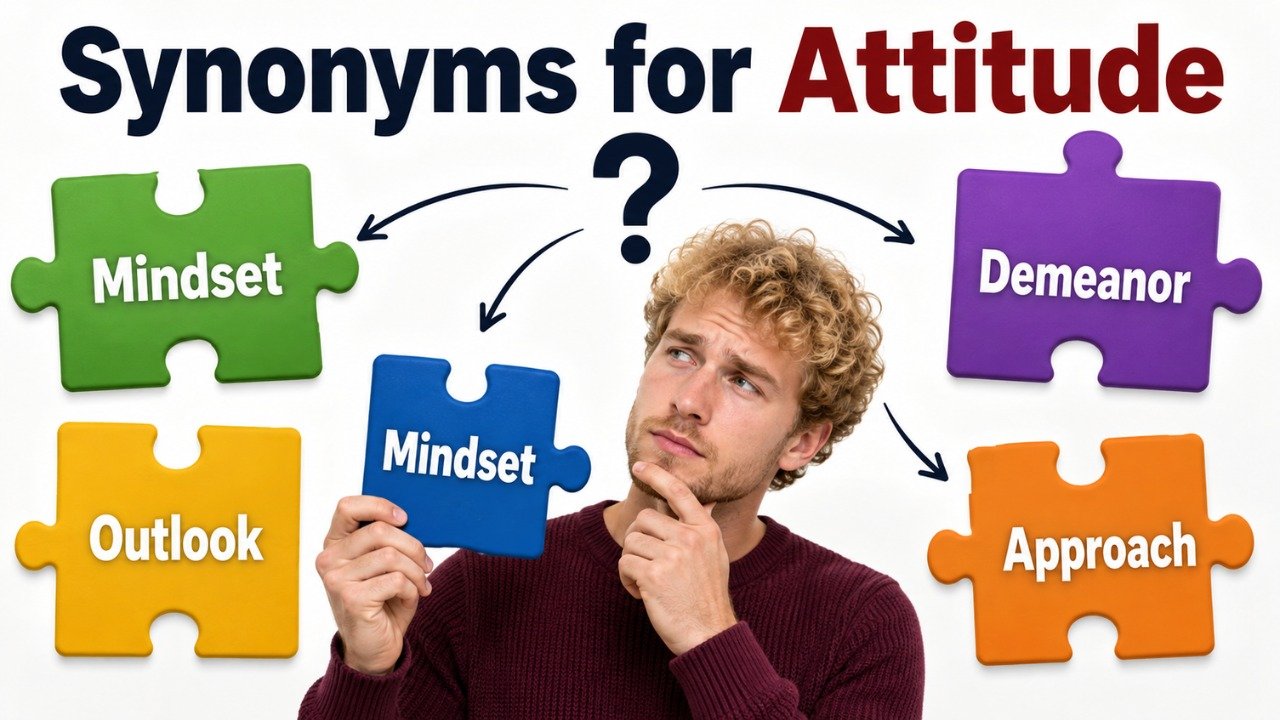
Quick Answer: The best synonyms for attitude include outlook, mindset, perspective, stance, disposition, demeanor, manner, approach, viewpoint, and posture. Use outlook for a general way of viewing life, mindset for a pattern of thinking, and perspective for how someone understands a situation. Stance is best for a declared opinion, while disposition describes a person’s usual emotional nature. Demeanor and manner refer to outward behavior, and posture can describe either physical position or a symbolic attitude.
Pronunciation and Word Details
Word: Attitude.
Pronunciation: /ˈæt.ɪ.tuːd/
Part of Speech: Noun.
Meaning: Attitude is a way of thinking, feeling, behaving, or positioning oneself toward a person, subject, or situation.
US Pronunciation:
UK Pronunciation:
What Does “Attitude” Mean?
Attitude means a person’s settled way of thinking or feeling about someone, something, or a particular situation.
Attitude is a noun. It can describe an opinion, emotional reaction, behavioral style, or physical position. A person may have a positive attitude toward learning, a cautious attitude toward change, or a rude attitude during a conversation.
The word can also describe how someone presents themselves through facial expressions, body language, tone, and behavior. In this sense, attitude is closely related to demeanor, manner, bearing, and conduct.
In formal discussions, attitude may refer to a position or stance on a social, professional, or academic issue. In technical contexts, it can describe the orientation or position of an object.
Meaning, Tone, and Context of “Attitude”
Attitude is a neutral word, but its emotional meaning depends on the adjective or context surrounding it.
Positive Context: A positive attitude suggests hope, confidence, cooperation, and willingness.
Negative Context: A bad attitude may suggest disrespect, resistance, arrogance, or unwillingness to cooperate.
Formal Context: Attitude can describe a person’s position, viewpoint, or response to an issue.
Conversational Context: In everyday speech, attitude often refers to someone’s unpleasant tone or disrespectful behavior.
Academic Context: Researchers may discuss public attitudes, cultural attitudes, social attitudes, or changing attitudes toward a subject.
Professional Context: Employers may use the word when discussing motivation, cooperation, communication, and workplace behavior.
Emotional Context: Attitude can reveal optimism, pessimism, confidence, fear, anger, or indifference.
Because attitude has several meanings, choosing a precise synonym helps readers understand whether you mean thoughts, opinions, emotions, behavior, or physical position.
When and How to Use “Attitude”
For General Thinking: Use attitude to describe how a person usually thinks about life, work, or challenges.
Example: Her positive attitude helped the team remain hopeful.
For Opinions: Use attitude when describing a person’s beliefs or feelings about an issue.
Example: Public attitudes toward remote learning have changed.
For Behavior: Use attitude when someone’s tone, facial expression, or actions communicate a particular feeling.
Example: His dismissive attitude made the discussion uncomfortable.
For Personal Nature: Use attitude to describe a person’s regular emotional tendency or disposition.
Example: She has a calm and patient attitude toward difficult customers.
For a Declared Position: Use attitude when explaining someone’s stance on a decision, rule, or proposal.
Example: The manager clarified her attitude toward workplace safety.
For Physical Position: Use attitude in specialized contexts to describe the orientation or position of a body or object.
Example: The pilot carefully adjusted the aircraft’s attitude.
Best Synonyms for Attitude
Outlook: A general way of viewing life, events, or future possibilities.
Example: His optimistic outlook helped him recover from disappointment.
Mindset: An established pattern of thoughts, beliefs, and expectations.
Example: A growth mindset encourages people to learn from mistakes.
Perspective: A particular way of understanding or interpreting something.
Example: Listening to others gave her a broader perspective.
Stance: A clear position or opinion about a subject.
Example: The committee maintained a firm stance on safety.
Disposition: A person’s usual emotional nature or tendency.
Example: Her cheerful disposition made visitors feel welcome.
Demeanor: A person’s outward behavior and appearance.
Example: His calm demeanor reassured the nervous students.
Manner: The way someone behaves, speaks, or deals with others.
Example: She answered the questions in a polite manner.
Approach: A way of thinking about or dealing with a situation.
Example: Their practical approach produced better results.
Viewpoint: A personal opinion or position from which something is considered.
Example: Each participant explained a different viewpoint.
Posture: A physical position or a symbolic position toward an issue.
Example: The organization adopted a cautious posture during negotiations.
50 Synonyms for Attitude With Short Meanings
- Outlook: A general way of viewing life or future events.
- Mindset: A settled pattern of thinking and belief.
- Perspective: A particular way of understanding a situation.
- Viewpoint: A personal opinion or point of view.
- Stance: A clear position taken on an issue.
- Position: A stated opinion or judgment about something.
- Opinion: A personal belief that may not be proven.
- View: A belief or judgment about a subject.
- Standpoint: A position from which something is considered.
- Point of View: A particular way of seeing or interpreting something.
- Disposition: A person’s usual emotional nature.
- Temperament: A person’s natural emotional character.
- Mentality: A characteristic way of thinking.
- Frame of Mind: A person’s emotional or mental condition.
- State of Mind: A person’s thoughts and feelings at a certain time.
- Orientation: A general direction of thought, interest, or position.
- Inclination: A natural preference or tendency.
- Tendency: A usual direction of thought, feeling, or behavior.
- Approach: A chosen way of dealing with something.
- Philosophy: A guiding set of beliefs or principles.
- Belief: An idea accepted as true.
- Conviction: A strongly held belief or opinion.
- Sentiment: A feeling or opinion about something.
- Feeling: An emotional response or personal opinion.
- Perception: The way something is noticed and understood.
- Interpretation: A particular explanation or understanding.
- Reaction: An emotional or behavioral response.
- Response: A reply or behavior caused by a situation.
- Disposition of Mind: A usual mental or emotional tendency.
- Demeanor: Outward behavior that reveals mood or character.
- Manner: The way a person behaves or speaks.
- Bearing: The way someone carries and presents themselves.
- Air: An appearance or manner that creates an impression.
- Tone: The emotional quality of speech or behavior.
- Behavior: The way a person acts.
- Conduct: The manner in which someone behaves.
- Comportment: A person’s outward behavior and self presentation.
- Presence: The impression created by someone’s appearance or behavior.
- Style: A characteristic way of acting or expressing oneself.
- Posture: A physical or symbolic position.
- Pose: A particular physical position or assumed manner.
- Positioning: The way someone places themselves physically or intellectually.
- Orientation of Mind: The direction of a person’s thoughts or interests.
- Policy: A chosen position or principle guiding decisions.
- Principle: A belief or rule that influences behavior.
- Outlook on Life: A general way of viewing experiences and possibilities.
- Worldview: A broad set of beliefs about life and society.
- Bias: A preference that influences judgment.
- Preconception: An opinion formed before having complete information.
- Predisposition: A tendency to think, feel, or act in a certain way.
Read Also:
Synonyms for Sincerely
Synonyms for Attitude by Context
When Attitude Means a Way of Thinking
Mindset, mentality, frame of mind, state of mind, outlook, worldview, philosophy, and orientation describe patterns of thought.
Mindset is useful when discussing beliefs that influence actions. Outlook describes a broad view of life or the future. Frame of mind usually refers to a temporary mental or emotional condition.
Example: Her attitude toward failure became more constructive.
With a Synonym: Her mindset toward failure became more constructive.
When Attitude Means an Opinion
Stance, position, viewpoint, standpoint, view, opinion, conviction, and perspective describe what someone thinks about an issue.
Stance is best for a clear or public position. Viewpoint is useful for personal opinions, while perspective includes the experiences that shape a person’s understanding.
Example: The director explained his attitude toward the proposal.
With a Synonym: The director explained his stance on the proposal.
When Attitude Means Emotional Nature
Disposition, temperament, inclination, sentiment, feeling, and predisposition describe emotional qualities or tendencies.
Disposition describes someone’s usual emotional nature. Temperament is often linked to natural personality, while sentiment describes a feeling or opinion about a particular subject.
Example: Her friendly attitude made everyone feel comfortable.
With a Synonym: Her friendly disposition made everyone feel comfortable.
When Attitude Means Outward Behavior
Demeanor, manner, bearing, conduct, behavior, tone, presence, air, and comportment describe how someone appears or acts.
Demeanor describes the overall impression created by behavior and appearance. Tone is more specific to speech or writing. Bearing often suggests confidence, posture, and self control.
Example: His serious attitude showed that he understood the problem.
With a Synonym: His serious demeanor showed that he understood the problem.
When Attitude Means Physical Position
Posture, pose, bearing, positioning, and orientation describe the physical arrangement or direction of a person or object.
Posture usually describes how the body is held. Pose is often a temporary position, while orientation describes direction or alignment.
Example: The dancer maintained a graceful attitude.
With a Synonym: The dancer maintained a graceful pose.
Another Word for Attitude
Mindset is often the best general replacement for attitude when discussing someone’s way of thinking. However, the most accurate alternative depends on whether attitude refers to an opinion, emotional nature, outward behavior, or physical position.
Original: A positive attitude can improve your response to challenges.
Better Option: A positive mindset can improve your response to challenges.
Original: The company expressed a cautious attitude toward expansion.
Better Option: The company expressed a cautious stance toward expansion.
Original: Her professional attitude impressed the interviewers.
Better Option: Her professional demeanor impressed the interviewers.
Original: His attitude toward life remained hopeful.
Better Option: His outlook on life remained hopeful.
When Not to Use “Attitude”
Avoid attitude when the sentence needs a more specific description. The word can refer to thinking, emotion, opinion, behavior, or physical position, so it may sound vague without enough context.
Use mindset when discussing established thought patterns. Use stance for a clear opinion. Use demeanor for outward behavior. Use disposition for emotional nature. Use posture for physical position.
Attitude can also sound judgmental in conversation, especially when someone says that another person has an attitude. A more specific description may sound fairer and clearer.
Weak: She had an attitude during the meeting.
Better: She responded in a dismissive manner during the meeting.
Weak: His attitude about the policy was clear.
Better: His stance on the policy was clear.
Weak: The applicant showed a good attitude.
Better: The applicant showed a cooperative and professional demeanor.
Weak: Her attitude changed after hearing the facts.
Better: Her perspective changed after hearing the facts.
Words Commonly Confused With Attitude
Attitude vs Mindset: Attitude can describe thoughts, feelings, opinions, or behavior. Mindset mainly refers to an established pattern of thinking.
Attitude vs Behavior: Attitude is an internal way of thinking or feeling, while behavior is the outward action that others can observe.
Attitude vs Outlook: Attitude can relate to a specific person or issue. Outlook usually describes a broader view of life or future events.
Attitude vs Perspective: Attitude includes emotional reactions and behavior. Perspective focuses on how someone understands or interprets something.
Attitude vs Stance: Attitude may be general or emotional. Stance is usually a clearly stated position on a particular issue.
Attitude vs Disposition: Attitude may change according to the situation. Disposition describes a person’s usual emotional nature.
Attitude vs Demeanor: Attitude may exist internally, while demeanor is the outward appearance of mood, character, or feeling.
Attitude vs Posture: Attitude can describe a mental or emotional position. Posture usually describes physical position or an official symbolic position.
Which Synonym Should You Choose?
Choose mindset when discussing learning, motivation, personal development, or patterns of thinking.
Choose outlook when describing someone’s broad view of life, the future, or possible outcomes.
Choose perspective when explaining how experience shapes a person’s understanding.
Choose viewpoint when presenting a personal opinion in an essay, report, or discussion.
Choose stance when referring to a strong, formal, or public position on an issue.
Choose disposition when describing someone’s usual emotional nature.
Choose demeanor when discussing outward behavior in a professional or social setting.
Choose manner when describing how someone speaks, responds, or treats other people.
Choose tone when the attitude is communicated through spoken or written language.
Choose posture when referring to body position or an official strategic position.
Real Life Examples of “Attitude” in Sentences
Original: Her positive attitude encouraged the whole team.
Better Option: Her positive mindset encouraged the whole team.
Original: His attitude toward the future remained hopeful.
Better Option: His outlook toward the future remained hopeful.
Original: The teacher understood the student’s attitude after hearing his story.
Better Option: The teacher understood the student’s perspective after hearing his story.
Original: The organization changed its attitude toward flexible working arrangements.
Better Option: The organization changed its stance on flexible working arrangements.
Original: Her friendly attitude made new employees feel welcome.
Better Option: Her friendly disposition made new employees feel welcome.
Original: He maintained a calm attitude throughout the interview.
Better Option: He maintained a calm demeanor throughout the interview.
Original: The customer’s rude attitude upset the assistant.
Better Option: The customer’s rude manner upset the assistant.
Original: His attitude in the message sounded impatient.
Better Option: His tone in the message sounded impatient.
Original: The manager appreciated her responsible attitude.
Better Option: The manager appreciated her responsible conduct.
Original: The speaker’s confident attitude held the audience’s attention.
Better Option: The speaker’s confident presence held the audience’s attention.
Synonym Groups and Usage Differences
Thinking Group
Mindset, mentality, frame of mind, state of mind, philosophy, and worldview describe mental patterns and guiding beliefs.
Mindset is often connected with achievement and learning. Mentality describes a characteristic way of thinking. Worldview is broader and includes beliefs about life, society, and human experience.
Example: A flexible mindset makes it easier to accept useful feedback.
Opinion Group
Stance, position, viewpoint, standpoint, view, opinion, and conviction describe beliefs about a subject.
Stance and position are useful in formal discussions. Viewpoint and standpoint emphasize the position from which a person considers something. Conviction describes a strongly held belief.
Example: The writer presented a balanced viewpoint on the issue.
Emotional Nature Group
Disposition, temperament, sentiment, feeling, inclination, and predisposition describe emotional qualities or tendencies.
Disposition and temperament often refer to personality. Sentiment and feeling usually relate to a particular subject or event.
Example: Her patient disposition helped her manage difficult situations.
Behavior Group
Demeanor, manner, conduct, behavior, bearing, air, presence, and comportment describe outward actions or appearance.
Demeanor creates an overall impression. Conduct refers to actions, while bearing suggests how confidently or calmly someone carries themselves.
Example: His respectful conduct earned the trust of his colleagues.
Interpretation Group
Perspective, perception, interpretation, outlook, and point of view describe how someone understands information or experience.
Perspective is shaped by knowledge and experience. Perception describes how something appears to a person, while interpretation explains the meaning they assign to it.
Example: Travel gave her a wider perspective on cultural differences.
Physical Position Group
Posture, pose, orientation, bearing, and positioning describe physical arrangement or direction.
Posture is the usual position of the body. Pose is often temporary, while orientation describes the direction in which something is placed.
Example: Correct posture can reduce discomfort while sitting.
Antonyms of Attitude
The opposite of attitude depends on whether the word refers to a positive outlook, a firm opinion, emotional involvement, or confident behavior.
Neutrality: The absence of a strong opinion or preference.
Indifference: A lack of interest, concern, or emotional involvement.
Uncertainty: A lack of confidence in a belief or position.
Open Mindedness: A willingness to consider different ideas instead of holding a fixed attitude.
Flexibility: A readiness to change a position or approach.
Objectivity: Judgment based on facts rather than personal feelings.
Humility: A lack of arrogance or exaggerated self importance.
Optimism: A hopeful outlook, opposite to a negative attitude.
Pessimism: An expectation of unfavorable outcomes, opposite to a positive attitude.
Respect: Considerate behavior, opposite to a rude or dismissive attitude.
Cooperation: A willingness to work with others, opposite to a resistant attitude.
Enthusiasm: Strong interest and energy, opposite to an indifferent attitude.
Comparison of Attitude and Related Words
Attitude vs Mindset
Attitude includes thoughts, emotions, opinions, and behavior toward a person or situation. Mindset mainly describes an established way of thinking.
Example With Attitude: Her attitude toward criticism became more positive.
Example With Mindset: Her growth mindset helped her learn from criticism.
Attitude vs Outlook
Attitude may relate to a specific issue or interaction. Outlook usually refers to a broader view of life or the future.
Example With Attitude: His attitude toward the new assignment was encouraging.
Example With Outlook: His outlook on the future was encouraging.
Attitude vs Perspective
Attitude contains an emotional or behavioral element. Perspective focuses on how someone understands a situation.
Example With Attitude: Her attitude toward the change was cautious.
Example With Perspective: Her experience gave her a cautious perspective on the change.
Attitude vs Stance
Attitude may be informal, emotional, or general. Stance is a clear position on a particular issue.
Example With Attitude: The manager’s attitude toward the proposal was uncertain.
Example With Stance: The manager stated her stance on the proposal.
Attitude vs Disposition
Attitude can change depending on the subject or situation. Disposition is a person’s usual emotional nature.
Example With Attitude: He showed a patient attitude during the delay.
Example With Disposition: He has a naturally patient disposition.
Attitude vs Demeanor
Attitude may be an internal thought or feeling. Demeanor is the outward behavior that others notice.
Example With Attitude: Her attitude toward the task was serious.
Example With Demeanor: Her serious demeanor showed that she was focused.
Attitude vs Behavior
Attitude is what a person thinks or feels. Behavior is what that person actually does.
Example With Attitude: His respectful attitude influenced the discussion.
Example With Behavior: His respectful behavior improved the discussion.
Common Phrases and Expressions With “Attitude”
Positive Attitude: A hopeful and constructive way of thinking.
Negative Attitude: A critical, resistant, or pessimistic way of thinking.
Bad Attitude: Disrespectful, uncooperative, or unpleasant behavior.
Right Attitude: A suitable and productive way of thinking.
Healthy Attitude: A balanced and constructive mental approach.
Professional Attitude: Respectful and responsible workplace behavior.
Change Your Attitude: An instruction to adopt a different way of thinking or behaving.
Attitude Toward Life: A person’s general outlook on experiences and possibilities.
Attitude Problem: A repeated pattern of rude, resistant, or uncooperative behavior.
Carefree Attitude: A relaxed manner with little worry or concern.
Common Mistakes to Avoid
A common mistake is using attitude without explaining whether it refers to thoughts, emotions, behavior, or opinion. Add a descriptive word or choose a more precise synonym.
Vague: She showed an attitude.
Clear: She showed a dismissive attitude toward the instructions.
Avoid using attitude as a complete explanation of someone’s behavior. Describe what the person said or did when the details matter.
Unclear: He had a bad attitude.
Clear: He interrupted others and refused to consider their suggestions.
Do not treat attitude and behavior as exact synonyms. Attitude is internal, while behavior is visible through actions.
Avoid replacing attitude with stance when discussing personality. Stance is mainly used for a position on a particular issue.
Do not use mindset when the sentence refers only to physical posture or outward manner.
Avoid repeating attitude several times in one paragraph. Use outlook, mindset, demeanor, stance, perspective, or manner where appropriate.
Be careful with judgmental language. Instead of labeling a person’s entire character, describe the specific tone, response, or conduct that caused concern.
Conclusion
Synonyms for attitude help express different shades of thought, emotion, opinion, and behavior. Choose mindset for patterns of thinking, outlook for a broad view of life, and perspective for a way of understanding events. Stance and position fit formal opinions, while disposition describes emotional nature. Demeanor, manner, tone, and conduct are better for outward behavior. Selecting the right alternative makes writing more precise and helps readers understand whether you are describing beliefs, feelings, actions, or physical position.
FAQs About Synonyms for Attitude
What Is the Best Synonym for Attitude?
Mindset is the best general synonym when attitude refers to a way of thinking. The ideal replacement depends on the sentence.
What Is a Formal Synonym for Attitude?
Stance, position, perspective, disposition, demeanor, and orientation are useful formal alternatives.
What Is Another Word for a Positive Attitude?
Optimistic outlook, positive mindset, hopeful perspective, and constructive approach are strong alternatives.
What Is Another Word for a Bad Attitude?
Negative mindset, rude manner, dismissive demeanor, resistant stance, and disrespectful behavior may fit depending on the context.
Is Attitude the Same as Behavior?
No. Attitude describes thoughts or feelings, while behavior describes visible actions.
What Is the Difference Between Attitude and Mindset?
Attitude may include thoughts, feelings, opinions, and behavior toward something. Mindset mainly describes a settled pattern of thinking.
Can Perspective Replace Attitude?
Perspective can replace attitude when the sentence refers to someone’s understanding or point of view. It is less suitable when attitude means outward behavior or emotional disposition.
