
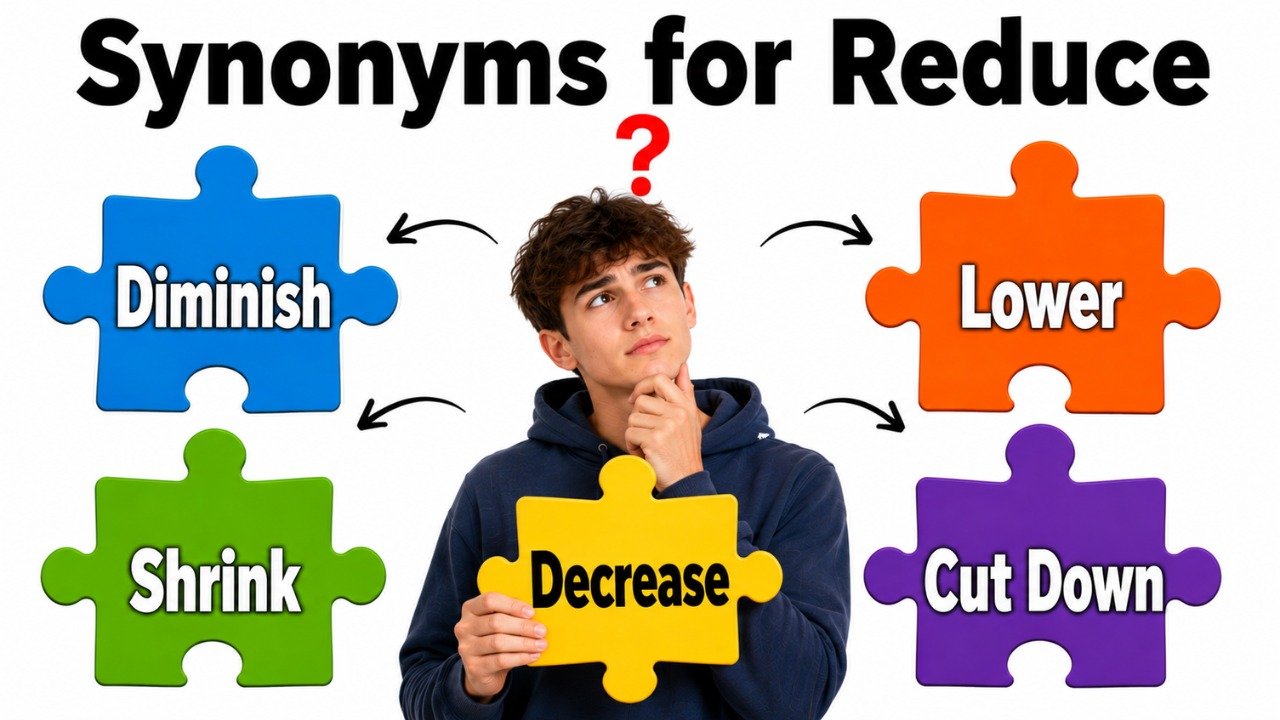
Quick Answer: The best synonyms for reduce include decrease, lessen, lower, diminish, minimize, cut, shrink, curtail, limit, and mitigate. Use decrease for a general reduction in amount, lower for prices or levels, and shrink for physical size. Choose cut for direct or informal wording, curtail for controlled restrictions, minimize for making something as small as possible, and mitigate when reducing harm, risk, pain, or negative effects.
Pronunciation and Word Details
Word: Reduce.
Pronunciation: /rɪˈduːs/
Part of Speech: Verb.
Meaning: Reduce means to make something smaller, lower, weaker, shorter, fewer, or less serious.
US Pronunciation:
UK Pronunciation:
What Does “Reduce” Mean?
Reduce means to make something smaller in size, lower in amount, less intense, shorter in length, or weaker in effect. It is a verb used in everyday conversation, formal writing, academic work, business communication, science, health discussions, and technical instructions.
The word can describe a decrease in quantity.
Example: The factory reduced its water usage.
It can describe a lower price, cost, or rate.
Example: The store reduced the price of the item.
Reduce can also refer to making pain, danger, stress, waste, or harm less serious.
Example: Regular exercise may reduce stress.
In writing and communication, reduce can mean making something shorter or simpler.
Example: The editor reduced the paragraph to three sentences.
In mathematics, reduce may mean simplifying a fraction or expression.
Example: Reduce the fraction to its simplest form.
The word is flexible, but the best synonym depends on what is becoming smaller. Costs may be cut, risks may be mitigated, pain may be eased, text may be condensed, and physical objects may be shrunk.
Meaning, Tone, and Context of “Reduce”
Reduce has a neutral and practical tone. It is common in both formal and informal language because it can describe many kinds of decrease.
In everyday conversation, reduce often refers to using, eating, spending, or doing less.
Example: I am trying to reduce my sugar intake.
In business writing, reduce commonly appears with costs, expenses, delays, waste, staff numbers, and production levels.
Example: The company introduced a plan to reduce operating costs.
In academic and scientific writing, reduce may describe a measurable decrease in risk, temperature, pressure, concentration, or environmental impact.
Example: The treatment reduced inflammation in the affected area.
In health and wellness contexts, reduce often appears with pain, stress, weight, symptoms, and harmful habits.
Example: Deep breathing can reduce feelings of anxiety.
In instructions, reduce may tell someone to lower heat, decrease speed, simplify an expression, or make something smaller.
Example: Reduce the heat after the water begins to boil.
Although reduce is clear and widely understood, it can sound repetitive when used several times in one paragraph. More specific alternatives such as lower, shrink, shorten, ease, limit, or condense often make writing more precise.
When and How to Use “Reduce”
For Lowering an Amount
Use reduce when the quantity, number, supply, or level of something becomes smaller.
Example: The new process reduced the amount of wasted material.
For Cutting Costs
Use reduce when expenses, prices, fees, or financial losses become lower.
Example: The business reduced its monthly expenses.
For Making Something Smaller
Use reduce when physical size, volume, weight, or space becomes smaller.
Example: Heating the sauce will reduce its volume.
For Limiting Risk
Use reduce when an action makes danger, uncertainty, or possible harm less likely.
Example: Safety training can reduce the risk of accidents.
For Easing Pain or Stress
Use reduce when symptoms, discomfort, pressure, or emotional strain become less intense.
Example: Rest helped reduce the pain in her shoulder.
For Shortening Content
Use reduce when text, speech, instructions, or a document is made shorter.
Example: The writer reduced the introduction to one paragraph.
For Lowering Speed or Intensity
Use reduce when movement, heat, sound, pressure, or force becomes less powerful.
Example: Reduce your speed before entering the narrow road.
For Decreasing Consumption
Use reduce when people use less energy, water, food, fuel, or another resource.
Example: The household reduced its electricity use during the summer.
Best Synonyms for Reduce
Decrease
Synonym: Decrease means to make something smaller in amount, number, strength, or degree.
Example: The new plan decreased processing time.
Lessen
Synonym: Lessen means to make something less severe, strong, important, or noticeable.
Example: The medicine lessened the discomfort.
Lower
Synonym: Lower means to bring a level, price, amount, or position down.
Example: The company lowered its service fees.
Diminish
Synonym: Diminish means to make something smaller, weaker, or less important.
Example: Repeated delays diminished public confidence.
Cut
Synonym: Cut means to reduce an amount, cost, number, or length directly.
Example: The team cut unnecessary expenses.
Minimize
Synonym: Minimize means to reduce something to the smallest practical amount or degree.
Example: Careful planning can minimize errors.
Shrink
Synonym: Shrink means to become smaller or cause something to become smaller.
Example: The material shrank after washing.
Curtail
Synonym: Curtail means to reduce or limit an activity, service, freedom, or amount.
Example: The organization curtailed spending during the difficult period.
Limit
Synonym: Limit means to control the amount, number, range, or extent of something.
Example: The rules limit the number of entries.
Mitigate
Synonym: Mitigate means to make harm, risk, pain, or a difficult effect less serious.
Example: Strong safety measures can mitigate workplace risks.
50 Synonyms for Reduce with Short Meanings
- Decrease: Make smaller in amount, number, or degree.
- Lessen: Make less serious, strong, or noticeable.
- Lower: Bring a level, amount, price, or position down.
- Diminish: Make smaller, weaker, or less important.
- Cut: Reduce an amount, cost, number, or length.
- Minimize: Make as small or limited as possible.
- Shrink: Make or become smaller in size.
- Curtail: Reduce or limit an activity or amount.
- Trim: Remove a small or unnecessary part.
- Limit: Control the amount, range, or extent.
- Restrict: Place controls on freedom, quantity, or activity.
- Curb: Control or reduce something harmful or excessive.
- Moderate: Make something less extreme or intense.
- Scale down: Reduce the size, level, or scope.
- Cut back: Use, spend, or produce less.
- Pare down: Remove unnecessary parts to make something smaller.
- Downsize: Reduce the size of a company, team, or operation.
- Shorten: Make something less long in distance, time, or length.
- Abbreviate: Make a word, phrase, or piece of writing shorter.
- Condense: Make information shorter while keeping its main meaning.
- Compress: Press or organize something into a smaller form.
- Simplify: Make something easier and less complicated.
- Streamline: Remove unnecessary steps to improve efficiency.
- Subtract: Take one amount away from another.
- Deduct: Remove an amount from a total.
- Discount: Reduce the original price or value.
- Slash: Reduce something quickly and significantly.
- Halve: Reduce something to half its original amount.
- Taper: Reduce something gradually over time.
- Ease: Make pain, pressure, or difficulty less severe.
- Relieve: Reduce pain, stress, worry, or pressure.
- Alleviate: Make suffering or difficulty less serious.
- Mitigate: Reduce harm, risk, or negative effects.
- Soften: Make something less strong, harsh, or severe.
- Weaken: Make something less powerful or effective.
- Dilute: Make a substance or effect weaker by adding something.
- Temper: Make an emotion, force, or reaction less extreme.
- Dampen: Reduce enthusiasm, sound, force, or intensity.
- Suppress: Hold down or prevent something from developing fully.
- Control: Keep an amount, activity, or problem within limits.
- Narrow: Make a range, choice, space, or difference smaller.
- Prune: Remove unnecessary parts to encourage better growth.
- Shave: Remove a small amount from a total, cost, or time.
- Economize: Use money or resources more carefully.
- Conserve: Reduce use to protect or preserve a resource.
- Devalue: Reduce the worth or importance of something.
- Depreciate: Cause or experience a decrease in financial value.
- Deflate: Reduce pressure, confidence, value, or size.
- Erode: Gradually reduce strength, value, confidence, or support.
- Attenuate: Reduce the strength, force, or intensity of something.
Read Also:
Synonyms for Differences
Synonyms for Reduce by Context
When Reduce Means Decrease an Amount
Decrease, lessen, lower, diminish, cut, and minimize are strong choices for amounts, numbers, levels, and quantities.
Decrease: The most direct formal alternative.
Example: The changes decreased waiting times.
Lower: Best for prices, rates, temperatures, and measurable levels.
Example: The new policy lowered borrowing costs.
Diminish: Useful when something gradually becomes smaller or weaker.
Example: Public interest diminished over time.
Minimize: Best when the goal is to make something as small as possible.
Example: The design minimizes energy loss.
When Reduce Means Cut Costs
Cut, trim, slash, economize, scale down, and cut back are useful for financial contexts.
Cut: A direct and common alternative.
Example: The company cut travel expenses.
Trim: Suggests a small or careful reduction.
Example: The department trimmed its annual budget.
Slash: Suggests a large and rapid reduction.
Example: The business slashed unnecessary spending.
Economize: Means using money or resources more carefully.
Example: The family economized by preparing meals at home.
When Reduce Means Make Something Smaller
Shrink, compress, condense, narrow, scale down, and pare down describe reductions in physical size or scope.
Shrink: Best for physical size.
Example: The fabric may shrink in hot water.
Compress: Best when something is pressed or stored in a smaller form.
Example: The software compresses large files.
Narrow: Best for ranges, spaces, choices, or differences.
Example: The committee narrowed the list to five candidates.
Scale down: Best for projects, operations, or plans.
Example: The organization scaled down the event.
When Reduce Means Shorten Writing or Speech
Shorten, abbreviate, condense, trim, simplify, and pare down work well for written or spoken content.
Shorten: A broad alternative for reducing length.
Example: Please shorten the final paragraph.
Abbreviate: Best for words, titles, and phrases.
Example: The name is commonly abbreviated in formal documents.
Condense: Means making text shorter while keeping the main points.
Example: She condensed the report into two pages.
Simplify: Means making content easier to understand.
Example: The editor simplified the technical explanation.
When Reduce Means Ease Pain or Difficulty
Ease, relieve, alleviate, soften, lessen, and mitigate describe lower pain, pressure, stress, or difficulty.
Ease: Natural in everyday and health related contexts.
Example: A warm compress may ease muscle pain.
Relieve: Best for pain, pressure, stress, or worry.
Example: The treatment relieved her symptoms.
Alleviate: A formal alternative for reducing suffering or difficulty.
Example: The project aims to alleviate food shortages.
Mitigate: Best for reducing harmful consequences.
Example: Early action may mitigate the damage.
When Reduce Means Control a Problem
Curb, restrict, limit, suppress, control, and moderate work well for unwanted behavior, growth, or activity.
Curb: Best for controlling something harmful or excessive.
Example: The campaign aims to curb unnecessary waste.
Restrict: Means placing clear limits on an action.
Example: The rules restrict access to private areas.
Suppress: Means preventing something from growing or appearing fully.
Example: The treatment suppresses unwanted symptoms.
Moderate: Means making something less extreme.
Example: The policy helped moderate price increases.
When Reduce Means Lower Intensity
Dampen, soften, weaken, temper, attenuate, and dilute describe lower force, strength, sound, emotion, or effect.
Dampen: Suitable for sound, enthusiasm, force, or emotional energy.
Example: The disappointing result dampened their enthusiasm.
Soften: Best for language, sound, light, or emotional impact.
Example: She softened the criticism before sending the message.
Temper: Means making a strong reaction more controlled.
Example: He tempered his excitement with caution.
Attenuate: A technical word for reducing strength or intensity.
Example: The material attenuates outside noise.
When Reduce Means Use Fewer Resources
Conserve, economize, cut back, limit, minimize, and streamline fit discussions about money, energy, water, and materials.
Conserve: Best when protecting a limited resource.
Example: Households were encouraged to conserve water.
Cut back: A conversational alternative for using less.
Example: We cut back on electricity use.
Streamline: Best when removing unnecessary steps or waste.
Example: The team streamlined the approval process.
Another Word for Reduce
Decrease is the best general replacement for reduce because it works with amounts, levels, numbers, rates, and intensity. However, lower is better for prices and measurable levels, lessen suits pain or seriousness, and shrink works for physical size.
Original: The company wants to reduce its operating costs.
Better Option: The company wants to decrease its operating costs.
Original: The treatment reduced the patient’s pain.
Better Option: The treatment lessened the patient’s pain.
Original: Please reduce the size of the image.
Better Option: Please shrink the size of the image.
Original: The editor reduced the article to one thousand words.
Better Option: The editor condensed the article to one thousand words.
When Not to Use “Reduce”
Reduce should not be used when a more precise word would explain the type, speed, or purpose of the decrease more clearly.
When You Mean a Physical Decrease in Size
Use shrink or compress when the change concerns physical size or file size.
Weak: The heat reduced the fabric.
Better: The heat shrank the fabric.
When You Mean a Lower Price
Use lower, discount, or cut when discussing a price.
Weak: The seller reduced the item.
Better: The seller lowered the price of the item.
When You Mean Less Pain
Use ease, relieve, or alleviate when discussing discomfort.
Weak: The medicine reduced her headache.
Better: The medicine relieved her headache.
When You Mean Shorter Writing
Use shorten, condense, or abbreviate when reducing text.
Weak: Please reduce the paragraph.
Better: Please condense the paragraph.
When You Mean a Gradual Reduction
Use taper, diminish, or lessen when something becomes smaller over time.
Weak: The noise reduced throughout the evening.
Better: The noise gradually diminished throughout the evening.
When the Word Is Too Vague
Explain exactly what is being reduced.
Vague: The new system reduces everything.
Better: The new system reduces processing time, energy use, and paperwork.
When Repetition Weakens the Paragraph
Repeated use of reduce can make writing sound mechanical.
Weak: The plan will reduce costs, reduce waste, and reduce delays.
Better: The plan will cut costs, minimize waste, and shorten delays.
Words Commonly Confused With Reduce
Reduce vs Decrease: Reduce is usually an action performed on something. Decrease can describe either causing a reduction or becoming smaller.
Reduce vs Lessen: Reduce is broad and measurable. Lessen often describes severity, pain, importance, or emotional intensity.
Reduce vs Lower: Reduce can apply to many kinds of change. Lower usually refers to levels, prices, rates, temperature, or position.
Reduce vs Minimize: Reduce means make smaller. Minimize means make as small as reasonably possible.
Reduce vs Diminish: Reduce often describes an intentional action. Diminish may describe a gradual or natural loss of size, strength, or importance.
Reduce vs Shrink: Reduce is broad. Shrink mainly refers to physical size, volume, or scope.
Reduce vs Curtail: Reduce means make less. Curtail means actively limit or shorten an activity, service, or freedom.
Reduce vs Mitigate: Reduce applies to many things. Mitigate specifically means making harm, danger, pain, or negative effects less serious.
Reduce vs Restrict: Reduce makes an amount smaller. Restrict places a limit on what is allowed.
Which Synonym Should You Choose?
Choose decrease when discussing a general reduction in amount, number, level, or rate.
Choose lessen when reducing pain, seriousness, importance, stress, or difficulty.
Choose lower for prices, temperatures, rates, volume, and measurable levels.
Choose diminish when something gradually becomes weaker, smaller, or less important.
Choose cut for direct, simple, and conversational writing.
Choose minimize when the goal is to make something as small as possible.
Choose shrink for physical size, volume, or scale.
Choose curtail when limiting an activity, service, freedom, or period of time.
Choose trim for small and careful reductions in cost, length, or content.
Choose curb when controlling harmful or excessive behavior.
Choose mitigate when reducing risk, damage, danger, or negative effects.
Choose alleviate when reducing suffering, hardship, or serious difficulty.
Choose relieve when reducing pain, pressure, stress, or worry.
Choose condense when shortening information without losing its main meaning.
Choose abbreviate when shortening a word, title, or phrase.
Choose streamline when removing unnecessary steps or waste.
Choose economize when using money or resources more carefully.
Choose conserve when protecting energy, water, fuel, or another limited resource.
Choose attenuate in technical writing about sound, signals, force, or intensity.
Real Life Examples of “Reduce” in Sentences
Original: The company reduced its monthly expenses.
Better Option: The company cut its monthly expenses.
Original: This treatment may reduce pain.
Better Option: This treatment may alleviate pain.
Original: The editor reduced the length of the article.
Better Option: The editor shortened the article.
Original: The new rules reduce the risk of errors.
Better Option: The new rules minimize the risk of errors.
Original: We need to reduce the size of the file.
Better Option: We need to compress the file.
Original: The program reduced unnecessary steps.
Better Option: The program streamlined the process.
Original: The organization reduced its workforce.
Better Option: The organization downsized its workforce.
Original: She reduced her daily sugar intake.
Better Option: She cut back on her daily sugar intake.
Original: Heavy curtains reduced the noise.
Better Option: Heavy curtains dampened the noise.
Original: The teacher reduced the number of assignments.
Better Option: The teacher limited the number of assignments.
Synonym Groups and Usage Differences
General Decrease Group
Decrease, lessen, lower, diminish, cut, and minimize belong to this group. They describe a broad reduction in amount, level, number, or strength.
Decrease is neutral and measurable. Lessen works well for severity, while lower suits prices and levels.
Example: The new system lowered energy consumption.
Size and Scope Group
Shrink, scale down, pare down, downsize, compress, and narrow describe smaller size, scope, or operation.
Shrink often concerns physical size. Downsize is common for organizations, while scale down fits projects and plans.
Example: The company scaled down the project after reviewing its budget.
Length and Content Group
Shorten, abbreviate, condense, trim, simplify, and streamline apply to text, speech, instructions, or processes.
Condense keeps the main information while reducing length. Streamline removes unnecessary complexity.
Example: The writer condensed the explanation into three clear sentences.
Cost and Spending Group
Cut, trim, slash, discount, economize, and shave are useful for financial reductions.
Trim suggests a careful reduction. Slash suggests a large reduction, while shave suggests removing a small amount.
Example: The manager shaved several thousand dollars from the annual budget.
Pain and Difficulty Group
Ease, relieve, alleviate, lessen, soften, and mitigate describe lower pain, pressure, hardship, or negative effects.
Relieve is natural for symptoms. Alleviate is more formal, while mitigate emphasizes limiting harm.
Example: The support program helped alleviate financial pressure.
Control Group
Curb, limit, restrict, suppress, control, and moderate describe keeping an activity or problem within acceptable limits.
Curb suits harmful behavior. Restrict places formal limits, while suppress prevents development or expression.
Example: The regulations aim to curb excessive waste.
Strength and Intensity Group
Weaken, dilute, temper, dampen, soften, and attenuate describe lower force, concentration, emotion, sound, or effect.
Dilute often applies to liquids, messages, or impact. Attenuate is more technical.
Example: Thick walls attenuate sound from nearby rooms.
Resource Group
Conserve, economize, streamline, minimize, and cut back relate to careful resource use.
Conserve protects a limited resource. Economize focuses on avoiding unnecessary expense.
Example: The new equipment conserves water and electricity.
Antonyms of Reduce
The opposite of reduce depends on whether the word refers to size, amount, cost, strength, or intensity.
Increase: Make something greater in amount, number, or degree.
Raise: Bring a price, level, amount, or position higher.
Expand: Make something larger in size, range, or scope.
Enlarge: Make something physically bigger.
Grow: Become or make something larger over time.
Multiply: Increase greatly in number or quantity.
Intensify: Make something stronger or more severe.
Strengthen: Make something more powerful or effective.
Extend: Make something longer in time, distance, or range.
Lengthen: Make something longer.
Amplify: Increase sound, force, meaning, or effect.
Boost: Increase performance, confidence, sales, or energy.
Enhance: Improve quality, value, or effectiveness.
Escalate: Increase rapidly in seriousness, amount, or intensity.
Accumulate: Gather or increase gradually over time.
Comparison: Reduce vs Related Words
Reduce vs Decrease
Reduce usually describes intentionally making something smaller. Decrease can also describe something becoming smaller naturally.
Example With Reduce: The company reduced its expenses.
Example With Decrease: Expenses decreased during the final quarter.
Reduce vs Lessen
Reduce is broad and often measurable. Lessen commonly describes severity, pain, stress, or importance.
Example With Reduce: The new machine reduced production time.
Example With Lessen: The medication lessened the pain.
Reduce vs Lower
Reduce applies to many kinds of decrease. Lower is especially natural with prices, rates, temperatures, and levels.
Example With Reduce: The policy reduced energy use.
Example With Lower: The company lowered its prices.
Reduce vs Minimize
Reduce means make smaller. Minimize means make something as small as practically possible.
Example With Reduce: The changes reduced the chance of delays.
Example With Minimize: The changes minimized the chance of delays.
Reduce vs Shrink
Reduce is broad and can describe abstract or physical change. Shrink normally relates to size, volume, or scope.
Example With Reduce: The team reduced the project budget.
Example With Shrink: The fabric shrank in hot water.
Reduce vs Curtail
Reduce means make less. Curtail suggests deliberately limiting an activity, service, or freedom.
Example With Reduce: The company reduced its travel expenses.
Example With Curtail: The company curtailed unnecessary business travel.
Reduce vs Mitigate
Reduce is general. Mitigate specifically refers to making harmful consequences less serious.
Example With Reduce: The barrier reduced the noise.
Example With Mitigate: The safety measures mitigated the risk of injury.
Reduce vs Restrict
Reduce changes the amount of something. Restrict controls what is permitted or available.
Example With Reduce: The school reduced the number of assignments.
Example With Restrict: The school restricted access to the laboratory.
Common Phrases and Expressions With “Reduce”
Reduce Costs: Make spending or expenses lower.
Reduce Risk: Make danger or uncertainty less likely.
Reduce Waste: Decrease unnecessary material or resource use.
Reduce Stress: Make emotional or physical pressure less severe.
Reduce Pain: Make discomfort less intense.
Reduce Spending: Use less money.
Reduce Consumption: Use or take in a smaller amount.
Reduce the Price: Make the cost of something lower.
Reduce in Size: Become or make something physically smaller.
Reduce the Impact: Make an effect or consequence less serious.
Reduce Emissions: Release fewer gases or pollutants.
Reduce Your Intake: Consume a smaller amount of food, drink, or another substance.
Common Mistakes to Avoid
Using Reduce Without an Object
Reduce is commonly transitive, which means it usually acts on something.
Incomplete: The new process will reduce.
Correct: The new process will reduce waste.
When something becomes smaller by itself, decrease may sound more natural.
Natural: Demand decreased during the winter.
Confusing Reduce With Decrease
Use reduce when someone or something causes the change. Use decrease when describing the change itself.
Action: The company reduced its prices.
Result: Prices decreased after the announcement.
Using Reduce for Every Type of Decrease
A specific synonym often makes the sentence clearer.
Vague: The medicine reduced the symptoms.
Clearer: The medicine relieved the symptoms.
Confusing Reduce With Restrict
Reduce means make smaller. Restrict means control or limit access and activity.
Incorrect: The rules reduced visitors from entering the room.
Correct: The rules restricted visitors from entering the room.
Using Minimize for a Small Reduction
Minimize means reduce as much as possible, not simply reduce slightly.
Inaccurate: The change minimized the cost by one percent.
Better: The change slightly reduced the cost.
Choosing an Overly Strong Synonym
Slash suggests a large and sudden reduction.
Exaggerated: The store slashed the price by one percent.
Natural: The store slightly lowered the price.
Repeating Reduce Too Often
Replace repeated uses with accurate alternatives.
Repetitive: The system reduces time, reduces costs, and reduces errors.
Improved: The system saves time, cuts costs, and minimizes errors.
Using Reduce When Shorten Is Clearer
Use shorten for time, distance, text, and length.
Less Precise: The new route reduced the journey.
More Precise: The new route shortened the journey.
Conclusion
Synonyms for reduce vary according to what becomes smaller or less serious. Decrease is the strongest general alternative, while lower suits prices and levels, shrink fits physical size, and condense works for writing. Choose cut for direct language, minimize for the smallest possible amount, alleviate for pain or hardship, and mitigate for risk or harm. Selecting a precise synonym makes your sentence clearer and shows exactly whether you are reducing cost, size, length, intensity, or difficulty.
FAQs About Synonyms for Reduce
What Is the Best Synonym for Reduce?
Decrease is the best general synonym for reduce. Lower, lessen, cut, shrink, and minimize may be more accurate in specific contexts.
What Is a Formal Synonym for Reduce?
Diminish, decrease, curtail, minimize, mitigate, alleviate, and attenuate are useful formal alternatives.
What Is Another Word for Reduce Costs?
Cut, lower, trim, slash, economize, scale down, and decrease are common alternatives for reducing costs.
What Is Another Word for Reduce Pain?
Ease, relieve, alleviate, lessen, soothe, and mitigate can describe making pain less severe.
What Is the Difference Between Reduce and Decrease?
Reduce usually describes causing something to become smaller. Decrease can describe either causing a reduction or becoming smaller naturally.
What Is a Stronger Word Than Reduce?
Slash, halve, minimize, eliminate, or drastically cut may sound stronger, depending on the size and type of reduction.
What Is the Opposite of Reduce?
Increase, raise, expand, enlarge, strengthen, intensify, and boost are common opposites of reduce.
