
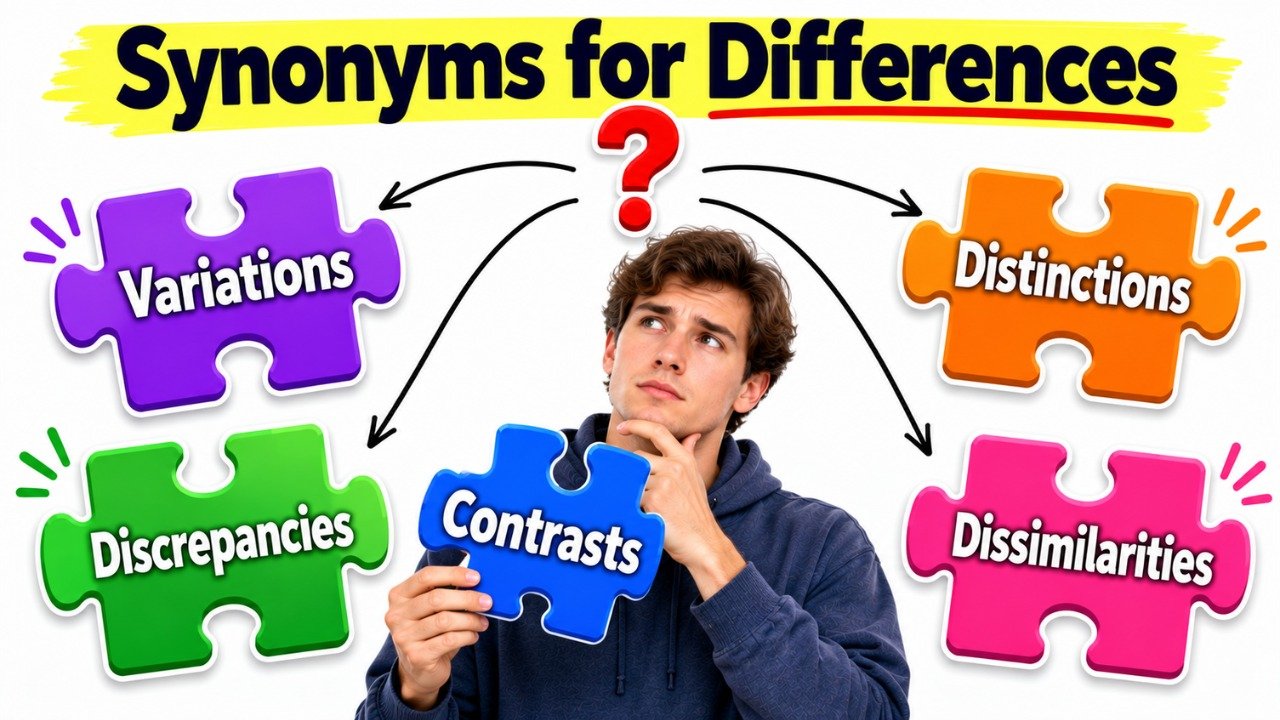
Quick Answer: The best synonyms for differences include distinctions, variations, contrasts, discrepancies, disparities, divergences, gaps, inequalities, disagreements, and changes. Use distinctions for clear qualities that separate two things, variations for small changes within the same group, and contrasts for strongly opposing features. Discrepancies work well for conflicting facts or records, while disparities describe unfair or noticeable gaps. Use disagreements when differences involve opinions, beliefs, decisions, or personal views.
Pronunciation and Word Details
Word: Differences.
Pronunciation: /ˈdɪfərənsɪz/
Part of Speech: Plural noun.
Meaning: Differences are qualities, amounts, opinions, or conditions that make people or things unlike one another.
US Pronunciation:
UK Pronunciation:
What Does “Differences” Mean?
Differences are the qualities, details, amounts, opinions, or conditions that make two or more people or things unlike each other.
Differences is the plural form of the noun difference. The word can describe visible distinctions, numerical gaps, changes in quality, conflicting opinions, cultural variety, or inconsistencies between facts.
In a comparison, differences identify the ways in which two subjects are not the same. For example, a reader may examine the differences between two writing styles, products, historical periods, or scientific theories.
The word can also refer to disagreements. When two people have differences, they may hold opposing opinions, values, expectations, or preferences.
In mathematics, research, and reports, differences can describe numerical gaps between values. In social discussions, the word may refer to cultural, personal, economic, or educational diversity.
The exact meaning becomes clear from the surrounding sentence.
Meaning, Tone, and Context of “Differences”
Differences is a neutral and flexible word used in everyday conversation, education, research, reports, essays, business writing, and formal analysis.
In general comparisons, the word has a neutral tone. It simply explains that two or more subjects are not identical.
In academic writing, differences often introduce an analysis of characteristics, results, methods, arguments, or patterns. Writers commonly discuss significant differences, key differences, measurable differences, or important differences.
In personal situations, differences may have an emotional meaning. The phrase personal differences can describe tension, disagreement, or incompatible expectations between people.
In discussions of society and culture, differences can have a positive and respectful tone. Cultural differences, individual differences, and differences in experience may contribute to diversity, creativity, and broader understanding.
In reports involving wealth, opportunity, education, or treatment, the word may describe inequality. In these cases, disparity or inequality may be more precise than difference.
The best synonym depends on whether the sentence refers to comparison, variety, disagreement, inconsistency, change, or an unequal gap.
When and How to Use “Differences”
For General Comparison: Use differences when identifying qualities that make two or more things unlike.
Example: The article explains the differences between formal and conversational language.
For Visible Features: Use differences when comparing appearance, shape, color, size, or design.
Example: The differences in color become clearer under natural light.
For Numerical Gaps: Use differences when comparing amounts, scores, measurements, prices, or percentages.
Example: The report shows differences in average income across the regions.
For Opinions: Use differences when people do not share the same ideas, beliefs, or preferences.
Example: The team discussed its differences before making a final decision.
For Cultural Variety: Use differences when explaining customs, traditions, values, or communication styles.
Example: Understanding cultural differences can prevent unnecessary confusion.
For Changes in Results: Use differences when comparing outcomes from separate tests, periods, or methods.
Example: Researchers observed clear differences between the two sets of results.
For Personal Characteristics: Use differences when describing variations in ability, personality, behavior, or experience.
Example: A good teacher recognizes individual differences among students.
Best Synonyms for Differences
Distinctions: Clear qualities or details that separate one thing from another.
Example: The guide explains the distinctions between fact and opinion.
Variations: Small or noticeable changes within a group, pattern, or type.
Example: Several variations of the traditional design were displayed.
Contrasts: Strong differences that become clear when subjects are compared.
Example: The photograph reveals a striking contrast between light and darkness.
Discrepancies: Differences between facts, statements, records, or expected results.
Example: The reviewer discovered discrepancies in the financial figures.
Disparities: Large or unfair differences in amount, quality, status, or opportunity.
Example: The study examined disparities in access to education.
Divergences: Points where ideas, paths, methods, or results move in different directions.
Example: The discussion revealed major divergences in their political views.
Gaps: Differences in knowledge, ability, age, performance, or amount.
Example: The training program aims to reduce gaps in employee skills.
Inequalities: Unfair differences in rights, resources, treatment, or opportunity.
Example: The reforms were designed to address social inequalities.
Disagreements: Differences in opinions, beliefs, plans, or decisions.
Example: The partners resolved their disagreements through calm discussion.
Changes: Ways in which something becomes different over time.
Example: The editor suggested several changes to improve the paragraph.
50 Synonyms for Differences with Short Meanings
- Distinctions: Qualities that clearly separate one thing from another.
- Dissimilarities: Features that show how subjects are unlike.
- Variations: Changes or different forms within the same group.
- Contrasts: Strong differences shown through comparison.
- Discrepancies: Conflicting details in facts, statements, or records.
- Disparities: Noticeable or unfair differences in amount or condition.
- Divergences: Movements or ideas that develop in separate directions.
- Deviations: Departures from an expected pattern or standard.
- Inequalities: Unfair differences in status, resources, or treatment.
- Inconsistencies: Details that do not agree or remain the same.
- Mismatches: Combinations or details that do not correspond properly.
- Gaps: Spaces or differences in amount, knowledge, or ability.
- Variances: Differences between expected and actual values or results.
- Differentials: Differences between amounts, rates, prices, or levels.
- Margins: Amounts by which one value exceeds another.
- Separations: Distances or divisions between people, ideas, or objects.
- Distances: Measurable or emotional spaces between two points.
- Unlikenesses: Qualities that make people or things dissimilar.
- Diversity: The presence of many different qualities, types, or backgrounds.
- Variety: A collection of different forms, choices, or examples.
- Individuality: The qualities that make a person or thing unique.
- Uniqueness: The state of being unlike anything else.
- Distinctiveness: A noticeable quality that separates something from others.
- Contradictions: Statements or ideas that oppose one another.
- Incompatibilities: Differences that prevent things from working together.
- Incongruities: Elements that seem unsuitable or inconsistent together.
- Imbalances: Unequal distributions of amount, power, or importance.
- Irregularities: Features that do not follow a normal pattern.
- Anomalies: Unusual details that differ from what is expected.
- Exceptions: Cases that do not follow a general rule.
- Departures: Movements away from an accepted form or standard.
- Alterations: Changes made to appearance, structure, or condition.
- Modifications: Adjustments made to improve or change something.
- Changes: Ways in which something becomes different.
- Shifts: Changes in direction, position, opinion, or emphasis.
- Fluctuations: Repeated rises and falls in amount or level.
- Adjustments: Small changes made for accuracy or improvement.
- Transformations: Major changes in form, character, or appearance.
- Disagreements: Situations in which people hold different opinions.
- Disputes: Serious disagreements involving opposing claims or views.
- Conflicts: Strong clashes between ideas, interests, or people.
- Divisions: Differences that separate people into opposing groups.
- Dissensions: Strong disagreements within a group.
- Oppositions: Positions, forces, or opinions that resist each other.
- Arguments: Exchanges involving conflicting reasons or opinions.
- Disaccord: A lack of agreement or harmony.
- Contentions: Disputed claims or points of disagreement.
- Points of Contrast: Particular details that show clear differences.
- Points of Distinction: Qualities that separate one subject from another.
- Areas of Disagreement: Subjects about which people hold opposing views.
Read Also:
Synonyms for Dirty
Synonyms for Differences by Context
When Differences Mean Distinctions
Distinctions, dissimilarities, contrasts, unlikenesses, and points of distinction work well when comparing characteristics.
Distinctions: Emphasizes clear details that separate related ideas or objects.
Example: The lesson explains the distinctions between active and passive voice.
Dissimilarities: Focuses on features that are not shared.
Example: The researchers identified several dissimilarities between the samples.
Contrasts: Highlights strong or easily noticeable differences.
Example: The story creates a sharp contrast between wealth and poverty.
When Differences Mean Variations
Variations, variety, diversity, individuality, and distinctiveness describe different forms, qualities, or characteristics within a larger group.
Variations: Best for small changes in form, pattern, color, or performance.
Example: The recipe appears in several regional variations.
Diversity: Best for the presence of different people, ideas, backgrounds, or forms.
Example: The group’s diversity encouraged a wider range of ideas.
Individuality: Best for qualities that make one person or object unique.
Example: Each writer should develop a style that reflects individuality.
When Differences Mean Numerical Gaps
Gaps, disparities, variances, differentials, and margins are useful when comparing amounts or measurements.
Gap: A general term for a difference between two amounts or levels.
Example: The program reduced the gap between expected and actual performance.
Variance: Commonly used for differences between planned and actual figures.
Example: The report explains the variance between the budget and final cost.
Differential: Often used for differences in prices, rates, wages, or measurements.
Example: The wage differential increased during the year.
Margin: The amount by which one result is higher or lower than another.
Example: The proposal was approved by a narrow margin.
When Differences Mean Disagreements
Disagreements, disputes, conflicts, dissensions, divisions, and arguments describe opposing opinions or interests.
Disagreement: A neutral term for different opinions.
Example: The committee had a disagreement about the final wording.
Dispute: Suggests a more serious or continuing disagreement.
Example: The neighbors settled their dispute peacefully.
Conflict: Describes a strong clash of interests, values, or goals.
Example: Conflicting priorities created tension within the team.
When Differences Mean Inconsistencies
Discrepancies, inconsistencies, mismatches, contradictions, and irregularities describe details that fail to agree.
Discrepancy: Best for conflicting figures, statements, or records.
Example: The accountant noticed a discrepancy in the monthly totals.
Inconsistency: Best when information or behavior changes without a clear reason.
Example: The editor found an inconsistency in the character’s description.
Mismatch: Best when two elements fail to fit or correspond.
Example: There was a mismatch between the job description and the actual duties.
When Differences Mean Changes
Changes, alterations, modifications, adjustments, shifts, and transformations describe movement from one condition to another.
Alteration: A deliberate change to form, appearance, or structure.
Example: The tailor made an alteration to the length of the dress.
Adjustment: A small change made to improve accuracy or suitability.
Example: A minor adjustment improved the balance of the design.
Transformation: A major and noticeable change.
Example: The building underwent a complete transformation.
Another Word for Differences
The best general replacement for differences is distinctions. It clearly describes qualities that separate two or more people, ideas, objects, or situations.
However, distinctions may not work in every context. Use disparities for unequal conditions, discrepancies for conflicting records, variations for different forms, and disagreements for opposing opinions.
Original: The article explains the differences between the two methods.
Better Option: The article explains the distinctions between the two methods.
Original: There are major differences in access to medical care.
Better Option: There are major disparities in access to medical care.
Original: The two reports contain several differences.
Better Option: The two reports contain several discrepancies.
Original: The members discussed their differences.
Better Option: The members discussed their disagreements.
When Not to Use “Differences”
Avoid differences when the word is too general to communicate the exact type of contrast.
In research, reports, and formal comparisons, use a more precise word when discussing numerical gaps, conflicting records, inequality, or disagreement.
Weak: The investigation found differences in the records.
Better: The investigation found discrepancies in the records.
Do not use differences when inequality is the real issue. A difference may be neutral, while a disparity often suggests an important or unfair gap.
Weak: The report discusses differences in access to education.
Better: The report discusses disparities in access to education.
Avoid the word when variation more accurately describes several forms within the same category.
Weak: The flower appears in several differences of color.
Better: The flower appears in several variations of color.
Do not use differences when referring specifically to an argument or conflict between people.
Weak: The partners had serious differences about money.
Better: The partners had a serious disagreement about money.
Avoid repeating differences throughout a comparison. Alternate with distinctions, contrasts, variations, gaps, or discrepancies when the meaning remains accurate.
Words Commonly Confused With Differences
Differences vs Distinctions: Differences is a broad word for anything that makes subjects unlike. Distinctions are specific qualities that clearly separate related subjects.
Differences vs Variations: Differences can occur between unrelated or opposing things. Variations are different forms or versions within the same general type.
Differences vs Discrepancies: Differences may be neutral and expected. Discrepancies usually involve information, figures, or statements that should agree but do not.
Differences vs Disparities: Differences can be small, large, fair, or neutral. Disparities usually describe significant or unfair gaps.
Differences vs Disagreements: Differences can involve appearance, amount, quality, or opinion. Disagreements refer specifically to conflicting views or decisions.
Differences vs Contrasts: Differences may be minor or subtle. Contrasts are usually strong and noticeable.
Differences vs Changes: Differences compare two or more subjects or conditions. Changes describe movement from an earlier condition to a later one.
Which Synonym Should You Choose?
Choose distinctions when explaining clear qualities that separate related ideas, objects, or categories.
Choose variations when describing different forms within the same group, design, pattern, or species.
Choose contrasts when two qualities are strongly opposed or visually noticeable.
Choose discrepancies when facts, records, statements, or figures do not agree.
Choose disparities when describing significant inequalities in income, opportunity, quality, treatment, or access.
Choose divergences when opinions, methods, paths, or results move in separate directions.
Choose gaps when comparing knowledge, skills, achievement, age, income, or performance.
Choose variances when discussing planned and actual figures in reports or calculations.
Choose disagreements when people hold different opinions but the conflict is not severe.
Choose disputes when a disagreement involves competing claims or continues for a long period.
Choose conflicts when opposing goals, values, interests, or actions create serious tension.
Choose diversity when differences contribute to variety among people, ideas, cultures, or experiences.
In essays, distinctions and contrasts are often effective. In reports, discrepancies, disparities, gaps, and variances provide greater precision. In everyday conversation, differences, changes, and disagreements usually sound more natural.
Real Life Examples of “Differences” in Sentences
Original: The teacher explained the differences between the two theories.
Better Option: The teacher explained the distinctions between the two theories.
Original: We noticed differences in the colors of the samples.
Better Option: We noticed variations in the colors of the samples.
Original: The report found differences between the recorded totals.
Better Option: The report found discrepancies between the recorded totals.
Original: There are large differences in income across the region.
Better Option: There are large disparities in income across the region.
Original: The two friends resolved their differences.
Better Option: The two friends resolved their disagreements.
Original: The results show differences from one month to another.
Better Option: The results show fluctuations from one month to another.
Original: The design highlights the differences between old and new styles.
Better Option: The design highlights the contrasts between old and new styles.
Original: The manager examined the differences between planned and actual spending.
Better Option: The manager examined the variances between planned and actual spending.
Original: Their differences created problems during the project.
Better Option: Their conflicting priorities created problems during the project.
Original: Small differences make each handmade item special.
Better Option: Small variations make each handmade item special.
Synonym Groups and Usage Differences
Comparison Group
Distinctions, dissimilarities, contrasts, and unlikenesses describe ways in which two or more subjects are not the same.
Distinctions identify precise separating features. Dissimilarities emphasize a lack of shared qualities, while contrasts highlight strong opposition.
Example: The comparison revealed clear distinctions between the two approaches.
Variation Group
Variations, diversity, variety, individuality, uniqueness, and distinctiveness describe different forms or qualities.
Variation often refers to small changes within a category. Diversity refers to the presence of many different forms, while uniqueness describes something that has no exact equivalent.
Example: The collection contains a wide variety of regional designs.
Measurement Group
Gaps, margins, disparities, variances, and differentials describe measurable differences.
Gap is broad and accessible. Variance is often used for planned and actual values, while disparity may indicate a serious or unfair inequality.
Example: The data revealed a significant gap in test performance.
Inconsistency Group
Discrepancies, inconsistencies, contradictions, mismatches, and incongruities describe details that do not fit or agree.
A discrepancy usually concerns records or facts. A contradiction involves directly opposing statements, while a mismatch concerns elements that do not correspond.
Example: Investigators discovered several discrepancies in the written accounts.
Disagreement Group
Disagreements, disputes, conflicts, dissensions, arguments, and divisions describe opposing views.
Disagreement is usually neutral. Dispute and conflict are stronger, while dissension often occurs within an organized group.
Example: Open communication helped the group resolve its disagreements.
Change Group
Alterations, modifications, adjustments, shifts, fluctuations, and transformations describe movement from one state to another.
An adjustment is usually small, while a transformation is major. A fluctuation involves repeated movement upward and downward.
Example: Minor adjustments made the final design easier to use.
Antonyms of Differences
The opposite of differences depends on the intended meaning. Similarities and likenesses oppose differences in characteristics. Agreement opposes differences in opinion, while equality opposes differences in status or opportunity.
Similarities: Qualities shared by two or more subjects.
Likenesses: Features that make people or things appear alike.
Sameness: The state of being identical or unchanged.
Uniformity: Consistency in form, appearance, or behavior.
Agreement: A shared opinion, decision, or understanding.
Harmony: Peaceful agreement between people or elements.
Consistency: The quality of remaining stable and compatible.
Equality: The state of having the same rights, value, or status.
Balance: An equal or properly proportioned condition.
Correspondence: A close match between two things.
Conformity: Similarity created by following the same rule or standard.
Identity: Exact sameness in essential qualities.
Comparison of Differences and Related Words
Differences vs Distinctions
Differences is a general term for ways in which subjects are unlike. Distinctions are precise qualities that separate one subject from another.
Example With Differences: The students discussed the differences between the two poems.
Example With Distinctions: The students identified important distinctions in tone and structure.
Differences vs Variations
Differences may describe unrelated or opposing qualities. Variations describe different forms within the same category.
Example With Differences: There are clear differences between poetry and prose.
Example With Variations: The poem appears in several regional variations.
Differences vs Contrasts
Differences can be subtle or strong. Contrasts are usually obvious and striking.
Example With Differences: The rooms have several differences in layout.
Example With Contrasts: The dark walls create a strong contrast with the white ceiling.
Differences vs Discrepancies
Differences may be expected or neutral. Discrepancies suggest that information which should match does not agree.
Example With Differences: There are differences in the students’ answers.
Example With Discrepancies: There are discrepancies between the receipts and the final total.
Differences vs Disparities
Differences can describe any degree of unlikeness. Disparities usually refer to large or unfair inequalities.
Example With Differences: The schools have differences in class size.
Example With Disparities: The report reveals serious disparities in educational resources.
Differences vs Disagreements
Differences can involve qualities, amounts, or opinions. Disagreements refer only to conflicting views, choices, or beliefs.
Example With Differences: Their personalities have several differences.
Example With Disagreements: They had disagreements about how the project should be managed.
Common Phrases and Expressions With Differences
Key Differences: The most important qualities that separate subjects.
Major Differences: Large or meaningful distinctions.
Minor Differences: Small distinctions that may not affect the main result.
Significant Differences: Differences important enough to deserve attention.
Noticeable Differences: Distinctions that can be observed easily.
Individual Differences: Variations in personality, ability, behavior, or experience.
Cultural Differences: Variations in customs, beliefs, values, and communication.
Differences Between: Distinctions involving two separate subjects.
Differences Among: Distinctions involving several people, groups, or things.
Settle Differences: Resolve disagreements or conflicts.
Put Aside Differences: Temporarily ignore disagreements to achieve a shared goal.
Irreconcilable Differences: Serious disagreements that cannot be resolved easily.
Common Mistakes to Avoid
One common mistake is using differences without explaining what is being compared. Make the sentence specific by naming the subjects or qualities.
Unclear: There are many differences.
Clear: There are many differences between the two teaching methods.
Use difference when referring to one distinction and differences when referring to several.
Incorrect: The main differences is the price.
Correct: The main difference is the price.
Correct: The main differences are price, size, and quality.
Use between when comparing two clearly identified subjects.
Correct: The article explains the differences between fiction and nonfiction.
Use among when discussing distinctions involving several members of a group.
Correct: The survey found differences among the five age groups.
Do not use differences and variations as automatic replacements. A variation is usually a different form within the same category.
Avoid using disparities for harmless or minor distinctions. Disparity often suggests a significant or unfair gap.
Do not describe conflicting records as ordinary differences when discrepancy is more precise.
Avoid repeating the phrase different differences or various differences. These combinations sound unnecessary.
Weak: The report discusses various different differences in performance.
Better: The report discusses several variations in performance.
Choose a synonym according to the intended meaning rather than replacing differences only to avoid repetition.
Conclusion
The most useful synonyms for differences include distinctions, variations, contrasts, discrepancies, disparities, divergences, gaps, and disagreements. Choose distinctions for clear separating qualities, variations for different forms, and contrasts for strong opposition. Discrepancies describe conflicting records, while disparities identify important or unfair gaps. Disagreements are best for opposing opinions. Understanding the context behind these synonyms for differences helps readers create clearer comparisons, more accurate reports, stronger essays, and more natural everyday sentences.
FAQs About Synonyms for Differences
What Is the Best Synonym for Differences?
Distinctions is the best general synonym. Variations, contrasts, discrepancies, and disagreements may be more accurate in specific contexts.
What Is Another Word for Major Differences?
Strong alternatives include significant distinctions, major contrasts, wide gaps, substantial disparities, and considerable variations.
What Is a Formal Synonym for Differences?
Distinctions, disparities, discrepancies, divergences, variances, and differentials are suitable for formal or academic writing.
Can Variations Replace Differences?
Variations can replace differences when discussing different forms within the same category. It is less suitable for disagreements or conflicting records.
What Is a Synonym for Differences in Opinion?
Disagreements, disputes, conflicts, divergences, divisions, and opposing views are useful alternatives.
What Is the Difference Between Discrepancies and Differences?
Differences may be natural or expected. Discrepancies occur when facts, figures, records, or statements that should agree do not match.
What Are the Opposites of Differences?
Common opposites include similarities, likenesses, sameness, uniformity, agreement, consistency, equality, and harmony.
