
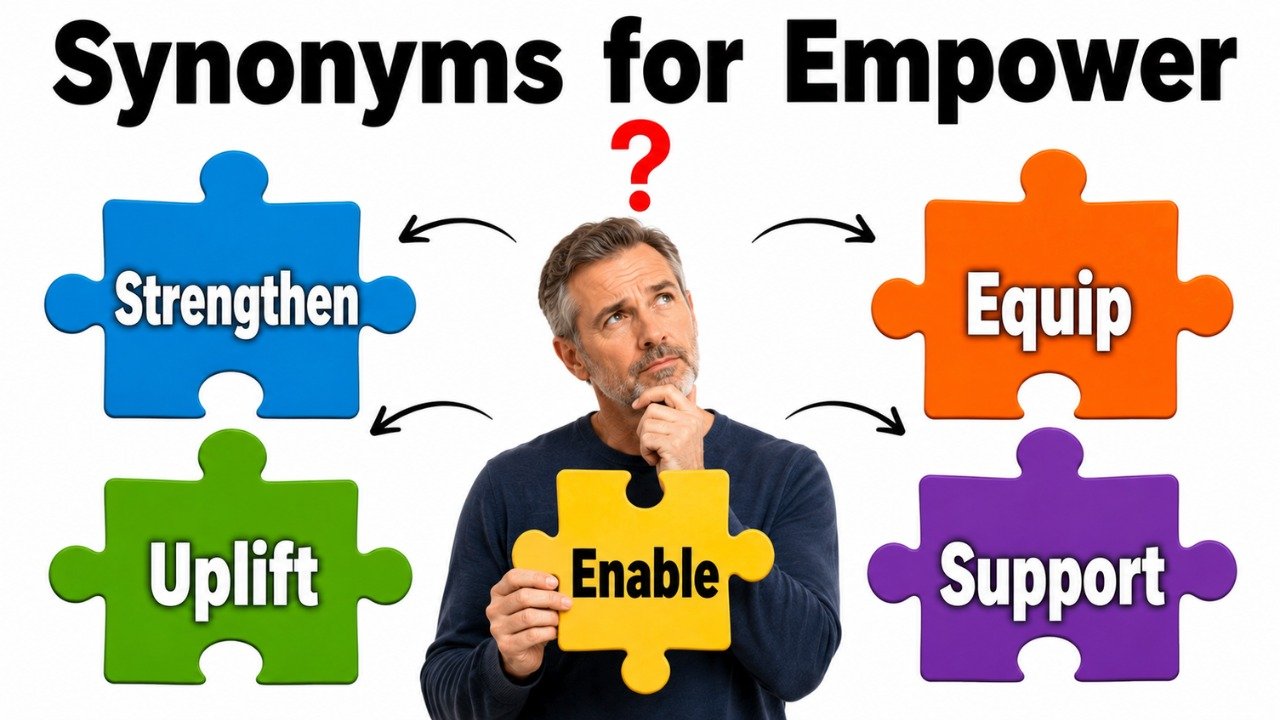
Quick Answer: The best synonyms for empower include enable, authorize, equip, strengthen, encourage, support, inspire, embolden, entrust, and liberate. Use authorize when granting official power, enable when making an action possible, and equip when providing skills or resources. Strengthen suits personal or organizational growth, while encourage and inspire fit emotional motivation. Choose entrust when giving responsibility and liberate when freeing someone from control or restriction.
Pronunciation and Word Details
Word: Empower.
Pronunciation: /ɪmˈpaʊər/
Part of Speech: Verb.
Meaning: Empower means to give someone the authority, confidence, resources, freedom, or ability to act independently.
US Pronunciation:
UK Pronunciation:
What Does “Empower” Mean?
Empower means to give a person or group the power, authority, skills, confidence, or resources needed to make decisions and take action. It is a verb commonly used in leadership, education, personal development, business, community work, and social discussions.
The word may describe official authority.
Example: The policy empowers managers to approve urgent requests.
It can also describe practical ability.
Example: Training empowers employees to solve problems independently.
In personal development, empower often means helping someone become more confident and self reliant.
Example: The mentor empowered her to speak with greater confidence.
The word can also describe providing access to knowledge, tools, money, opportunities, or support.
Example: Education empowers people to make informed choices.
Empower usually suggests that power or ability is given in a positive and constructive way. It does not simply mean controlling another person. Instead, it often means helping someone gain greater independence and influence over their own decisions.
Meaning, Tone, and Context of “Empower”
Empower usually carries a positive, encouraging, and purposeful tone. It is commonly used when discussing confidence, independence, authority, opportunity, education, leadership, and social progress.
In professional writing, empower often describes giving employees greater authority or responsibility.
Example: Effective leaders empower their teams to make decisions.
In education, it refers to providing learners with knowledge and practical skills.
Example: The course empowers students to communicate clearly.
In personal development, the word has an emotional and motivational tone.
Example: Her experience empowered her to pursue a new career.
In formal or legal contexts, empower may mean giving someone official permission.
Example: The agreement empowers the committee to investigate complaints.
The word is also common in discussions about communities, equality, financial independence, health awareness, and access to opportunities.
Although empower is positive, it can sound vague or exaggerated when a sentence does not explain what kind of power, support, or ability is being provided. In precise writing, identify whether the person receives authority, resources, knowledge, confidence, or freedom.
When and How to Use “Empower”
For Granting Authority
Use empower when a person receives formal power to make decisions or perform an action.
Example: The new rules empower department heads to approve expenses.
For Building Confidence
Use empower when support helps someone trust their abilities and speak or act independently.
Example: The workshop empowered participants to share their ideas confidently.
For Providing Skills
Use empower when education or training gives someone the ability to complete tasks effectively.
Example: Practical lessons empower learners to solve everyday problems.
For Supplying Resources
Use empower when someone receives tools, money, information, or access needed to succeed.
Example: The program empowers small businesses through funding and expert guidance.
For Encouraging Independence
Use empower when people gain greater control over their own choices and responsibilities.
Example: The plan empowers residents to manage local projects.
For Supporting Leadership
Use empower when leaders give team members responsibility, trust, and decision making freedom.
Example: Good managers empower employees instead of controlling every detail.
For Creating Opportunity
Use empower when an action removes barriers and opens a path toward growth.
Example: Affordable education can empower people to pursue better opportunities.
For Promoting Participation
Use empower when individuals are encouraged to contribute ideas, vote, speak, or take part in decisions.
Example: The committee empowered community members to influence the final proposal.
Best Synonyms for Empower
Enable
Synonym: Enable means to make someone capable of doing something or make an action possible.
Example: The new system enables employees to work more efficiently.
Authorize
Synonym: Authorize means to give official permission or legal power.
Example: The director authorized the team to begin the project.
Equip
Synonym: Equip means to provide the tools, skills, knowledge, or resources needed for a task.
Example: The training equips students with practical communication skills.
Strengthen
Synonym: Strengthen means to make someone or something more capable, confident, or effective.
Example: Regular practice strengthens a speaker’s confidence.
Encourage
Synonym: Encourage means to give someone confidence, hope, or support.
Example: Her teacher encouraged her to apply for the scholarship.
Support
Synonym: Support means to provide assistance, approval, or resources.
Example: The organization supports families through education and guidance.
Inspire
Synonym: Inspire means to motivate someone through ideas, feelings, or an example.
Example: His success inspired others to continue learning.
Embolden
Synonym: Embolden means to make someone more confident or courageous.
Example: The positive response emboldened her to present another idea.
Entrust
Synonym: Entrust means to give someone responsibility or authority because they are trusted.
Example: The manager entrusted her with leading the new department.
Liberate
Synonym: Liberate means to free someone from control, restriction, or limitation.
Example: Access to knowledge can liberate people from harmful misinformation.
50 Synonyms for Empower with Short Meanings
- Enable: Make someone capable of acting.
- Authorize: Give official permission or authority.
- Equip: Provide necessary skills, tools, or resources.
- Strengthen: Make more powerful, capable, or confident.
- Encourage: Give confidence, hope, or support.
- Motivate: Give someone a reason to take action.
- Inspire: Create enthusiasm or determination.
- Support: Provide practical or emotional assistance.
- Uplift: Improve confidence, mood, or social position.
- Embolden: Make someone more courageous.
- Energize: Give energy, enthusiasm, or drive.
- Activate: Cause someone or something to begin acting.
- Permit: Allow an action to take place.
- Allow: Give someone the freedom to act.
- License: Give formal permission to perform an activity.
- Commission: Give authority to complete a particular duty.
- Entrust: Give responsibility to someone trusted.
- Delegate: Give a task or authority to another person.
- Enfranchise: Give rights, especially the right to vote.
- Liberate: Free someone from control or restriction.
- Free: Remove limitations or control.
- Release: Allow someone to escape a restriction or burden.
- Emancipate: Free someone from legal, social, or political control.
- Validate: Confirm the value or legitimacy of someone’s feelings or choices.
- Affirm: Express support for someone’s worth or ability.
- Reassure: Restore confidence by reducing fear or doubt.
- Cultivate: Help a skill, quality, or ability develop.
- Develop: Help someone improve skills or abilities.
- Prepare: Make someone ready for action or responsibility.
- Train: Teach the skills needed for a role or task.
- Educate: Provide knowledge and understanding.
- Resource: Supply people with useful materials or assistance.
- Fund: Provide money needed for action or growth.
- Back: Give support or approval.
- Sponsor: Provide financial or practical assistance.
- Facilitate: Make a process or action easier.
- Advance: Help someone or something progress.
- Promote: Support development, success, or participation.
- Elevate: Raise someone’s position, influence, or confidence.
- Reinforce: Make an ability, belief, or position stronger.
- Fortify: Give greater strength or confidence.
- Grant Power: Give someone control or authority.
- Give Authority: Allow someone to make official decisions.
- Give Control: Allow someone to manage choices or actions.
- Build Confidence: Help someone trust their abilities.
- Give a Voice: Help someone express opinions and influence decisions.
- Open Opportunities: Create access to growth or success.
- Increase Independence: Help someone rely more on personal choices and abilities.
- Make Capable: Provide the ability needed to act.
- Provide Tools: Supply resources needed to complete a task.
Read Also:
Synonyms for Prepare

Synonyms for Empower by Context
When Empower Means Granting Authority
Authorize, commission, permit, license, delegate, entrust, and give authority are suitable when someone receives formal decision making power.
Authorize: Best for official permission.
Example: The board authorized the director to approve the agreement.
Delegate: Best when a leader transfers a task or responsibility.
Example: She delegated the hiring decision to the department manager.
Entrust: Best when authority is given because of confidence in someone’s judgment.
Example: The owner entrusted him with managing the new office.
Commission: Best for assigning a specific duty or project.
Example: The council commissioned a team to study the problem.
When Empower Means Making Someone Capable
Enable, equip, train, educate, prepare, develop, and make capable fit situations involving practical ability.
Enable: Means making an action possible.
Example: Clear instructions enable workers to complete the task safely.
Equip: Means providing tools, knowledge, or skills.
Example: The course equips learners with valuable technical skills.
Train: Focuses on teaching practical methods.
Example: The program trains participants to manage small projects.
Prepare: Means making someone ready for future responsibilities.
Example: The experience prepared her for a leadership position.
When Empower Means Building Confidence
Encourage, embolden, affirm, reassure, uplift, inspire, and build confidence describe emotional strength.
Encourage: Gives support and hope.
Example: Her family encouraged her to continue her education.
Embolden: Creates greater courage.
Example: Early success emboldened him to accept more responsibility.
Affirm: Confirms someone’s worth, feelings, or ability.
Example: The mentor affirmed her ability to lead the discussion.
Reassure: Reduces doubt or fear.
Example: His calm advice reassured the new employee.
When Empower Means Providing Support
Support, back, sponsor, fund, resource, facilitate, and provide tools describe practical or financial assistance.
Support: A broad word for emotional, financial, or practical help.
Example: The organization supports young entrepreneurs.
Fund: Specifically means providing money.
Example: The program funds community education projects.
Resource: Means supplying necessary materials or assistance.
Example: The department resourced the team for the new assignment.
Facilitate: Means making a process easier.
Example: The coordinator facilitated access to training materials.
When Empower Means Creating Freedom
Liberate, free, release, emancipate, enfranchise, and give control describe freedom from restriction or greater personal rights.
Liberate: Means removing control or limitation.
Example: Knowledge can liberate people from false beliefs.
Emancipate: Refers to freedom from social, legal, or political control.
Example: The reforms helped emancipate workers from unfair restrictions.
Enfranchise: Means granting voting or civic rights.
Example: The law enfranchised thousands of previously excluded citizens.
Give Control: Means allowing someone to direct personal choices.
Example: Flexible schedules give employees greater control over their time.
When Empower Means Motivating Action
Motivate, inspire, energize, activate, encourage, and uplift are useful when someone gains enthusiasm or determination.
Motivate: Gives a practical or emotional reason to act.
Example: Clear goals motivate people to remain focused.
Inspire: Creates a strong desire to achieve something.
Example: Her story inspired others to follow their ambitions.
Energize: Adds enthusiasm and energy.
Example: The new plan energized the entire team.
Activate: Causes participation or action to begin.
Example: The campaign activated volunteers throughout the community.
When Empower Means Promoting Growth
Develop, cultivate, advance, elevate, promote, strengthen, reinforce, and fortify describe improvement over time.
Cultivate: Develops a quality gradually.
Example: Good teachers cultivate curiosity and independent thinking.
Advance: Helps someone progress toward a better position.
Example: The scholarship advanced her academic career.
Elevate: Raises status, influence, quality, or confidence.
Example: The leadership course elevated her professional confidence.
Strengthen: Makes a skill, system, or person more capable.
Example: Regular discussion strengthens decision making abilities.
Another Word for Empower
Enable is the best general replacement for empower because it means making someone capable of taking action. However, authorize is better for official authority, equip is stronger for skills and resources, and encourage works best for emotional confidence.
Original: The policy empowers teachers to change lesson plans.
Better Option: The policy authorizes teachers to change lesson plans.
Original: The training empowers employees to solve technical problems.
Better Option: The training equips employees to solve technical problems.
Original: Her support empowered me to speak openly.
Better Option: Her support encouraged me to speak openly.
Original: Education empowers people to make informed decisions.
Better Option: Education enables people to make informed decisions.
When Not to Use “Empower”
Empower can sound vague, promotional, or exaggerated when the sentence does not explain what ability, authority, or resource is being provided. A more specific verb often creates clearer writing.
When You Mean Official Permission
Use authorize, permit, or license when the action depends on formal approval.
Weak: The document empowers the officer to sign the agreement.
Better: The document authorizes the officer to sign the agreement.
When You Mean Practical Training
Use equip or train when someone learns specific skills.
Weak: The workshop empowers employees to operate the equipment.
Better: The workshop trains employees to operate the equipment.
When You Mean Emotional Support
Use encourage, reassure, or inspire when someone mainly receives confidence or motivation.
Weak: Her kind words empowered him before the interview.
Better: Her kind words encouraged him before the interview.
When You Mean Financial Assistance
Use fund, sponsor, or support when money is being provided.
Weak: The grant empowers local projects.
Better: The grant funds local projects.
When You Mean Freedom From Restriction
Use liberate, free, or emancipate when removing control is the central idea.
Weak: The new rule empowered workers from unnecessary restrictions.
Better: The new rule freed workers from unnecessary restrictions.
When the Sentence Sounds Exaggerated
Do not use empower for a small convenience unless it truly increases authority, capability, or independence.
Weak: This chair empowers people to sit comfortably.
Better: This chair allows people to sit comfortably.
When the Word Becomes Repetitive
Repeated use can make writing sound vague and overly promotional.
Weak: The program empowers students, empowers teachers, and empowers communities.
Better: The program equips students, supports teachers, and strengthens communities.
Words Commonly Confused With Empower
Empower vs Enable: Empower often includes authority, independence, or confidence. Enable simply means making an action possible.
Empower vs Authorize: Empower can involve emotional or practical support. Authorize specifically means giving official permission.
Empower vs Encourage: Empower gives someone the ability or control to act. Encourage gives confidence or motivation.
Empower vs Inspire: Empower may provide resources or authority. Inspire creates enthusiasm or ambition.
Empower vs Equip: Empower is broad. Equip focuses on providing tools, skills, information, or resources.
Empower vs Support: Empower helps someone act independently. Support may provide assistance without transferring power or control.
Empower vs Entrust: Empower may increase general independence. Entrust means giving a particular duty or responsibility to someone trusted.
Empower vs Liberate: Empower increases ability or authority. Liberate removes control, oppression, or restriction.
Empower vs Motivate: Empower provides power or capability. Motivate gives someone a reason or desire to act.
Which Synonym Should You Choose?
Choose enable when something makes an action possible.
Choose authorize when granting formal, legal, or official permission.
Choose equip when providing skills, tools, knowledge, or resources.
Choose strengthen when improving a person, system, organization, or ability.
Choose encourage when someone needs emotional confidence or support.
Choose inspire when an example, story, or idea creates enthusiasm.
Choose motivate when giving someone a reason to begin or continue an action.
Choose embolden when someone becomes noticeably braver.
Choose entrust when assigning responsibility to a reliable person.
Choose delegate when transferring a particular task or decision.
Choose support when providing broad emotional, practical, or financial help.
Choose fund when the assistance is specifically financial.
Choose educate when knowledge creates greater independence.
Choose train when practical instruction develops a skill.
Choose facilitate when making a process easier without directly controlling it.
Choose liberate when removing restrictions or control.
Choose enfranchise when granting voting or civic rights.
Choose affirm when confirming someone’s worth, feelings, or abilities.
Choose uplift when improving confidence, hope, or social position.
Choose cultivate when developing a skill, quality, or attitude gradually.
Real Life Examples of “Empower” in Sentences
Original: The manager empowered the team to make routine decisions.
Better Option: The manager authorized the team to make routine decisions.
Original: The course empowers students to communicate effectively.
Better Option: The course equips students to communicate effectively.
Original: Her advice empowered me to apply for the position.
Better Option: Her advice encouraged me to apply for the position.
Original: The new system empowers users to manage their accounts.
Better Option: The new system enables users to manage their accounts.
Original: The organization empowers small businesses through grants.
Better Option: The organization funds small businesses through grants.
Original: The teacher empowered learners to express their opinions.
Better Option: The teacher emboldened learners to express their opinions.
Original: Education empowers individuals to understand their rights.
Better Option: Education enables individuals to understand their rights.
Original: The director empowered her assistant to lead the meeting.
Better Option: The director entrusted her assistant with leading the meeting.
Original: The reform empowered citizens to participate in elections.
Better Option: The reform enfranchised citizens and allowed them to participate in elections.
Original: The workshop empowered employees with practical knowledge.
Better Option: The workshop trained employees and provided practical knowledge.
Synonym Groups and Usage Differences
Authority Group
Authorize, commission, delegate, entrust, license, permit, and give authority belong to this group. These words describe formal permission or responsibility.
Authorize is best for official power. Delegate means transferring a task, while entrust suggests confidence in someone’s judgment.
Example: The director delegated responsibility for the event to her assistant.
Ability Group
Enable, equip, train, educate, prepare, develop, and make capable describe increased competence.
Enable makes action possible. Equip provides resources, while train teaches practical skills.
Example: The course equips participants with essential financial knowledge.
Confidence Group
Encourage, embolden, reassure, affirm, uplift, fortify, and build confidence relate to emotional strength.
Encourage is broad and friendly. Embolden suggests greater courage, while reassure reduces anxiety.
Example: Positive comments emboldened her to share another proposal.
Motivation Group
Motivate, inspire, energize, activate, promote, and advance encourage action or progress.
Motivate gives a reason to act. Inspire creates enthusiasm, while energize adds immediate drive.
Example: The speaker inspired the audience to pursue meaningful goals.
Support Group
Support, back, sponsor, fund, resource, facilitate, and provide tools describe assistance.
Support is broad. Fund provides money, while facilitate makes an activity easier.
Example: The organization funded training for local workers.
Freedom Group
Liberate, free, release, emancipate, enfranchise, give control, and increase independence relate to freedom and rights.
Liberate and emancipate focus on removing restrictions. Enfranchise specifically concerns civic or voting rights.
Example: The reforms gave communities greater control over local decisions.
Growth Group
Strengthen, develop, cultivate, elevate, advance, reinforce, fortify, and promote describe improvement.
Cultivate suggests gradual development. Strengthen increases effectiveness, while elevate raises status or influence.
Example: Mentorship cultivates leadership skills and professional confidence.
Antonyms of Empower
The opposite of empower depends on whether the word refers to authority, confidence, ability, or freedom.
Disempower: Remove someone’s power, confidence, or control.
Weaken: Make someone or something less capable.
Discourage: Reduce confidence, hope, or enthusiasm.
Restrict: Limit freedom, action, or access.
Control: Direct another person’s choices or behavior.
Disable: Prevent someone or something from functioning effectively.
Hinder: Make progress or action more difficult.
Suppress: Prevent expression, activity, or development.
Oppress: Control someone through unfair or cruel treatment.
Restrain: Hold back freedom or movement.
Prevent: Stop an action from happening.
Undermine: Gradually weaken confidence, authority, or effectiveness.
Deprive: Prevent someone from having a right, resource, or opportunity.
Silence: Prevent someone from expressing an opinion.
Exclude: Keep someone from participating or gaining access.
Comparison: Empower vs Related Words
Empower vs Enable
Empower often gives authority, confidence, or independence. Enable makes an action possible.
Example With Empower: The policy empowers workers to report safety concerns.
Example With Enable: The online form enables workers to submit reports quickly.
Empower vs Authorize
Empower can be emotional, practical, or official. Authorize is specifically about formal permission.
Example With Empower: The training empowered employees to solve problems independently.
Example With Authorize: The director authorized employees to approve refunds.
Empower vs Encourage
Empower gives ability or control. Encourage provides confidence and support.
Example With Empower: The program empowered residents to manage the project.
Example With Encourage: The organizer encouraged residents to attend the meeting.
Empower vs Inspire
Empower may provide tools, authority, or freedom. Inspire creates enthusiasm or admiration.
Example With Empower: The scholarship empowered her to continue her education.
Example With Inspire: Her teacher inspired her to study science.
Empower vs Equip
Empower is broad and may include authority or confidence. Equip specifically means supplying skills, knowledge, or tools.
Example With Empower: The course empowered participants to pursue new careers.
Example With Equip: The course equipped participants with technical skills.
Empower vs Support
Empower aims to increase independence or decision making power. Support provides assistance that may or may not create independence.
Example With Empower: The policy empowered families to choose their own services.
Example With Support: The policy supported families through financial assistance.
Empower vs Motivate
Empower gives capability, authority, or resources. Motivate creates desire or determination.
Example With Empower: The software empowers workers to organize their schedules.
Example With Motivate: The reward motivates workers to meet their goals.
Empower vs Liberate
Empower increases power or ability. Liberate removes restrictions or control.
Example With Empower: Education empowers people to make informed choices.
Example With Liberate: Education can liberate people from limiting beliefs.
Common Phrases and Expressions With “Empower”
Empower People: Give individuals greater ability, confidence, or authority.
Empower Employees: Allow workers to make decisions and take responsibility.
Empower Communities: Help local groups gain resources, influence, and independence.
Empower Students: Give learners knowledge, confidence, and practical skills.
Empower Women: Increase women’s access to rights, choices, resources, and opportunities.
Empower Leaders: Give leaders the tools and authority needed to guide others.
Empower Individuals: Help people control their choices and pursue personal goals.
Empower Users: Give people greater control over a product, service, or system.
Empower Decision Making: Provide the information and authority needed to choose effectively.
Empower Through Education: Build independence and ability by providing knowledge.
Empower Change: Give people the ability and motivation to create improvement.
Empower Growth: Provide support and opportunities for development.
Common Mistakes to Avoid
Using Empower Without Explaining How
The word may sound vague unless the sentence identifies the authority, knowledge, resource, or support being provided.
Vague: The program empowers young people.
Clear: The program equips young people with financial skills and career guidance.
Confusing Empower With Encourage
Encouragement provides emotional support, but empowerment usually increases actual ability, authority, or independence.
Weak: The kind message empowered her to feel better.
Better: The kind message encouraged her and restored her confidence.
Using Empower Instead of Authorize
Use authorize when formal permission is the main meaning.
Less Precise: The contract empowers the agent to sign documents.
More Precise: The contract authorizes the agent to sign documents.
Using Empower Instead of Equip
Use equip when providing specific resources or skills.
Less Precise: The course empowers students with computer skills.
More Precise: The course equips students with computer skills.
Overusing Promotional Language
Empower can sound exaggerated when used for minor features or ordinary actions.
Exaggerated: The storage box empowers you to organize your pencils.
Natural: The storage box helps you organize your pencils.
Repeating Empower Too Often
Use specific alternatives to improve clarity and variety.
Repetitive: The project empowers teachers, empowers students, and empowers parents.
Improved: The project supports teachers, equips students, and gives parents a stronger voice.
Assuming Empower Means Control
Empowering someone means increasing their independence, not controlling their choices.
Incorrect Idea: The leader empowered the team by making every decision for them.
Better Idea: The leader empowered the team by sharing authority and trusting their judgment.
Choosing an Overly Strong Alternative
Liberate and emancipate describe freedom from serious restrictions. They may sound excessive in ordinary situations.
Exaggerated: The flexible schedule liberated him from arriving at eight.
Natural: The flexible schedule allowed him to choose a convenient start time.
Conclusion
Synonyms for empower vary according to whether the sentence concerns authority, ability, confidence, support, or freedom. Enable is the best general replacement, while authorize fits official permission and equip suits skills or resources. Choose encourage or inspire for motivation, entrust for responsibility, support for assistance, and liberate for freedom from restrictions. Using a precise alternative explains exactly how someone gains the power, confidence, opportunity, or independence needed to act successfully.
FAQs About Synonyms for Empower
What Is the Best Synonym for Empower?
Enable is the best general synonym for empower. Authorize, equip, strengthen, encourage, and support may be more precise in specific contexts.
What Is a Formal Synonym for Empower?
Authorize, commission, delegate, entrust, enable, and enfranchise are useful formal alternatives.
What Is Another Word for Empowering Someone?
You can use enabling, equipping, encouraging, supporting, strengthening, motivating, or authorizing, depending on the meaning.
Is Empower the Same as Enable?
Not exactly. Empower often involves authority, confidence, or independence, while enable simply means making an action possible.
What Is a Synonym for Empower in Leadership?
Authorize, delegate, entrust, support, equip, and give authority are strong leadership alternatives.
What Is a Synonym for Empower Emotionally?
Encourage, uplift, embolden, affirm, reassure, inspire, and strengthen can describe emotional empowerment.
What Is the Opposite of Empower?
Disempower, weaken, discourage, restrict, suppress, control, and undermine are common opposites of empower.
