
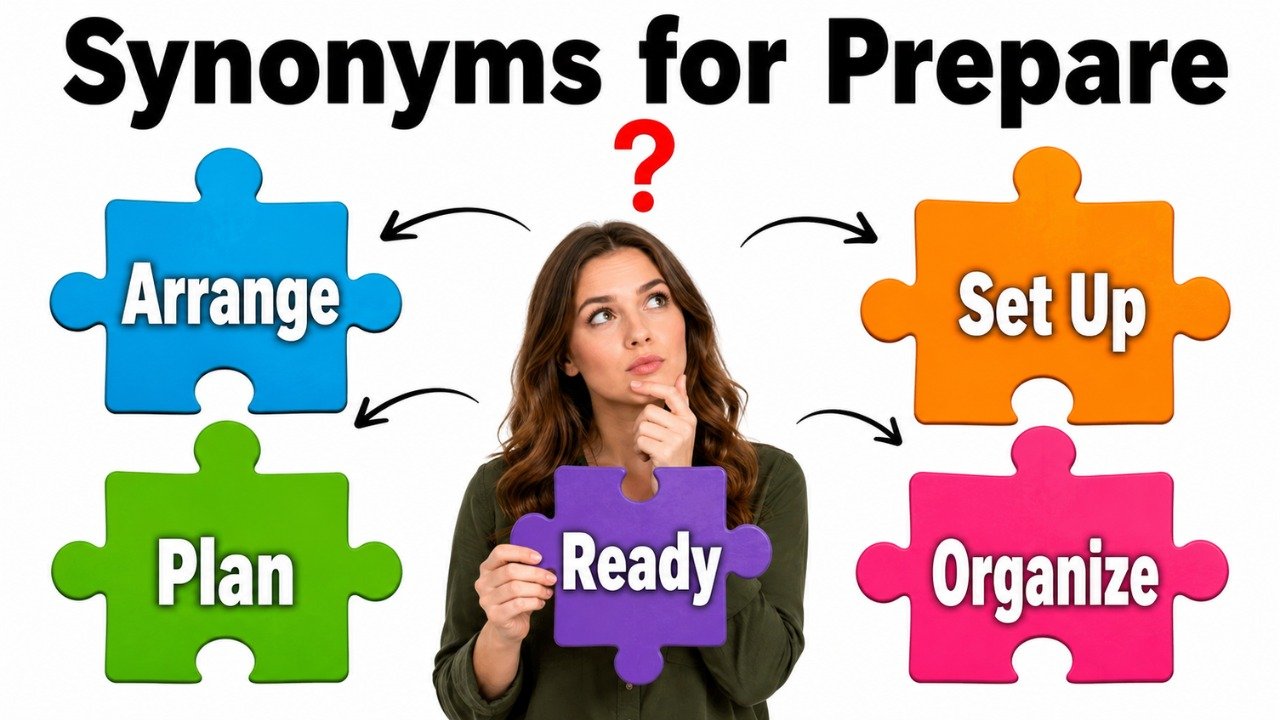
Quick Answer: The best synonyms for prepare include arrange, organize, plan, ready, equip, develop, formulate, assemble, rehearse, and cook. Use arrange for putting details or objects in order, organize for coordinating people or tasks, and plan for deciding future actions. Ready is best when making someone or something fit for use. Equip relates to providing necessary tools, while rehearse suits performances. Cook is the clearest choice when prepare refers to making food.
Pronunciation and Word Details
Word: Prepare
Pronunciation: /prɪˈpeə/
Part of Speech: Verb
Meaning: To make someone or something ready for an activity, purpose, event, or future situation.
US Pronunciation:
UK Pronunciation:
What Does “Prepare” Mean?
Prepare means to make someone or something ready for a particular activity, purpose, event, or situation. It is mainly used as a verb and can describe planning, arranging, producing, training, cooking, studying, or gathering necessary materials.
A person can prepare for an examination by studying. A manager can prepare a report by collecting and organizing information. A cook can prepare a meal by combining and cooking ingredients. A traveler can prepare for a journey by packing clothes and checking important documents.
Prepare may also describe helping another person become ready. A teacher prepares students for a test, while a coach prepares athletes for a competition. In each case, the word refers to completing the necessary actions before something begins.
The exact replacement for prepare depends on the activity. Plan suits future actions, arrange suits details, equip suits tools and resources, rehearse suits performances, and cook suits food.
Meaning, Tone, and Context of “Prepare”
Prepare has a neutral and practical tone. It is appropriate in formal writing, professional communication, academic work, instructions, everyday conversation, and technical explanations.
In professional settings, prepare may describe reports, presentations, schedules, budgets, documents, and meetings. In education, it often relates to lessons, examinations, assignments, research, and student development.
In domestic contexts, prepare commonly refers to food, rooms, clothing, and household arrangements. In travel, it may involve packing, planning, checking schedules, and gathering documents.
The word can also have an emotional or mental meaning. Someone may prepare for difficult news, an important conversation, or a major life change. In this context, brace, condition, or ready may communicate the intended meaning more precisely.
Prepare is flexible, but it can sometimes sound general. Strong writing often replaces it with a more specific verb that identifies the exact action being performed.
When and How to Use “Prepare”
For Planning: Use prepare when deciding what must be done before an event or activity.
Example: The committee met early to prepare for the annual conference.
For Organizing: Use it when arranging materials, information, people, or tasks.
Example: She prepared the documents in the order requested by the examiner.
For Cooking: Prepare can mean making food or a drink ready to serve.
Example: He prepared a fresh vegetable soup for dinner.
For Studying: Use prepare when completing academic work before a test, class, or presentation.
Example: The students prepared carefully for their final examination.
For Training: Prepare can describe developing the skills or knowledge needed for a role.
Example: The course prepares learners for professional employment.
For Producing Documents: Use it for writing, compiling, or completing reports and records.
Example: The assistant prepared a detailed summary of the meeting.
For Travel: Prepare can include packing, checking documents, and planning transportation.
Example: They prepared for the journey several days in advance.
For Mental Readiness: Use it when someone becomes emotionally ready for a difficult experience.
Example: The doctor prepared the family for the serious conversation.
For Events: Prepare may describe setting up a place, schedule, or activity.
Example: The volunteers prepared the hall for the ceremony.
For Emergencies: Use prepare when taking precautions against a possible danger.
Example: Residents prepared for the approaching storm by securing their homes.
Best Synonyms for Prepare
Arrange: To put objects, activities, or details into a suitable order.
Example: She arranged the chairs before the guests arrived.
Organize: To coordinate people, tasks, materials, or information efficiently.
Example: He organized the files into clearly marked folders.
Plan: To decide in advance how something will happen.
Example: The family planned their journey carefully.
Ready: To make someone or something suitable for immediate use.
Example: The staff readied the room for the next meeting.
Equip: To provide the tools, knowledge, or resources needed for a purpose.
Example: The training program equipped workers with practical skills.
Develop: To create or improve something gradually.
Example: The team developed a detailed communication strategy.
Formulate: To create a plan, idea, rule, or method carefully.
Example: Researchers formulated a new approach to the problem.
Assemble: To gather parts, people, or materials together.
Example: The technician assembled the equipment before the demonstration.
Rehearse: To practice before a performance, speech, or important activity.
Example: The actors rehearsed the final scene several times.
Cook: To prepare food by heating, combining, or processing ingredients.
Example: She cooked a healthy meal for her family.
50 Synonyms for Prepare with Short Meanings
- Arrange: Put details, objects, or activities into order.
- Organize: Coordinate materials, people, or tasks efficiently.
- Plan: Decide future actions in advance.
- Ready: Make suitable for immediate use or action.
- Equip: Provide necessary tools, knowledge, or resources.
- Develop: Create or improve something over time.
- Formulate: Design a plan, method, idea, or rule carefully.
- Devise: Think of and create a solution or strategy.
- Assemble: Gather parts, materials, or people together.
- Compile: Collect information and place it into one document.
- Draft: Write an initial version of a document.
- Compose: Create written, musical, or formal material.
- Construct: Build or create something from separate parts.
- Produce: Make or create something for use.
- Create: Bring something new into existence.
- Make: Form, build, or produce something.
- Cook: Make food ready by heating or combining ingredients.
- Mix: Combine ingredients or substances together.
- Concoct: Create a mixture, meal, story, or plan.
- Process: Treat or change materials into a usable form.
- Package: Place something in suitable wrapping or containers.
- Set Up: Arrange equipment, a place, or a system for use.
- Establish: Create or arrange something on a firm basis.
- Coordinate: Bring separate activities or people together effectively.
- Schedule: Decide the time and order of planned activities.
- Prearrange: Arrange details before an event takes place.
- Stage: Organize and present an event or activity.
- Gather: Bring necessary people or materials together.
- Collect: Obtain and bring together information or objects.
- Stock: Supply a place with necessary goods or materials.
- Provision: Supply food, equipment, or other necessities.
- Furnish: Provide required items, information, or equipment.
- Outfit: Supply a person or place with necessary clothing or tools.
- Arm: Provide equipment, knowledge, or means of protection.
- Prime: Make someone or something ready for action.
- Condition: Train or adapt someone for a particular situation.
- Train: Teach skills needed for a task or role.
- Educate: Give knowledge and intellectual preparation.
- Instruct: Teach or provide clear directions.
- Brief: Give essential information before an activity.
- Coach: Train and guide someone toward better performance.
- Groom: Develop someone for a future position or responsibility.
- Rehearse: Practice before a performance or presentation.
- Practice: Repeat an activity to improve readiness and skill.
- Study: Learn information before a test or task.
- Review: Examine material again to strengthen understanding.
- Anticipate: Think ahead about what may happen.
- Brace: Mentally or physically ready someone for difficulty.
- Adapt: Change something to suit a new purpose or condition.
- Adjust: Make small changes to improve suitability or readiness.
Read Also:
Synonyms for Overwhelmed

Synonyms for Prepare by Context
When Prepare Means to Plan
Plan, formulate, devise, schedule, anticipate, and prearrange describe thinking ahead and deciding what should happen.
Plan is the broadest replacement. Formulate suggests careful intellectual work, while devise often refers to creating a strategy, method, or solution. Schedule focuses on dates and times.
Example: The team planned every stage of the project.
Example: The scientists formulated a method for testing the material.
Example: She devised a practical solution to the scheduling problem.
When Prepare Means to Organize
Arrange, organize, coordinate, assemble, gather, collect, set up, and stage describe bringing details, objects, people, or activities into a useful order.
Arrange works well for objects and appointments. Organize is broader and may involve several connected tasks. Coordinate emphasizes making separate activities work together.
Example: The assistant arranged the documents by date.
Example: Volunteers organized the community event.
Example: She coordinated transportation for all participants.
When Prepare Means to Create
Create, make, produce, develop, construct, compose, compile, and draft describe bringing something into existence.
Draft suits an early written version. Compile means collecting information into one place. Compose is common for writing, music, and formal statements. Develop suggests gradual creation or improvement.
Example: The writer drafted a response to the proposal.
Example: The researcher compiled the findings into a report.
Example: The designer developed a practical layout.
When Prepare Means to Make Food
Cook, mix, concoct, process, make, and assemble can replace prepare in food related contexts.
Cook is best when heat is involved. Mix means combining ingredients. Assemble suits dishes made by placing prepared ingredients together. Concoct can describe creating an unusual meal or drink.
Example: She cooked pasta for the evening meal.
Example: Mix the flour and water in a large bowl.
Example: He assembled the salad shortly before serving it.
When Prepare Means to Train
Train, educate, instruct, coach, groom, condition, rehearse, practice, study, and review describe gaining skills, knowledge, or confidence.
Train is suitable for practical skills. Educate has a broader intellectual meaning. Rehearse refers to practicing a speech, performance, or planned action. Groom often means developing someone for a future position.
Example: The program trains workers to use the new equipment.
Example: The director rehearsed the performers before the show.
Example: She studied every evening for the examination.
When Prepare Means to Supply
Equip, provision, furnish, stock, outfit, and arm describe providing necessary items, tools, information, or resources.
Equip is the most flexible choice. Provision commonly refers to food and essential supplies. Furnish can refer to objects or information. Arm may be figurative when it means providing knowledge or confidence.
Example: The course equipped students with useful communication skills.
Example: The shelter was provisioned with food and clean water.
Example: The guide furnished visitors with detailed instructions.
When Prepare Means to Get Ready
Ready, prime, brace, condition, adapt, and adjust describe making a person or thing suitable for action or change.
Ready is the clearest general alternative. Prime often means preparing someone with information or making equipment ready. Brace suggests becoming ready for something difficult or unpleasant.
Example: The staff readied the building for inspection.
Example: The announcement primed the audience for the main discussion.
Example: Residents braced for severe weather.
Another Word for Prepare
Plan is often the best general replacement for prepare when the sentence refers to future actions. However, the best alternative depends on what is being made ready.
Use organize for people and tasks, arrange for details or objects, equip for tools and resources, rehearse for performances, and cook for food.
Original: We need to prepare the conference carefully.
Better Option: We need to plan the conference carefully.
Original: She prepared the files before the meeting.
Better Option: She organized the files before the meeting.
Original: The trainer prepared the workers for their new roles.
Better Option: The trainer equipped the workers for their new roles.
Original: He prepared the speech several times before the ceremony.
Better Option: He rehearsed the speech several times before the ceremony.
When Not to Use “Prepare”
Do not use prepare when a more specific verb can show exactly what happened. In instructions, reports, and professional writing, precise verbs often make a sentence clearer.
Weak: Prepare the ingredients in the bowl.
Better: Mix the ingredients in the bowl.
Avoid using prepare when you mean only plan. Preparing usually includes practical action, while planning mainly involves deciding what should happen.
Weak: They prepared where they would travel next summer.
Better: They planned where they would travel next summer.
Do not use prepare when the intended action is simply writing.
Weak: She prepared a letter to the committee.
Better: She drafted a letter to the committee.
Avoid prepare when describing repeated practice before a performance.
Weak: The musicians prepared the song every afternoon.
Better: The musicians rehearsed the song every afternoon.
Do not use prepare for supplying tools when equip is clearer.
Weak: The organization prepared each worker with protective clothing.
Better: The organization equipped each worker with protective clothing.
Avoid repeating prepare several times within the same paragraph.
Weak: The teacher prepared the lesson, prepared the materials, and prepared the students for the activity.
Better: The teacher planned the lesson, organized the materials, and readied the students for the activity.
Words Commonly Confused With Prepare
Prepare vs Plan: Prepare involves completing practical steps before an event. Plan mainly means deciding in advance what will happen.
Prepare vs Arrange: Prepare is broad, while arrange focuses on putting details, objects, or appointments in a suitable order.
Prepare vs Organize: Prepare means making something ready. Organize means coordinating its separate parts efficiently.
Prepare vs Ready: Prepare can refer to planning, producing, cooking, or training. Ready specifically means making something suitable for immediate use.
Prepare vs Make: Make means creating or producing something. Prepare may involve creating it, but it can also mean organizing or becoming ready.
Prepare vs Practice: Prepare covers every action taken before an activity. Practice means repeatedly performing a skill to improve it.
Prepare vs Rehearse: Prepare is broad. Rehearse specifically means practicing before a performance, presentation, or planned event.
Prepare vs Cook: Prepare food may include washing, cutting, mixing, or arranging ingredients. Cook specifically involves making food, usually with heat.
Prepare vs Equip: Prepare means making someone ready in any way. Equip specifically means providing tools, knowledge, clothing, or resources.
Prepare vs Compile: Prepare a report may involve research, planning, and writing. Compile means collecting existing information into one document.
Which Synonym Should You Choose?
Choose plan when deciding future actions, goals, or activities.
Choose arrange when putting objects, appointments, or details into a suitable order.
Choose organize when coordinating several tasks, people, materials, or pieces of information.
Choose ready when making someone or something suitable for immediate action.
Choose equip when providing tools, resources, clothing, or knowledge.
Choose formulate when carefully developing a policy, strategy, method, or idea.
Choose devise when creating an original solution, system, or plan.
Choose compile when gathering facts, records, or research into one document.
Choose draft when writing the first version of a letter, report, agreement, or speech.
Choose rehearse when practicing a performance, speech, presentation, or ceremony.
Choose train when teaching practical abilities for work, sport, or another activity.
Choose study when becoming ready for an examination, lesson, or academic task.
Choose cook when making food with heat.
Choose mix when combining ingredients or substances.
Choose assemble when bringing parts, materials, or people together.
Choose set up when arranging equipment, a room, a system, or an event.
Choose brace when becoming mentally or physically ready for difficulty.
Choose stock when filling a place with goods or supplies.
Choose adapt when changing something for a new condition or purpose.
Choose review when examining information again before a test, meeting, or decision.
Real Life Examples of “Prepare” in Sentences
Original: She prepared the meeting agenda the previous evening.
Better Option: She drafted the meeting agenda the previous evening.
Original: The volunteers prepared the hall for the celebration.
Better Option: The volunteers arranged the hall for the celebration.
Original: He prepared a detailed plan for the project.
Better Option: He formulated a detailed plan for the project.
Original: The students prepared for their history examination.
Better Option: The students studied for their history examination.
Original: The chef prepared a warm vegetable meal.
Better Option: The chef cooked a warm vegetable meal.
Original: The actors prepared the final scene before the performance.
Better Option: The actors rehearsed the final scene before the performance.
Original: The company prepared its employees to use the new system.
Better Option: The company trained its employees to use the new system.
Original: She prepared all the information in one document.
Better Option: She compiled all the information in one document.
Original: The guide prepared the travelers for difficult conditions.
Better Option: The guide equipped the travelers for difficult conditions.
Original: Residents prepared for the approaching storm.
Better Option: Residents braced for the approaching storm.
Synonym Groups and Usage Differences
Planning Group
Plan, formulate, devise, schedule, anticipate, and prearrange relate to deciding actions before they happen.
Plan is broad and common. Formulate sounds more formal and careful. Devise emphasizes invention, while anticipate means thinking about likely future needs or problems.
Example: The committee formulated a strategy for improving attendance.
Organization Group
Arrange, organize, coordinate, gather, collect, assemble, stage, and set up relate to ordering people, materials, or activities.
Arrange often applies to details or objects. Coordinate is best when several people or activities must work together. Stage commonly refers to events or presentations.
Example: The team coordinated every part of the public ceremony.
Creation Group
Create, make, produce, construct, develop, compose, draft, and compile describe making something.
Construct often refers to physical objects or carefully built ideas. Draft means producing an initial written version. Develop suggests growth or gradual improvement.
Example: The researcher developed a new method for recording results.
Food Group
Cook, mix, concoct, process, assemble, and make describe different stages of food preparation.
Cook usually involves heat. Mix focuses on combining ingredients. Process may describe treating food for storage or consumption.
Example: Mix the spices before adding them to the vegetables.
Training Group
Train, educate, instruct, coach, groom, condition, rehearse, practice, study, and review relate to developing knowledge or ability.
Train and coach emphasize practical performance. Educate is broader. Rehearse suits planned presentations, while review means examining learned material again.
Example: The coach trained the athletes for the regional competition.
Supply Group
Equip, furnish, provision, stock, outfit, and arm relate to providing what is needed.
Equip is useful in professional and educational contexts. Provision often refers to essential supplies. Outfit commonly refers to clothing and equipment.
Example: The laboratory was equipped with modern safety tools.
Readiness Group
Ready, prime, brace, condition, adapt, and adjust describe making someone or something fit for a situation.
Brace emphasizes readiness for difficulty. Adapt means changing for a new environment. Adjust refers to making smaller changes.
Example: She adjusted the presentation to suit a younger audience.
Antonyms of Prepare
The opposite of prepare depends on whether the word refers to planning, organizing, training, producing, or becoming ready.
Neglect: Fail to give necessary attention or preparation.
Ignore: Refuse to consider important needs or warnings.
Disorganize: Make something confused or poorly arranged.
Disarrange: Disturb an existing order or arrangement.
Dismantle: Take a structure or system apart.
Destroy: Damage something so badly that it cannot be used.
Abandon: Leave a plan, task, or activity unfinished.
Delay: Make an action happen later than intended.
Postpone: Move an activity to a later time.
Cancel: Decide that a planned event will not happen.
Forget: Fail to remember a necessary action or item.
Improvise: Act without detailed advance preparation.
Overlook: Fail to notice or deal with an important detail.
Unpack: Remove items that were packed for a journey or purpose.
Disband: Separate an organized group.
Comparison of Prepare and Related Words
Prepare vs Plan
Prepare means completing the actions needed before something happens. Plan means deciding what those actions will be.
Example With Prepare: We prepared the room before the interview.
Example With Plan: We planned the interview several weeks in advance.
Prepare vs Arrange
Prepare is broad and may include planning, creating, or training. Arrange means placing things or details into order.
Example With Prepare: She prepared everything needed for the workshop.
Example With Arrange: She arranged the chairs in a circle.
Prepare vs Organize
Prepare means making something ready. Organize means coordinating its separate parts in an orderly way.
Example With Prepare: He prepared for the business conference.
Example With Organize: He organized the conference schedule.
Prepare vs Ready
Prepare can describe a long process. Ready often refers to the final action that makes something suitable for immediate use.
Example With Prepare: The team prepared the building throughout the week.
Example With Ready: The team readied the building before the guests arrived.
Prepare vs Equip
Prepare may involve knowledge, planning, practice, or materials. Equip specifically means providing what is needed.
Example With Prepare: The course prepares students for office work.
Example With Equip: The course equips students with practical computer skills.
Prepare vs Rehearse
Prepare includes all actions taken before an event. Rehearse means practicing the performance itself.
Example With Prepare: She prepared carefully for the presentation.
Example With Rehearse: She rehearsed the presentation in front of a friend.
Prepare vs Practice
Prepare is a broad process. Practice means repeating an activity to develop skill.
Example With Prepare: The player prepared for the tournament.
Example With Practice: The player practiced serving every morning.
Prepare vs Cook
Prepare food includes cleaning, cutting, measuring, mixing, and arranging. Cook usually refers to heating food.
Example With Prepare: He prepared the vegetables before lunch.
Example With Cook: He cooked the vegetables over low heat.
Prepare vs Compile
Prepare a document can involve planning, writing, checking, and formatting. Compile means gathering information from different places.
Example With Prepare: She prepared the annual report.
Example With Compile: She compiled the sales figures for the annual report.
Common Phrases and Expressions With Prepare
Prepare For: Become ready for a future activity or situation.
Example: Students should prepare for the examination early.
Prepare to Leave: Complete the actions needed before departing.
Example: The visitors prepared to leave before sunset.
Prepare a Meal: Make food ready to eat.
Example: He prepared a meal for the entire family.
Prepare a Report: Research, organize, and write formal information.
Example: The manager prepared a report on employee performance.
Prepare a Statement: Write or arrange an official explanation.
Example: The representative prepared a statement for the meeting.
Prepare the Ground: Create favorable conditions for a future action.
Example: The discussion prepared the ground for a final agreement.
Prepare in Advance: Complete necessary work before it becomes urgent.
Example: Travelers should prepare in advance for changing weather.
Prepare Yourself: Become mentally, emotionally, or physically ready.
Example: Prepare yourself for a challenging but rewarding experience.
Prepare a Presentation: Develop and organize material for an audience.
Example: She prepared a presentation about environmental responsibility.
Prepare for the Worst: Take precautions against the most difficult possible outcome.
Example: The residents prepared for the worst as the storm approached.
Common Mistakes to Avoid
A common mistake is using prepare without explaining what is being made ready. A sentence such as “She prepared carefully” may be unclear unless the context identifies the event, task, or purpose.
Another mistake is confusing prepare with plan. Planning is usually one part of preparation. A person may plan a journey but still need to pack, gather documents, and arrange transportation.
Avoid repeating prepare in several nearby sentences. Replace it with arrange, organize, draft, compile, rehearse, cook, or equip when those words express the action more precisely.
Do not use cook as a complete synonym in every food context. Preparing a salad may not involve cooking. In that situation, make, mix, assemble, or prepare may be more accurate.
Be careful with ready. In formal writing, ready is often followed by an object. For example, “The staff readied the room” is correct, although “prepared the room” is more common in everyday usage.
Do not confuse set up with setup. Set up is a verb phrase, while setup is normally a noun. Write “They set up the equipment,” but write “The equipment setup was simple.”
Avoid using equip when no tools, knowledge, clothing, or resources are being provided. Equip does not simply mean planning or organizing.
In professional writing, choose a verb that identifies the actual work. Instead of writing “The assistant prepared the information,” write “The assistant compiled the research findings” or “The assistant organized the records.”
Conclusion
Synonyms for prepare make instructions, reports, essays, and everyday sentences clearer and more precise. Use plan for future actions, arrange for details, organize for connected tasks, and ready when something must become fit for immediate use. Equip works for tools and knowledge, while draft and compile suit documents. Rehearse and practice describe skill development, and cook is best for food involving heat. Choosing the right alternative helps readers understand exactly how someone or something became ready.
FAQs About Synonyms for Prepare
What is the best synonym for prepare?
Plan is a useful general synonym when prepare refers to future actions. Arrange, organize, ready, and equip may be more precise in other contexts.
What is a formal synonym for prepare?
Formulate, organize, arrange, compile, develop, and coordinate are suitable formal alternatives.
What is another word for preparing a document?
Draft, compose, compile, write, develop, and produce can describe preparing a document.
What is another word for preparing for an examination?
Study, review, practice, and revise are useful alternatives when preparing for an examination.
Can ready replace prepare?
Ready can replace prepare when the meaning is to make someone or something fit for immediate use or action.
What is another word for preparing food?
Cook, make, mix, assemble, and process are useful choices, depending on the method.
What is the difference between prepare and plan?
Plan means deciding in advance what will happen. Prepare includes the practical actions needed to make the plan possible.
