
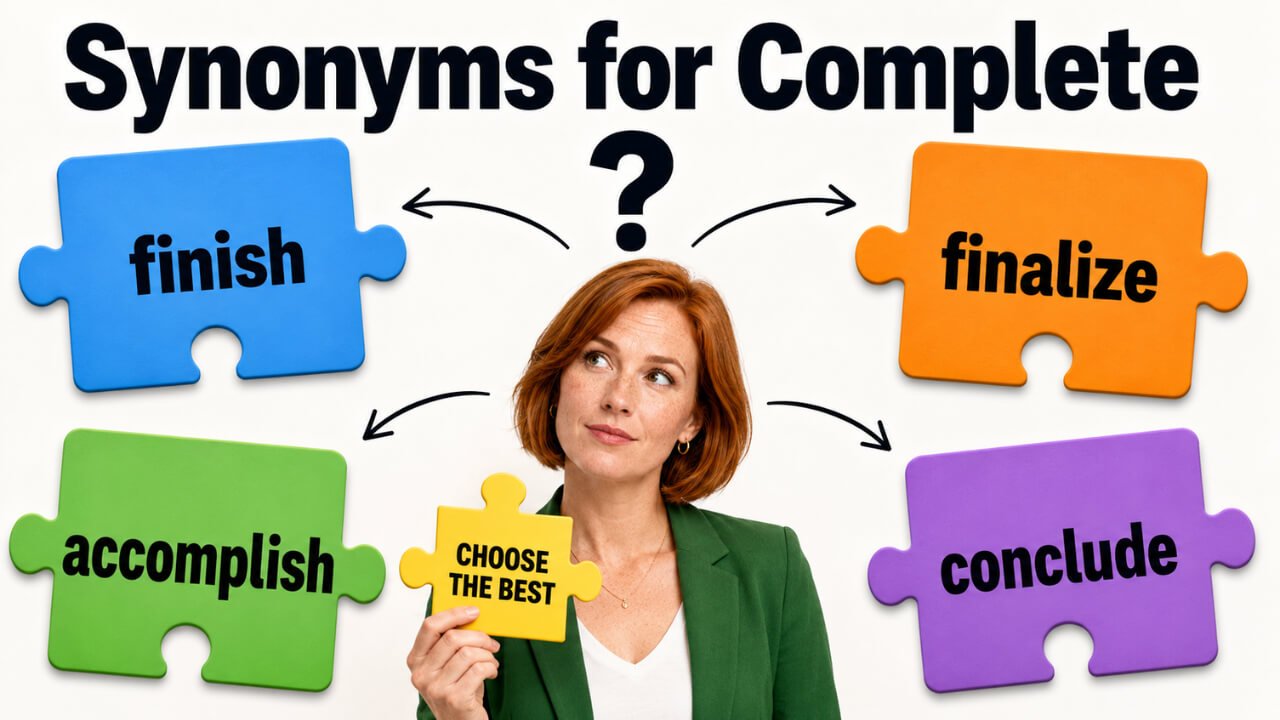
Quick Answer: Synonyms for complete include finished, whole, entire, full, total, comprehensive, thorough, concluded, finalized, and fulfilled. The best synonym depends on context. Use finished when a task is done, whole when nothing is missing, entire when referring to all of something, comprehensive for detailed coverage, thorough for careful work, and finalized for official completion.
Pronunciation and Word Details
Word: Complete
Pronunciation: /kəmˈpliːt/
Part of Speech: Adjective and verb
Meaning: Complete means finished, whole, or having all necessary parts.
US Pronunciation:
UK Pronunciation:
What Does “Complete” Mean?
Complete means finished, whole, or having everything needed. It can describe a task, object, set, process, document, answer, plan, or idea.
As an adjective, complete means that nothing is missing. For example, a complete report includes all required details. As a verb, complete means to finish or bring something to an end. For example, you can complete an assignment, complete a form, or complete a project.
The word works in everyday speech, academic writing, professional documents, instructions, and formal communication.
Meaning, Tone, and Context of “Complete”
Complete is a clear, neutral, and useful word. It can sound formal or everyday depending on the sentence.
In professional writing, complete often means finished properly or fully prepared. In academic writing, it can mean detailed, full, or comprehensive. In casual speech, it usually means done or finished. In technical or official contexts, complete can mean that all required parts, steps, or information are included.
Some synonyms make the meaning more exact. Finished focuses on the end of a task. Whole focuses on nothing being missing. Entire means all of something. Comprehensive means wide and detailed. Finalized means officially finished or approved.
When and How to Use “Complete”
For Finished Work: Use complete when a task, project, form, or assignment is done.
Example: Please complete the form before Friday.
For Whole Things: Use complete when something has all its parts.
Example: The box contains a complete set of tools.
For Detailed Information: Use complete when an answer, guide, or report includes all important points.
Example: She gave a complete explanation of the process.
For Official Tasks: Use complete when something must be finished according to a rule or requirement.
Example: The application will be reviewed after all sections are complete.
For Strong Emphasis: Use complete to mean total or absolute.
Example: The announcement came as a complete surprise.
For Finishing an Action: Use complete as a verb when someone finishes doing something.
Example: He completed the training program last month.
Best Synonyms for Complete
Finished: Done and no longer in progress.
Example: The report is finished and ready to submit.
Whole: Having all parts, with nothing missing.
Example: The child ate the whole apple.
Entire: Including every part of something.
Example: The entire team attended the meeting.
Full: Containing all that is needed or possible.
Example: Please provide a full explanation.
Total: Including everything or everyone.
Example: The total cost was higher than expected.
Comprehensive: Complete and covering many details.
Example: The guide gives a comprehensive overview of the topic.
Thorough: Complete because it is careful and detailed.
Example: The manager made a thorough review of the file.
Concluded: Brought to an end.
Example: The discussion concluded after two hours.
Finalized: Completed in an official or final form.
Example: The agreement was finalized yesterday.
Fulfilled: Completed as required, promised, or expected.
Example: She fulfilled all the conditions of the contract.
50 Synonyms for Complete with Short Meanings
1. Finished: Done and no longer active.
2. Done: Completed or ended.
3. Whole: Having all parts.
4. Entire: Including everything.
5. Full: Containing all necessary parts.
6. Total: Including the complete amount.
7. Comprehensive: Covering all important details.
8. Thorough: Careful and fully detailed.
9. Concluded: Brought to an end.
10. Finalized: Made final or official.
11. Fulfilled: Completed according to a duty or promise.
12. Accomplished: Successfully completed.
13. Achieved: Reached or completed successfully.
14. Completed: Fully finished.
15. Executed: Carried out fully.
16. Performed: Done or carried out.
17. Carried out: Completed as planned.
18. Wrapped up: Finished in a casual sense.
19. Settled: Finished or resolved.
20. Resolved: Completed by finding an answer or solution.
21. Closed: Ended or completed.
22. Ended: Brought to a stop.
23. Over: Finished or no longer happening.
24. Through: Finished with something.
25. Intact: Whole and not damaged.
26. Undivided: Whole and not separated.
27. Unbroken: Whole and continuous.
28. Unabridged: Not shortened or reduced.
29. Exhaustive: Covering everything possible.
30. All inclusive: Including everything needed.
31. Extensive: Covering a large amount.
32. Detailed: Including many important points.
33. In depth: Covering a subject deeply.
34. Full scale: Complete in size, level, or effort.
35. Fully developed: Complete in growth or form.
36. Mature: Fully developed or complete.
37. Perfect: Complete without faults in a certain context.
38. Absolute: Complete or total in degree.
39. Utter: Complete in a strong emotional sense.
40. Pure: Complete in quality or nature.
41. Integral: Necessary to make something whole.
42. Inclusive: Containing all relevant parts.
43. Finished off: Completed with a final touch.
44. Rounded off: Completed in a smooth or satisfying way.
45. Brought to an end: Finished fully.
46. Brought to completion: Finished successfully.
47. Made whole: Restored or completed.
48. Filled out: Completed with required information.
49. Supplied: Provided with what was missing.
50. Equipped: Provided with all necessary items.
Read Also:
Synonyms for Walk

Synonyms for Complete by Context
When Complete Means Finished
Useful Synonyms: Finished, done, concluded, finalized, accomplished, closed.
Example: The project is complete.
Better Option: The project is finished.
When Complete Means Whole
Useful Synonyms: Whole, entire, full, intact, undivided, unbroken.
Example: We need a complete set of documents.
Better Option: We need the entire set of documents.
When Complete Means Detailed
Useful Synonyms: Comprehensive, thorough, exhaustive, extensive, detailed, in depth.
Example: The teacher gave a complete explanation.
Better Option: The teacher gave a thorough explanation.
When Complete Means Officially Finished
Useful Synonyms: Finalized, settled, resolved, concluded, approved.
Example: The deal is complete.
Better Option: The deal is finalized.
When Complete Means Total or Absolute
Useful Synonyms: Total, absolute, utter, full, pure.
Example: It was a complete disaster.
Better Option: It was a total disaster.
When Complete Means Fulfill a Requirement
Useful Synonyms: Fulfill, accomplish, execute, perform, carry out.
Example: You must complete all steps before submitting.
Better Option: You must fulfill all steps before submitting.
Another Word for Complete
Another Word: The best single replacement for complete is finished when you mean that something is done. However, the best alternative depends on context. Use whole for something with no missing parts, entire for all of something, comprehensive for detailed coverage, and finalized for official completion.
Original: The assignment is complete.
Better Option: The assignment is finished.
Original: We reviewed the complete file.
Better Option: We reviewed the entire file.
Original: She gave a complete answer.
Better Option: She gave a comprehensive answer.
Original: The agreement is complete.
Better Option: The agreement is finalized.
When Not to Use “Complete”
Do not use complete when another word gives a more exact meaning. Complete can sound general if the sentence needs to show whether something is finished, whole, detailed, official, or total.
Weak: The guide is complete.
Better: The guide is comprehensive.
Weak: The work is complete.
Better: The work is finished.
Weak: The complete class was present.
Better: The entire class was present.
Weak: The problem is complete.
Better: The problem is resolved.
Weak: He had complete anger.
Better: He had utter anger.
Avoid repeating complete too often in one paragraph. Use finished, full, entire, thorough, finalized, or fulfilled to make the writing smoother and more specific.
Words Commonly Confused With Complete
Complete vs Finished: Complete can mean finished or whole. Finished only means done or ended.
Example: The report is finished, but it may not be complete if details are missing.
Complete vs Whole: Complete means having all necessary parts. Whole means not divided or not missing any part.
Example: A complete guide explains everything, while a whole cake is not cut.
Complete vs Entire: Complete means full or finished. Entire means all of something.
Example: She read the entire book and gave a complete summary.
Complete vs Comprehensive: Complete can be general. Comprehensive means detailed and wide in coverage.
Example: A complete list includes all items, while a comprehensive guide explains them deeply.
Complete vs Total: Complete means full or finished. Total focuses on the full amount or degree.
Example: The total price is shown after the complete order is reviewed.
Complete vs Final: Complete means done or whole. Final means last or not likely to change.
Example: The draft is complete, but the final version will be sent tomorrow.
Which Synonym Should You Choose?
Choose finished when writing about work, tasks, projects, assignments, or actions that are done.
Choose whole when something has all parts and nothing is missing.
Choose entire when referring to all of a group, object, period, area, or amount.
Choose full when something contains everything needed.
Choose comprehensive when writing about guides, reports, lessons, explanations, or coverage.
Choose thorough when something is complete because it is careful and detailed.
Choose finalized when something is officially finished, approved, or made final.
Choose fulfilled when a requirement, duty, promise, or condition has been completed.
Choose total when you want to show full amount, full degree, or strong emphasis.
Choose concluded when a discussion, event, meeting, or process has ended.
Real Life Examples of “Complete” in Sentences
Original: The report is complete.
Better Option: The report is finished.
Original: She gave a complete explanation of the rule.
Better Option: She gave a thorough explanation of the rule.
Original: We need the complete list before the meeting.
Better Option: We need the full list before the meeting.
Original: The complete team joined the session.
Better Option: The entire team joined the session.
Original: He completed the training in two weeks.
Better Option: He finished the training in two weeks.
Original: The agreement is complete now.
Better Option: The agreement is finalized now.
Original: The guide is complete and easy to follow.
Better Option: The guide is comprehensive and easy to follow.
Original: She completed all the requirements.
Better Option: She fulfilled all the requirements.
Original: The event is complete.
Better Option: The event has concluded.
Original: It was a complete surprise.
Better Option: It was a total surprise.
Synonym Groups and Usage Differences
Finished Work Group
Use: Finished, done, concluded, closed, and wrapped up show that something has ended. These words are useful for tasks, projects, meetings, events, and daily work.
Example: The meeting concluded before lunch.
Whole and Full Group
Use: Whole, entire, full, intact, and undivided show that nothing is missing. These words are useful for objects, groups, sets, files, and periods of time.
Example: The entire folder was sent to the reviewer.
Detailed Coverage Group
Use: Comprehensive, thorough, exhaustive, detailed, and in depth describe information that covers a subject well. These words are useful for reports, articles, guides, lessons, and explanations.
Example: The article gives a comprehensive answer to the question.
Official Completion Group
Use: Finalized, settled, resolved, approved, and concluded show formal or official completion. These words fit contracts, agreements, decisions, plans, and applications.
Example: The final decision was settled after the review.
Requirement Group
Use: Fulfilled, accomplished, achieved, executed, and carried out show that a duty, goal, promise, or requirement has been completed.
Example: The team fulfilled every condition before the deadline.
Emphasis Group
Use: Total, absolute, utter, full, and pure make the meaning stronger. They are useful when complete means extreme or full in degree.
Example: His answer showed absolute confidence.
Antonyms of Complete
Incomplete: Missing parts or not finished.
Unfinished: Started but not completed.
Partial: Only part of the whole.
Limited: Not full or not complete in range.
Fragmentary: Made of broken or incomplete parts.
Deficient: Lacking something necessary.
Insufficient: Not enough or not complete enough.
Unresolved: Not solved or not settled.
Pending: Still waiting to be completed.
Ongoing: Still happening or still in progress.
Imperfect: Not complete or not without faults.
Broken: Not whole or not working properly.
Comparison: Complete vs Related Words
Complete vs Finished
Difference: Complete can mean finished or having all parts. Finished only means done.
Example With Complete: The file is complete and includes every document.
Example With Finished: The file is finished and ready to send.
Complete vs Whole
Difference: Complete often refers to required parts or steps. Whole means not divided or missing any part.
Example With Complete: This is a complete set of instructions.
Example With Whole: She ate the whole orange.
Complete vs Entire
Difference: Complete means full or finished. Entire means all parts of something considered together.
Example With Complete: He gave a complete answer.
Example With Entire: He read the entire chapter.
Complete vs Comprehensive
Difference: Complete can mean full, while comprehensive means full and detailed.
Example With Complete: The document is complete.
Example With Comprehensive: The document is comprehensive.
Complete vs Thorough
Difference: Complete means nothing important is missing. Thorough means careful, detailed, and fully checked.
Example With Complete: The form is complete.
Example With Thorough: The review is thorough.
Complete vs Finalized
Difference: Complete means done, while finalized means officially finished and approved.
Example With Complete: The plan is complete.
Example With Finalized: The plan is finalized.
Common Phrases and Expressions With Complete
Complete Set: A group with every required item.
Complete List: A list that includes all relevant items.
Complete Guide: A guide that covers all important details.
Complete Answer: An answer that includes all needed information.
Complete Form: A form with all required fields filled in.
Complete Control: Full power or authority over something.
Complete Silence: Total absence of sound.
Complete Surprise: Something totally unexpected.
Complete Failure: A total lack of success.
Complete the Task: To finish the required work.
Common Mistakes to Avoid
A common mistake is using complete when finished is more natural. For simple tasks, finished often sounds clearer. For example, say the work is finished instead of the work is complete in casual speech.
Another mistake is using complete for people or emotions in unnatural ways. Say utter shock or total joy instead of complete shock or complete joy when a stronger emotional synonym fits better.
Also avoid confusing complete with comprehensive. A document can be complete because all parts are included, but comprehensive means it covers the topic deeply. Choose the word that matches your exact meaning.
Conclusion
Synonyms for complete help you describe whether something is finished, whole, detailed, official, or total. Use finished for tasks, whole for things with no missing parts, entire for all of something, comprehensive for detailed information, finalized for official completion, and fulfilled for requirements or promises. Complete is a strong and flexible word, but the right synonym makes your writing clearer, more natural, and more precise.
FAQs About Synonyms for Complete
What is the best synonym for complete?
Answer: The best synonym for complete is finished when you mean done. Use whole when you mean nothing is missing and comprehensive when you mean detailed.
What is another word for complete in formal writing?
Answer: Formal alternatives include comprehensive, finalized, concluded, fulfilled, accomplished, and executed. The best choice depends on the sentence.
What is a synonym for complete a task?
Answer: Good synonyms for complete a task include finish, accomplish, carry out, execute, fulfill, and wrap up.
What is a synonym for a complete list?
Answer: Good alternatives for a complete list include full list, entire list, comprehensive list, exhaustive list, and all inclusive list.
What is the difference between complete and finished?
Answer: Finished means done. Complete can mean done, but it can also mean whole or having all necessary parts.
What is the opposite of complete?
Answer: Common opposites of complete include incomplete, unfinished, partial, limited, deficient, pending, and unresolved.
Can complete mean perfect?
Answer: Sometimes complete can suggest perfect or fully developed, but perfect is stronger. Use perfect only when something has no flaws, not just when it is finished
