
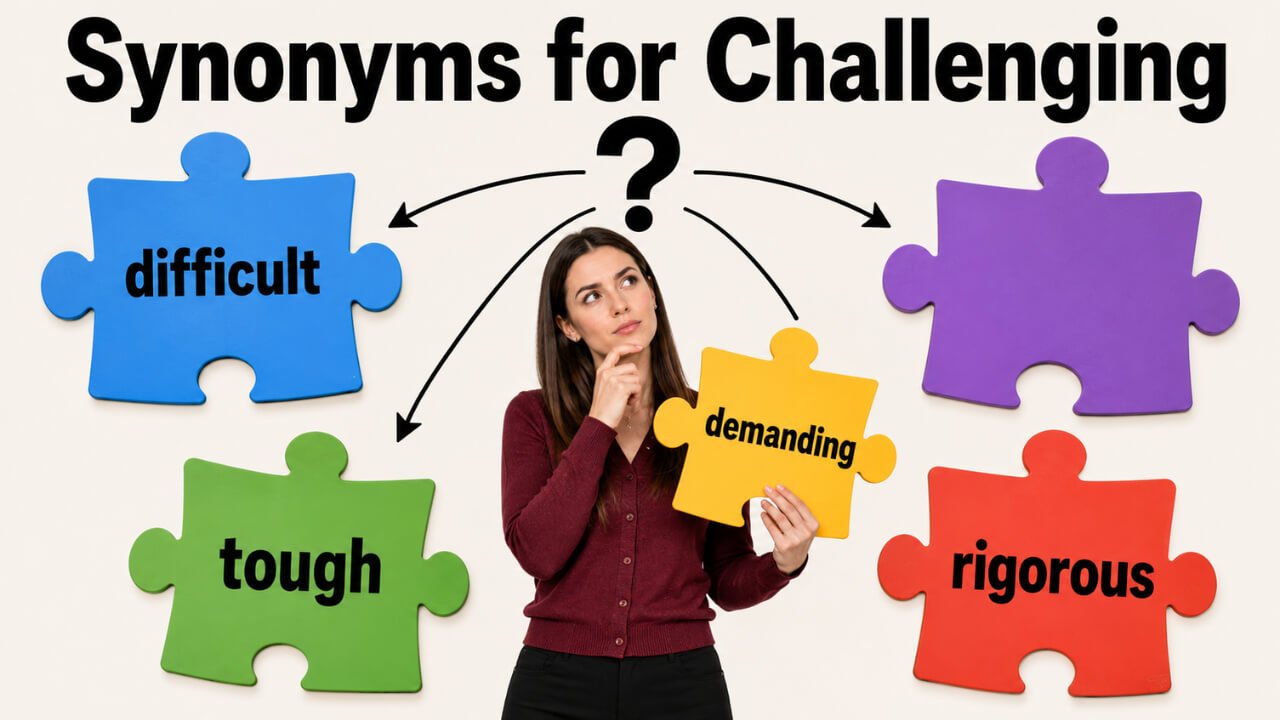
Quick Answer: Synonyms for challenging include difficult, demanding, tough, hard, testing, complex, tricky, rigorous, strenuous, and arduous. The best synonym depends on the context. Use difficult for general problems, demanding for tasks that need effort and skill, complex for detailed topics, rigorous for formal or academic writing, and tough for casual speech. For physical effort, strenuous or arduous may be more accurate.
Pronunciation and Word Details
Word: Challenging
Pronunciation: /ˈtʃæl.ɪn.dʒɪŋ/
Part of Speech: Adjective
Meaning: Difficult in a way that tests skill, patience, effort, knowledge, or ability.
US Pronunciation:
UK Pronunciation:
What Does “Challenging” Mean?
Direct Answer: Challenging means difficult in a way that requires effort, skill, patience, thought, or determination. It is mainly used as an adjective to describe tasks, problems, goals, roles, questions, courses, situations, and experiences that are not easy.
A challenging task is not always negative. It often suggests that something is hard but useful, meaningful, or possible to overcome. For example, a challenging course may require serious study, but it can also improve knowledge. A challenging job may feel demanding, but it can help someone build experience and confidence.
The word can describe mental difficulty, physical effort, emotional pressure, academic work, professional responsibility, or personal growth.
Meaning, Tone, and Context of “Challenging”
Meaning: Challenging describes something that tests a person’s ability, patience, knowledge, strength, or determination. It suggests difficulty, but not always failure or negativity.
Tone: The tone of challenging is usually neutral, polite, and sometimes positive. It sounds softer and more professional than hard or difficult. It can show that something is demanding but still valuable.
Context: The word is common in education, business, sports, personal development, work communication, essays, reports, and everyday conversation. A teacher may describe a test as challenging. A manager may call a project challenging. An athlete may describe training as challenging.
Use: It works well when you want to describe difficulty without sounding too negative. It often suggests growth, learning, discipline, and effort.
When and How to Use “Challenging”
For Difficult Tasks: Use challenging when a task requires effort, focus, or skill.
Example: The project was challenging, but the team completed it successfully.
For Learning: Use challenging when a subject, course, or lesson helps someone improve through difficulty.
Example: The course was challenging, but it improved my writing skills.
For Work Situations: Use challenging to describe responsibilities that require planning, patience, or experience.
Example: Managing several deadlines at once can be challenging.
For Emotional Situations: Use challenging when a situation is hard to handle emotionally.
Example: Moving away from family was challenging at first.
For Physical Effort: Use challenging when an activity needs strength, stamina, or endurance.
Example: The mountain trail was challenging for new hikers.
For Personal Growth: Use challenging when difficulty leads to learning, strength, or improvement.
Example: The experience was challenging, but it made her more confident.
Best Synonyms for Challenging
Difficult: Hard to do, understand, solve, or manage.
Example: The exam was difficult for many students.
Demanding: Requiring a lot of effort, skill, time, or attention.
Example: The new role is demanding, but it offers valuable experience.
Tough: Hard to deal with, especially in casual speech.
Example: It was a tough decision for the whole family.
Hard: Not easy to complete, understand, or handle.
Example: The question was hard to answer without more details.
Testing: Difficult in a way that puts patience, strength, or ability under pressure.
Example: It was a testing period for the team.
Complex: Having many parts, details, or ideas that are not easy to understand.
Example: The instructions were complex and needed careful reading.
Tricky: Difficult because it is confusing, hidden, or easy to misunderstand.
Example: This grammar rule is tricky for beginners.
Rigorous: Strict, detailed, and demanding, often used in formal or academic contexts.
Example: The students followed a rigorous study plan.
Strenuous: Requiring great physical effort or energy.
Example: The workout was strenuous but effective.
Arduous: Very difficult and requiring long effort.
Example: The journey through the mountains was arduous.
50 Synonyms for Challenging with Short Meanings
- Difficult: Hard to do or understand.
- Demanding: Requiring much effort or skill.
- Tough: Hard to handle or complete.
- Hard: Not easy.
- Testing: Putting patience or ability under pressure.
- Complex: Made of many difficult parts.
- Tricky: Difficult because it can confuse people.
- Rigorous: Strict and highly demanding.
- Strenuous: Requiring strong physical effort.
- Arduous: Involving long and tiring effort.
- Formidable: Difficult to face because it seems powerful or impressive.
- Taxing: Tiring because it requires effort.
- Grueling: Extremely tiring and difficult.
- Exacting: Requiring great care, skill, or precision.
- Complicated: Not simple or easy to understand.
- Problematic: Causing difficulty or concern.
- Laborious: Requiring a lot of work.
- Painstaking: Requiring careful and detailed effort.
- Intense: Strong and demanding.
- Heavy: Serious, difficult, or burdensome.
- Stressful: Causing mental or emotional pressure.
- Pressing: Needing urgent attention and effort.
- Daunting: Making someone feel nervous because it seems difficult.
- Trying: Difficult and likely to test patience.
- Uncomfortable: Hard because it causes unease.
- Awkward: Difficult to manage smoothly.
- Delicate: Requiring careful handling.
- Sensitive: Needing tact, care, or caution.
- Intricate: Full of small and complex details.
- Advanced: More difficult than basic level.
- High level: Requiring strong skill or knowledge.
- Sophisticated: Complex and developed in a refined way.
- Serious: Important and not easy to handle.
- Ambitious: Difficult because it aims high.
- Stretching: Pushing someone beyond usual ability.
- Skill testing: Measuring ability through difficulty.
- Mind stretching: Making someone think deeply.
- Thought provoking: Encouraging deep thought.
- Hard earned: Gained through effort and difficulty.
- Uphill: Difficult from the beginning.
- Rough: Difficult, unpleasant, or hard to manage.
- Severe: Very serious or difficult.
- Troublesome: Causing problems or difficulty.
- Burdensome: Heavy in responsibility or effort.
- Tiring: Causing fatigue.
- Exhausting: Very tiring.
- Hard going: Difficult to continue or complete.
- Difficult to manage: Hard to control or organize.
- Not easy: Simple phrase meaning difficult.
- Demand heavy: Requiring serious effort, care, or attention.
Read Also:
Synonyms for Complete

Synonyms for Challenging by Context
When Challenging Means Difficult
Use these synonyms when something is hard to do, solve, understand, learn, or complete.
Difficult: The test was difficult, but fair.
Hard: It was hard to finish the work in one day.
Tough: The interview was tough.
Daunting: The first step felt daunting.
Formidable: They faced a formidable opponent.
When Challenging Means Demanding
Use these words when a task needs serious effort, discipline, time, or skill.
Demanding: The job is demanding and requires focus.
Rigorous: The training program is rigorous.
Exacting: The work requires exacting attention to detail.
Taxing: The schedule was mentally taxing.
Laborious: The report was laborious to prepare.
When Challenging Means Complex
Use these synonyms when difficulty comes from many parts, details, rules, or ideas.
Complex: The case was complex.
Complicated: The process became complicated.
Intricate: The design was intricate.
Sophisticated: The system uses sophisticated methods.
Tricky: The final question was tricky.
When Challenging Means Physically Hard
Use these alternatives when the difficulty involves strength, energy, movement, or endurance.
Strenuous: The exercise was strenuous.
Arduous: The hike was arduous.
Grueling: The race was grueling.
Exhausting: The long shift was exhausting.
Tiring: The work was tiring.
When Challenging Means Emotionally Hard
Use these words when the situation affects feelings, confidence, patience, or stress.
Stressful: The week was stressful.
Trying: It was a trying time for everyone.
Difficult: The conversation was difficult.
Sensitive: The topic was sensitive.
Uncomfortable: The meeting became uncomfortable.
Another Word for Challenging
Best Replacement: Another word for challenging is difficult. It is the most common and flexible replacement. However, the best alternative depends on the context. Use demanding for work, complex for detailed ideas, tough for casual speech, rigorous for formal study, and strenuous for physical effort.
Original: The assignment was challenging for beginners.
Better Option: The assignment was difficult for beginners.
Original: She accepted a challenging position.
Better Option: She accepted a demanding position.
Original: The instructions were challenging to follow.
Better Option: The instructions were complex and hard to follow.
Original: The mountain trail was challenging.
Better Option: The mountain trail was strenuous.
When Not to Use “Challenging”
Avoid Vague Use: Do not use challenging when a more exact word explains the difficulty better. If something is confusing, use tricky or complicated. If something is physically tiring, use strenuous or exhausting. If something causes emotional pressure, use stressful or difficult.
Avoid Repetition: Do not repeat challenging several times in the same paragraph. Repetition can make writing sound weak or unclear.
Weak: The project was challenging because the task was challenging and the deadline was challenging.
Better: The project was demanding because the task was complex and the deadline was tight.
Weak: The math problem was challenging because it was not easy.
Better: The math problem was tricky because it required several hidden steps.
Weak: The workout was challenging and made me tired.
Better: The workout was strenuous and exhausting.
Weak: The situation was challenging for her feelings.
Better: The situation was emotionally difficult for her.
Words Commonly Confused With Challenging
Challenging vs Difficult: Challenging often sounds more positive because it suggests growth, learning, or effort. Difficult is more general and simply means not easy.
Challenging vs Demanding: Challenging can describe any type of difficulty. Demanding means something requires a lot of effort, time, attention, or skill.
Challenging vs Complex: Challenging means hard to handle. Complex means made of many connected parts, details, or ideas.
Challenging vs Tricky: Challenging can be hard in a broad way. Tricky means difficult because something is confusing, hidden, or easy to misunderstand.
Challenging vs Stressful: Challenging focuses on difficulty. Stressful focuses on emotional pressure, tension, or worry.
Challenging vs Arduous: Challenging can be mild, moderate, or strong. Arduous suggests long, serious, and tiring effort.
Which Synonym Should You Choose?
Choose difficult: Use it when you need a simple general word for something that is not easy.
Choose demanding: Use it for a job, role, schedule, course, or responsibility that needs serious effort.
Choose tough: Use it in casual speech when something is hard to deal with.
Choose complex: Use it when the difficulty comes from many details, steps, systems, or ideas.
Choose tricky: Use it when something is confusing or easy to get wrong.
Choose rigorous: Use it for formal writing, academic work, research, training, or strict standards.
Choose strenuous: Use it when the difficulty is physical.
Choose arduous: Use it when something requires long and tiring effort.
Choose daunting: Use it when something feels intimidating before it begins.
Choose testing: Use it when something puts patience, strength, or ability under pressure.
Real Life Examples of “Challenging” in Sentences
Original: The project was challenging from the beginning.
Better Option: The project was demanding from the beginning.
Original: The final question was challenging.
Better Option: The final question was tricky.
Original: Learning a new language can be challenging.
Better Option: Learning a new language can be difficult.
Original: The mountain hike was challenging.
Better Option: The mountain hike was strenuous.
Original: The course is challenging but useful.
Better Option: The course is rigorous but useful.
Original: It was a challenging time for the family.
Better Option: It was a difficult time for the family.
Original: The puzzle was challenging for children.
Better Option: The puzzle was complex for children.
Original: Her new role is challenging.
Better Option: Her new role is demanding.
Original: The task became challenging after the rules changed.
Better Option: The task became complicated after the rules changed.
Original: The race was challenging for all players.
Better Option: The race was grueling for all players.
Synonym Groups and Usage Differences
Difficulty Group
Use: This group includes difficult, hard, tough, and not easy. Use these words when you want a broad and simple way to describe difficulty.
Example: The decision was difficult for everyone involved.
Effort Group
Use: This group includes demanding, taxing, laborious, and exacting. Use these when a task requires time, energy, skill, or careful attention.
Example: Preparing the documents was laborious.
Complexity Group
Use: This group includes complex, complicated, intricate, and sophisticated. Use these when the difficulty comes from details, systems, or many connected parts.
Example: The machine has a complex control system.
Physical Effort Group
Use: This group includes strenuous, arduous, grueling, tiring, and exhausting. Use these when the body is under pressure.
Example: The long climb was grueling.
Emotional Pressure Group
Use: This group includes stressful, trying, sensitive, uncomfortable, and difficult. Use these when the difficulty affects emotions, patience, or confidence.
Example: The discussion was sensitive and needed care.
Antonyms of Challenging
Easy: Not difficult to do or understand.
Simple: Clear and not complicated.
Effortless: Requiring little or no effort.
Undemanding: Not requiring much work, skill, or attention.
Straightforward: Easy to understand or follow.
Basic: At an easy or beginner level.
Manageable: Possible to deal with without too much difficulty.
Light: Not heavy in effort or responsibility.
Relaxing: Calm and not stressful.
Comfortable: Easy to handle without pressure.
Comparison: Challenging vs Related Words
Challenging vs Difficult
Difference: Challenging can suggest useful difficulty that helps someone grow. Difficult is more general and simply means not easy.
Example With Challenging: The training was challenging, but it improved her skills.
Example With Difficult: The instructions were difficult to understand.
Challenging vs Demanding
Difference: Challenging means hard in a broad sense. Demanding means requiring a lot of effort, attention, time, or ability.
Example With Challenging: The new project was challenging.
Example With Demanding: The new project was demanding because it required daily updates.
Challenging vs Complex
Difference: Challenging describes the level of difficulty. Complex describes something with many parts or details.
Example With Challenging: The lesson was challenging for beginners.
Example With Complex: The lesson explained a complex scientific idea.
Challenging vs Tricky
Difference: Challenging may require effort or skill. Tricky usually means something is confusing, misleading, or hard to handle correctly.
Example With Challenging: The exam was challenging.
Example With Tricky: The exam had a tricky question at the end.
Challenging vs Tough
Difference: Challenging sounds more neutral and polished. Tough sounds more casual and direct.
Example With Challenging: The interview was challenging.
Example With Tough: The interview was tough.
Common Phrases and Expressions With Challenging
Challenging Task: A task that requires effort or skill.
Challenging Situation: A hard situation to manage.
Challenging Time: A difficult period in life or work.
Challenging Role: A position with serious responsibilities.
Challenging Question: A question that is hard to answer.
Challenging Course: A course that requires serious study.
Challenging Project: A project with difficulty, pressure, or complexity.
Challenging Environment: A place or condition that is hard to work in.
Challenging Experience: An experience that tests patience, skill, or strength.
Challenging Goal: A goal that requires effort and determination.
Common Mistakes to Avoid
Using It Too Often: Repeating challenging several times can make writing sound weak. Replace it with difficult, demanding, complex, tricky, stressful, strenuous, or rigorous when those words are more exact.
Choosing the Wrong Synonym: Do not use strenuous for mental difficulty unless physical effort is involved. Do not use complex unless something has many details or parts.
Ignoring Tone: Challenging sounds polite and balanced. If something is truly negative, words like frustrating, exhausting, painful, or impossible may be clearer.
Being Too Vague: Instead of saying a task is challenging, explain why it is challenging. Mention time, effort, skill, emotion, complexity, or pressure.
Unnatural Phrasing: Avoid phrases that sound forced. Use natural combinations like challenging task, challenging role, challenging course, challenging situation, and challenging experience.
Conclusion
The keyword synonyms for challenging includes useful alternatives such as difficult, demanding, tough, complex, tricky, rigorous, strenuous, arduous, and daunting. The best synonym depends on the type of difficulty. Use difficult for general situations, demanding for effort, complex for detailed ideas, tough for casual speech, and strenuous for physical tasks. Choosing the right synonym makes your writing clearer, more natural, and more accurate.
FAQs About Synonyms for Challenging
What is the best synonym for challenging?
Answer: The best general synonym for challenging is difficult. It works in most situations where something is not easy.
What is a professional synonym for challenging?
Answer: A professional synonym for challenging is demanding. It works well for jobs, projects, responsibilities, and work related tasks.
What is a formal synonym for challenging?
Answer: A formal synonym for challenging is rigorous when describing study, research, testing, or standards. Demanding is also a strong formal option.
What is a casual synonym for challenging?
Answer: A casual synonym for challenging is tough. It sounds natural in everyday speech.
Is challenging a positive word?
Answer: Challenging can be positive, neutral, or mildly negative. It often suggests that something is hard but useful, meaningful, or possible to overcome.
What is the difference between challenging and difficult?
Answer: Challenging often suggests growth, effort, or improvement. Difficult simply means not easy and is more general.
What is the opposite of challenging?
Answer: The opposite of challenging can be easy, simple, effortless, undemanding, straightforward, or manageable, depending on context
