
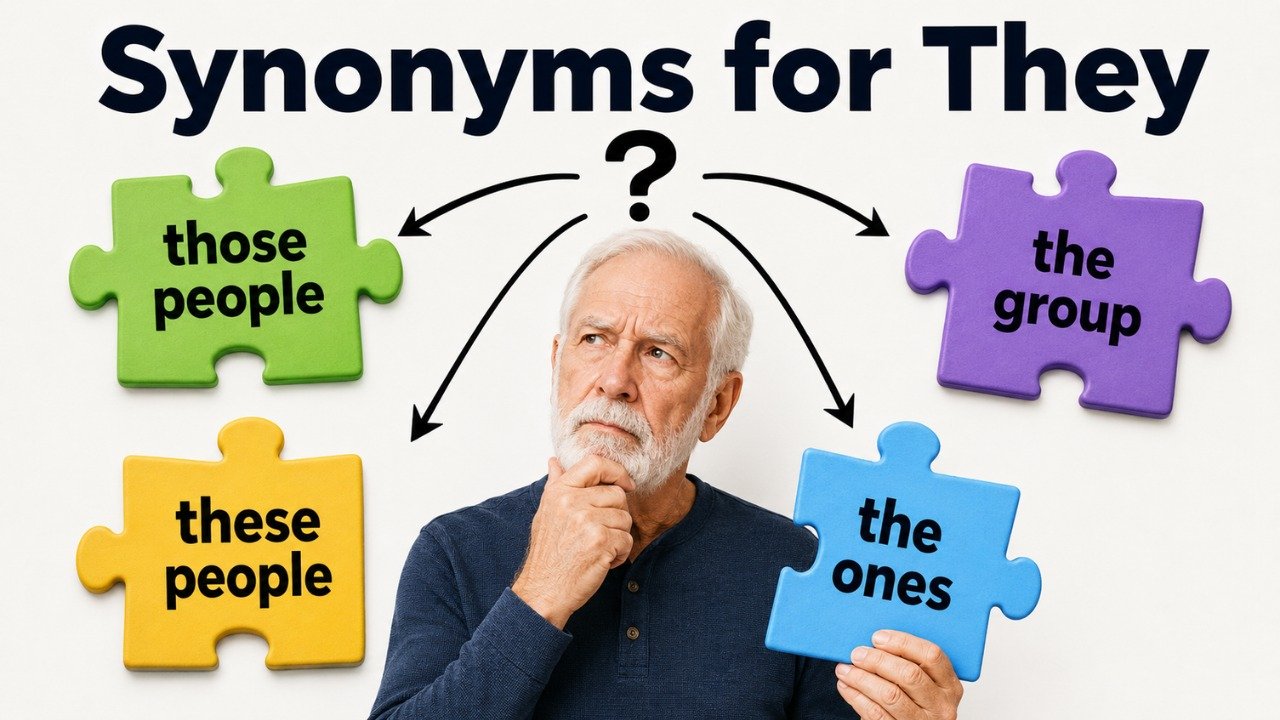
Quick Answer: Useful synonyms for they include those people, these people, the individuals, the group, the members, the team, the participants, the person, that person, and he or she. The best alternative depends on what they refers to. Use those people or the individuals for a plural group, the team or the members for a defined collective, and the person or that person for one unknown individual. In many sentences, singular they is clearer, more natural, and more inclusive than he or she.
Pronunciation and Word Details
Word: They
Pronunciation: /ðeɪ/
Part of Speech: Pronoun
Meaning: A pronoun used for two or more people or things, one person whose identity is unknown, or a person who uses they as a personal pronoun.
US Pronunciation:
UK Pronunciation:
What Does “They” Mean?
They is a pronoun used as the subject of a sentence. It most commonly refers to two or more people, animals, objects, or previously mentioned subjects.
Plural Use: The students arrived early because they wanted good seats.
They can also refer to one person when the person is unknown, unspecified, or not identified by gender.
Singular Use: Someone left their notebook, but they may return for it.
They may also refer to a known individual who uses they as a personal pronoun.
Personal Use: Alex said they would attend the meeting.
The word can sometimes refer generally to people, authorities, experts, or an unnamed group.
General Use: They say regular practice improves confidence.
Because they can have several meanings, the surrounding sentence must make its reference clear.
Meaning, Tone, and Context of “They”
They has a neutral and natural tone. It appears in casual speech, formal writing, academic work, instructions, stories, reports, emails, and everyday conversation.
As a plural pronoun, they replaces the names of multiple people or things. This prevents unnecessary repetition.
Repetitive: Maria and Emma arrived, and Maria and Emma sat near the window.
Natural: Maria and Emma arrived, and they sat near the window.
Singular they is widely used when a person is unknown or when gender is not relevant to the sentence.
Natural: If a customer needs help, they should speak to the manager.
In highly formal documents, a specific noun such as the applicant, the employee, the participant, or the customer may sometimes provide greater clarity.
Formal: The applicant must submit the form before the deadline.
They can become vague when the reader cannot identify the person or group being discussed. In such cases, repeating the exact noun is better.
When and How to Use “They”
For More Than One Person
Use they when referring to two or more people who have already been identified.
Example: The musicians finished their performance, and they thanked the audience.
For More Than One Thing
They can refer to plural animals, objects, ideas, or other nonhuman subjects.
Example: The documents are important because they contain the final results.
For an Unknown Person
Use singular they when the identity or gender of one person is unknown.
Example: Someone called earlier, but they did not leave a message.
For a General Person
They can refer to any person who fits a particular situation or condition.
Example: Every visitor should make sure they have a valid ticket.
For a Known Individual
Use they for a known person who uses they as their personal pronoun.
Example: Jordan explained that they would lead the discussion.
For Avoiding Repetition
They can replace a repeated plural noun phrase and make writing smoother.
Example: The volunteers collected the supplies, and they organized them carefully.
For General Opinions
They sometimes refers to people in general or an unnamed group.
Example: They say patience becomes easier with practice.
For Organizations in Informal Language
In conversational language, they may refer to the people running an organization.
Example: I contacted the company, and they answered my question.
In formal writing, it may be more precise to use the company, its representatives, or it.
Best Synonyms for They
Those People: A clear replacement for a previously identified group of people.
Example: Those people have already completed the registration process.
These People: A replacement for a group that is nearby or currently being discussed.
Example: These people will guide us through the building.
The Individuals: A formal alternative for separate people within a group.
Example: The individuals were asked to provide identification.
The Group: A collective term for several people considered together.
Example: The group will present its findings tomorrow.
The Members: A useful replacement when people belong to an organization, club, or team.
Example: The members approved the proposal.
The Team: A natural alternative for people working toward the same goal.
Example: The team completed the project ahead of schedule.
The Participants: A precise replacement for people taking part in an activity, event, or study.
Example: The participants answered every question.
The Person: A singular alternative when referring to one unknown or unspecified individual.
Example: The person should report the issue immediately.
That Person: A direct singular replacement when one particular individual is being discussed.
Example: That person may have additional information.
He or She: A traditional singular alternative when the gender of a person is unknown.
Example: Each applicant must confirm whether he or she can attend.
50 Synonyms for They with Short Meanings
- Those People: People previously mentioned or located farther away.
- These People: People nearby or currently being discussed.
- The People: A general group of human beings.
- The Individuals: Separate people considered within a group.
- Those Individuals: Specific people previously identified.
- These Individuals: Specific people currently being discussed.
- The Persons: A formal term for multiple individuals.
- Those Persons: A formal reference to previously identified people.
- The Group: Several people considered as one unit.
- The Members: People belonging to a team, organization, or community.
- The Team: People working together toward a shared goal.
- The Staff: People employed by an organization.
- The Workers: People performing jobs or physical tasks.
- The Employees: People employed by a business or organization.
- The Participants: People taking part in an activity or study.
- The Attendees: People present at an event or meeting.
- The Students: People studying at a school, college, or course.
- The Players: People participating in a game or sport.
- The Residents: People living in a particular place.
- The Citizens: Legal members of a country or community.
- The Customers: People purchasing goods or services.
- The Users: People using a product, system, or service.
- The Applicants: People applying for a position or opportunity.
- The Candidates: People being considered for a role or selection.
- The Guests: People invited to an event or location.
- The Visitors: People temporarily entering a place.
- The Neighbors: People living close to one another.
- The Others: Additional people apart from those already mentioned.
- Both: Two people or things considered together.
- The Pair: Two people or things treated as a unit.
- The People Involved: Those participating in a particular situation.
- Those Involved: People connected with an event or activity.
- Those Concerned: People affected by or connected with a matter.
- The People Concerned: A clear formal reference to affected individuals.
- The Group Members: People who belong to a particular group.
- The Representatives: People acting for another person or organization.
- The Authorities: People or institutions with official power.
- The Officials: People holding formal positions of authority.
- The Organizers: People responsible for arranging an activity or event.
- The Organizers Involved: The specific people managing an event or plan.
- The Person: One unknown or unspecified individual.
- That Person: One particular individual being discussed.
- The Individual: A formal term for one person.
- He or She: A traditional reference to one person of unknown gender.
- She or He: An alternative order for referring to one unknown person.
- Someone: An unknown or unspecified person.
- Somebody: An informal word for an unknown person.
- Anyone: Any person without specifying who.
- Anybody: An informal alternative meaning any person.
- The Person Concerned: The individual connected with or affected by a matter.
Read Also:
Synonyms for Kill

Synonyms for They by Context
When They Refers to More Than One Person
Useful alternatives include those people, these people, the individuals, the members, the group, and the people involved.
Choose a specific noun when the reader needs to know exactly who is being discussed.
Example: The volunteers arrived early because they wanted to prepare.
Alternative: The volunteers arrived early because the group wanted to prepare.
Example: They have already submitted the required forms.
Alternative: Those individuals have already submitted the required forms.
When They Refers to One Unknown Person
Useful alternatives include the person, that person, the individual, someone, he or she, and the person concerned.
Singular they is often more natural because it avoids repeating he or she.
Example: If someone calls, tell them they can leave a message.
Alternative: If someone calls, tell that person a message can be left.
When They Refers to a Known Person Neutrally
When referring to a known individual, the best choice is usually the person’s name, title, role, or chosen pronoun.
Example: Taylor said they would arrive at noon.
Alternative: Taylor said Taylor would arrive at noon.
The alternative is grammatically possible but repetitive. They is usually the smoother choice.
When They Refers to a Team
Use the team, the members, the players, the staff, the employees, or the group when the people share a role or purpose.
Example: They completed the assignment together.
Alternative: The team completed the assignment together.
When They Refers to Participants
Use the participants, attendees, applicants, candidates, visitors, guests, or students when the group has a clearly defined role.
Example: They answered a short questionnaire.
Alternative: The participants answered a short questionnaire.
When They Refers to an Organization
In informal language, they may refer to the people managing an organization. Formal writing may prefer the organization, the company, the committee, its representatives, or it.
Example: I contacted the office, and they replied immediately.
Formal Alternative: I contacted the office, and its representatives replied immediately.
When They Refers to People in General
They can refer to an unnamed group or people generally. Alternatives include people, experts, researchers, officials, or the authorities.
Example: They recommend checking the instructions carefully.
Alternative: Experts recommend checking the instructions carefully.
Another Word for They
There is no single replacement that works in every sentence. The best alternative depends on whether they refers to several people, one unknown person, a defined group, or an organization.
For plural use, those people is a direct alternative. For formal writing, the individuals is often suitable. For singular use, the person may work, although singular they is usually more natural. When a role is known, repeat the role instead of using a general pronoun.
Original: They will announce the results tomorrow.
Better Option: The organizers will announce the results tomorrow.
Original: They were asked to complete the survey.
Better Option: The participants were asked to complete the survey.
Original: If a customer has a complaint, they should contact the manager.
Better Option: If a customer has a complaint, the customer should contact the manager.
Original: Someone left because they felt unwell.
Better Option: Someone left because that person felt unwell.
When Not to Use “They”
Avoid they when the reader cannot identify its antecedent. An antecedent is the noun that a pronoun replaces.
Weak: When Sara spoke to Emma, they seemed worried.
Better: When Sara spoke to Emma, Sara seemed worried.
The original sentence does not show whether Sara, Emma, or both people were worried.
Avoid they when a specific role would provide more useful information.
Weak: They will review your application next week.
Better: The admissions committee will review your application next week.
Do not use they as an object pronoun. Them is the correct object form.
Weak: I invited they to the meeting.
Better: I invited them to the meeting.
Do not use they is, even when they refers to one person. Singular they still takes are.
Weak: Someone is outside, and they is waiting.
Better: Someone is outside, and they are waiting.
In formal writing, avoid using they for a singular organization when it is being treated as one entity.
Weak: The company changed their policy because they wanted clearer rules.
Better: The company changed its policy because it wanted clearer rules.
Avoid repeating they so often that the paragraph becomes confusing.
Weak: They told them that they should send them the documents.
Better: The managers told the applicants to send the documents to the review team.
Words Commonly Confused With They
They vs Them: They is a subject pronoun, while them is an object pronoun. Write “They called me” but “I called them.”
They vs Their: They refers to people or things performing an action. Their shows ownership. Write “They finished their work.”
They vs Theirs: Theirs is an independent possessive pronoun. Write “They said the seats were theirs.”
They vs Themselves: Themselves is a reflexive pronoun used when the action returns to the same people. Write “They prepared themselves.”
They vs They’re: They is a pronoun. They’re is a contraction of they are.
They vs There: They refers to people or things. There refers to a place or introduces the existence of something.
They vs He or She: They is natural and concise for one unknown person. He or she is longer and can sound more formal.
They vs It: They usually refers to multiple subjects or a person. It normally refers to one object, animal, idea, or organization.
They vs Those: They is a personal pronoun. Those is a demonstrative pronoun or determiner used to point to particular people or things.
Which Synonym Should You Choose?
Choose those people when referring clearly to a previously identified group.
Choose these people when the group is nearby or is the current focus.
Choose the individuals in formal reports, academic writing, research, or official communication.
Choose the group when several people are acting as one collective unit.
Choose the members when people belong to a committee, club, organization, or team.
Choose the team when people are cooperating toward one objective.
Choose the participants for people involved in a survey, experiment, event, discussion, or activity.
Choose the applicants when discussing people applying for a job, course, program, or opportunity.
Choose the employees or staff when referring to people working for an organization.
Choose the person or the individual when formal writing requires a clear singular noun.
Choose he or she when a traditional formal construction is required, although singular they is usually more concise.
Choose the exact role, such as customer, student, visitor, manager, or candidate, when clarity is more important than avoiding repetition.
Keep they when the alternative sounds repetitive, unnatural, unnecessarily long, or less inclusive.
Real Life Examples of “They” in Sentences
Original: The students said they needed more time.
Better Option: The students said the group needed more time.
Original: They will open the doors at nine.
Better Option: The organizers will open the doors at nine.
Original: Someone called, but they did not leave a name.
Better Option: Someone called, but that person did not leave a name.
Original: The workers finished because they followed the plan carefully.
Better Option: The workers finished because the team followed the plan carefully.
Original: They were selected for the final interview.
Better Option: The candidates were selected for the final interview.
Original: The guests arrived, and they waited in the reception area.
Better Option: The guests arrived and waited in the reception area.
Original: If an employee feels unwell, they should inform the supervisor.
Better Option: If an employee feels unwell, the employee should inform the supervisor.
Original: They answered every question in the survey.
Better Option: The participants answered every question in the survey.
Original: I contacted the office, and they responded quickly.
Better Option: I contacted the office, and its representatives responded quickly.
Original: The players celebrated because they had won the match.
Better Option: The players celebrated because the team had won the match.
Synonym Groups and Usage Differences
General Plural Group
Those people, these people, the people, the individuals, and the persons can replace they when referring to multiple people.
Those people and these people are conversational and direct. The individuals and the persons sound more formal.
Example: Those people have already received their instructions.
Collective Group
The group, the team, the members, the pair, and both refer to people considered together.
The team suggests cooperation. The pair means exactly two. Both also applies to exactly two subjects.
Example: Both have agreed to attend the meeting.
Workplace Group
The staff, employees, workers, officials, and representatives describe people according to their professional roles.
These alternatives make a sentence more precise than they.
Example: The staff will prepare the room before the event.
Participation Group
Participants, attendees, applicants, candidates, guests, and visitors refer to people involved in a particular activity or process.
Example: The attendees were asked to remain seated.
Community Group
Residents, citizens, neighbors, students, and customers identify people through location, membership, activity, or relationship.
Example: The residents requested additional security measures.
Singular Neutral Group
The person, that person, the individual, someone, and the person concerned may replace singular they.
These choices can provide clarity, but repeating them too often may make writing sound awkward.
Example: The person concerned will receive a written response.
Traditional Singular Group
He or she and she or he are traditional alternatives for referring to one person whose gender is unknown.
They are grammatically acceptable but often less concise than singular they.
Example: Each participant should confirm whether he or she can attend.
Formal Reference Group
The individuals, the persons, those concerned, the people involved, and the relevant group are useful in reports, notices, policies, and official writing.
Example: Those concerned will be contacted directly.
Antonyms of They
They does not have a true antonym because pronouns show grammatical perspective rather than opposite meanings. However, several pronouns contrast with they by referring to different people or quantities.
I: Refers to the person speaking.
We: Refers to the speaker and at least one other person.
You: Refers to the person or people being addressed.
He: Refers to one male person.
She: Refers to one female person.
It: Refers mainly to one object, animal, idea, or entity.
This Person: Refers to one specific person nearby or currently discussed.
That Person: Refers to one specific person already identified.
One: Refers generally or formally to an unspecified person.
Comparison: They vs Related Words
They vs Them
They functions as a subject. Them functions as an object.
Example With They: They invited us to the ceremony.
Example With Them: We invited them to the ceremony.
They vs Their
They performs the action. Their shows possession.
Example With They: They completed the assignment.
Example With Their: Their assignment was complete.
They vs They’re
They is a pronoun. They’re is the shortened form of they are.
Example With They: They work in the same building.
Example With They’re: They’re working in the same building.
They vs There
They refers to people or things. There refers to a place or introduces something.
Example With They: They left the books on the table.
Example With There: The books are over there.
They vs He or She
They is shorter and more natural when a person is unknown. He or she is a traditional formal construction.
Example With They: Every applicant should check that they completed the form.
Example With He or She: Every applicant should check that he or she completed the form.
They vs It
They may refer to multiple objects, multiple people, or one person. It usually refers to one object, idea, animal, or organization.
Example With They: The documents arrived, and they were complete.
Example With It: The document arrived, and it was complete.
They vs Those People
They is concise and depends on an earlier noun. Those people is more explicit and can point to a particular group.
Example With They: The visitors said they were ready.
Example With Those People: Those people said they were ready.
They vs Everyone
They refers to specific or previously mentioned people. Everyone means every person in a group.
Example With They: They received a copy of the schedule.
Example With Everyone: Everyone received a copy of the schedule.
Common Phrases and Expressions With “They”
They Say: Used to introduce a common belief, opinion, or report.
There They Are: Used when people or things have been found or noticed.
They Are the Ones: Identifies a particular group as responsible or important.
They Themselves: Adds emphasis to the people performing an action.
They All: Refers to every member of a particular group.
They Both: Refers to exactly two people or things.
They Too: Shows that the same statement applies to another group.
They Alone: Emphasizes that only those people are involved.
Who Are They: Asks for the identity of a group or person.
As They Say: Introduces a familiar expression or general opinion.
Common Mistakes to Avoid
A common mistake is using they without a clear antecedent. The reader should immediately understand which person, people, animals, or things the pronoun represents.
Another error is confusing they with them. They performs an action, while them receives the action.
Do not confuse they’re with their or there. They’re means they are, their shows ownership, and there refers to a place or introduces something.
Singular they always takes a plural verb form. Write they are, they have, and they were, even when referring to one person.
Avoid changing between singular and plural meanings without making the reference clear. A sentence should show whether they refers to one person or several people.
Do not replace every use of they with he or she. This can make sentences repetitive and less natural.
In formal writing, repeat the exact role when necessary. Words such as applicant, employee, participant, or customer may communicate the intended meaning more clearly.
Remember that role nouns are context based replacements rather than universal synonyms. The word students can replace they only when the people being discussed are students.
Conclusion
Understanding synonyms for they helps writers create clearer and more precise sentences. Use those people or the individuals for a general plural group, the team or members for a collective, and participants, applicants, or employees when a specific role is known. For one unknown person, the person and he or she are possible alternatives, although singular they is often more natural. The best replacement depends on number, identity, formality, and context. Keep they whenever it provides the clearest and smoothest wording.
FAQs About Synonyms for They
What Is the Best Synonym for They?
Those people is a useful plural alternative, while the person can replace singular they. The best choice depends on who or what the pronoun represents.
Can They Refer to One Person?
Yes. Singular they can refer to one person whose identity or gender is unknown, irrelevant, or already understood.
Is He or She a Synonym for They?
He or she can replace singular they in some sentences, but it is longer and may sound less natural.
What Is a Formal Alternative to They?
The individuals, the persons, those concerned, or a specific role such as the applicants may work in formal writing.
Can They Refer to Things?
Yes. They can refer to multiple objects, animals, ideas, documents, or other plural nouns.
Should a Singular They Use Is or Are?
Singular they takes are. Write “They are ready,” even when referring to one person.
How Can I Avoid Repeating They?
Use the exact noun, a role based term, or combine related clauses. Alternatives may include the team, participants, students, employees, or those people.
