
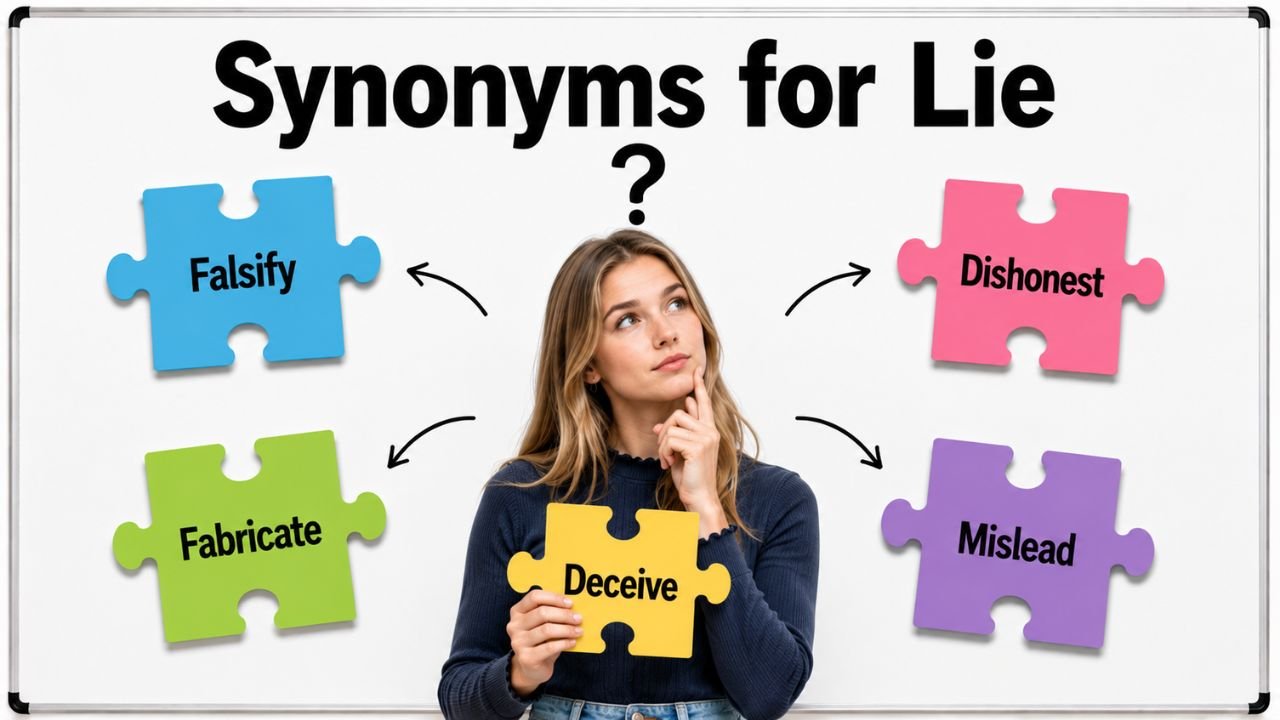
Quick Answer: The best synonyms for lie include falsehood, untruth, fib, fabrication, deception, deceit, misrepresentation, false claim, invention, and cover story. Use falsehood as a neutral general replacement, fib for a small or harmless lie, fabrication for an invented story, misrepresentation for inaccurate information, and deception for the broader act of misleading someone. When lie means resting in a flat position, suitable alternatives include recline, rest, repose, lounge, and stretch out.
Pronunciation and Word Details
Word: Lie.
Pronunciation: /laɪ/.
Part of Speech: Noun and verb.
Meaning: A false statement intended to deceive, or the act of resting in a flat or horizontal position.
US Pronunciation:
UK Pronunciation:
What Does “Lie” Mean?
Lie most commonly means a false statement that someone makes deliberately to deceive another person. It can function as both a noun and a verb.
As a noun, lie refers to the false statement itself.
Example: His explanation was a lie.
As a verb, lie means to say something that the speaker knows is not true.
Example: She lied about completing the assignment.
Lie also has a separate meaning. It can describe resting in a flat position or being located somewhere.
Example: He wanted to lie on the sofa.
Example: The village lies beyond the mountains.
The intended meaning usually becomes clear from the words surrounding lie. In writing, selecting a more specific synonym can prevent confusion and communicate whether the sentence refers to deception, physical position, or location.
Meaning, Tone, and Context of “Lie”
Lie is a direct and emotionally strong word when it refers to dishonesty. Calling a statement a lie suggests that the speaker deliberately communicated something false.
In casual conversation, lie is commonly used for everyday dishonesty.
Example: He told a lie about where he had been.
In formal writing, words such as falsehood, misrepresentation, fabrication, and deception may sound more precise.
Example: The report contained a serious misrepresentation of the facts.
In legal, professional, or academic contexts, writers should avoid calling something a lie unless deliberate dishonesty is clear. A statement may be incorrect, inaccurate, mistaken, or unsupported without being intentionally deceptive.
When lie means resting or being positioned, its tone is neutral.
Example: The documents lie on the desk.
Literary writing may use lie to describe location, existence, or an abstract source.
Example: The answer lies within the evidence.
When and How to Use “Lie”
For a Deliberate False Statement: Use lie when a person knowingly says something untrue.
Example: He told a lie to avoid responsibility.
For Minor Dishonesty: Use lie when someone gives a small false explanation or excuse.
Example: She lied about why she arrived late.
For Invented Information: Use lie when a story or claim has been completely created.
Example: The entire account was a lie.
For Misleading Others: Use lie when false information is intended to influence another person.
Example: He lied to make the offer appear more valuable.
For Resting Horizontally: Use lie when someone places their body in a flat position.
Example: She decided to lie on the bed for a few minutes.
For Describing Location: Use lie when something is situated in a particular place.
Example: A small lake lies beyond the forest.
For Abstract Sources: Use lie when describing where a cause, answer, difficulty, or responsibility exists.
Example: The main problem lies in poor communication.
Best Synonyms for Lie
Falsehood: A statement or belief that is not true.
Example: The investigation revealed several falsehoods in his account.
Untruth: Something that is false or inaccurate.
Example: She admitted that her earlier statement was an untruth.
Fib: A small lie that is usually considered less serious.
Example: He told a fib about eating the last piece of cake.
Fabrication: A completely invented statement, story, or explanation.
Example: The dramatic story was a fabrication.
Deception: The act of causing someone to believe something false.
Example: The plan depended on secrecy and deception.
Deceit: Dishonest behavior intended to mislead another person.
Example: Their relationship was damaged by years of deceit.
Misrepresentation: A false or misleading description of facts.
Example: The advertisement contained a misrepresentation of the product.
False Claim: A statement presented as true without being accurate.
Example: The witness withdrew the false claim.
Cover Story: A false explanation created to hide the truth.
Example: They invented a cover story to explain their absence.
Recline: To rest in a leaning or horizontal position.
Example: She reclined comfortably in the chair.
50 Synonyms for Lie with Short Meanings
- Falsehood: A statement that is not true.
- Untruth: Something false or inaccurate.
- Fib: A small or relatively harmless lie.
- Fabrication: A completely invented statement or story.
- Deception: The act of making someone believe something false.
- Deceit: Dishonest behavior intended to mislead.
- Misrepresentation: A misleading or inaccurate presentation of facts.
- Invention: A story or explanation created rather than reported truthfully.
- Fiction: An invented account presented as though it were real.
- False Statement: A statement that does not match the truth.
- Tall Tale: An exaggerated or unbelievable story.
- Cover Story: A false explanation used to hide the truth.
- Half Truth: A partly true statement that hides important facts.
- White Lie: A minor lie told to avoid harm or embarrassment.
- False Claim: An inaccurate statement presented as true.
- False Report: An untrue account of an event or situation.
- False Account: A misleading description of what happened.
- False Story: An invented or dishonest narrative.
- Pretense: False behavior intended to create an incorrect impression.
- Sham: Something presented as genuine when it is not.
- Hoax: A deliberate trick designed to deceive people.
- Fraud: Serious deception used for personal advantage.
- Canard: A false and often harmful report or rumor.
- Distortion: A changed version of the truth.
- Exaggeration: A statement that makes something seem greater than it is.
- Deceive: To make someone believe something false.
- Mislead: To cause someone to form an incorrect belief.
- Fabricate: To invent information or an event.
- Falsify: To change or create information dishonestly.
- Misrepresent: To describe something inaccurately or unfairly.
- Invent: To create a false story or explanation.
- Prevaricate: To avoid telling the complete truth.
- Dissemble: To hide true feelings, intentions, or facts.
- Equivocate: To use unclear language to avoid a direct truth.
- Bluff: To deceive someone by pretending to have confidence or ability.
- Feign: To pretend that a feeling, condition, or situation is real.
- Pretend: To act as though something false is true.
- Distort: To change facts so that they create a false impression.
- Conceal the Truth: To hide important and accurate information.
- Bend the Truth: To change facts slightly for personal advantage.
- Recline: To rest in a leaning or horizontal position.
- Rest: To relax the body by sitting or lying down.
- Repose: To rest peacefully in a still position.
- Lounge: To sit or lie in a relaxed way.
- Stretch Out: To extend the body while resting.
- Sprawl: To lie or sit with the body spread loosely.
- Be Recumbent: To be lying down.
- Be Situated: To exist in a particular place or position.
- Be Located: To be found in a particular place.
- Remain: To continue to exist or stay in a position.
Read Also:
Synonyms for Nose

Synonyms for Lie by Context
When Lie Means a False Statement
Use these alternatives when referring to a statement that is deliberately untrue.
Useful Synonyms: Falsehood, untruth, fib, fabrication, false claim, false statement.
Example: His excuse was a complete fabrication.
Example: She later admitted that the statement was an untruth.
When Lie Means Deception
Use these words when describing the broader act or practice of misleading another person.
Useful Synonyms: Deception, deceit, fraud, hoax, pretense, sham.
Example: The entire arrangement was based on deception.
Example: The supposed competition was a hoax.
When Lie Means Misleading Information
These alternatives work when facts have been changed, hidden, or presented unfairly.
Useful Synonyms: Misrepresentation, distortion, half truth, false report, false account.
Example: The description was a serious misrepresentation of the facts.
Example: His explanation contained several distortions.
When Lie Means to Say Something Untrue
Use these verb alternatives when describing the action of dishonesty.
Useful Synonyms: Deceive, mislead, fabricate, falsify, misrepresent, invent.
Example: The witness fabricated part of the story.
Example: The description was designed to mislead readers.
When Lie Means to Avoid the Truth
Use these alternatives when someone avoids giving a clear or complete answer.
Useful Synonyms: Prevaricate, dissemble, equivocate, conceal the truth, bend the truth.
Example: The spokesperson continued to equivocate when questioned.
Example: He bent the truth to make himself appear more experienced.
When Lie Means to Rest
Use these alternatives when lie refers to placing the body in a horizontal or relaxed position.
Useful Synonyms: Recline, rest, repose, lounge, stretch out, sprawl.
Example: She reclined on the sofa after dinner.
Example: The children stretched out on the grass.
When Lie Means to Be Located
Use these alternatives when describing where something exists or is positioned.
Useful Synonyms: Be situated, be located, remain, exist.
Example: The historic building is located near the river.
Example: The responsibility remains with the manager.
Another Word for Lie
The best single replacement for lie is falsehood when lie is used as a noun. However, deceive is more suitable when lie is used as a verb, while recline is appropriate when lie refers to resting.
Original: His explanation was a lie.
Better Option: His explanation was a falsehood.
Original: Do not lie about your experience.
Better Option: Do not misrepresent your experience.
Original: The witness decided to lie about the event.
Better Option: The witness decided to fabricate an account of the event.
Original: She wanted to lie on the sofa.
Better Option: She wanted to recline on the sofa.
When Not to Use “Lie”
Do not use lie when a person may simply be mistaken. A lie requires deliberate dishonesty.
Weak: Her incorrect answer was a lie.
Better: Her incorrect answer was a mistake.
Avoid lie in formal writing when a more precise word can identify the type of dishonesty.
Weak: The document contains lies.
Better: The document contains several factual misrepresentations.
Do not call an opinion a lie merely because you disagree with it.
Weak: His opinion about the book is a lie.
Better: His interpretation of the book differs from mine.
Avoid using lie when the statement is exaggerated but not completely false.
Weak: His description was a lie.
Better: His description was an exaggeration.
Do not use lie when you mean that someone is resting if the sentence could be misunderstood.
Unclear: She wanted to lie after the discussion.
Better: She wanted to lie down and rest after the discussion.
Words Commonly Confused With Lie
Lie vs Lay: Lie means to rest in a horizontal position and does not take a direct object. Lay means to place something somewhere and requires an object.
Example With Lie: I need to lie down.
Example With Lay: Please lay the book on the table.
Lie vs Lied: Lied is the past tense of lie when it means saying something false.
Example: He lied about his age.
Lie vs Lay as Past Tense: Lay is the past tense of lie when lie means reclining.
Present: I lie on the sofa every afternoon.
Past: I lay on the sofa yesterday.
Lie vs Falsehood: Lie often emphasizes deliberate dishonesty. Falsehood can describe any untrue statement, although it may also imply deception.
Example With Lie: He told a lie to avoid punishment.
Example With Falsehood: The article repeated an old falsehood.
Lie vs Fib: A fib is usually a small and less serious lie.
Example With Lie: The witness told a serious lie.
Example With Fib: The child told a fib about washing his hands.
Lie vs Mislead: Lie means making a deliberately false statement. Mislead can involve false statements, missing details, confusing language, or deceptive behavior.
Example With Lie: She lied about the price.
Example With Mislead: The unclear description misled several buyers.
Which Synonym Should You Choose?
Choose falsehood for a clear and neutral reference to an untrue statement.
Choose untruth when you want softer language than lie.
Choose fib for a small and relatively harmless lie.
Choose fabrication for a completely invented story, explanation, or detail.
Choose deception when discussing the general act of misleading someone.
Choose deceit when describing repeated or morally serious dishonesty.
Choose misrepresentation in formal, professional, legal, or academic writing.
Choose false claim when someone presents inaccurate information as fact.
Choose half truth when a statement includes some truth but hides important details.
Choose white lie for a minor lie intended to protect feelings or avoid embarrassment.
Choose falsify when records, evidence, data, or documents have been changed dishonestly.
Choose equivocate when someone avoids answering clearly.
Choose recline when lie means resting in a leaning or horizontal position.
Choose be located when lie describes the position of a place or object.
Real Life Examples of “Lie” in Sentences
Original: He told a lie about finishing the work.
Better Option: He told a falsehood about finishing the work.
Original: She lied about her qualifications.
Better Option: She misrepresented her qualifications.
Original: The entire explanation was a lie.
Better Option: The entire explanation was a fabrication.
Original: He told a small lie to avoid embarrassment.
Better Option: He told a fib to avoid embarrassment.
Original: The report included several lies.
Better Option: The report included several false claims.
Original: They lied to make the plan appear successful.
Better Option: They distorted the facts to make the plan appear successful.
Original: The witness continued to lie during questioning.
Better Option: The witness continued to prevaricate during questioning.
Original: She wanted to lie on the grass.
Better Option: She wanted to stretch out on the grass.
Original: The town lies near the coast.
Better Option: The town is located near the coast.
Original: The real difficulty lies in the lack of preparation.
Better Option: The real difficulty exists in the lack of preparation.
Synonym Groups and Usage Differences
Small Lie Group
Synonyms: Fib, white lie, exaggeration.
These words describe minor dishonesty or statements that may not cause serious harm.
Example: He told a fib about why he missed the meeting.
Invented Story Group
Synonyms: Fabrication, invention, fiction, tall tale, false story.
These alternatives describe information that has been created rather than truthfully reported.
Example: Her story about meeting a famous explorer was a complete fabrication.
Deliberate Deception Group
Synonyms: Deception, deceit, fraud, hoax, sham.
These words describe planned or serious attempts to mislead people.
Example: The false offer was part of a deliberate fraud.
Misleading Information Group
Synonyms: Misrepresentation, distortion, half truth, false account.
These alternatives describe information that has been changed, presented unfairly, or made incomplete.
Example: The summary was a distortion of the original statement.
Avoiding the Truth Group
Synonyms: Prevaricate, dissemble, equivocate, conceal the truth.
These words describe avoiding a direct and honest response.
Example: He began to equivocate when asked about the missing money.
Resting Position Group
Synonyms: Recline, rest, repose, lounge, stretch out, sprawl.
These alternatives relate to lying down or relaxing physically.
Example: She reclined in the chair and closed her eyes.
Antonyms of Lie
The antonyms of lie depend on whether the word refers to dishonesty, a false statement, or resting in a horizontal position.
Truth: Information that agrees with reality.
Fact: Something that can be shown to be true.
Honesty: The quality of being truthful and sincere.
Truthfulness: The habit of communicating accurate information.
Candor: Honest and direct expression.
Sincerity: Genuine and honest behavior.
Accuracy: Freedom from error or false information.
Disclosure: The act of making hidden information known.
Admission: An honest statement accepting a fact or responsibility.
Confession: An acknowledgment of something previously hidden.
Stand: To remain upright rather than lie down.
Rise: To move from a lying or seated position to an upright one.
Comparison of Lie and Related Words
Lie vs Falsehood
Lie strongly suggests deliberate dishonesty. Falsehood refers to something untrue and may sound more formal.
Example With Lie: His excuse was a deliberate lie.
Example With Falsehood: The report repeated a widely accepted falsehood.
Lie vs Fib
Lie can describe serious dishonesty. Fib usually describes a small or less harmful untruth.
Example With Lie: She told a lie during the investigation.
Example With Fib: He told a fib about eating the biscuits.
Lie vs Fabrication
Lie is a general word for deliberate untruth. Fabrication refers to a story, claim, or detail that has been completely invented.
Example With Lie: His answer was a lie.
Example With Fabrication: His entire account of the journey was a fabrication.
Lie vs Deception
Lie usually refers to a false statement. Deception includes any action, appearance, omission, or statement that misleads someone.
Example With Lie: She told a lie about the missing file.
Example With Deception: The plan relied on deception and secrecy.
Lie vs Misrepresentation
Lie is direct and often emotional. Misrepresentation is more formal and describes presenting facts inaccurately or unfairly.
Example With Lie: He lied about the condition of the house.
Example With Misrepresentation: The description was a misrepresentation of the property’s condition.
Lie vs Recline
Lie is the common general verb for resting horizontally. Recline sounds more formal and often suggests leaning back comfortably.
Example With Lie: She decided to lie on the bed.
Example With Recline: She reclined in the comfortable chair.
Common Phrases and Expressions With Lie
Tell a Lie: Say something deliberately untrue.
White Lie: A small lie intended to avoid harm or embarrassment.
Live a Lie: Build one’s life around something false or hidden.
Bold Faced Lie: A clear and shameless falsehood.
Lie Through Your Teeth: Tell an obvious or serious lie confidently.
Lie Low: Stay hidden or avoid attention.
Lie Down: Move into a flat or resting position.
Lie Ahead: Exist or happen in the future.
Lie in Wait: Remain hidden while waiting for someone or something.
Lie at the Heart of: Be the central cause or most important part of something.
Common Mistakes to Avoid
A frequent mistake is confusing lie and lay. Lie does not require an object, while lay requires something to be placed.
Incorrect: I need to lay down.
Correct: I need to lie down.
Incorrect: Please lie the papers on the desk.
Correct: Please lay the papers on the desk.
Another mistake involves the past tense. When lie means making a false statement, its past tense is lied.
Present: They lie about their progress.
Past: They lied about their progress.
When lie means resting, its past tense is lay, and its past participle is lain.
Present: She lies on the sofa.
Past: She lay on the sofa yesterday.
Past Participle: She has lain on the sofa for an hour.
Writers should not describe every incorrect statement as a lie. A person may be mistaken, confused, uninformed, or inaccurate without deliberately deceiving anyone.
Avoid vague accusations in formal writing. Instead of writing that a person lied, identify the specific false claim, misrepresentation, or unsupported statement.
Conclusion
Understanding synonyms for lie helps you describe dishonesty, false information, and physical position more accurately. Use falsehood for a general untrue statement, fib for minor dishonesty, fabrication for an invented story, and misrepresentation for formal writing. Choose deception when referring to a broader effort to mislead. When lie means resting, use recline, rest, repose, or stretch out. The best alternative always depends on the intended meaning, seriousness, tone, and sentence context.
FAQs About Synonyms for Lie
What Is the Best Synonym for Lie?
Answer: Falsehood is the best general synonym when lie means an untrue statement. Recline is suitable when lie means resting horizontally.
What Is a Formal Synonym for Lie?
Answer: Formal alternatives include falsehood, fabrication, misrepresentation, deception, and falsification.
What Is a Softer Word for Lie?
Answer: Untruth and fib sound softer than lie. Fib is most suitable for a minor and relatively harmless false statement.
What Is the Difference Between a Lie and a Fib?
Answer: A lie may be serious or harmful, while a fib is usually small, informal, and less damaging.
Can Misrepresentation Mean Lie?
Answer: Yes. Misrepresentation can describe a false or misleading presentation of facts, especially in formal or professional contexts.
What Is Another Word for Lying Down?
Answer: Reclining, resting, reposing, lounging, stretching out, and sprawling are useful alternatives for lying down.
What Is the Past Tense of Lie?
Answer: Lied is the past tense when lie means speaking falsely. Lay is the past tense when lie means resting in a horizontal position.
