
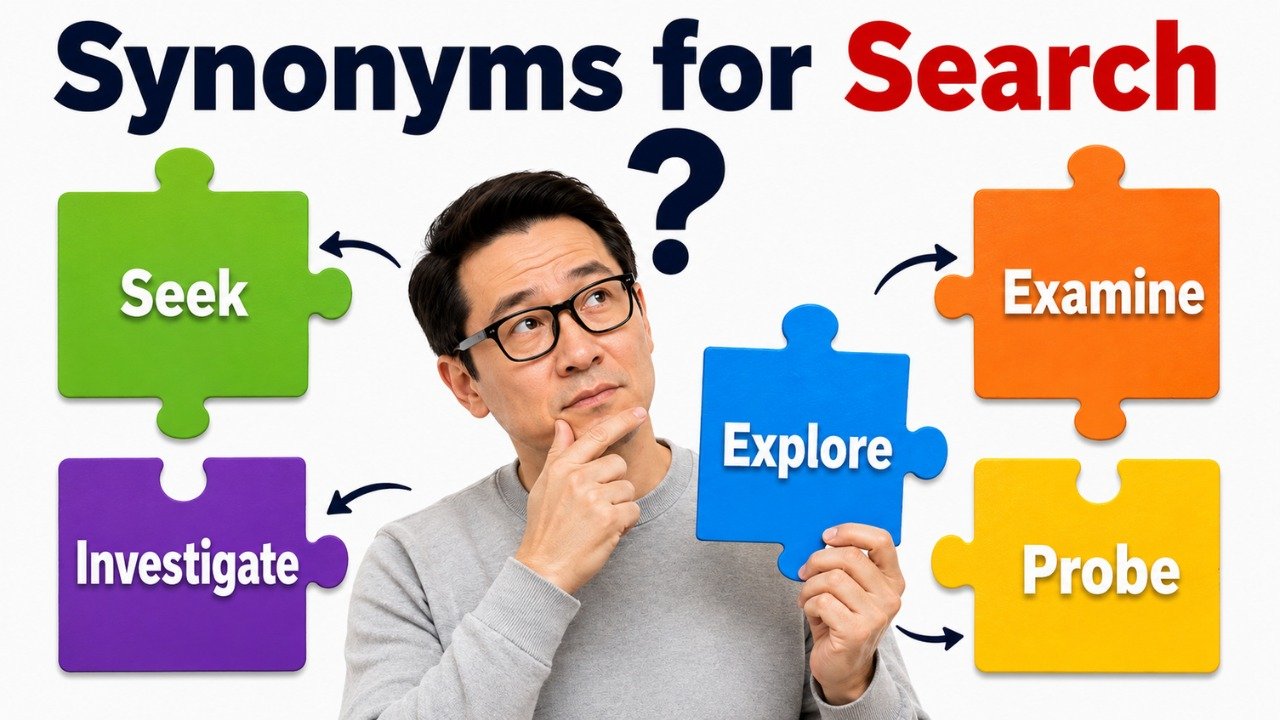
Quick Answer: Synonyms for search include seek, explore, investigate, examine, inspect, scan, research, hunt, browse, and look for. Use seek when trying to obtain something, investigate for a careful study, examine for close attention, scan for a quick review, and hunt for an active attempt to find something. Search works in formal writing, casual conversation, digital tasks, academic research, criminal investigations, and descriptions of personal discovery.
Pronunciation and Word Details
Word: Search.
Pronunciation: /sɜːrtʃ/
Part of Speech: Noun and verb.
Meaning: To look carefully for a person, object, answer, place, or piece of information.
US Pronunciation:
UK Pronunciation:
What Does “Search” Mean?
Search means to try to find someone or something by looking carefully, checking possible locations, or examining available information.
As a verb, search describes the action of looking. You may search a room, search for an answer, or search through a collection of documents.
As a noun, search refers to the process or effort involved in finding something. A person may begin a search, conduct a search, or continue a search for missing information.
The word can describe physical actions, intellectual research, digital information retrieval, police activity, and personal efforts to discover meaning or opportunity.
Physical Context: They searched the house for the missing keys.
Information Context: She searched for reliable information about the subject.
Research Context: The team searched the records for evidence.
Personal Context: He spent years searching for a clear sense of purpose.
Meaning, Tone, and Context of “Search”
Search is generally a neutral word. It can sound casual, formal, technical, serious, or emotional depending on the sentence.
In everyday conversation, search often means looking for an object, location, or answer.
Example: I searched every drawer for the receipt.
In academic and professional writing, search may describe research, investigation, examination, or information retrieval.
Example: The researchers conducted a detailed search of the available literature.
In legal or security contexts, search can describe an official inspection of a person, property, vehicle, or location.
Example: The officers carried out a careful search of the building.
In emotional or reflective writing, search may refer to a desire for purpose, truth, happiness, identity, or belonging.
Example: Her journey became a search for peace and understanding.
The word is direct and widely understood, but a more specific synonym can make writing clearer.
When and How to Use “Search”
For Finding an Object
Use search when someone is making an effort to locate a missing or needed object.
Example: We searched the office for the missing folder.
For Seeking Information
Use search when looking through records, books, documents, or other information.
Example: She searched the database for the customer’s order.
For Research
Use search when gathering facts, evidence, sources, or explanations.
Example: The student searched for information about ancient architecture.
For Investigation
Use search when examining a place, event, or situation carefully.
Example: Investigators searched the area for additional evidence.
For Personal Discovery
Use search when describing an effort to find purpose, identity, hope, or direction.
Example: He traveled widely in search of inspiration.
For Digital Information
Use search when entering a word or phrase to locate information electronically.
Example: Search the document for the customer’s name.
For Careful Examination
Use search when looking closely at a face, expression, room, or written passage.
Example: She searched his expression for a sign of doubt.
Best Synonyms for Search
Seek: To try to find, obtain, or achieve something.
Example: Many graduates seek opportunities that match their skills.
Explore: To examine a subject, place, or possibility in order to learn more.
Example: The researchers explored several possible explanations.
Investigate: To examine facts or events carefully to discover the truth.
Example: The committee investigated the cause of the problem.
Examine: To inspect or study something closely.
Example: The doctor examined the patient’s injured hand.
Inspect: To check something carefully for faults, damage, or important details.
Example: The engineer inspected the equipment before use.
Scan: To look over something quickly in order to find specific information.
Example: She scanned the list for her name.
Research: To study a subject systematically and gather information.
Example: The writer researched the historical setting of the story.
Hunt: To make an active and sometimes difficult effort to find something.
Example: They hunted for an affordable apartment near the office.
Browse: To look through information or items without examining everything closely.
Example: He browsed the shelves for a useful reference book.
Look For: To try to find a person, thing, answer, or opportunity.
Example: I am looking for a quieter place to work.
50 Synonyms for Search with Short Meanings
- Seek: Try to find or obtain something.
- Explore: Examine something to learn more about it.
- Investigate: Study facts carefully to discover the truth.
- Examine: Look at something closely.
- Inspect: Check carefully for details or problems.
- Scan: Look over something quickly.
- Research: Gather and study information systematically.
- Hunt: Make an active effort to find something.
- Browse: Look through items or information casually.
- Look For: Try to locate someone or something.
- Look Up: Find a specific fact or piece of information.
- Probe: Investigate deeply and carefully.
- Inquire: Ask for information about something.
- Quest: Make a determined search for something important.
- Pursue: Continue trying to find or achieve something.
- Trace: Follow signs, records, or movements to find something.
- Track: Follow the progress or location of something.
- Check: Look at something to confirm its condition or accuracy.
- Review: Examine information again or carefully.
- Study: Examine a subject to gain knowledge.
- Survey: Examine an area, group, or subject broadly.
- Scrutinize: Examine something very closely.
- Comb: Search an area thoroughly.
- Scour: Search widely and carefully.
- Sift: Examine many items to find what is useful.
- Rummage: Search through mixed or disorganized items.
- Explore For: Investigate possibilities while trying to find something.
- Canvass: Search an area or ask many people for information.
- Query: Request or search for specific information.
- Retrieve: Find and bring back stored information or an object.
- Discover: Find something previously unknown or hidden.
- Detect: Notice or find something difficult to observe.
- Locate: Find the exact position of something.
- Identify: Find and recognize a person, object, or fact.
- Uncover: Discover something hidden or unknown.
- Unearth: Find something buried, forgotten, or concealed.
- Ferret Out: Discover something through determined searching.
- Root Out: Search for and find something hidden.
- Search Through: Examine the contents of something carefully.
- Look Around: Examine a place to find something.
- Look Into: Investigate a subject or problem.
- Follow Up: Continue investigating after receiving information.
- Audit: Examine records or systems carefully.
- Screen: Check people, objects, or information using set criteria.
- Monitor: Observe continuously to notice changes or results.
- Verify: Search for evidence that confirms something.
- Assess: Examine something to understand its condition or value.
- Analyze: Study details to understand meaning or structure.
- Reconnoiter: Examine an area to gather information.
- Delve Into: Investigate a subject deeply.
Read Also:
Synonyms for Violent

Synonyms for Search by Context
When Search Means Trying to Find Something
Seek, look for, hunt, locate, pursue, and track are useful when the goal is to find a person, object, opportunity, or result.
Seek: Best for formal or purposeful efforts.
Example: The organization seeks qualified applicants.
Look For: Best for simple everyday situations.
Example: I am looking for my glasses.
Hunt: Best for an active or difficult search.
Example: We hunted for a suitable venue.
Locate: Best when finding an exact position.
Example: The technician located the damaged cable.
When Search Means Studying Information
Research, study, examine, analyze, review, and look up are suitable when finding facts or developing knowledge.
Research: Best for systematic information gathering.
Example: She researched the topic before writing her report.
Study: Best for careful learning.
Example: The team studied previous sales results.
Look Up: Best for finding one specific fact.
Example: He looked up the meaning of the unfamiliar word.
Review: Best for checking existing information.
Example: Please review the records before the meeting.
When Search Means Investigating
Investigate, probe, inspect, scrutinize, look into, and audit describe careful attempts to find facts, causes, errors, or evidence.
Investigate: Best for discovering the cause or truth.
Example: Officials investigated the unexpected system failure.
Probe: Best for a deep and focused investigation.
Example: The panel probed the reasons behind the decision.
Inspect: Best for checking physical conditions or quality.
Example: The mechanic inspected the engine.
Scrutinize: Best for extremely careful examination.
Example: The editor scrutinized every sentence.
When Search Means Looking Quickly
Scan, browse, check, survey, and look around work when the examination is quick, broad, or informal.
Scan: Best when trying to notice one detail quickly.
Example: She scanned the menu for vegetarian dishes.
Browse: Best for casual exploration.
Example: He browsed several books before choosing one.
Survey: Best for observing a whole area or situation.
Example: The manager surveyed the room before speaking.
When Search Means Looking Thoroughly
Comb, scour, sift, rummage, search through, and ferret out emphasize effort and attention.
Comb: Best for searching an area methodically.
Example: Volunteers combed the field for the missing bracelet.
Scour: Best for searching many places carefully.
Example: She scoured the shops for the right fabric.
Sift: Best for sorting through large amounts of material.
Example: The researcher sifted through hundreds of documents.
Rummage: Best for searching through untidy objects.
Example: He rummaged through the cupboard for a flashlight.
When Search Means Personal Discovery
Seek, explore, pursue, quest, delve into, and discover work well for abstract goals such as truth, happiness, meaning, or identity.
Seek: Best for a serious personal goal.
Example: She sought peace after a difficult year.
Explore: Best for considering new ideas or possibilities.
Example: He explored several possible career paths.
Quest: Best for a long and meaningful journey.
Example: The story follows her quest for freedom.
Another Word for Search
The best single replacement for search is often seek, especially when someone is trying to find, obtain, or achieve something. However, the strongest alternative depends on whether the search involves an object, information, evidence, or a personal goal.
Original: The company is searching for an experienced designer.
Better Option: The company is seeking an experienced designer.
Original: The team searched the records for errors.
Better Option: The team examined the records for errors.
Original: Officials searched the cause of the incident.
Better Option: Officials investigated the cause of the incident.
Original: She searched the list quickly for her name.
Better Option: She scanned the list quickly for her name.
When Not to Use “Search”
Search can sound too general when a more precise verb would explain how someone is looking.
When Describing Formal Research
Use research, examine, analyze, or investigate when the process involves careful academic or professional study.
Weak: The scientist searched the effects of the treatment.
Better: The scientist researched the effects of the treatment.
When Checking Something Quickly
Use scan or check when the action is brief.
Weak: She searched the page for the date.
Better: She scanned the page for the date.
When Examining Quality or Condition
Use inspect when checking an object for damage or faults.
Weak: The mechanic searched the brakes.
Better: The mechanic inspected the brakes.
When Trying to Obtain Something
Use seek when the goal is an opportunity, answer, service, or result.
Weak: The company is searching financial advice.
Better: The company is seeking financial advice.
When Describing a Casual Action
Look for may sound more natural in ordinary conversation.
Weak: I am searching my keys.
Better: I am looking for my keys.
When Search Becomes Repetitive
Repeated use can make writing sound mechanical.
Weak: We searched the room, searched the shelves, and searched the drawers.
Better: We examined the room, checked the shelves, and rummaged through the drawers.
Words Commonly Confused With Search
Search vs Seek: Search often focuses on the act of looking, while seek focuses on the goal of finding or obtaining something.
Search vs Research: Search means trying to find something, while research involves systematic study and information gathering.
Search vs Explore: Search has a specific target, while explore can involve learning without knowing exactly what will be found.
Search vs Investigate: Search means looking for something, while investigate means examining facts to discover a cause or truth.
Search vs Examine: Search aims to locate something, while examine aims to understand or evaluate something closely.
Search vs Inspect: Search involves finding, while inspect involves checking condition, quality, safety, or accuracy.
Search vs Scan: Search can be detailed, while scan usually means looking quickly for one important detail.
Search vs Browse: Search often has a clear goal, while browse is usually casual and open ended.
Search vs Hunt: Both involve finding something, but hunt suggests stronger effort, difficulty, or competition.
Search vs Locate: Search describes the process, while locate describes successfully finding the position.
Which Synonym Should You Choose?
Choose seek when describing a formal effort to find, obtain, or achieve something.
Choose look for in natural, casual conversation.
Choose research when gathering detailed information for an essay, report, project, or study.
Choose investigate when trying to discover the cause of an event, problem, or suspicious activity.
Choose examine when studying an object, document, person, or idea closely.
Choose inspect when checking quality, safety, damage, or condition.
Choose scan when looking quickly for a name, date, phrase, or detail.
Choose browse when exploring items or information casually.
Choose hunt when the search requires determination or considerable effort.
Choose locate when the exact position of something must be found.
Choose scrutinize when extremely close attention is required.
Choose analyze when studying information to understand patterns, meaning, or results.
Choose query when requesting particular information from a system or collection of data.
Choose explore when considering possibilities, ideas, places, or opportunities.
Real Life Examples of “Search” in Sentences
Original: We searched the entire house for the missing document.
Better Option: We combed the entire house for the missing document.
Original: She searched the report for the final figure.
Better Option: She scanned the report for the final figure.
Original: The police searched the cause of the accident.
Better Option: The police investigated the cause of the accident.
Original: He searched several websites for information.
Better Option: He researched the topic using several resources.
Original: The engineer searched the machine for damage.
Better Option: The engineer inspected the machine for damage.
Original: I searched for a better solution.
Better Option: I sought a better solution.
Original: They searched through old boxes in the garage.
Better Option: They rummaged through old boxes in the garage.
Original: The manager searched the records carefully.
Better Option: The manager scrutinized the records carefully.
Original: She searched different career possibilities.
Better Option: She explored different career possibilities.
Original: The rescue team searched for the lost hikers.
Better Option: The rescue team tracked the lost hikers.
Synonym Groups and Usage Differences
Finding Group
Seek, look for, locate, hunt, track, and pursue describe attempts to find a person, thing, opportunity, or result.
Seek is formal. Look for is conversational. Locate emphasizes the result. Hunt suggests difficulty. Track involves following signs or movement.
Example: The team tracked the shipment until it reached its destination.
Research Group
Research, study, review, analyze, query, and look up relate to information gathering.
Research is systematic. Study involves learning. Review means checking existing material. Analyze focuses on meaning and structure. Look up is used for one fact.
Example: She looked up the publication date before completing the citation.
Investigation Group
Investigate, probe, inspect, audit, scrutinize, and look into describe careful examination.
Investigate finds causes. Probe goes deeper. Inspect checks condition. Audit examines records or systems. Scrutinize involves intense attention.
Example: The accountant audited the financial records.
Quick Review Group
Scan, browse, check, survey, and look around describe brief or broad observation.
Scan is quick and targeted. Browse is casual. Check confirms something. Survey gives a broad view.
Example: He scanned the schedule for the next available appointment.
Thorough Search Group
Comb, scour, sift, rummage, ferret out, and root out emphasize effort.
Comb is methodical. Scour covers many locations. Sift separates useful information. Rummage involves mixed objects. Ferret out means discovering something concealed.
Example: Investigators sifted through the evidence for useful details.
Discovery Group
Explore, discover, uncover, unearth, delve into, and quest relate to finding new knowledge or hidden information.
Explore is open and curious. Discover means finding something new. Uncover reveals something hidden. Delve into means investigating deeply.
Example: The documentary delves into the history of the community.
Antonyms of Search
The opposite of search depends on whether search means looking, investigating, or trying to obtain something.
Ignore: Give no attention to something.
Overlook: Fail to notice or examine something.
Disregard: Deliberately pay no attention.
Abandon: Stop trying to find or achieve something.
Avoid: Stay away from something instead of examining it.
Neglect: Fail to give proper attention.
Dismiss: Decide something is not worth considering.
Forget: Stop remembering or trying to find something.
Conceal: Hide something rather than reveal or discover it.
Lose: Become unable to find or keep something.
Miss: Fail to notice or locate something.
Hide: Put something where it cannot easily be found.
Comparison: Search vs Related Words
Search vs Seek
Search emphasizes the activity of looking. Seek emphasizes the goal of finding, receiving, or achieving.
Example With Search: They searched the building for the missing file.
Example With Seek: They sought professional advice about the problem.
Search vs Research
Search can be a simple attempt to find something. Research is a structured process of gathering and evaluating information.
Example With Search: She searched for the author’s name.
Example With Research: She researched the author’s early life.
Search vs Explore
Search usually has a specific target. Explore involves examining possibilities or learning more without a fixed result.
Example With Search: He searched for a cheaper apartment.
Example With Explore: He explored several neighborhoods before moving.
Search vs Investigate
Search focuses on locating something. Investigate focuses on discovering facts, causes, or responsibility.
Example With Search: Officers searched the field for evidence.
Example With Investigate: Officers investigated how the incident occurred.
Search vs Examine
Search is used when trying to find something. Examine is used when studying something closely.
Example With Search: She searched the document for a date.
Example With Examine: She examined the document for signs of alteration.
Search vs Inspect
Search aims to locate an item or detail. Inspect aims to evaluate condition, quality, safety, or accuracy.
Example With Search: He searched the vehicle for his wallet.
Example With Inspect: He inspected the vehicle for mechanical problems.
Search vs Scan
Search may be careful and extended. Scan is usually quick and focused.
Example With Search: She searched the entire report for supporting evidence.
Example With Scan: She scanned the report for the total cost.
Search vs Browse
Search often has a particular goal. Browse means looking casually without a definite target.
Example With Search: He searched for a book about gardening.
Example With Browse: He browsed the gardening section.
Search vs Hunt
Search is neutral, while hunt suggests greater effort, urgency, or difficulty.
Example With Search: We searched for a suitable table.
Example With Hunt: We hunted for a rare antique table.
Common Phrases and Expressions With “Search”
Search For Answers: Try to find explanations or solutions.
Search for Meaning: Try to understand purpose or significance.
Search for Truth: Attempt to discover accurate facts.
Search for Evidence: Look for information that proves something.
Search the Area: Examine a particular place carefully.
Search Through Records: Examine stored documents or information.
In Search Of: Trying to find or obtain something.
Conduct a Search: Organize and carry out a formal effort to find something.
Begin a Search: Start looking for someone or something.
Continue the Search: Keep trying to find something.
End the Search: Stop looking because the goal was achieved or abandoned.
Narrow the Search: Reduce the number of possibilities being examined.
Expand the Search: Look across a wider area or range of information.
Thorough Search: A careful and complete effort to find something.
Online Search: An attempt to find information using a digital system.
Common Mistakes to Avoid
Using Search Without the Correct Preposition
Use search for before the object being sought. Use search without for when naming the place or object being examined.
Incorrect: She searched her keys.
Correct: She searched for her keys.
Correct: She searched the drawer for her keys.
Confusing Search With Research
Research is more suitable for detailed academic or professional study.
Incorrect: We searched the effects of climate on the material.
Correct: We researched the effects of climate on the material.
Using Search When Inspect Is More Accurate
Inspect should be used when checking condition, quality, or safety.
Less Accurate: The technician searched the device for damage.
Better: The technician inspected the device for damage.
Repeating Search Too Often
Use context specific alternatives to improve clarity and rhythm.
Repetitive: She searched the report, searched the records, and searched the files.
Improved: She examined the report, reviewed the records, and scanned the files.
Choosing an Overly Strong Synonym
Scour, hunt, scrutinize, and probe suggest greater effort than a normal search.
Unnatural: I scoured my pocket for a coin.
Natural: I checked my pocket for a coin.
Confusing Browse With Search
Browse suggests casual exploration, while search usually has a clear target.
Example: She browsed the shelves without looking for a particular title.
Example: She searched the shelves for a medical dictionary.
Using Search Vaguely
Explain what is being sought and where the search occurs.
Vague: They completed the search.
Clear: They completed the search for missing documents in the storage room.
Conclusion
Synonyms for search can make descriptions more precise and natural. Use seek for formal goals, look for in everyday speech, research for detailed study, and investigate when discovering causes or facts. Scan works for a quick review, inspect for checking condition, and hunt for a difficult effort. Explore is useful for ideas and possibilities, while locate emphasizes successfully finding a position. Choosing the right alternative helps readers understand the purpose, depth, and method of the search.
FAQs About Synonyms for Search
What Is the Best Synonym for Search?
Seek is one of the best general synonyms, especially when trying to find, obtain, or achieve something. Look for is more natural in casual speech.
What Is a Formal Synonym for Search?
Seek, investigate, examine, research, and scrutinize are suitable formal alternatives. The correct choice depends on the purpose of the search.
What Is Another Word for Search for Information?
Research is best for detailed information gathering. Look up works when finding one fact, while query is suitable for requesting specific information.
What Is a Casual Synonym for Search?
Look for is the most natural casual alternative. Check, browse, and look around may also work in everyday situations.
What Is the Difference Between Search and Seek?
Search emphasizes looking through places or information. Seek emphasizes the goal of finding, obtaining, or achieving something.
Can Explore Be a Synonym for Search?
Yes. Explore works when examining possibilities, places, ideas, or subjects. It may not fit when looking for one specific missing object.
What Is a Synonym for Searching Carefully?
Examine, inspect, scrutinize, comb, scour, and investigate can describe careful searching. Scrutinize suggests especially close attention.
