
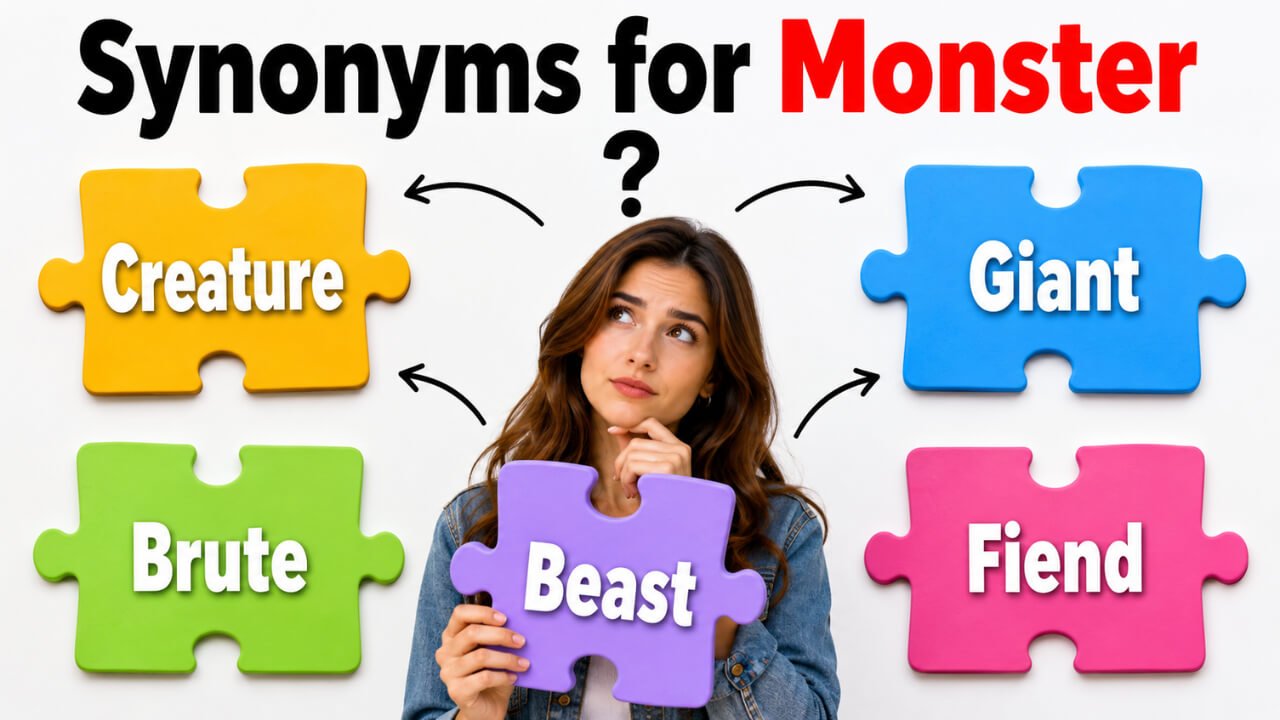
Quick Answer: The best synonyms for monster include creature, beast, fiend, demon, ogre, monstrosity, villain, tyrant, behemoth, and colossus. Use creature as a neutral general term, beast for a frightening animal, and demon or ogre for supernatural or imaginary beings. Fiend and villain describe cruel people, while monstrosity refers to something shocking, ugly, or unnatural. Behemoth and colossus are suitable when monster describes something extremely large or powerful.
Pronunciation and Word Details
Word: Monster
Pronunciation: /ˈmɒn.stər/
Part of Speech: Noun
Meaning: A frightening imaginary creature, a cruel person, or something unusually large and powerful.
US Pronunciation:
UK Pronunciation:
What Does “Monster” Mean?
Monster means a frightening, unnatural, or imaginary creature. It can also describe a person who behaves with extreme cruelty or something that is unusually large, powerful, or difficult to control.
Monster is mainly used as a noun. In stories, it refers to creatures such as dragons, ogres, demons, or strange beasts. When used for a person, it expresses strong moral judgment and suggests cruelty or inhuman behavior.
The word can also be used informally to describe the size or power of an object, machine, storm, task, or problem.
Imaginary Creature: The monster lived inside a dark cave.
Cruel Person: The ruler was remembered as a heartless monster.
Enormous Object: A monster of a machine stood beside the warehouse.
Serious Problem: The small disagreement developed into a monster.
Powerful Force: The storm became a monster before reaching the coast.
Meaning, Tone, and Context of “Monster”
Monster is usually a strong and emotional word. Its tone may be frightening, critical, dramatic, imaginative, or informal, depending on the context.
In fiction, fantasy, and storytelling, monster describes a dangerous or unusual creature. The tone may be scary, mysterious, or entertaining.
When applied to a person, monster is highly negative. It suggests that the person is cruel, violent, heartless, or morally shocking. Because it is such a powerful judgment, it should not be used casually in formal or factual writing.
In informal language, monster can describe something impressively large or powerful. A person might describe a huge vehicle, difficult project, powerful storm, or enormous meal as a monster.
Neutral Storytelling Tone: The creature was presented as a mysterious monster.
Frightening Tone: A terrifying monster emerged from the shadows.
Critical Tone: Only a monster could behave with such cruelty.
Informal Tone: They built a monster of an engine.
Figurative Tone: Fear can become a monster when it is left uncontrolled.
When and How to Use “Monster”
For an Imaginary Creature
Use monster when describing a frightening, unnatural, magical, or legendary being.
Example: The children listened to a story about a monster beneath the mountain.
For a Cruel Person
Monster can describe someone whose actions are considered extremely cruel, violent, or inhuman.
Example: The villagers viewed the brutal ruler as a monster.
For Something Extremely Large
In informal language, monster can refer to an object, machine, animal, or project of unusual size.
Example: The workers used a monster of a crane to lift the heavy structure.
For a Powerful Force
Monster may describe a storm, wave, fire, or other force that is exceptionally powerful and dangerous.
Example: The small storm developed into a monster overnight.
For a Serious Problem
The word can describe a problem that has become complicated, overwhelming, or difficult to manage.
Example: A simple accounting error turned into a financial monster.
For a Frightening Feeling
Monster can represent fear, anger, jealousy, or another harmful emotion in figurative writing.
Example: His jealousy became a monster that damaged every relationship.
For Impressive Ability
In very informal conversation, monster can describe a person with exceptional strength, skill, or energy.
Example: She is a monster on the training field.
This use can sound exaggerated, so it is better suited to casual speech than formal writing.
Best Synonyms for Monster
Creature
Synonym: A living or imaginary being, especially one whose exact nature is unknown.
Example: A strange creature appeared near the edge of the forest.
Beast
Synonym: A large, dangerous, or frightening animal or imaginary being.
Example: The fearless knight faced the beast alone.
Fiend
Synonym: An evil creature or an extremely cruel person.
Example: The story describes the villain as a merciless fiend.
Demon
Synonym: An evil supernatural being found in religious traditions, legends, or fiction.
Example: The ancient tale tells of a demon trapped beneath the ruins.
Ogre
Synonym: A large and frightening imaginary creature or a cruel person.
Example: The ogre guarded the entrance to the hidden kingdom.
Monstrosity
Synonym: Something extremely ugly, unnatural, shocking, or badly designed.
Example: The abandoned structure looked like a concrete monstrosity.
Villain
Synonym: A wicked character or a person responsible for harmful actions.
Example: The villain attempted to take control of the kingdom.
Tyrant
Synonym: A cruel ruler who uses power unfairly or violently.
Example: The people eventually rebelled against the tyrant.
Behemoth
Synonym: Something enormous, powerful, and difficult to control.
Example: The cargo ship was a steel behemoth.
Colossus
Synonym: A person, creature, organization, or object of enormous size or influence.
Example: The machine stood like a mechanical colossus above the workers.
50 Synonyms for Monster with Short Meanings
- Creature: A living or imaginary being.
- Beast: A large or dangerous animal or creature.
- Brute: A violent, cruel, or physically powerful being.
- Fiend: An evil creature or cruel person.
- Demon: An evil supernatural being.
- Devil: A wicked supernatural being or cruel person.
- Ogre: A large imaginary creature or frightening person.
- Giant: A person or creature of enormous size.
- Colossus: Something extremely large or influential.
- Titan: A being or person of great size, strength, or power.
- Behemoth: An enormous and powerful creature or object.
- Leviathan: A gigantic creature or extremely large thing.
- Monstrosity: Something unnatural, ugly, or shocking.
- Abomination: Something regarded with intense disgust or horror.
- Horror: A frightening being, experience, or sight.
- Terror: Something or someone that causes intense fear.
- Nightmare: A frightening situation, person, or creature.
- Freak: An unusual or abnormal fictional creature.
- Mutant: A fictional being changed through mutation.
- Goblin: A small and often harmful imaginary creature.
- Troll: A frightening creature from traditional stories.
- Ghoul: An evil being associated with death and graveyards.
- Dragon: A large legendary creature often shown breathing fire.
- Chimera: A mythical creature made from different animal parts.
- Bogeyman: An imaginary creature used to represent fear.
- Apparition: A strange or frightening supernatural figure.
- Specter: A ghostly and disturbing figure.
- Phantom: A mysterious ghost or imaginary presence.
- Villain: A wicked person or harmful fictional character.
- Tyrant: A cruel person who abuses power.
- Cruel Person: Someone who deliberately causes pain or suffering.
- Bully: A person who intimidates or harms weaker people.
- Sadist: A person who takes pleasure in another person’s suffering.
- Predator: Someone or something that hunts or exploits others.
- Menace: A dangerous person, creature, or problem.
- Threat: Someone or something likely to cause harm.
- Evildoer: A person who commits wicked actions.
- Wrongdoer: Someone who acts illegally or immorally.
- Tormentor: A person who repeatedly causes pain or distress.
- Despot: A ruler who exercises cruel and unlimited power.
- Oppressor: Someone who treats people unfairly and cruelly.
- Persecutor: A person who repeatedly mistreats others.
- Hulk: A very large and heavy person or object.
- Juggernaut: A huge and powerful force that is difficult to stop.
- Mammoth: Something unusually large or demanding.
- Whopper: An informally described object of remarkable size.
- Goliath: A person, creature, or organization of enormous power.
- Mythical Beast: A frightening creature from myths or legends.
- Supernatural Creature: A being believed to exist beyond nature.
- Fearsome Being: A creature or person that inspires great fear.
Read Also:
Synonyms for Agree
Synonyms for Monster by Context
When Monster Means a Frightening Creature
Creature, beast, brute, horror, terror, and fearsome being describe something frightening or dangerous.
Creature is the most neutral option. Beast suggests physical danger or wild behavior. Horror and terror place greater emphasis on the fear caused by the being.
Example: A strange creature moved through the darkness.
Example: The warriors prepared to fight the enormous beast.
Example: The figure in the doorway was a terrifying horror.
When Monster Means an Imaginary Being
Demon, devil, ogre, goblin, troll, ghoul, dragon, chimera, and bogeyman are useful for fantasy, myths, legends, and supernatural stories.
These words are not interchangeable because each represents a different type of fictional being. Dragon suggests a large reptile like creature, while goblin usually refers to a smaller and mischievous being. Ogre commonly describes a large and violent humanlike creature.
Example: An ogre lived beyond the northern forest.
Example: The legend described a dragon guarding the treasure.
Example: Villagers believed a ghoul wandered through the ruins.
When Monster Means a Cruel Person
Fiend, brute, villain, tyrant, bully, tormentor, despot, oppressor, and persecutor describe harmful people.
Fiend and brute are highly emotional. Villain is common in stories but can also describe a real wrongdoer. Tyrant and despot are suitable for cruel rulers. Oppressor and persecutor focus on repeated unfair treatment.
Example: The cruel ruler became known as a tyrant.
Example: The bully made the younger students feel unsafe.
Example: The novel presents him as a heartless villain.
When Monster Means Something Extremely Large
Giant, colossus, titan, behemoth, leviathan, hulk, mammoth, juggernaut, whopper, and goliath describe exceptional size, power, or influence.
Giant is the most widely understood choice. Behemoth and leviathan create a stronger dramatic effect. Mammoth can describe a large task, project, object, or cost. Whopper is informal and often playful.
Example: The ship was a steel behemoth.
Example: Completing the building was a mammoth task.
Example: A mechanical colossus stood in the center of the factory.
When Monster Means Something Ugly or Shocking
Monstrosity, abomination, horror, nightmare, and freak can describe something disturbing, unnatural, badly designed, or morally offensive.
Monstrosity is often used for an ugly building, machine, creation, or creature. Abomination expresses intense moral disgust. Nightmare refers to a frightening or extremely difficult situation.
Example: The unfinished building had become an architectural monstrosity.
Example: The journey turned into a complete nightmare.
When Monster Means a Dangerous Problem
Menace, threat, terror, nightmare, juggernaut, and destructive force can describe an overwhelming danger or problem.
Menace usually refers to something that creates continuing danger. Threat focuses on the possibility of harm. Juggernaut describes something powerful that seems impossible to stop.
Example: The spreading fire became a serious threat.
Example: Uncontrolled debt can develop into a financial nightmare.
Another Word for Monster
Creature is the best general replacement for monster when referring to an unknown, unusual, or imaginary being. It has a more neutral tone and does not automatically suggest that the being is evil.
The best alternative still depends on context. Use beast for a dangerous animal, fiend for a cruel person, monstrosity for something ugly or unnatural, and behemoth for something extremely large.
Original: A monster appeared from behind the trees.
Better Option: A creature appeared from behind the trees.
Original: The cruel ruler behaved like a monster.
Better Option: The cruel ruler behaved like a tyrant.
Original: A monster of a ship entered the harbor.
Better Option: A behemoth of a ship entered the harbor.
Original: The new structure looked like a monster.
Better Option: The new structure looked like a monstrosity.
When Not to Use “Monster”
Monster is powerful but sometimes too emotional, vague, informal, or judgmental. A more precise synonym may communicate the intended meaning better.
When Describing an Unknown Animal
Creature or animal may be more neutral when the subject is not clearly dangerous.
Weak: A monster was discovered in the deep water.
Better: An unusual creature was discovered in the deep water.
When Writing an Objective Report
Calling a person a monster introduces strong personal judgment. Use factual language that describes the person’s actions.
Weak: The commander was a monster.
Better: The commander was responsible for repeated acts of cruelty.
When Describing Official Misconduct
Tyrant, oppressor, offender, or wrongdoer may explain the role more clearly.
Weak: The ruler became a monster.
Better: The ruler became a violent tyrant.
When Size Is the Main Meaning
Giant, mammoth, behemoth, or enormous object is more precise.
Weak: They purchased a monster machine.
Better: They purchased an enormous industrial machine.
When the Word Is Repeated
Using monster too frequently can weaken its emotional effect.
Weak: The monster entered the monster’s cave and awakened another monster.
Better: The beast entered its cave and awakened another fearsome creature.
When Referring to a Person’s Appearance
Do not call someone a monster, freak, or monstrosity because of appearance, illness, disability, or physical difference. Such wording is insulting and dehumanizing.
Weak: The villagers called the unusual looking man a monster.
Better: The villagers unfairly treated the unfamiliar man with fear.
Words Commonly Confused With Monster
Monster vs Creature: Monster usually suggests fear, danger, unusual size, or evil. Creature is a neutral term for any living or imaginary being.
Monster vs Beast: Monster often refers to an imaginary or unnatural being. Beast commonly describes a dangerous animal or a person behaving violently.
Monster vs Demon: Monster is a broad category. Demon specifically refers to an evil supernatural being.
Monster vs Ogre: Monster can have many forms. An ogre is usually portrayed as a large, frightening, humanlike creature.
Monster vs Giant: Monster emphasizes frightening or unnatural qualities. Giant mainly emphasizes enormous size.
Monster vs Monstrosity: Monster commonly refers to a being or cruel person. Monstrosity describes something shocking, unnatural, ugly, or badly created.
Monster vs Villain: Monster may be a creature, cruel person, or enormous thing. Villain is a person or character who deliberately causes harm.
Monster vs Behemoth: Monster can suggest fear or cruelty. Behemoth mainly describes extraordinary size and power.
Monster vs Mutant: Monster is a broad imaginative term. Mutant refers to an organism or fictional being that has undergone mutation.
Which Synonym Should You Choose?
Choose creature when you need a neutral word for an animal, imaginary being, or unknown life form.
Choose beast when the subject is wild, physically dangerous, or animal like.
Choose fiend when describing an extremely cruel person or an evil fictional being.
Choose demon for an evil supernatural being in mythology, religion, or fiction.
Choose ogre for a large and frightening humanlike creature from traditional stories.
Choose villain for a wicked character in a story or a person responsible for deliberate harm.
Choose tyrant or despot for a cruel ruler who abuses authority.
Choose monstrosity for something unnatural, ugly, shocking, or badly designed.
Choose abomination when expressing intense disgust or moral rejection.
Choose giant when size is the main feature.
Choose behemoth, leviathan, or colossus for something enormous and powerful.
Choose mammoth when describing a very large task, project, cost, or object.
Choose menace or threat for a dangerous person, creature, force, or problem.
Choose nightmare for a frightening experience or extremely difficult situation.
Choose goblin, troll, ghoul, dragon, or chimera when identifying a particular type of mythical creature.
Real Life Examples of “Monster” in Sentences
Original: The hero fought a monster near the castle.
Better Option: The hero fought a beast near the castle.
Original: A strange monster was seen in the lake.
Better Option: A strange creature was seen in the lake.
Original: The ruler became a monster who showed no mercy.
Better Option: The ruler became a tyrant who showed no mercy.
Original: The machine was a monster compared with the older model.
Better Option: The machine was a behemoth compared with the older model.
Original: The abandoned building looked like a monster.
Better Option: The abandoned building looked like a monstrosity.
Original: The monster in the story could breathe fire.
Better Option: The dragon in the story could breathe fire.
Original: The storm grew into a monster during the night.
Better Option: The storm grew into a terrifying force during the night.
Original: The simple project became a monster.
Better Option: The simple project became a nightmare.
Original: The cruel guard was considered a monster.
Better Option: The cruel guard was considered a tormentor.
Original: Fear became a monster inside his mind.
Better Option: Fear became a powerful menace inside his mind.
Synonym Groups and Usage Differences
Creature Group
Creature, beast, brute, and fearsome being describe living or imaginary beings.
Creature is neutral. Beast suggests danger or wildness. Brute emphasizes physical power and cruelty.
Example: A mysterious creature emerged from the forest.
Supernatural Group
Demon, devil, ghoul, apparition, specter, and phantom describe beings associated with supernatural forces.
Demon and devil suggest evil. Apparition, specter, and phantom are closer to ghostly figures.
Example: The legend tells of a phantom wandering through the empty halls.
Mythical Being Group
Ogre, goblin, troll, dragon, chimera, bogeyman, giant, and mythical beast are connected with legends and fantasy.
Each word identifies a particular kind of imagined creature, so the surrounding story should guide the choice.
Example: A troll guarded the ancient bridge.
Cruel Person Group
Fiend, villain, tyrant, bully, tormentor, despot, oppressor, and persecutor describe harmful people.
Fiend is strongly emotional. Tyrant and despot focus on abused authority. Bully and tormentor describe repeated mistreatment.
Example: The despot punished anyone who challenged his rule.
Enormous Size Group
Giant, titan, behemoth, leviathan, colossus, hulk, mammoth, juggernaut, and goliath emphasize size, strength, or influence.
Behemoth and leviathan create a dramatic image. Mammoth is common for large projects and difficult tasks.
Example: The company faced a mammoth challenge.
Fear and Danger Group
Horror, terror, nightmare, menace, threat, and predator focus on fear, danger, or suffering.
Threat is relatively neutral, while horror and terror are more emotional. Nightmare often describes a terrible experience rather than a physical creature.
Example: The journey became a nightmare after the road disappeared.
Unnatural Creation Group
Monstrosity, abomination, freak, and mutant describe something viewed as unusual, unnatural, or disturbing.
These words require care. Freak should generally be limited to fictional creatures or unusual events and should not be used as an insulting label for a person.
Example: The scientist created a fictional mutant for the story.
Antonyms of Monster
The opposite of monster depends on whether the word describes a creature, cruel person, frightening force, or enormous object.
Human: An ordinary member of humankind.
Person: A neutral word for an individual.
Hero: Someone admired for courage and good actions.
Protector: Someone who keeps others safe.
Guardian: A person or being that protects someone or something.
Savior: Someone who rescues others from danger.
Benefactor: A person who provides help or support.
Friend: Someone who offers affection, trust, or assistance.
Helper: A person who gives practical support.
Angel: A spiritual being associated with goodness or protection.
Saint: A person regarded as exceptionally kind or morally good.
Gentle Soul: A kind and peaceful person.
Innocent: A person who has not caused harm or wrongdoing.
Beauty: Something admired for its attractive qualities.
Marvel: Something that inspires admiration rather than fear.
Miniature: Something much smaller than normal.
Trifle: Something small or unimportant.
Weakling: Someone or something lacking physical strength.
Comparison: Monster vs Related Words
Monster vs Creature
Monster suggests fear, danger, unnatural qualities, or cruelty. Creature is a broad and neutral term.
Example With Monster: A terrifying monster guarded the cave.
Example With Creature: A small creature moved beneath the leaves.
Monster vs Beast
Monster is commonly imaginary or unnatural. Beast often refers to a dangerous animal or a brutal person.
Example With Monster: The monster had three heads and enormous wings.
Example With Beast: The hunters followed the wounded beast.
Monster vs Demon
Monster can describe many kinds of frightening beings. Demon specifically describes an evil supernatural spirit.
Example With Monster: The story features a monster from another world.
Example With Demon: The legend describes a demon imprisoned beneath the temple.
Monster vs Giant
Monster emphasizes fear, cruelty, or abnormality. Giant primarily communicates exceptional size.
Example With Monster: The children feared the monster in the story.
Example With Giant: A friendly giant helped the lost travelers.
Monster vs Villain
Monster can be a creature, person, force, or enormous object. Villain refers to a wicked character or person who causes harm.
Example With Monster: The monster destroyed the village walls.
Example With Villain: The villain planned to steal the crown.
Monster vs Monstrosity
Monster normally refers to a being or cruel person. Monstrosity often refers to an ugly, shocking, or unnatural creation.
Example With Monster: A monster emerged from the laboratory.
Example With Monstrosity: The damaged machine had become a twisted monstrosity.
Monster vs Behemoth
Monster may express fear, cruelty, or extreme size. Behemoth focuses mainly on enormous size and power.
Example With Monster: A monster chased the travelers through the woods.
Example With Behemoth: The cargo vessel was a floating behemoth.
Common Phrases and Expressions With “Monster”
Create a Monster: To cause a problem that eventually becomes difficult to control.
Green Eyed Monster: A traditional expression for jealousy.
Monster Under the Bed: An imaginary fear, especially one associated with childhood.
Monster of a Problem: An extremely large or difficult problem.
Monster of a Machine: A machine of exceptional size or power.
Monster Storm: An unusually large, powerful, or destructive storm.
Monster Hit: Something that achieves enormous popularity or success.
Monster Task: A very large and difficult piece of work.
Monster Appetite: An unusually strong desire for food.
Monster Within: A person’s hidden anger, cruelty, fear, or destructive impulses.
Common Mistakes to Avoid
Treating Every Creature as a Monster
Creature is neutral, while monster suggests danger, fear, cruelty, or abnormality.
Unclear: A harmless butterfly is a beautiful monster.
Better: A harmless butterfly is a beautiful creature.
Using Monster as a Factual Description of a Person
Monster expresses emotional judgment rather than objective information. In formal writing, describe the person’s actual behavior.
Emotional: The official was a monster.
More Precise: The official repeatedly abused his authority and mistreated innocent people.
Confusing Monster and Monstrosity
Monster usually refers to a being or cruel person. Monstrosity usually refers to something ugly, unnatural, or shocking.
Incorrect: The badly designed building was a cruel monster.
Correct: The badly designed building was an architectural monstrosity.
Using Giant When Fear Is the Main Idea
Giant only communicates size. It does not always suggest evil or danger.
Unclear: The small but frightening creature was a giant.
Better: The small but frightening creature was a monster.
Using Monster Repeatedly
Too much repetition makes descriptions sound basic and weak.
Repetitive: The monster entered the cave where another monster guarded a monster egg.
Improved: The beast entered the cave where another creature guarded a dragon egg.
Choosing a Specific Mythical Creature Incorrectly
Dragon, ogre, troll, goblin, and ghoul describe different beings. Select the word that matches the creature’s appearance and role.
Unclear: The ghostly figure was a dragon.
Better: The ghostly figure was a specter.
Using Harmful Labels for Real People
Avoid using monster, freak, mutant, beast, or monstrosity to mock someone’s appearance, health, body, or physical differences. Describe people respectfully and focus on actions when criticism is necessary.
Conclusion
Synonyms for monster vary according to whether the word describes a frightening creature, cruel person, supernatural being, enormous object, or serious problem. Creature is the most neutral alternative, while beast, demon, ogre, and dragon suit fictional contexts. Fiend, villain, and tyrant describe cruelty, while behemoth, colossus, and mammoth emphasize size. Choosing a context specific synonym makes descriptions clearer, more accurate, and more engaging while avoiding unnecessary repetition or harmful language.
FAQs About Synonyms for Monster
What Is the Best Synonym for Monster?
Creature is the best general synonym because it can describe an unknown, unusual, or imaginary being. Beast is better when the subject is dangerous or animal like.
What Is a Formal Synonym for Monster?
Monstrosity, abomination, behemoth, and cruel person may work in formal writing, depending on the intended meaning. Objective writing should describe harmful actions rather than simply labeling someone a monster.
What Is Another Word for a Scary Monster?
Beast, demon, fiend, ogre, ghoul, horror, and fearsome creature are useful alternatives for a scary monster.
What Is Another Word for a Huge Monster?
Giant, titan, behemoth, leviathan, colossus, and goliath describe a monster or object of enormous size.
Is Creature a Synonym for Monster?
Yes, creature is a broad and neutral synonym. However, not every creature is a monster because creature does not automatically suggest fear, evil, or abnormality.
What Is a Synonym for a Cruel Person?
Fiend, brute, tyrant, villain, tormentor, oppressor, and despot can describe a cruel person. The best choice depends on the person’s behavior and position.
What Is the Difference Between Monster and Beast?
Monster often describes an imaginary, unnatural, or frightening being. Beast usually refers to a dangerous animal, although it can also describe a violent or cruel person.
