
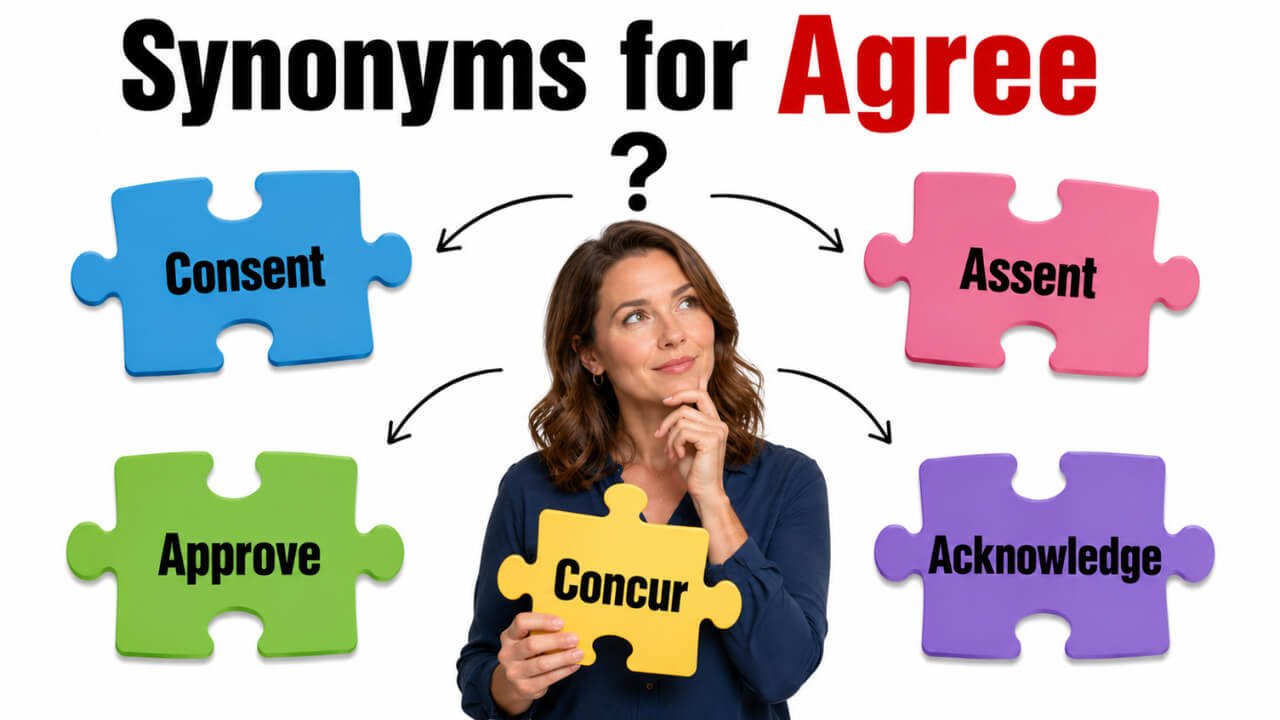
Quick Answer: Useful synonyms for agree include concur, consent, assent, accept, approve, acknowledge, concede, endorse, align, and correspond. Use concur for formal agreement, consent when giving permission, assent when accepting a proposal, approve when supporting a decision, and concede when admitting that another person is correct. Align and correspond work best when ideas, results, or details match. In casual conversation, see eye to eye and go along with are natural alternatives.
Pronunciation and Word Details
Word: Agree
Pronunciation: /əˈɡriː/
Part of Speech: Verb
Meaning: To share the same opinion, accept a suggestion, give permission, or match something else.
US Pronunciation:
UK Pronunciation:
What Does “Agree” Mean?
Agree means to have the same opinion as another person, accept a suggestion, give permission, or show that two things are consistent.
Agree is mainly used as a verb. Its precise meaning depends on the sentence and the preposition that follows it.
A person can agree with someone, agree on a decision, agree to a proposal, or agree that a statement is true. The word can also describe information, results, colors, foods, or ideas that match or work well together.
Shared Opinion: We agree that the new plan is practical.
Consent: She agreed to attend the meeting.
Joint Decision: The committee agreed on a final date.
Consistency: His explanation agrees with the available evidence.
Suitability: Spicy food does not agree with him.
Meaning, Tone, and Context of “Agree”
Agree is a neutral and widely used word. It appears naturally in formal writing, academic discussions, workplace communication, polite conversation, negotiations, and everyday speech.
In casual conversation, agree usually describes a shared opinion. In professional writing, it can show acceptance of a proposal or support for a decision. In legal or official contexts, consent, assent, authorize, and approve may communicate a more exact meaning.
Agree is usually polite and cooperative, but its tone can change with the surrounding words. Strongly agree expresses firm support, while reluctantly agree suggests hesitation.
Neutral Tone: I agree with your conclusion.
Formal Tone: The representatives concurred with the recommendation.
Polite Tone: I agree that your suggestion deserves consideration.
Reluctant Tone: He eventually agreed to the revised conditions.
Strong Tone: We completely agree with the final decision.
When and How to Use “Agree”
For Sharing an Opinion
Use agree when two or more people hold the same belief, judgment, or viewpoint.
Example: I agree with your opinion about the new policy.
For Accepting a Proposal
Use agree to when someone accepts a plan, request, offer, or condition.
Example: She agreed to review the document before Friday.
For Reaching a Decision
Use agree on when people jointly choose a subject, date, price, rule, or course of action.
Example: The team agreed on a practical solution.
For Introducing a Statement
Use agree that before a complete clause containing a subject and verb.
Example: Most participants agree that the process needs improvement.
For Giving Permission
Agree can mean giving consent, although consent or authorize may be more precise in formal contexts.
Example: His parents agreed to the proposed travel arrangements.
For Showing Consistency
Agree can describe facts, figures, statements, or results that match.
Example: The two reports agree on the main findings.
For Showing Suitability
Agree with can describe something that is suitable for a person’s health, comfort, or preferences.
Example: Heavy meals do not agree with her.
Best Synonyms for Agree
Concur
Synonym: To hold the same opinion, especially in formal communication.
Example: The researchers concur that additional testing is necessary.
Consent
Synonym: To give permission or willingly accept a proposal.
Example: Every participant consented to the procedure.
Assent
Synonym: To express formal approval or acceptance.
Example: The members assented to the revised terms.
Accept
Synonym: To receive, recognize, or approve an offer, idea, or condition.
Example: She accepted the committee’s recommendation.
Approve
Synonym: To officially support or authorize a decision.
Example: The director approved the updated budget.
Acknowledge
Synonym: To recognize that a fact, statement, or problem is true.
Example: He acknowledged that the original estimate was inaccurate.
Concede
Synonym: To admit reluctantly that another person is correct.
Example: She conceded that his argument was stronger.
Endorse
Synonym: To publicly or formally support an idea, plan, or person.
Example: Several members endorsed the proposed changes.
Align
Synonym: To bring opinions, plans, or interests into agreement.
Example: Their priorities align with the organization’s goals.
Correspond
Synonym: To match or be consistent with something.
Example: The final figures correspond with the original records.
50 Synonyms for Agree with Short Meanings
- Concur: To share the same opinion.
- Consent: To willingly give permission.
- Assent: To formally express agreement.
- Accept: To receive or approve something willingly.
- Approve: To support or officially authorize.
- Acknowledge: To recognize that something is true.
- Concede: To admit a point, often reluctantly.
- Admit: To accept that a statement is true.
- Endorse: To give public or formal support.
- Support: To favor an idea, decision, or person.
- Affirm: To state agreement or support positively.
- Confirm: To establish that something is correct.
- Comply: To act according to a request or rule.
- Acquiesce: To accept something without strong protest.
- Accede: To agree to a formal request or demand.
- Subscribe to: To support a belief, theory, or opinion.
- Concur with: To express the same formal opinion.
- Consent to: To give permission for something.
- Assent to: To formally accept a proposal.
- Go along with: To accept or support a plan.
- See eye to eye: To share the same opinion.
- Be of one mind: To think alike about something.
- Be in accord: To have matching views or interests.
- Be in agreement: To hold the same position.
- Share the view: To have the same opinion.
- Hold the same opinion: To think alike about an issue.
- Accept the point: To recognize the value of an argument.
- Recognize: To accept the truth or importance of something.
- Grant: To admit that a point is valid.
- Allow: To give permission for an action.
- Authorize: To give official permission.
- Permit: To allow something to happen.
- Cooperate: To work willingly toward a shared purpose.
- Settle: To reach a final agreement.
- Reconcile: To resolve differences and restore agreement.
- Compromise: To settle through mutual concessions.
- Align: To bring opinions or goals into agreement.
- Accord: To be consistent or harmonious.
- Correspond: To match in meaning, facts, or details.
- Coincide: To occur together or match closely.
- Match: To be equal, similar, or consistent.
- Harmonize: To work together without conflict.
- Fit: To suit a purpose or match a situation.
- Suit: To be appropriate or acceptable.
- Tally: To match or correspond with information.
- Conform: To follow an accepted rule or standard.
- Be compatible: To exist or work together successfully.
- Be consistent: To match without contradiction.
- Come to terms: To reach an agreement after discussion.
- Reach an understanding: To settle differences through mutual acceptance.
Read Also:
Synonyms for Emotional

Synonyms for Agree by Context
When Agree Means Sharing the Same Opinion
Concur, see eye to eye, share the view, be of one mind, and be in agreement describe people who hold similar opinions.
Concur is formal and suitable for reports, essays, and professional discussions. See eye to eye is conversational and often describes a friendly relationship between people who think alike.
Example: The two specialists concur on the likely cause.
Example: We do not always see eye to eye, but we respect each other.
When Agree Means Giving Consent
Consent, assent, accept, approve, authorize, permit, and accede describe permission or acceptance.
Consent focuses on voluntary permission. Approve and authorize are more official. Assent is formal, while accept is useful in both formal and everyday situations.
Example: She consented to the proposed changes.
Example: The manager authorized the additional expense.
When Agree Means Admitting a Point
Acknowledge, admit, concede, recognize, and grant describe accepting that a fact or argument is valid.
Concede often suggests reluctance. Acknowledge is more neutral, while admit may suggest that the speaker previously denied or avoided the truth.
Example: He conceded that the alternative plan was more affordable.
Example: The report acknowledges several important limitations.
When Agree Means Matching
Correspond, coincide, match, tally, accord, harmonize, and be consistent describe information or ideas that do not conflict.
Correspond is appropriate for facts, records, and descriptions. Tally is often used for numbers or accounts. Harmonize describes elements that work pleasantly together.
Example: Her description corresponds with the available evidence.
Example: The figures in both documents tally.
When Agree Means Reaching a Settlement
Settle, compromise, reconcile, come to terms, and reach an understanding describe resolving a disagreement.
Compromise means that each side gives up something. Reconcile focuses on overcoming differences. Come to terms often describes agreement after a difficult discussion.
Example: Both parties compromised to reach a fair settlement.
Example: The neighbors finally came to terms over the property boundary.
Another Word for Agree
Concur is often the best single formal replacement for agree when people share the same opinion. However, the best alternative depends on the intended meaning.
Use consent for permission, approve for official support, concede for reluctant admission, and correspond when facts or details match.
Original: I agree with the final recommendation.
Better Option: I concur with the final recommendation.
Original: She agreed to the medical procedure.
Better Option: She consented to the medical procedure.
Original: The director agreed to the proposed budget.
Better Option: The director approved the proposed budget.
Original: The results agree with our earlier findings.
Better Option: The results correspond with our earlier findings.
When Not to Use “Agree”
Agree is clear and useful, but it can sound repetitive or imprecise when a sentence requires a more specific word.
When Official Permission Is Involved
Consent, authorize, or approve may communicate the meaning more clearly.
Weak: The administrator agreed to the request.
Better: The administrator approved the request.
When Describing Matching Data
Correspond, tally, or coincide is usually more precise.
Weak: The numbers agree with the earlier report.
Better: The numbers correspond with the earlier report.
When Someone Admits a Point Reluctantly
Concede communicates hesitation more accurately.
Weak: He agreed that his calculation was incorrect.
Better: He conceded that his calculation was incorrect.
When Agree Appears Repeatedly
Replacing repeated uses with precise alternatives improves readability.
Weak: We agree with the plan, agree with its purpose, and agree with the proposed schedule.
Better: We support the plan, endorse its purpose, and accept the proposed schedule.
When Legal or Personal Consent Must Be Clear
Do not use agree when voluntary consent needs to be stated precisely.
Weak: The participant agreed to the use of personal information.
Better: The participant consented to the use of personal information.
Words Commonly Confused With Agree
Agree vs Accept: Agree means sharing an opinion or supporting a proposal. Accept means receiving or recognizing something, even when the person does not personally support it.
Agree vs Approve: Agree expresses a shared opinion. Approve often involves official support, permission, or authorization.
Agree vs Consent: Agree can describe opinions or decisions. Consent specifically means giving voluntary permission.
Agree vs Concur: Both words express a shared opinion. Concur is more formal and appears frequently in professional or academic writing.
Agree vs Admit: Agree means holding the same view. Admit means recognizing that a fact is true, sometimes after denying or avoiding it.
Agree vs Concede: Agree is usually neutral. Concede often shows that a person accepts another argument reluctantly.
Agree vs Comply: Agree describes acceptance or shared opinion. Comply means following a request, instruction, law, or rule.
Agree vs Correspond: Agree can refer to people or opinions. Correspond usually describes facts, records, descriptions, or details that match.
Which Synonym Should You Choose?
Choose concur for formal writing, academic discussions, professional reports, and carefully reasoned opinions.
Choose consent when someone voluntarily gives permission.
Choose assent when formal acceptance of a proposal, rule, or decision is involved.
Choose accept for offers, conditions, invitations, conclusions, or situations.
Choose approve when a person with authority officially supports a request, plan, or decision.
Choose endorse when expressing strong, public, or formal support.
Choose acknowledge when recognizing a fact, concern, mistake, or limitation.
Choose concede when someone reluctantly admits that another person is correct.
Choose see eye to eye in casual conversation when two people share the same opinion.
Choose go along with when someone informally accepts another person’s plan.
Choose correspond or tally for matching facts, figures, reports, and records.
Choose align when goals, interests, opinions, or strategies move in the same direction.
Choose compromise when both sides make concessions to settle a disagreement.
Choose reach an understanding when people resolve differences through discussion.
Real Life Examples of “Agree” in Sentences
Original: I agree with your explanation of the problem.
Better Option: I concur with your explanation of the problem.
Original: She agreed to the new working conditions.
Better Option: She accepted the new working conditions.
Original: The committee agreed with the proposal.
Better Option: The committee endorsed the proposal.
Original: He finally agreed that his estimate was incorrect.
Better Option: He finally conceded that his estimate was incorrect.
Original: The parents agreed to the school trip.
Better Option: The parents consented to the school trip.
Original: The manager agreed to the additional expense.
Better Option: The manager approved the additional expense.
Original: Our conclusions agree with the earlier research.
Better Option: Our conclusions correspond with the earlier research.
Original: The two departments agree on their main priorities.
Better Option: The two departments align on their main priorities.
Original: We agreed after discussing the problem for several hours.
Better Option: We reached an understanding after discussing the problem for several hours.
Original: The two friends agree about almost everything.
Better Option: The two friends see eye to eye about almost everything.
Synonym Groups and Usage Differences
Shared Opinion Group
Concur, see eye to eye, share the view, and be of one mind describe similar beliefs or judgments.
Concur is formal, while see eye to eye is conversational.
Example: The advisers concur that the proposal is practical.
Consent Group
Consent, assent, accede, permit, and authorize relate to permission or acceptance.
Consent highlights free choice. Authorize emphasizes official power.
Example: The owner authorized the repairs.
Support Group
Approve, endorse, support, affirm, and subscribe to express positive acceptance of an idea or decision.
Endorse often communicates stronger or more public support than agree.
Example: Most members endorsed the new policy.
Admission Group
Acknowledge, admit, concede, recognize, and grant describe accepting the truth or validity of a point.
Concede usually carries a reluctant tone.
Example: The speaker acknowledged the weakness in his argument.
Compatibility Group
Correspond, accord, coincide, tally, align, match, and harmonize show consistency or compatibility.
These words are useful when comparing facts, figures, opinions, colors, styles, or goals.
Example: The witness’s account corresponds with the recorded evidence.
Settlement Group
Settle, compromise, reconcile, come to terms, and reach an understanding describe resolving conflict.
Compromise involves concessions, while reconcile emphasizes restoring harmony.
Example: Both sides compromised on the final price.
Antonyms of Agree
The opposite of agree changes according to whether the word refers to opinion, permission, acceptance, consistency, or cooperation.
Disagree: To hold a different opinion.
Dissent: To formally express disagreement.
Object: To express opposition or disapproval.
Oppose: To act or argue against something.
Reject: To refuse to accept an idea or proposal.
Refuse: To decline a request or offer.
Deny: To state that something is not true.
Contradict: To make a statement that conflicts with another statement.
Dispute: To question the truth or validity of something.
Resist: To oppose pressure, change, or control.
Differ: To hold a different opinion or quality.
Conflict: To be incompatible or contradictory.
Diverge: To move away from a shared direction or viewpoint.
Mismatch: To fail to correspond or fit.
Disapprove: To have an unfavorable opinion.
Comparison: Agree vs Related Words
Agree vs Concur
Agree is neutral and common in all types of communication. Concur is more formal and usually refers to sharing an opinion.
Example With Agree: I agree that the rule should be changed.
Example With Concur: The reviewers concur that the rule requires revision.
Agree vs Consent
Agree has several meanings, including sharing an opinion and accepting a plan. Consent specifically refers to giving voluntary permission.
Example With Agree: We agree that the proposal is reasonable.
Example With Consent: She consented to the proposed arrangement.
Agree vs Approve
Agree shows shared opinion or acceptance. Approve often indicates official support or permission from someone with authority.
Example With Agree: The employees agree with the new approach.
Example With Approve: The supervisor approved the new approach.
Agree vs Accept
Agree describes a shared view or willingness to follow a proposal. Accept can mean receiving an offer, recognizing reality, or tolerating a situation.
Example With Agree: I agree with your recommendation.
Example With Accept: I accept your invitation.
Agree vs Concede
Agree is neutral and may be enthusiastic. Concede suggests reluctant acceptance after disagreement.
Example With Agree: She agreed that the solution was effective.
Example With Concede: She conceded that his solution was more effective.
Agree vs Correspond
Agree can describe people, opinions, and information. Correspond mainly describes things that match in facts, meaning, or detail.
Example With Agree: We agree about the cause of the problem.
Example With Correspond: The evidence corresponds with the witness’s statement.
Common Phrases and Expressions With “Agree”
Agree Completely: To share an opinion without any reservation.
Agree Strongly: To express firm support for a statement or position.
Agree With Someone: To share another person’s opinion.
Agree With Something: To support an idea, statement, or decision.
Agree On Something: To reach a shared decision about a subject.
Agree To Something: To accept a proposal, request, or condition.
Agree That: To introduce a statement accepted as true.
Agree in Principle: To support the main idea while details remain unsettled.
Agree to Disagree: To accept that a difference of opinion cannot be resolved.
Could Not Agree More: To express complete and enthusiastic agreement.
Common Mistakes to Avoid
Saying “I Am Agree”
Agree is a verb, not an adjective. Do not place am, is, or are directly before it.
Incorrect: I am agree with your suggestion.
Correct: I agree with your suggestion.
Using the Wrong Preposition
Use agree with for people, opinions, and statements. Use agree on for shared decisions. Use agree to for proposals, requests, and actions.
Incorrect: We agreed with a meeting date.
Correct: We agreed on a meeting date.
Incorrect: She agreed on sign the document.
Correct: She agreed to sign the document.
Confusing Agreement With Acceptance
A person can accept a situation without agreeing that it is fair or desirable.
Unclear: He agreed with the final result, although he disliked it.
Clearer: He accepted the final result, although he disliked it.
Repeating Agree Too Often
Repeated use can make a paragraph sound flat and imprecise. Choose alternatives that express the intended meaning.
Repetitive: They agreed with the plan and agreed to its conditions.
Improved: They supported the plan and accepted its conditions.
Using a Casual Phrase in Formal Writing
Expressions such as see eye to eye and go along with may sound too conversational in reports or academic work.
Too Casual: The researchers see eye to eye on the main conclusion.
Better: The researchers concur on the main conclusion.
Choosing a Stronger Synonym Without Considering Tone
Endorse, authorize, and concede carry meanings that agree does not always express. Use them only when the context supports that meaning.
Unclear: She endorsed that the answer was correct.
Better: She agreed that the answer was correct.
Conclusion
Synonyms for agree help writers express shared opinions, consent, approval, acknowledgment, compatibility, and settlement more precisely. Use concur for formal agreement, consent for voluntary permission, approve for official support, and concede for reluctant admission. Choose correspond or tally when facts and figures match, and use see eye to eye in casual conversation. Understanding these differences allows you to select a natural alternative that matches the sentence, tone, audience, and intended meaning without unnecessary repetition.
FAQs About Synonyms for Agree
What Is the Best Synonym for Agree?
Concur is one of the best formal synonyms for agree when two people share the same opinion. The most suitable replacement still depends on context.
What Is a Formal Word for Agree?
Concur, assent, consent, accede, and endorse are useful formal alternatives. Concur is best for opinions, while consent is best for permission.
What Is a Casual Synonym for Agree?
See eye to eye and go along with are natural casual alternatives. See eye to eye means sharing an opinion, while go along with means accepting a plan.
What Is Another Word for Strongly Agree?
Completely support, fully endorse, firmly concur, and wholeheartedly approve can express strong agreement.
Is Accept a Synonym for Agree?
Accept can replace agree when someone receives an offer, accepts conditions, or recognizes a situation. It does not always mean sharing the same opinion.
What Is the Difference Between Agree and Consent?
Agree can describe a shared opinion, decision, or matching information. Consent specifically means giving voluntary permission.
Which Synonym Should Be Used When Facts Match?
Correspond, coincide, tally, match, and be consistent are suitable when facts, figures, statements, or results agree with one another.
