
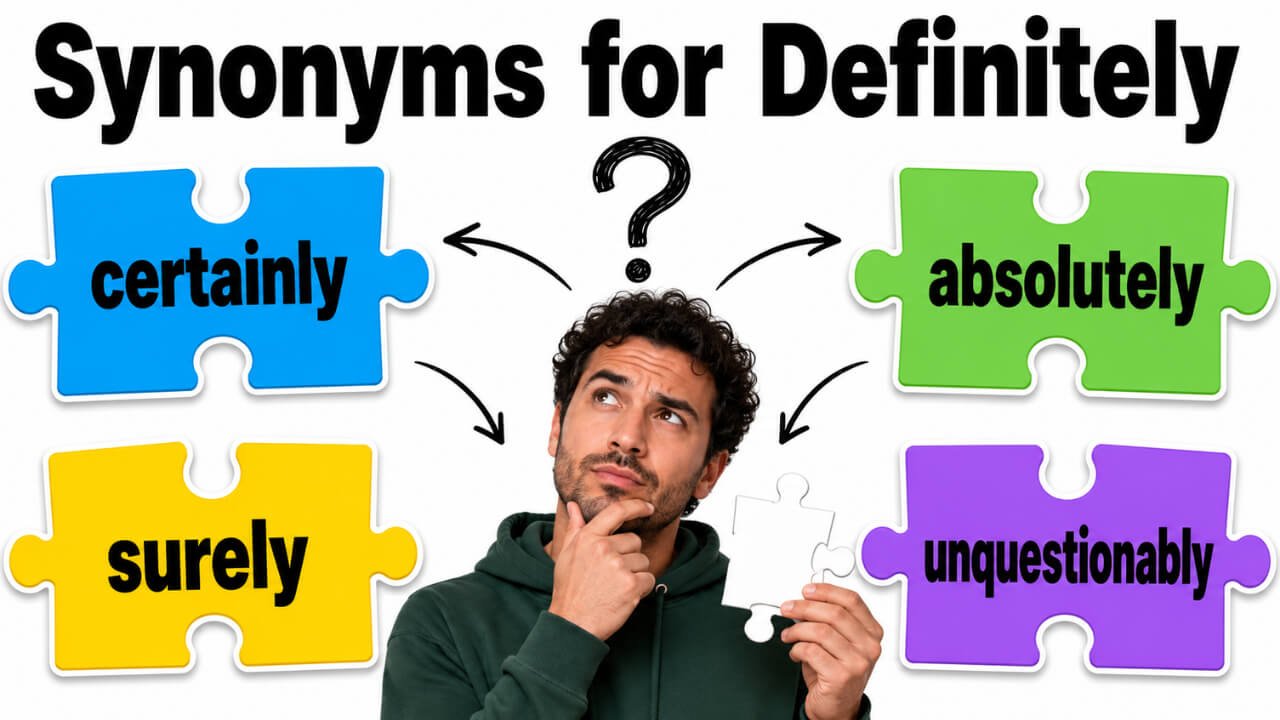
Quick Answer: The best synonyms for definitely include certainly, surely, undoubtedly, unquestionably, absolutely, positively, clearly, assuredly, undeniably, and indeed. Use certainly for polite or formal confidence, surely for a natural conversational tone, and undoubtedly when there is no reasonable doubt. Absolutely is best for strong agreement or emphasis, while clearly works when evidence makes something easy to recognize. Assuredly and unquestionably suit formal statements, reports, and confident conclusions.
Pronunciation and Word Details
Word: Definitely
Pronunciation: /ˈdefɪnətli/
Part of Speech: Adverb
Meaning: In a certain, clear, and unquestionable way, without doubt or hesitation.
US Pronunciation:
UK Pronunciation:
What Does “Definitely” Mean?
Definitely means certainly, clearly, or without any doubt. It is an adverb used to show strong confidence, firm agreement, clear intention, or complete certainty about an action, statement, decision, or result.
The word can strengthen a verb, adjective, or entire sentence. It often tells the listener that the speaker has made a firm decision or strongly believes something is true.
Example: She will definitely attend the meeting.
In this sentence, definitely shows strong confidence about her attendance.
Example: That is definitely the correct answer.
Here, the word emphasizes certainty and accuracy.
Definitely can appear in formal writing, everyday conversation, professional communication, personal promises, recommendations, predictions, and responses.
Meaning, Tone, and Context of “Definitely”
Definitely usually has a confident, positive, and emphatic tone. It communicates that the speaker has little or no uncertainty.
In casual speech, it often expresses enthusiastic agreement.
Example: I would definitely visit that place again.
In professional communication, definitely can confirm a decision or commitment.
Example: We will definitely complete the report before the deadline.
In academic or highly formal writing, words such as certainly, undoubtedly, clearly, or conclusively may sound more precise. Definitely is not incorrect in formal writing, but it can sometimes sound conversational.
The strength of the word depends on context. It may express certainty, agreement, intention, emphasis, or a confident prediction.
When and How to Use “Definitely”
For Strong Certainty
Use definitely when you are highly confident that a statement is true.
Example: This is definitely the most practical solution.
For Firm Agreement
Use definitely as a strong positive response to an idea, request, or invitation.
Example: I would definitely support that proposal.
For Clear Intention
Use definitely when someone has made a firm decision about a future action.
Example: We will definitely apply for the program.
For Strong Recommendations
Use definitely to show that you strongly recommend an experience, choice, or action.
Example: You should definitely read the full instructions first.
For Emphasis
Definitely can strengthen a description or opinion.
Example: The second design is definitely more attractive.
For Confident Predictions
Use definitely when you believe a future result is highly likely.
Example: The new process will definitely save time.
Be careful with predictions because definitely suggests complete confidence. Use probably or likely when some uncertainty remains.
Best Synonyms for Definitely
Certainly
Synonym: Without doubt or with complete confidence.
Example: She will certainly understand your concern.
Surely
Synonym: With confidence that something is true or expected.
Example: The team will surely improve with more practice.
Undoubtedly
Synonym: In a way that leaves no reasonable doubt.
Example: She is undoubtedly qualified for the position.
Unquestionably
Synonym: In a way that cannot reasonably be challenged.
Example: The new method is unquestionably more efficient.
Absolutely
Synonym: Completely, certainly, or with strong agreement.
Example: I absolutely agree with your conclusion.
Positively
Synonym: With complete certainty or strong assurance.
Example: He positively identified the correct document.
Assuredly
Synonym: Certainly and confidently, especially in formal language.
Example: The decision will assuredly affect future planning.
Undeniably
Synonym: In a way that is clearly true and cannot be denied.
Example: Her contribution was undeniably valuable.
Clearly
Synonym: In an obvious or easily understood way.
Example: The results clearly support the main argument.
Indeed
Synonym: Used to confirm or emphasize that something is true.
Example: The task was indeed more difficult than expected.
50 Synonyms for Definitely with Short Meanings
- Certainly: Without doubt or hesitation.
- Surely: With confidence that something is true.
- Undoubtedly: Without any reasonable doubt.
- Unquestionably: In a way that cannot be challenged.
- Absolutely: Completely and with total certainty.
- Positively: With firm confidence or assurance.
- Assuredly: Certainly, especially in formal language.
- Undeniably: In a way that cannot be denied.
- Indisputably: In a manner that cannot be disputed.
- Unmistakably: In a way that is completely clear.
- Clearly: In an obvious and understandable manner.
- Obviously: In a way that is easy to recognize.
- Plainly: Clearly and without uncertainty.
- Evidently: As shown by available facts or evidence.
- Conclusively: In a way that settles all doubt.
- Decidedly: Clearly and noticeably.
- Categorically: In a direct and unconditional manner.
- Emphatically: With strong and forceful emphasis.
- Indeed: Used to confirm or strengthen a statement.
- Truly: In a real, honest, or certain way.
- Really: Used to emphasize truth or certainty.
- Genuinely: In a sincere and authentic manner.
- Firmly: With strong belief or determination.
- Confidently: With certainty and self assurance.
- Unequivocally: In a clear way that allows no doubt.
- Unambiguously: In a manner with only one clear meaning.
- Incontrovertibly: In a way that cannot be disproved.
- Irrefutably: In a manner that cannot be proven false.
- Demonstrably: In a way that can be clearly shown.
- Provably: In a way that can be supported with proof.
- Verifiably: In a manner that can be checked and confirmed.
- Decisively: With firmness and clear determination.
- Definitively: In a final and authoritative manner.
- Indubitably: Without doubt, especially in formal usage.
- Doubtlessly: Without uncertainty or hesitation.
- Beyond doubt: Completely certain.
- Beyond question: Too certain to be challenged.
- Without doubt: With complete confidence.
- Without question: Certainly and without disagreement.
- Without a doubt: Used to express complete certainty.
- For certain: Known or believed with confidence.
- For sure: Definitely, especially in casual conversation.
- No doubt: Almost certainly or unquestionably.
- Most certainly: A strong and polite expression of certainty.
- Sure enough: As expected or predicted.
- By all means: Certainly or with willing agreement.
- In fact: Used to confirm or add a stronger truth.
- As a matter of fact: Used to emphasize that something is true.
- Beyond dispute: Too clear or certain to be argued against.
- With certainty: In a confident and unquestionable manner.
Read Also:
Synonyms for Innovation

Synonyms for Definitely by Context
When Definitely Means Certainly
Use certainly, surely, assuredly, undoubtedly, or most certainly when expressing confidence that something is true or will happen.
Example: She will certainly provide the requested information.
Example: The plan will surely produce better results.
Certainly sounds polite and professional. Surely feels more natural in conversation, while undoubtedly creates a stronger and more formal tone.
When Definitely Means Strong Agreement
Use absolutely, certainly, by all means, indeed, or most certainly when agreeing with a suggestion, opinion, or request.
Example: I absolutely agree with your recommendation.
Example: You may certainly use the available materials.
Absolutely sounds enthusiastic and direct. Certainly is more polite and controlled. By all means often gives permission or encouragement.
When Definitely Means Clearly True
Use clearly, obviously, plainly, evidently, undeniably, or unmistakably when facts or evidence support a conclusion.
Example: The figures clearly show an improvement.
Example: Her experience is undeniably relevant to the role.
Clearly works well in reports and explanations. Obviously can sound impatient when the information is not obvious to everyone.
When Definitely Means Without Any Doubt
Use unquestionably, indisputably, unequivocally, irrefutably, or beyond doubt when a statement cannot reasonably be challenged.
Example: The evidence is unquestionably important.
Example: The results prove beyond doubt that the process is effective.
These alternatives are strong and often suit formal arguments, reports, essays, and evidence based conclusions.
When Definitely Means Firmly
Use firmly, confidently, decisively, categorically, or emphatically when focusing on determination or a strong response.
Example: She firmly rejected the inaccurate claim.
Example: The manager categorically denied the accusation.
These words often describe how a statement, belief, refusal, or decision is expressed.
Another Word for Definitely
Certainly is often the best single replacement for definitely because it works in both formal and everyday contexts. However, the strongest alternative depends on whether the sentence expresses certainty, agreement, evidence, emphasis, or firm intention.
Original: She will definitely complete the assignment.
Better Option: She will certainly complete the assignment.
Original: This is definitely the strongest argument.
Better Option: This is unquestionably the strongest argument.
Original: I definitely agree with your suggestion.
Better Option: I absolutely agree with your suggestion.
Original: The evidence definitely supports the conclusion.
Better Option: The evidence clearly supports the conclusion.
When Not to Use “Definitely”
Avoid definitely when you are uncertain about a fact, prediction, decision, or result. The word expresses strong confidence, so it can make a statement misleading when evidence is limited.
Weak: The weather will definitely improve next week.
Better: The weather will probably improve next week.
Do not overuse definitely in the same paragraph. Repetition can make writing sound informal or overly forceful.
Weak: The plan is definitely useful, and it will definitely work because the team is definitely prepared.
Better: The plan is clearly useful and will probably succeed because the team is well prepared.
In formal reports, use a more precise alternative when evidence supports the claim.
Weak: The new policy will definitely improve performance.
Better: The available evidence strongly suggests that the new policy will improve performance.
Avoid using definitely as filler when it adds no useful meaning.
Weak: She definitely explained the instructions clearly.
Better: She explained the instructions clearly.
Words Commonly Confused With Definitely
Definitely vs Certainly: Both express confidence, but certainly often sounds more polite and formal. Definitely can sound stronger and more conversational.
Definitely vs Probably: Definitely expresses near complete certainty, while probably shows that something is likely but not guaranteed.
Definitely vs Absolutely: Definitely confirms certainty, while absolutely often expresses complete agreement, intensity, or total degree.
Definitely vs Clearly: Definitely shows the speaker’s confidence. Clearly suggests that evidence or observation makes something obvious.
Definitely vs Surely: Both communicate confidence, but surely may express expectation, persuasion, or surprise depending on the sentence.
Definitely vs Undoubtedly: Definitely works naturally in conversation. Undoubtedly sounds more formal and emphasizes the absence of reasonable doubt.
Definitely vs Definitively: Definitely means certainly. Definitively means finally, conclusively, or authoritatively.
Which Synonym Should You Choose?
Choose certainly for polite responses, formal communication, professional emails, and confident statements.
Choose surely for natural conversation, expectations, and reassuring statements.
Choose undoubtedly for essays, reports, and formal claims that carry strong confidence.
Choose unquestionably when a fact, quality, or conclusion cannot reasonably be challenged.
Choose absolutely for enthusiastic agreement, total certainty, or strong emphasis.
Choose clearly when facts, results, observations, or evidence support the statement.
Choose undeniably when a fact is too obvious or well supported to reject.
Choose conclusively when evidence settles a question or produces a final result.
Choose firmly when describing a determined belief, decision, instruction, or refusal.
Choose unequivocally when a formal statement has one clear meaning and allows no uncertainty.
Choose probably instead of definitely when the outcome remains uncertain.
Real Life Examples of “Definitely” in Sentences
Original: I will definitely attend the workshop.
Better Option: I will certainly attend the workshop.
Original: She is definitely the strongest candidate.
Better Option: She is undoubtedly the strongest candidate.
Original: The second option is definitely more affordable.
Better Option: The second option is clearly more affordable.
Original: I definitely agree with your decision.
Better Option: I absolutely agree with your decision.
Original: This result definitely proves the theory.
Better Option: This result conclusively proves the theory.
Original: The new system is definitely easier to use.
Better Option: The new system is unquestionably easier to use.
Original: He definitely refused to change the schedule.
Better Option: He firmly refused to change the schedule.
Original: Her work definitely improved the final project.
Better Option: Her work undeniably improved the final project.
Original: We will definitely consider your application.
Better Option: We will certainly consider your application.
Original: The statement is definitely false.
Better Option: The statement is demonstrably false.
Synonym Groups and Usage Differences
Certainty Group
Certainly, surely, undoubtedly, assuredly, and doubtlessly express confidence that something is true or likely to happen.
Certainly is neutral and flexible. Surely is more conversational, while assuredly and doubtlessly sound more formal.
Example: The new schedule will certainly reduce confusion.
Strong Agreement Group
Absolutely, indeed, most certainly, and by all means express agreement, approval, confirmation, or permission.
Absolutely is energetic and direct. Most certainly sounds polite, while by all means often encourages someone to proceed.
Example: I absolutely support the proposed change.
Evidence Group
Clearly, evidently, demonstrably, provably, verifiably, and conclusively connect certainty with facts, proof, or observable information.
These words are useful in reports, research, explanations, and analytical writing.
Example: The data clearly indicates a steady increase.
No Doubt Group
Unquestionably, indisputably, undeniably, irrefutably, and incontrovertibly describe claims that cannot reasonably be denied or disproved.
These are strong formal words and should be used only when the evidence supports such certainty.
Example: Her experience is unquestionably valuable.
Firm Expression Group
Firmly, emphatically, categorically, confidently, and decisively describe the strength or manner of a statement, action, belief, or decision.
Example: The committee categorically rejected the inaccurate report.
Antonyms of Definitely
The opposite of definitely depends on whether the word refers to certainty, confidence, agreement, or likelihood.
Uncertainly: Without confidence or complete knowledge.
Possibly: In a way that may or may not happen.
Probably: Likely, but not completely certain.
Perhaps: Used when something is possible but uncertain.
Maybe: A casual word expressing possibility.
Doubtfully: In a way that shows uncertainty or disbelief.
Questionably: In a manner that creates doubt.
Apparently: Seemingly true based on limited information.
Tentatively: Without complete confidence or final commitment.
Vaguely: Without clear detail or certainty.
Indecisively: Without making a firm choice.
Unlikely: Not expected to happen.
Comparison: Definitely vs Related Words
Definitely vs Certainly
Definitely and certainly both express strong confidence. Certainly is often more polite and formal, while definitely commonly appears in everyday conversation.
Example With Definitely: I will definitely send the document this evening.
Example With Certainly: I will certainly review your request.
Definitely vs Absolutely
Definitely confirms that something is certain. Absolutely can express certainty, complete degree, or enthusiastic agreement.
Example With Definitely: She is definitely joining the team.
Example With Absolutely: I absolutely agree with the final decision.
Definitely vs Probably
Definitely suggests that something is certain. Probably means that something is likely but still uncertain.
Example With Definitely: He will definitely attend because he has confirmed his place.
Example With Probably: He will probably attend, but he has not confirmed yet.
Definitely vs Clearly
Definitely expresses the speaker’s confidence. Clearly suggests that facts, evidence, or observation support the conclusion.
Example With Definitely: This is definitely the right choice for me.
Example With Clearly: The results clearly show that the first method was faster.
Definitely vs Definitively
Definitely means certainly or without doubt. Definitively means finally, conclusively, or in an authoritative way.
Example With Definitely: We will definitely discuss the issue.
Example With Definitively: The investigation definitively identified the cause.
Common Phrases and Expressions With “Definitely”
Definitely Worth It: Deserving the required time, money, or effort.
Definitely Agree: To express strong agreement with an opinion.
Definitely Not: A firm and clear negative response.
Definitely Yes: A strong positive answer.
Will Definitely: Used to express a firm future intention or confident prediction.
Would Definitely: Used for a strong preference or recommendation.
Most Definitely: A stronger and often enthusiastic form of definitely.
Definitely Possible: Clearly capable of happening or being achieved.
Definitely Better: Clearly improved or more suitable.
Definitely Recommend: To give a strong and confident recommendation.
Common Mistakes to Avoid
A common spelling mistake is writing definately instead of definitely. The correct spelling contains the word finite in its middle structure.
Do not use definitely when you only mean probably. Definite language can make an uncertain prediction sound misleading or careless.
Avoid repeating definitely several times in one paragraph. Replace it with certainly, clearly, undoubtedly, absolutely, or a more precise sentence structure.
Do not confuse definitely with definitively. Definitely expresses certainty, while definitively describes something settled in a final or authoritative way.
Avoid using obviously when you mean definitely. Obviously suggests that everyone should recognize the fact, which may sound dismissive or rude.
In academic writing, do not make absolute claims without evidence. Use clearly, demonstrably, or conclusively only when facts support the conclusion.
Conclusion
Synonyms for definitely allow writers to express certainty, agreement, confidence, and emphasis with greater precision. Certainly works well in polite and formal communication, while surely feels natural in conversation. Use absolutely for strong agreement, clearly for evidence based conclusions, and undoubtedly for confident formal claims. Unquestionably, conclusively, and unequivocally suit stronger statements that leave little room for doubt. Choosing the right alternative improves clarity and ensures that the strength of each sentence matches the available evidence.
FAQs About Synonyms for Definitely
What is the best synonym for definitely?
Certainly is the most flexible synonym because it works naturally in formal writing, professional communication, and everyday conversation.
Is absolutely a synonym for definitely?
Yes. Absolutely can replace definitely when expressing strong agreement, complete certainty, or emphasis.
What is a formal synonym for definitely?
Undoubtedly, unquestionably, assuredly, unequivocally, and conclusively are useful formal alternatives.
What is a casual synonym for definitely?
For sure, surely, absolutely, and no doubt are natural choices for casual conversation.
Are definitely and probably the same?
No. Definitely expresses strong certainty, while probably means something is likely but not guaranteed.
What word means definitely without any doubt?
Undoubtedly, unquestionably, indisputably, and without a doubt all express the absence of uncertainty.
What is the difference between definitely and definitively?
Definitely means certainly. Definitively means finally, conclusively, or with authority.
