
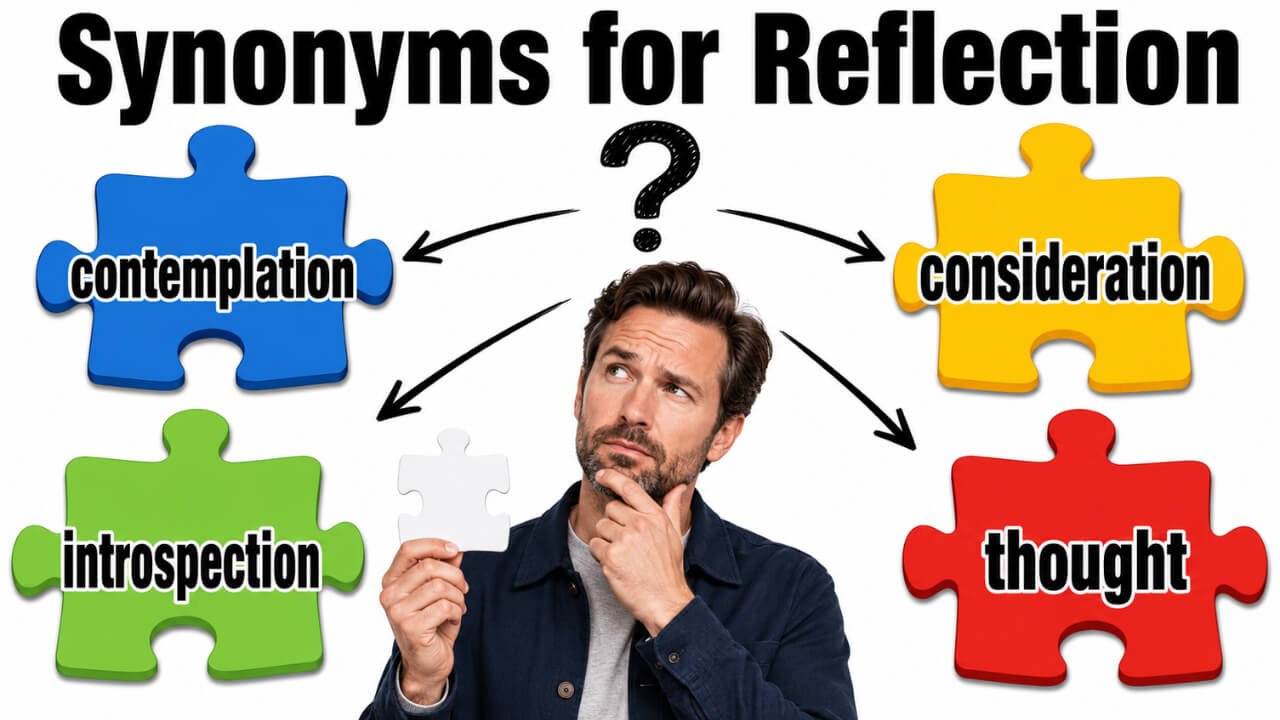
Quick Answer: Common synonyms for reflection include contemplation, introspection, thought, consideration, meditation, recollection, review, image, likeness, and indication. Use contemplation for careful thought, introspection for examining your feelings, recollection for remembering the past, and image or likeness for something seen in a mirror. In formal writing, consideration and analysis often work best. For personal writing, introspection is more precise, while indication is suitable when reflection means evidence of a quality or condition.
Pronunciation and Word Details
Word: Reflection
Pronunciation: /rɪˈflek.ʃən/
Part of Speech: Noun
Meaning: Reflection means careful thought, an image produced by a surface, or something that reveals a particular quality.
US Pronunciation:
UK Pronunciation:
What Does “Reflection” Mean?
Reflection means serious thought about an experience, idea, decision, or feeling. It is a noun that can describe the mental process of thinking carefully about something.
The word also refers to an image seen in a mirror, glass, water, or another smooth surface. In science, reflection describes light, heat, or sound returning from a surface instead of passing through it.
Reflection can also mean a sign or expression of a quality. For example, a person’s actions may be described as a reflection of their character.
The correct meaning depends on the sentence. In personal writing, reflection usually refers to thoughtful consideration. In visual descriptions, it usually means a mirrored image. In formal discussion, it may describe evidence, expression, or indication.
Meaning, Tone, and Context of “Reflection”
Reflection is a neutral and widely used word. Its tone can become thoughtful, emotional, academic, technical, or descriptive depending on the context.
In personal and emotional writing, reflection suggests calm and meaningful thought. A personal reflection may explore feelings, experiences, lessons, and changes in perspective.
In academic writing, reflection often describes an examination of what someone learned from an activity, event, course, or project. It can involve analysis, evaluation, and self awareness.
In visual contexts, the word is descriptive and neutral. It refers to an image appearing on a shiny or smooth surface.
In scientific contexts, reflection is a technical term for the return of light, sound, or heat from a surface.
In formal writing, reflection can also describe how one thing reveals another. Poor service, for example, may be called a reflection of weak management.
When and How to Use “Reflection”
For Careful Thought: Use reflection when someone considers an idea, experience, or decision in depth.
Example: After careful reflection, she decided to accept the new position.
For Personal Growth: Use reflection when examining feelings, behavior, strengths, or past choices.
Example: Personal reflection helped him understand how his attitude had changed.
For Learning: Use reflection when discussing lessons gained from an activity or experience.
Example: Her written reflection explained what she learned from the project.
For Memory: Use reflection when thinking about something that happened in the past.
Example: His reflection on childhood brought back several warm memories.
For a Mirrored Image: Use reflection for an image seen in water, glass, or a mirror.
Example: The mountain’s reflection appeared clearly in the lake.
For Light or Sound: Use reflection when light or sound returns from a surface.
Example: The reflection of light made the room appear brighter.
For Evidence of a Quality: Use reflection when one thing reveals the condition, character, or nature of another.
Example: Her kindness is a reflection of her values.
Best Synonyms for Reflection
Contemplation: Deep and careful thought about something.
Example: The decision required several days of contemplation.
Introspection: Examination of your own thoughts, emotions, and motives.
Example: Introspection helped her recognize the cause of her frustration.
Thought: The process of considering an idea, problem, or situation.
Example: He gave the proposal some thought before responding.
Consideration: Careful attention given to a matter before making a decision.
Example: The request deserves serious consideration.
Meditation: Calm, focused thought or mental practice.
Example: Quiet meditation allowed him to organize his thoughts.
Recollection: The act of remembering something from the past.
Example: Her recollection of the event remained clear.
Review: An examination of something that has happened or been completed.
Example: A review of the project revealed several useful lessons.
Image: A visual form seen in a mirror or on a reflective surface.
Example: His image appeared in the polished glass.
Likeness: A visual representation that resembles someone or something.
Example: The calm water created a likeness of the trees.
Indication: A sign that reveals a condition, quality, or situation.
Example: The results were an indication of steady improvement.
50 Synonyms for Reflection with Short Meanings
- Contemplation: Deep and careful thought.
- Introspection: Examination of your own thoughts and feelings.
- Thought: Mental consideration of something.
- Consideration: Careful attention before reaching a decision.
- Meditation: Calm and focused thinking.
- Rumination: Continued thinking about a subject.
- Pondering: Serious consideration of an idea or problem.
- Deliberation: Careful discussion or thought before deciding.
- Musing: Quiet and thoughtful consideration.
- Self Examination: Careful study of your own behavior or feelings.
- Retrospection: Consideration of past events or experiences.
- Review: Examination of something that has happened.
- Analysis: Detailed study of information or experience.
- Evaluation: Judging the quality or value of something.
- Assessment: Careful examination used to form a judgment.
- Examination: Close study of a subject or experience.
- Observation: Careful attention to what is seen or experienced.
- Recollection: The act of remembering a past event.
- Remembrance: The process of keeping something in memory.
- Memory: A remembered person, event, or experience.
- Reminiscence: An enjoyable memory of the past.
- Recall: The ability or act of remembering.
- Image: A visual form produced by a reflective surface.
- Likeness: An image that resembles its subject.
- Mirror Image: An exact image produced by a mirror.
- Representation: A form that presents or stands for something.
- Portrayal: A visual or written presentation of something.
- Depiction: A visual or descriptive representation.
- Reproduction: A copy of an original image or form.
- Replica: A close or exact copy.
- Duplicate: Something made to look exactly like another.
- Impression: An image, effect, or idea produced by something.
- Echo: A returned sound or repeated effect.
- Projection: An image displayed on a surface.
- Manifestation: A visible expression of a quality or condition.
- Expression: An outward display of an idea, feeling, or quality.
- Indication: A sign that reveals something.
- Sign: Something showing that a condition exists.
- Evidence: Information that demonstrates a fact or quality.
- Result: An outcome that reveals the effect of an action.
- Effect: A change produced by a cause.
- Return: The movement of light or sound back from a surface.
- Reverberation: A sound that continues through repeated reflection.
- Glare: Strong light reflected from a surface.
- Gleam: A small or gentle reflected light.
- Shimmer: A soft light that appears to move.
- Sheen: A smooth and gentle shine on a surface.
- Shine: Brightness produced or returned by a surface.
- Radiance: Bright light or visible brilliance.
- Sparkle: Small, bright flashes of reflected light.
Read Also:
Synonyms for Potential

Synonyms for Reflection by Context
When Reflection Means Careful Thought
Contemplation, consideration, pondering, deliberation, meditation, and musing describe the process of thinking carefully.
Contemplation suggests deep and extended thought. Consideration is more practical and is often connected with decisions. Deliberation involves comparing options before choosing.
Example: After considerable contemplation, he changed his original plan.
Example: The committee reached its decision after careful deliberation.
When Reflection Means Self Analysis
Introspection, self examination, analysis, evaluation, and assessment refer to examining personal thoughts, emotions, actions, or progress.
Introspection focuses on feelings and motives. Self examination involves honestly reviewing personal behavior. Evaluation and assessment are more structured and suitable for academic or professional writing.
Example: Through introspection, she understood why the criticism had affected her.
Example: His self examination revealed several areas for improvement.
When Reflection Means Remembering
Recollection, remembrance, memory, reminiscence, recall, and retrospection relate to thinking about past experiences.
Recollection describes the act of remembering. Reminiscence often refers to pleasant memories. Retrospection involves reviewing past events from a later perspective.
Example: Her recollection of the conversation was surprisingly detailed.
Example: The reunion encouraged warm reminiscence about their school years.
When Reflection Means a Mirrored Image
Image, likeness, mirror image, reproduction, replica, depiction, and representation can replace reflection when referring to a visible form.
Image is the most common general alternative. Mirror image emphasizes an exact reversed copy. Likeness focuses on similarity rather than perfect accuracy.
Example: The child stared at her image in the mirror.
Example: A clear likeness of the building appeared in the water.
When Reflection Means an Indication
Indication, sign, evidence, manifestation, and expression work when reflection describes how one thing reveals another.
Indication and sign are useful in neutral writing. Evidence is stronger because it suggests proof. Manifestation is more formal and describes a visible result of an idea, feeling, or condition.
Example: Their success was an indication of careful preparation.
Example: His patience was a manifestation of strong self control.
When Reflection Means Returned Light or Sound
Return, echo, reverberation, glare, gleam, shimmer, sheen, shine, radiance, and sparkle relate to physical reflection.
Echo and reverberation describe returned sound. Glare refers to unpleasantly strong reflected light. Gleam, shimmer, sheen, and sparkle describe different forms of visible brightness.
Example: The echo returned from the distant wall.
Example: A gentle shimmer appeared across the surface of the sea.
Another Word for Reflection
The best single replacement for reflection is contemplation when the intended meaning is careful thought. However, the most accurate alternative depends on whether the sentence refers to thinking, remembering, an image, light, or evidence.
Original: After some reflection, Maria changed her answer.
Better Option: After some contemplation, Maria changed her answer.
Original: His reflection appeared in the window.
Better Option: His image appeared in the window.
Original: The essay contains reflection on her childhood.
Better Option: The essay contains recollections of her childhood.
Original: The mistake was a reflection of poor planning.
Better Option: The mistake was an indication of poor planning.
When Not to Use “Reflection”
Do not use reflection when a more specific word would make the meaning clearer. Because reflection has several meanings, readers may not immediately know whether it refers to thought, memory, an image, or evidence.
Avoid using it repeatedly in personal essays. Words such as introspection, analysis, review, and consideration can add precision and variety.
Do not use reflection for every type of memory. Recollection or reminiscence may communicate the intended meaning more clearly.
In scientific writing, distinguish reflection from refraction. Reflection occurs when light returns from a surface, while refraction occurs when light changes direction as it enters another material.
Weak: The report provides a reflection of the results.
Better: The report provides an analysis of the results.
Weak: She saw a reflection of her early years.
Better: She recalled several memories from her early years.
Weak: His reflection showed that the plan had failed.
Better: His evaluation showed that the plan had failed.
Weak: The figures are a reflection that sales have increased.
Better: The figures are evidence that sales have increased.
Words Commonly Confused With Reflection
Reflection vs Contemplation: Reflection can refer to thought, an image, or returned light. Contemplation refers only to deep and careful thought.
Reflection vs Introspection: Reflection may involve any subject, while introspection specifically examines your own thoughts, emotions, and motives.
Reflection vs Recollection: Reflection involves considering an experience, while recollection means remembering the details of that experience.
Reflection vs Meditation: Reflection is general careful thought. Meditation is a focused mental practice that may involve calm attention, breathing, or spiritual awareness.
Reflection vs Image: Reflection can describe the process that produces a visible form. Image refers directly to the form that appears.
Reflection vs Refraction: Reflection is the return of light from a surface. Refraction is the bending of light as it passes from one material into another.
Reflection vs Analysis: Reflection may be personal and emotional. Analysis is usually structured, logical, and focused on examining separate parts.
Which Synonym Should You Choose?
Choose contemplation when referring to deep, serious, or extended thought.
Choose introspection when examining your own emotions, motives, beliefs, or behavior.
Choose consideration when discussing a decision, request, proposal, or practical matter.
Choose analysis when examining information, results, evidence, or a completed activity.
Choose evaluation when judging performance, quality, value, or progress.
Choose review when looking back at a project, lesson, event, or decision.
Choose recollection when remembering a specific past event.
Choose reminiscence when remembering pleasant or meaningful experiences.
Choose image when describing something visible in a mirror, window, or water.
Choose likeness when the visible form resembles the original subject.
Choose indication when one thing reveals a quality, condition, or trend.
Choose evidence when the sign strongly supports a fact or conclusion.
Choose echo when describing sound returned from a surface.
Choose shimmer, gleam, or sheen when describing soft reflected light.
In formal essays and reports, analysis, evaluation, and consideration are usually precise choices. In personal writing, contemplation, introspection, and recollection often sound more natural. In conversation, thought, memory, and image are simple and clear.
Real Life Examples of “Reflection” in Sentences
Original: After reflection, I realized that my response had been unfair.
Better Option: After introspection, I realized that my response had been unfair.
Original: The meeting gave everyone time for reflection.
Better Option: The meeting gave everyone time for contemplation.
Original: Her reflection on the project identified several mistakes.
Better Option: Her evaluation of the project identified several mistakes.
Original: He shared a reflection about his first day at school.
Better Option: He shared a recollection of his first day at school.
Original: I could see my reflection in the glass.
Better Option: I could see my image in the glass.
Original: The trees created a beautiful reflection in the lake.
Better Option: The trees created a beautiful mirror image in the lake.
Original: Her work is a reflection of her dedication.
Better Option: Her work is evidence of her dedication.
Original: The falling numbers were a reflection of reduced demand.
Better Option: The falling numbers were an indication of reduced demand.
Original: The reflection of the sunlight covered the floor.
Better Option: The gleam of sunlight covered the floor.
Original: His final paragraph offered a reflection on everything he had learned.
Better Option: His final paragraph offered an analysis of everything he had learned.
Synonym Groups and Usage Differences
Thought Group
Contemplation, consideration, pondering, deliberation, meditation, and musing all describe careful thought. Contemplation is deep, while deliberation is usually connected with a decision.
Example: The proposal requires thoughtful consideration before approval.
Self Awareness Group
Introspection, self examination, evaluation, and assessment involve studying personal feelings, behavior, or progress. Introspection is emotional, while assessment is more structured.
Example: Honest introspection helped her recognize an unhelpful habit.
Memory Group
Recollection, remembrance, reminiscence, recall, memory, and retrospection relate to past experiences. Reminiscence often carries a warm or emotional tone.
Example: His recollection of the journey included many small details.
Image Group
Image, likeness, mirror image, representation, depiction, and reproduction describe visible forms or copies. Mirror image is the closest term for something seen in a mirror.
Example: Her image appeared clearly on the polished surface.
Evidence Group
Indication, sign, evidence, expression, and manifestation show how one thing reveals another. Evidence is strongest, while sign and indication are more general.
Example: The improved results were evidence of effective preparation.
Light and Sound Group
Echo, reverberation, glare, gleam, shimmer, sheen, shine, radiance, and sparkle describe returned sound or visible light.
Example: A soft shimmer moved across the water at sunset.
Antonyms of Reflection
The opposite of reflection depends on its meaning. For careful thought, the opposite may be thoughtlessness or inattention. For remembering, the opposite may be forgetfulness. In physics, absorption is the opposite process when energy enters a material instead of returning from it.
Thoughtlessness: Acting without careful consideration.
Inattention: Failure to give proper thought or notice.
Neglect: Lack of care or consideration.
Impulsiveness: Acting immediately without reflection.
Carelessness: Failure to think or act with sufficient attention.
Forgetfulness: The inability or failure to remember.
Oblivion: A state in which something is completely forgotten.
Distortion: An inaccurate or altered image.
Concealment: The act of hiding a quality or fact.
Absorption: The process of taking in light, heat, or sound rather than returning it.
Comparison: Reflection vs Related Words
Reflection vs Contemplation
Reflection is a broad word that can refer to thought, an image, evidence, or returned light. Contemplation specifically means deep and serious thought.
Example With Reflection: Her reflection on the experience changed her opinion.
Example With Contemplation: After an hour of contemplation, she reached a decision.
Reflection vs Introspection
Reflection may focus on an event, idea, subject, or personal experience. Introspection always focuses inward on personal thoughts, feelings, and motives.
Example With Reflection: His reflection explored the lessons from the project.
Example With Introspection: His introspection helped him understand his fear of failure.
Reflection vs Recollection
Reflection involves thinking carefully about an experience. Recollection involves remembering what happened.
Example With Reflection: Her reflection explained what the journey taught her.
Example With Recollection: Her recollection described what happened during the journey.
Reflection vs Image
Reflection can refer to the visual effect created by a reflective surface. Image refers to the visible form itself.
Example With Reflection: The reflection disappeared when the water moved.
Example With Image: His image appeared in the mirror.
Reflection vs Analysis
Reflection may include emotions, opinions, and personal insights. Analysis usually uses evidence and logical examination.
Example With Reflection: Her reflection described how the experience affected her.
Example With Analysis: Her analysis explained why the strategy failed.
Reflection vs Refraction
Reflection occurs when light returns from a surface. Refraction occurs when light bends while passing into a different material.
Example With Reflection: The mirror produced a clear reflection of the lamp.
Example With Refraction: Refraction caused the object under the water to appear displaced.
Common Phrases and Expressions With Reflection
On Reflection: After thinking carefully about something.
Upon Reflection: After reviewing a situation or decision.
A Moment of Reflection: A short period of quiet thought.
Personal Reflection: Thought about your own experiences or feelings.
Self Reflection: Examination of your thoughts, behavior, and emotions.
Deep Reflection: Serious and extended consideration.
A Reflection Of: Something that reveals a quality or condition.
Mirror Reflection: An image produced by a mirror.
Reflection of Light: Light that returns from a surface.
Room for Reflection: Time or space available for careful thought.
Common Mistakes to Avoid
Using Reflection Too Broadly: Reflection has several meanings. Choose a more specific word when readers may misunderstand the intended sense.
Repeating the Word: Avoid using reflection in every paragraph of an essay. Alternate it with contemplation, analysis, evaluation, recollection, or introspection when appropriate.
Choosing the Wrong Synonym: Introspection is suitable only for examining yourself. Do not use it for a mirrored image, scientific process, or general review.
Confusing Reflection and Refraction: Reflection returns light from a surface. Refraction bends light as it enters a different material.
Using Memory Words Incorrectly: Recollection means remembering something, while reflection means thinking about its meaning or importance.
Using Image for Careful Thought: Image works for visual contexts but cannot replace reflection when the sentence refers to consideration.
Creating Unnatural Phrases: Expressions such as “make a reflection about” may sound awkward. Use “reflect on,” “write a reflection on,” or “give careful consideration to.”
Making the Meaning Vague: Add a clear subject after reflection. Phrases such as “reflection on the experience” or “reflection of the building” help readers understand the intended meaning.
Conclusion
Synonyms for reflection vary because the word can describe thought, memory, a mirrored image, evidence, or returned light and sound. Contemplation and consideration suit careful thought, while introspection works for personal feelings and motives. Recollection and reminiscence relate to memory. Image, likeness, and mirror image fit visual contexts. Indication and evidence are better when something reveals a condition or quality. Choosing a precise synonym makes every sentence clearer, more natural, and easier to understand.
FAQs About Synonyms for Reflection
What is the best synonym for reflection?
Contemplation is the best general synonym when reflection means careful thought. The best choice changes when the word refers to an image, memory, or sign.
What is a formal synonym for reflection?
Consideration, contemplation, analysis, evaluation, and introspection are suitable formal alternatives.
What is another word for personal reflection?
Introspection, self examination, contemplation, and self evaluation are useful alternatives for personal reflection.
Is contemplation the same as reflection?
They are similar when discussing careful thought. However, reflection has additional meanings related to images, light, sound, and evidence.
What is a synonym for a reflection in a mirror?
Image, mirror image, likeness, reproduction, and duplicate can describe a reflection seen in a mirror.
What word can replace reflection in an essay?
Use analysis for detailed examination, evaluation for judging results, introspection for personal insight, and recollection for remembered experiences.
What is the opposite of reflection?
Thoughtlessness is an opposite when reflection means careful thought. Absorption is an opposite when reflection refers to light, heat, or sound.
