
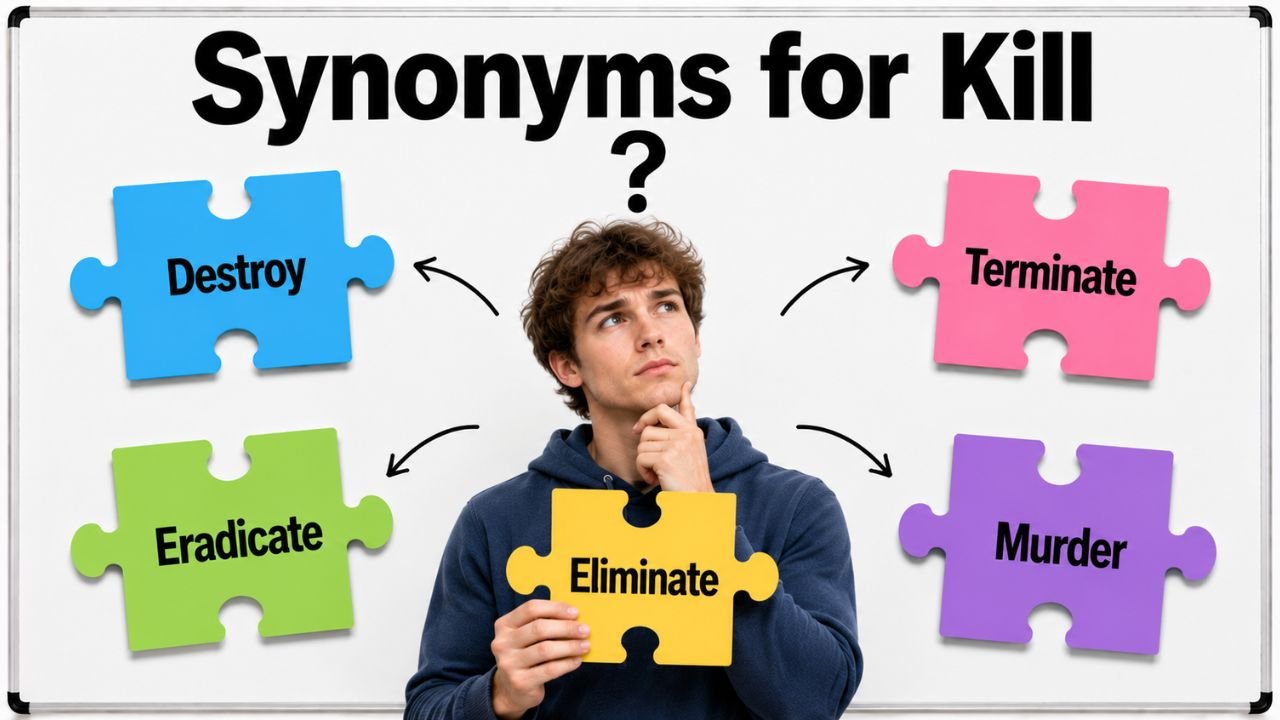
Quick Answer: Common synonyms for kill include slay, murder, assassinate, execute, eliminate, destroy, eradicate, exterminate, extinguish, and end. Use murder for an unlawful and intentional act, assassinate for killing an important public figure, execute for an officially ordered death, and slay for literary or dramatic writing. Destroy, eradicate, and exterminate are suitable when referring to diseases, pests, objects, or harmful forces. In figurative contexts, end, stop, ruin, cancel, or suppress may sound more natural than kill.
Pronunciation and Word Details
Word: Kill
Pronunciation: /kɪl/
Part of Speech: Verb and noun
Meaning: To cause a person, animal, plant, activity, process, or feeling to die, stop, or end completely.
US Pronunciation:
UK Pronunciation:
What Does “Kill” Mean?
Kill means to cause the death of a person, animal, or living organism. It is most commonly used as a verb, although it can also function as a noun when referring to an act of killing.
The word can describe literal death, as in “The disease can kill untreated patients.” It can also describe the destruction of plants, insects, bacteria, or harmful organisms.
Kill has several figurative meanings. It may mean to stop a process, cancel an idea, ruin an experience, remove pain, or turn off a machine.
Literal Use: The poison can kill small insects.
Destructive Use: The extreme heat killed the crops.
Figurative Use: His rude comment killed the cheerful mood.
Technical Use: The administrator killed the unresponsive process.
Informal Use: Let us play a game to kill time.
Meaning, Tone, and Context of “Kill”
Kill is a strong and direct word. Its tone depends on whether it is being used literally or figuratively.
In literal situations, kill can sound serious, emotional, violent, or disturbing. More precise alternatives such as murder, execute, assassinate, or cause the death of may be better in formal, legal, historical, or academic writing.
In everyday conversation, kill is frequently used figuratively. People may talk about killing time, killing an idea, killing pain, or killing the mood. These expressions normally describe stopping, removing, or ruining something rather than causing physical death.
In technical contexts, kill may refer to stopping a computer program, process, engine, or electrical system.
Formal Tone: Eliminate, terminate, eradicate, or cause the death of.
Legal Tone: Murder, execute, or unlawfully kill.
Literary Tone: Slay, dispatch, or strike down.
Scientific Tone: Eradicate, destroy, neutralize, or exterminate.
Conversational Tone: End, stop, ruin, cancel, or finish off.
Emotional Tone: Murder, slaughter, massacre, or butcher.
When and How to Use “Kill”
For Causing Death
Use kill when stating generally that someone or something caused the death of a living being.
Example: The dangerous infection can kill vulnerable animals.
For Unlawful Intentional Death
Use murder when the death is deliberate and unlawful. Kill is broader because it does not always suggest intention or criminal responsibility.
Example: The court found that the victim had been murdered.
For Destroying Harmful Organisms
Kill is commonly used for insects, bacteria, viruses, weeds, and other harmful organisms.
Example: The treatment kills harmful bacteria on the surface.
For Damaging Plants
Kill can describe weather, disease, poor soil, or chemicals causing plants to die.
Example: A severe frost may kill young flowers.
For Stopping a Process
Kill may be used in technical or informal contexts when a process, program, machine, or activity is stopped.
Example: Close the application or kill the frozen process.
For Ending an Idea or Plan
Kill can mean to reject, cancel, or prevent an idea from continuing.
Example: Rising costs killed the expansion plan.
For Ruining a Feeling or Atmosphere
Kill may describe something that destroys excitement, confidence, interest, or enjoyment.
Example: The unexpected argument killed the friendly mood.
For Removing Pain
Kill is sometimes used informally to mean removing or greatly reducing pain.
Example: The treatment helped kill the pain.
For Spending Unused Time
The phrase kill time means to do something while waiting.
Example: She read a magazine to kill time before the appointment.
Best Synonyms for Kill
Slay: To kill, especially in literary, historical, or dramatic language.
Example: The warrior was said to have slain the beast.
Murder: To kill a person intentionally and unlawfully.
Example: The investigator believed the victim had been murdered.
Assassinate: To deliberately kill an important or well known person, often for political reasons.
Example: The leader was assassinated during a period of unrest.
Execute: To put someone to death under official or legal authority.
Example: The prisoner was executed after the final judgment.
Eliminate: To remove a person, threat, problem, or possibility completely.
Example: The new procedure may eliminate a serious safety risk.
Destroy: To damage something so badly that it cannot survive, function, or continue.
Example: The fire destroyed much of the forest.
Eradicate: To remove or destroy something harmful completely.
Example: Health workers hope to eradicate the disease.
Exterminate: To destroy an entire group of pests or harmful organisms.
Example: Specialists were hired to exterminate the insects.
Extinguish: To put out a fire or end something completely.
Example: Firefighters worked quickly to extinguish the flames.
End: To cause something to stop or no longer exist.
Example: The agreement ended the long dispute.
50 Synonyms for Kill with Short Meanings
- Slay: To kill in a dramatic, literary, or historical context.
- Murder: To kill someone intentionally and unlawfully.
- Assassinate: To deliberately kill an important public person.
- Execute: To put someone to death under official authority.
- Eliminate: To remove or get rid of something completely.
- Destroy: To damage something beyond survival or repair.
- Eradicate: To remove something harmful completely.
- Exterminate: To destroy an entire group of pests or organisms.
- Extinguish: To put out or bring something completely to an end.
- End: To cause something to stop or cease existing.
- Dispatch: To kill quickly, especially in literary writing.
- Butcher: To kill brutally or carelessly.
- Slaughter: To kill many people or animals violently.
- Massacre: To kill many defenseless people or animals.
- Annihilate: To destroy completely.
- Wipe Out: To destroy or remove completely.
- Finish Off: To complete the destruction or defeat of something.
- Put to Death: To deliberately cause someone to die.
- Take a Life: To cause the death of a person.
- Strike Down: To cause sudden death, illness, or defeat.
- Do Away With: To remove, destroy, or end something.
- Terminate: To bring something to a definite end.
- Neutralize: To make a person, threat, or substance ineffective.
- Crush: To defeat, destroy, or suppress completely.
- Defeat: To overcome an opponent or force.
- Overpower: To defeat through greater strength or force.
- Ruin: To damage something so severely that it loses its value.
- Wreck: To destroy or badly damage something.
- Devastate: To cause severe destruction or emotional damage.
- Demolish: To destroy a structure or defeat something completely.
- Obliterate: To destroy every visible sign of something.
- Decimate: To destroy a large part of a group.
- Extirpate: To remove or destroy something completely.
- Stamp Out: To eliminate something harmful or unwanted.
- Root Out: To find and remove a problem completely.
- Suppress: To stop an activity, feeling, or movement by force.
- Quash: To stop or reject something completely.
- Stifle: To prevent something from growing, developing, or continuing.
- Smother: To stop something by covering, controlling, or suppressing it.
- Silence: To stop a sound, voice, criticism, or opposition.
- Halt: To cause an activity or process to stop.
- Stop: To prevent something from continuing.
- Cancel: To decide that an event, plan, or activity will not happen.
- Abort: To stop a process before it is completed.
- Discontinue: To stop providing, producing, or doing something.
- Deactivate: To make a system, device, or function inactive.
- Disable: To prevent something from operating normally.
- Deadening: To reduce or remove feeling, sound, or effect.
- Numb: To remove physical or emotional feeling.
- Spoil: To ruin the quality, enjoyment, or success of something.
Read Also:
Synonyms for Lie

Synonyms for Kill by Context
When Kill Means Cause Death
Slay, put to death, take a life, strike down, and dispatch can replace kill when referring to literal death.
Slay and dispatch often sound literary or dramatic. Take a life is less direct and may sound more sensitive.
Example: The disease took the lives of several animals.
Example: The legendary knight slew the creature.
When Kill Means Murder
Murder, assassinate, butcher, slaughter, and massacre describe more specific forms of killing.
Murder suggests intention and illegality. Assassinate normally refers to a prominent person. Slaughter and massacre suggest multiple deaths or extreme violence.
Example: Investigators believed the victim had been murdered.
Example: Several historical leaders were assassinated for political reasons.
When Kill Means Destroy Completely
Destroy, annihilate, obliterate, wipe out, devastate, and demolish describe complete or serious destruction.
These words can apply to buildings, communities, plans, hopes, systems, or natural environments.
Example: The storm devastated the coastal area.
Example: The fire destroyed the abandoned building.
When Kill Means Remove Something Harmful
Eradicate, eliminate, exterminate, extirpate, stamp out, and root out are suitable for diseases, pests, corruption, harmful habits, or serious problems.
Example: The campaign aims to eradicate the infection.
Example: The organization introduced new controls to root out fraud.
When Kill Means Stop a Process
Stop, halt, terminate, abort, discontinue, deactivate, and disable work well for activities, programs, systems, and operations.
Example: The operator halted production after discovering the fault.
Example: The system automatically terminated the damaged process.
When Kill Means Ruin
Ruin, spoil, wreck, devastate, crush, and smother can describe the destruction of plans, moods, confidence, enjoyment, or creativity.
Example: Constant criticism crushed his confidence.
Example: The interruption spoiled the peaceful atmosphere.
When Kill Means Suppress
Suppress, silence, quash, stifle, and smother describe preventing an idea, emotion, protest, voice, or development from continuing.
Example: Fear can stifle creativity.
Example: The new rule was designed to suppress dishonest practices.
When Kill Means Remove Feeling
Numb, deaden, relieve, reduce, and dull may be more natural when referring to pain or emotion.
Example: The medicine helped numb the pain.
Example: Repeated disappointment had deadened his enthusiasm.
Another Word for Kill
The best single replacement for kill is often eliminate because it can describe removing a threat, problem, possibility, or harmful element without always suggesting physical death.
However, the most accurate alternative depends on the context. Use murder for unlawful intentional death, destroy for severe physical damage, eradicate for removing disease, and stop for ending an activity.
Original: The treatment can kill harmful bacteria.
Better Option: The treatment can eliminate harmful bacteria.
Original: The frost killed the young plants.
Better Option: The frost destroyed the young plants.
Original: The committee killed the proposal.
Better Option: The committee rejected the proposal.
Original: Her comment killed the excitement.
Better Option: Her comment ruined the excitement.
When Not to Use “Kill”
Avoid using kill when a more precise word can explain the exact action. The word may sound too violent, informal, vague, or emotionally strong in formal communication.
Do not use kill when you simply mean stop, reject, reduce, or turn off. Choose a word that clearly describes what happened.
Weak: The manager killed the project.
Better: The manager canceled the project.
Weak: The medicine killed my headache.
Better: The medicine relieved my headache.
Weak: The update killed the old feature.
Better: The update discontinued the old feature.
Weak: The cold weather killed our plans.
Better: The cold weather ruined our plans.
Weak: Please kill the lights before leaving.
Better: Please turn off the lights before leaving.
Kill should also be avoided in sensitive writing when a gentler phrase such as died, caused the death of, or took the life of communicates the idea more respectfully.
Words Commonly Confused With Kill
Kill vs Murder: Kill is a general word for causing death. Murder specifically means intentionally and unlawfully killing a person.
Kill vs Assassinate: Kill can refer to any person or living organism. Assassinate normally refers to deliberately killing a prominent person for political or ideological reasons.
Kill vs Execute: Kill is broad and does not explain authority. Execute means putting someone to death through an official order.
Kill vs Slay: Kill is neutral and common. Slay sounds literary, dramatic, historical, or poetic.
Kill vs Destroy: Kill normally applies to living things, although it also has figurative uses. Destroy commonly applies to objects, systems, buildings, plans, and environments.
Kill vs Eliminate: Kill may suggest death or complete stopping. Eliminate means removing something and often sounds more neutral or formal.
Kill vs Eradicate: Kill may refer to a single organism. Eradicate means removing an entire disease, problem, or harmful condition.
Kill vs Exterminate: Kill may involve one or several living things. Exterminate suggests destroying an entire group of pests or unwanted organisms.
Kill vs Terminate: Kill is direct and may sound emotional. Terminate is formal and usually refers to ending a process, agreement, operation, or service.
Which Synonym Should You Choose?
Choose murder when describing the intentional and unlawful killing of a person.
Choose assassinate when an important political, royal, military, or public figure is deliberately killed.
Choose execute when death occurs under official or legal authority.
Choose slay when writing a legend, fantasy story, historical account, or dramatic passage.
Choose eliminate when referring to removing a threat, error, risk, possibility, or competitor.
Choose destroy when something is damaged beyond repair or survival.
Choose eradicate when discussing the complete removal of a disease, infection, harmful practice, or social problem.
Choose exterminate when referring to the complete destruction of pests or harmful organisms.
Choose extinguish when discussing fire, light, hope, enthusiasm, or life in literary writing.
Choose terminate when writing about contracts, programs, processes, operations, or employment.
Choose halt or stop when the meaning is simply to prevent an activity from continuing.
Choose cancel when an event, plan, order, or project will no longer happen.
Choose ruin or spoil when something damages an experience, mood, plan, or result.
Choose suppress or quash when stopping opposition, information, protest, or an unwanted activity.
Choose numb or deaden when reducing pain, emotion, sound, or physical feeling.
Real Life Examples of “Kill” in Sentences
Original: The pesticide killed the insects in the garden.
Better Option: The pesticide exterminated the insects in the garden.
Original: The severe disease killed many trees.
Better Option: The severe disease destroyed many trees.
Original: The committee killed the proposal after reviewing its cost.
Better Option: The committee rejected the proposal after reviewing its cost.
Original: The software update killed the older function.
Better Option: The software update discontinued the older function.
Original: The loud interruption killed the peaceful mood.
Better Option: The loud interruption ruined the peaceful mood.
Original: The company wants to kill unnecessary expenses.
Better Option: The company wants to eliminate unnecessary expenses.
Original: The treatment may kill the infection.
Better Option: The treatment may eradicate the infection.
Original: The operator killed the frozen computer process.
Better Option: The operator terminated the frozen computer process.
Original: One careless mistake killed their chances of winning.
Better Option: One careless mistake destroyed their chances of winning.
Original: She listened to music to kill time.
Better Option: She listened to music to pass the time.
Synonym Groups and Usage Differences
Literal Death Group
Kill, slay, dispatch, put to death, take a life, and strike down refer directly to death.
Kill is the most general word. Slay and dispatch are more literary. Take a life sounds less direct and may suit sensitive writing.
Example: The illness took the lives of several animals.
Criminal Killing Group
Murder, assassinate, butcher, slaughter, and massacre suggest intentional, unlawful, political, brutal, or large scale killing.
These words should not be treated as interchangeable because each describes a different situation.
Example: The investigation focused on whether the victim had been murdered.
Official Death Group
Execute and put to death describe death caused through official authority or an ordered punishment.
Execute is formal and specific. Put to death is more descriptive and less technical.
Example: The ruler ordered the prisoner to be put to death.
Complete Destruction Group
Destroy, annihilate, obliterate, demolish, wipe out, and devastate describe extreme damage.
Destroy is broad. Annihilate and obliterate suggest complete destruction. Devastate suggests severe physical or emotional damage.
Example: The earthquake devastated several communities.
Removal Group
Eliminate, eradicate, exterminate, extirpate, root out, and stamp out describe removing something unwanted.
Eliminate is general. Eradicate is common for diseases and serious problems. Exterminate is normally used for pests.
Example: The program was created to eradicate the disease.
Ending Group
End, stop, halt, terminate, abort, cancel, and discontinue describe bringing an activity or process to a close.
Stop and end are neutral. Terminate is formal. Abort means ending something before completion.
Example: Officials halted the operation for safety reasons.
Damage Group
Ruin, wreck, spoil, crush, and devastate describe serious damage to an experience, plan, object, or emotion.
Example: The unexpected expense ruined their travel plans.
Suppression Group
Suppress, quash, stifle, smother, and silence refer to preventing something from being expressed or developed.
Example: Excessive control can stifle original thinking.
Antonyms of Kill
The opposite of kill depends on whether the word refers to death, destruction, stopping, or emotional damage.
Save: To prevent someone or something from dying or being destroyed.
Revive: To bring someone or something back to life, activity, or strength.
Rescue: To remove someone or something from danger.
Protect: To keep someone or something safe from harm.
Preserve: To keep something alive, safe, or unchanged.
Spare: To choose not to harm or kill someone.
Heal: To make a wound, illness, or emotional condition better.
Restore: To return something to its earlier condition.
Create: To bring something new into existence.
Build: To develop or strengthen something.
Support: To help something continue or succeed.
Encourage: To give confidence, hope, or motivation.
Continue: To keep an activity or process going.
Activate: To make a system or process begin operating.
Start: To cause something to begin.
Comparison: Kill vs Related Words
Kill vs Murder
Kill means to cause death, whether intentionally or accidentally. Murder means to kill a person intentionally and unlawfully.
Example With Kill: The accident killed two passengers.
Example With Murder: The criminal was convicted of murdering the victim.
Kill vs Slay
Kill is common in everyday language. Slay is more literary, dramatic, or historical.
Example With Kill: The disease can kill unprotected animals.
Example With Slay: The hero slew the monster in the ancient tale.
Kill vs Destroy
Kill usually refers to living things, but it can also be figurative. Destroy normally refers to objects, buildings, systems, hopes, or plans.
Example With Kill: The poison killed the weeds.
Example With Destroy: The storm destroyed several buildings.
Kill vs Eliminate
Kill can suggest death or complete stopping. Eliminate means to remove something and often sounds less violent.
Example With Kill: The chemical kills harmful bacteria.
Example With Eliminate: The filter eliminates harmful particles.
Kill vs Eradicate
Kill may refer to one living thing or one occurrence. Eradicate means to remove an entire disease, problem, or harmful condition.
Example With Kill: The treatment kills the parasite.
Example With Eradicate: The campaign aims to eradicate the parasite from the region.
Kill vs Exterminate
Kill is broad and may refer to one organism. Exterminate means to destroy an entire group of pests.
Example With Kill: The trap killed one insect.
Example With Exterminate: The service was hired to exterminate the infestation.
Kill vs Terminate
Kill is direct and often informal when used for processes. Terminate is more formal and suitable for systems, contracts, and operations.
Example With Kill: The technician killed the frozen program.
Example With Terminate: The technician terminated the frozen program.
Kill vs Ruin
Kill may be used figuratively to mean destroying enjoyment or success. Ruin communicates this meaning more directly.
Example With Kill: The argument killed the evening.
Example With Ruin: The argument ruined the evening.
Common Phrases and Expressions With “Kill”
Kill Time: To do something while waiting or to make time pass.
Kill the Mood: To ruin a particular emotional atmosphere.
Kill the Pain: To remove or greatly reduce physical pain.
Kill the Lights: To turn off the lights.
Kill the Engine: To switch off an engine.
Kill a Process: To force a computer process or program to stop.
Kill an Idea: To reject or prevent an idea from developing.
Kill a Deal: To cause an agreement or negotiation to fail.
Kill Two Birds With One Stone: To achieve two results through one action.
Dressed to Kill: Wearing clothes intended to look extremely attractive or impressive.
Common Mistakes to Avoid
One common mistake is using kill when a more precise word is required. Kill does not automatically mean murder. A person may be killed accidentally, but murder always suggests intention and illegality.
Another mistake is using assassinate for every intentional killing. Assassinate normally applies to prominent public people and often involves political motives.
Avoid using exterminate for a single insect or animal. The word usually suggests destroying an entire population or infestation.
Do not use eradicate when you only mean reduce. Eradicate means removing something completely.
Writers also overuse kill in figurative sentences. Although phrases such as kill the mood and kill time are natural, formal writing may require words such as ruin, stop, cancel, reject, terminate, or eliminate.
Avoid unnecessarily violent wording in sensitive contexts. A gentler and more respectful phrase may communicate the meaning more appropriately.
Always choose a synonym according to intention, legality, scale, tone, and context.
Conclusion
Understanding synonyms for kill helps writers communicate death, destruction, removal, and stopping more precisely. Murder is appropriate for unlawful intentional death, while assassinate refers to killing a prominent person. Destroy, annihilate, and devastate describe serious damage. Eradicate and exterminate suit diseases or pests, while terminate, cancel, and halt work better for processes and plans. In figurative writing, ruin, spoil, suppress, or eliminate may sound clearer and less violent. The best choice always depends on tone, purpose, and context.
FAQs About Synonyms for Kill
What Is the Best Synonym for Kill?
The best general synonym is eliminate, but the correct word depends on the context. Murder, destroy, eradicate, terminate, and ruin have more specific meanings.
Is Murder the Same as Kill?
No. Kill means to cause death generally. Murder specifically means intentionally and unlawfully killing a person.
What Is a Formal Word for Kill?
Eliminate, terminate, execute, eradicate, and cause the death of are formal alternatives, depending on the intended meaning.
What Is a Literary Synonym for Kill?
Slay, dispatch, strike down, and extinguish are common literary alternatives.
What Is Another Word for Killing Bacteria?
Eliminate, destroy, eradicate, neutralize, and disinfect may be suitable, depending on the scientific context.
What Is Another Word for Killing a Plan?
Cancel, reject, terminate, abandon, halt, or discontinue can replace kill when referring to a plan or project.
Can Kill Be Used Figuratively?
Yes. Kill can mean to ruin a mood, stop a process, cancel an idea, remove pain, turn off a machine, or pass unused time.
