
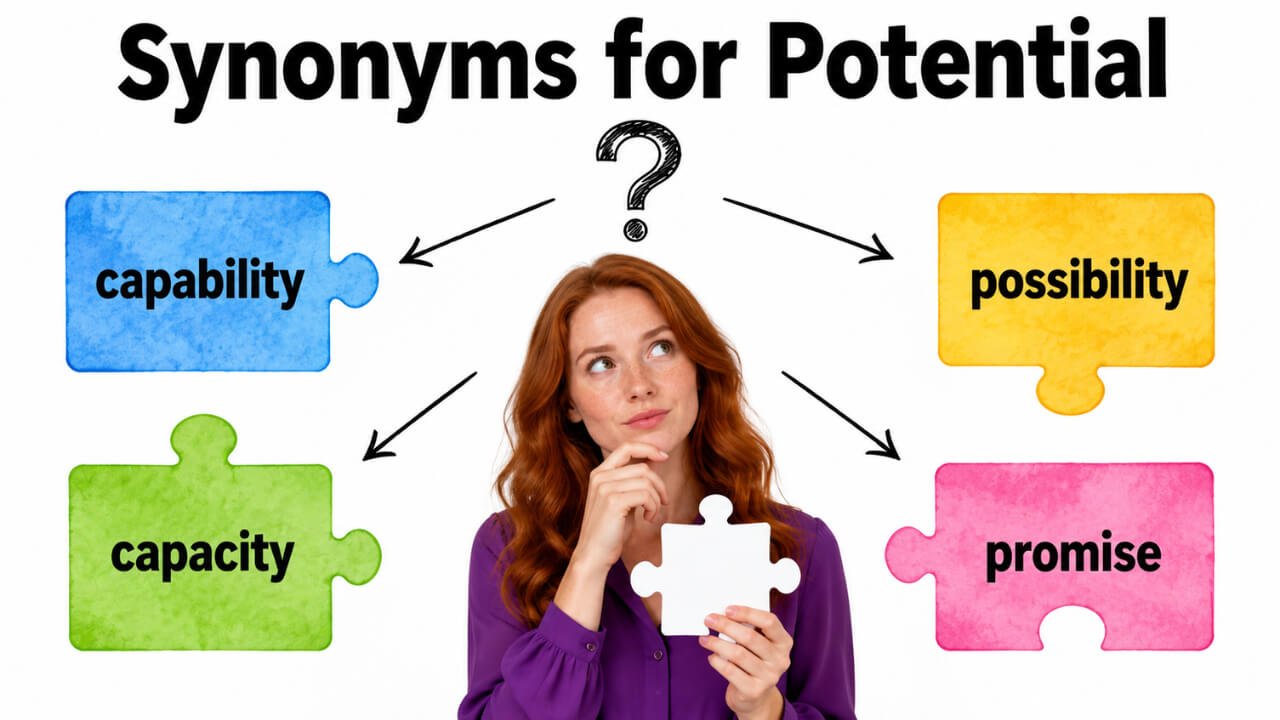
Quick Answer: Synonyms for potential include possible, prospective, promising, likely, latent, untapped, capability, capacity, aptitude, and promise. Use possible for something that may happen, prospective for a future person or opportunity, and promising for something likely to succeed. Latent and untapped describe qualities that exist but have not developed fully. Capability, capacity, and aptitude refer to a person’s ability, while promise describes signs of future success or improvement.
Pronunciation and Word Details
Word: Potential
Pronunciation: /pəˈtenʃəl/
Part of Speech: Adjective and noun
Meaning: Something that may happen, develop, succeed, or become valuable in the future.
US Pronunciation:
UK Pronunciation:
What Does “Potential” Mean?
Potential means having the possibility, ability, or qualities needed to develop, happen, or succeed in the future.
As an adjective, potential describes something that is possible but has not happened yet. A potential problem is a problem that may arise. A potential customer is someone who may become a customer.
As a noun, potential refers to a person’s ability, capacity, or promise for future development. A student with great potential has qualities that may lead to future achievement.
The word can describe opportunities, risks, talent, growth, results, candidates, benefits, problems, and future events. Its exact meaning depends on whether the sentence focuses on possibility, ability, or expected development.
Meaning, Tone, and Context of “Potential”
Potential has a neutral and flexible tone. It is common in everyday conversation, professional communication, academic writing, reports, essays, evaluations, and technical discussions.
When potential describes a future possibility, it usually has a cautious tone. It suggests that something may happen, but it is not certain.
When it describes a person’s ability, potential often has a positive and encouraging tone. It suggests that someone has qualities that may lead to future success.
In business or professional writing, potential can describe opportunities, candidates, risks, benefits, growth, or results. In education, it often refers to a learner’s ability to improve. In science and technical writing, it can describe possible effects, energy, or future outcomes.
The word is useful because it does not claim that something is guaranteed. It presents a possibility or ability that may develop under the right conditions.
When and How to Use “Potential”
For Future Possibility: Use potential when something may happen but is not certain.
Example: The team discussed several potential solutions to the problem.
For Personal Ability: Use potential when someone has the ability to improve or succeed.
Example: The teacher recognized the student’s potential as a writer.
For Business Opportunity: Use potential when an idea, market, product, or plan may become successful.
Example: The proposal has strong potential for future growth.
For Possible Risk: Use potential when identifying a danger or problem that could occur.
Example: The report outlines the potential risks of delaying the repairs.
For Future Candidates: Use potential when someone may be selected for a position or responsibility.
Example: The committee interviewed three potential candidates.
For Hidden Talent: Use potential when a quality exists but has not been fully developed.
Example: With regular practice, she could realize her full potential.
For Expected Benefits: Use potential when an action may produce a positive result.
Example: The new approach offers several potential benefits.
For Academic Evaluation: Use potential when discussing a learner’s capacity to progress.
Example: His early work shows considerable academic potential.
Best Synonyms for Potential
1. Possible
Synonym: Able to happen, exist, or be achieved.
Example: The manager considered every possible solution.
2. Prospective
Synonym: Expected or likely to become something in the future.
Example: Prospective students attended the information session.
3. Promising
Synonym: Showing signs of future success or improvement.
Example: She is a promising young designer.
4. Likely
Synonym: Expected to happen or be true.
Example: Rain is likely later in the evening.
5. Latent
Synonym: Present but not yet visible, active, or developed.
Example: The training helped reveal his latent talent.
6. Untapped
Synonym: Available but not yet used or developed.
Example: The region has considerable untapped economic potential.
7. Capability
Synonym: The ability or power to perform a task successfully.
Example: The candidate demonstrated strong leadership capability.
8. Capacity
Synonym: The ability to develop, understand, perform, or achieve something.
Example: She has the capacity to manage complex responsibilities.
9. Aptitude
Synonym: A natural ability to learn or perform a particular activity.
Example: He showed an early aptitude for mathematics.
10. Promise
Synonym: Signs that someone or something may become successful.
Example: The new method shows considerable promise.
50 Synonyms for Potential with Short Meanings
- Possible: Able to happen or exist.
- Prospective: Expected to become something in the future.
- Promising: Showing signs of future success.
- Likely: Expected to happen or be true.
- Probable: More likely than not to happen.
- Conceivable: Possible to imagine or believe.
- Plausible: Seemingly reasonable or possible.
- Feasible: Possible and practical to achieve.
- Achievable: Capable of being successfully completed.
- Attainable: Possible to reach or obtain.
- Viable: Capable of working or succeeding.
- Latent: Present but not yet developed.
- Dormant: Existing but currently inactive.
- Undeveloped: Not yet fully grown or improved.
- Unrealized: Existing as a possibility but not achieved.
- Untapped: Available but not yet used.
- Emerging: Beginning to appear or develop.
- Budding: Starting to show ability or promise.
- Aspiring: Hoping and working to achieve something.
- Future: Expected to exist or happen later.
- Expected: Considered likely to happen.
- Anticipated: Predicted or looked forward to.
- Impending: Likely to happen very soon.
- Possible Outcome: A result that may occur.
- Capability: The ability to perform successfully.
- Capacity: The power or ability to develop or achieve.
- Ability: The skill or power to do something.
- Aptitude: A natural ability to learn something.
- Talent: A natural skill or special ability.
- Promise: Signs of future success.
- Possibility: Something that may happen or exist.
- Prospect: A possible future event or opportunity.
- Opportunity: A favorable chance for progress.
- Likelihood: The chance that something will happen.
- Chance: A possibility that an event may occur.
- Scope: The opportunity or room for development.
- Power: The ability to act or produce a result.
- Competence: The ability to perform effectively.
- Proficiency: A high level of skill or ability.
- Readiness: The state of being prepared to act.
- Suitability: The quality of being appropriate for a purpose.
- Qualification: A quality or skill that makes someone suitable.
- Potentiality: An existing possibility or capacity for development.
- Growth Capacity: The ability to develop or expand.
- Room for Growth: The possibility of future improvement.
- Hidden Ability: A skill that has not yet been recognized.
- Natural Aptitude: An inborn ability to learn or perform.
- Inherent Capacity: An ability that naturally exists within someone or something.
- Future Capability: An ability that may develop later.
- Prospective Value: Value that may appear or increase in the future.
Read Also:
Synonyms for Friendship
Synonyms for Potential by Context
When Potential Means Possible
Possible, conceivable, plausible, probable, likely, and feasible describe something that may happen or be true.
Example: The researchers considered several possible explanations.
Possible is the most general choice. Conceivable means something can be imagined. Plausible suggests that an idea appears reasonable. Probable and likely suggest a stronger chance of happening.
Feasible is best when the possibility must also be practical.
Example: The plan is feasible within the available budget.
When Potential Means Future or Prospective
Prospective, future, expected, anticipated, emerging, and impending describe people, events, or developments connected with the future.
Example: The organization contacted several prospective members.
Prospective is useful for people who may gain a position, role, or status later. Future is broader and simply refers to a later time.
Expected and anticipated suggest that something is likely to happen. Impending usually refers to an event that is approaching soon.
Example: The team prepared for the impending deadline.
When Potential Means Hidden Ability
Latent, dormant, untapped, undeveloped, unrealized, and hidden describe abilities or resources that exist but have not been fully used.
Example: The course helped students discover their latent abilities.
Latent means present but not yet active or visible. Dormant suggests temporary inactivity. Untapped describes something valuable that has not yet been used.
Unrealized potential refers to an ability or opportunity that has not become an actual achievement.
Example: His artistic talent remained largely unrealized.
When Potential Means Future Success
Promising, budding, emerging, aspiring, viable, and hopeful describe people or ideas that may succeed.
Example: She is a promising researcher with original ideas.
Promising suggests clear signs of future success. Budding usually describes someone at the beginning of a career or skill.
Emerging can describe a developing person, field, trend, or opportunity. Viable is suitable for a plan or idea that can realistically succeed.
Example: The committee believes the proposal is commercially viable.
When Potential Means Ability
Ability, capability, capacity, aptitude, talent, competence, and proficiency describe what a person or system can do.
Example: He has the ability to explain complex ideas clearly.
Capability often refers to the power to complete a particular task. Capacity can describe the amount of development or responsibility someone can handle.
Aptitude and talent often refer to natural ability. Competence and proficiency describe demonstrated skill rather than an undeveloped possibility.
When Potential Means Opportunity
Opportunity, prospect, possibility, chance, scope, and room for growth describe favorable future conditions.
Example: The position offers excellent opportunities for professional development.
Opportunity usually refers to a favorable situation. Prospect describes a possible future benefit or event. Scope means there is space or freedom for improvement.
Example: The project provides considerable scope for creativity.
When Potential Means Risk
Possible, prospective, likely, conceivable, and anticipated can describe negative events that may occur.
Example: The inspection identified several potential safety risks.
Possible is neutral, while likely suggests a stronger probability. Anticipated is useful when a problem has already been predicted.
Potential is often preferred in risk discussions because it identifies danger without claiming that the danger will definitely occur.
Another Word for Potential
The best general replacement for potential is possible when describing something that may happen. Capability is better when discussing ability, while promise works well when referring to future success. The best alternative depends on the sentence.
Original: The report identifies a potential problem.
Better Option: The report identifies a possible problem.
Original: She has the potential to become an excellent manager.
Better Option: She has the capability to become an excellent manager.
Original: The young musician has great potential.
Better Option: The young musician shows great promise.
Original: The plan has potential for expansion.
Better Option: The plan offers considerable scope for expansion.
When Not to Use “Potential”
Avoid using potential when the event or result has already happened. Potential refers to possibility or undeveloped ability rather than an established fact.
Weak: The completed project delivered potential benefits last year.
Better: The completed project delivered significant benefits last year.
Do not use potential when you mean that something is highly likely. Potential only means possible and does not indicate a specific level of probability.
Weak: The storm is potential to reach the coast tonight.
Better: The storm is likely to reach the coast tonight.
Avoid using potential as an adjective after linking verbs in unnatural constructions.
Weak: The candidate is potential for the leadership role.
Better: The candidate has potential for the leadership role.
Better: The candidate is a promising choice for the leadership role.
Do not use potential when a more specific ability word would improve clarity.
Weak: She has potential in solving technical problems.
Better: She has a strong aptitude for solving technical problems.
Avoid repeating potential several times in one paragraph.
Weak: The potential candidate discussed the potential benefits and potential risks of the potential plan.
Better: The prospective candidate discussed the possible benefits and risks of the proposed plan.
Do not use promising when discussing a negative possibility.
Weak: The inspection revealed a promising safety hazard.
Better: The inspection revealed a potential safety hazard.
Words Commonly Confused With Potential
Potential vs Possible: Potential can describe a future possibility or an undeveloped ability. Possible mainly means that something can happen or exist.
Potential vs Probable: Potential means something may happen. Probable means it is more likely to happen than not.
Potential vs Prospective: Potential is broader and may describe ability, risk, or possibility. Prospective usually describes a future person, role, customer, student, or opportunity.
Potential vs Promising: Potential describes the capacity for future success. Promising suggests that there are already encouraging signs of success.
Potential vs Capability: Potential is an ability that may develop. Capability is the present power or ability to perform a task.
Potential vs Capacity: Potential refers to possible future development. Capacity describes the amount of ability, responsibility, or growth that someone or something can support.
Potential vs Talent: Potential may exist in many areas and may not yet be proven. Talent is a natural skill that is often already noticeable.
Potential vs Aptitude: Potential is a broad possibility of future achievement. Aptitude is a natural ability to learn or perform a particular activity.
Potential vs Opportunity: Potential is the possibility of development or success. Opportunity is a favorable situation that allows progress.
Potential vs Potentiality: Potential is the common modern word. Potentiality is a more formal noun referring to an existing possibility or capacity.
Which Synonym Should You Choose?
Choose possible when something may happen, exist, or be true.
Choose likely when evidence suggests that an event has a strong chance of happening.
Choose probable in formal writing when an outcome is more likely than not.
Choose prospective when referring to a future employee, student, customer, candidate, or member.
Choose promising when a person, idea, or project already shows encouraging signs of success.
Choose feasible when a plan is both possible and practical.
Choose viable when an idea, method, or business plan can work successfully over time.
Choose latent when an ability or quality exists but is not yet visible.
Choose untapped when a resource, market, talent, or opportunity has not yet been used.
Choose capability when discussing the ability to perform a particular task.
Choose capacity when describing the ability to grow, learn, manage, or contain something.
Choose aptitude when someone has a natural ability in a particular subject or activity.
Choose talent when a natural skill is already noticeable.
Choose promise when describing signs of future success in formal or encouraging writing.
Choose prospect when referring to a future opportunity or possible outcome.
Choose scope when discussing room for development, creativity, or improvement.
Choose opportunity when the sentence focuses on a favorable chance rather than an internal ability.
Choose potential in reports, essays, and professional communication when you need a neutral word covering future possibility, ability, risk, or growth.
Real Life Examples of “Potential” in Sentences
Original: The new employee has the potential to become a strong leader.
Better Option: The new employee has the capability to become a strong leader.
Original: The committee discussed the potential effects of the change.
Better Option: The committee discussed the possible effects of the change.
Original: She is a potential candidate for the position.
Better Option: She is a prospective candidate for the position.
Original: The student has considerable potential in science.
Better Option: The student has considerable aptitude for science.
Original: The plan has potential for long term success.
Better Option: The plan shows promise for long term success.
Original: The region has strong potential for tourism.
Better Option: The region offers considerable scope for tourism.
Original: The team identified a potential delay.
Better Option: The team identified a possible delay.
Original: The young athlete has great potential.
Better Option: The young athlete shows great promise.
Original: The proposal could create potential opportunities for growth.
Better Option: The proposal could create valuable opportunities for growth.
Original: The training program helped her reach her potential.
Better Option: The training program helped her develop her full ability.
Synonym Groups and Usage Differences
Possibility Group
Possible, conceivable, plausible, probable, likely, and feasible describe different levels or types of possibility.
Possible is broad and neutral. Conceivable means something can be imagined. Plausible suggests that an explanation appears believable.
Likely and probable indicate a stronger chance than possible. Feasible adds the idea of practicality.
Example: The revised schedule is both possible and feasible.
Future Group
Prospective, future, expected, anticipated, impending, and emerging describe things connected with a later time.
Prospective often appears before nouns referring to people or opportunities. Expected and anticipated suggest prediction.
Impending usually describes something approaching soon, while emerging describes something beginning to develop.
Example: Prospective students received information about future courses.
Hidden Ability Group
Latent, dormant, untapped, undeveloped, unrealized, and hidden ability describe qualities that have not yet been fully expressed.
Latent ability exists beneath the surface. Dormant ability is inactive but may become active again.
Untapped ability has not yet been used, while unrealized ability has not become a completed achievement.
Example: Supportive teaching helped reveal her latent potential.
Skill and Capacity Group
Ability, capability, capacity, aptitude, talent, competence, and proficiency relate to what a person can do.
Ability is the broadest term. Capability often refers to performing a specific task. Capacity emphasizes how much someone can learn, manage, or achieve.
Aptitude and talent can be natural. Competence and proficiency usually describe skills that have already developed.
Example: His natural aptitude developed into professional proficiency.
Success Group
Promise, promising, viable, budding, emerging, and aspiring describe future progress or achievement.
Promise and promising suggest encouraging signs. Budding describes someone beginning to develop a skill.
Aspiring describes a person who hopes to enter a role or profession. Viable describes an idea or plan that has a realistic chance of working.
Example: The budding artist shows considerable promise.
Opportunity Group
Opportunity, prospect, chance, possibility, scope, and room for growth describe conditions that may lead to progress.
Opportunity is a favorable situation. Prospect is a possible future benefit. Chance is more general and may be positive or negative.
Scope and room for growth emphasize the space available for improvement.
Example: The role offers excellent scope for professional development.
Antonyms of Potential
The opposite of potential changes according to whether the word refers to possibility, ability, development, or future success.
Impossible: Unable to happen or be achieved.
Unlikely: Not expected to happen.
Improbable: Having a very low chance of occurring.
Actual: Existing as a fact rather than a possibility.
Realized: Successfully developed or achieved.
Developed: Fully grown, improved, or established.
Proven: Demonstrated to be effective or true.
Certain: Guaranteed or known to happen.
Incapable: Lacking the ability to perform something.
Incompetent: Unable to perform a task effectively.
Limited: Restricted in ability, size, or opportunity.
Unpromising: Showing little chance of future success.
Hopeless: Having no reasonable chance of improvement.
Ineffective: Unable to produce the intended result.
Unfeasible: Not practical or possible to complete.
Unviable: Unable to work or succeed over time.
Exhausted: Fully used with no remaining possibility or resource.
Fulfilled: Completely developed or achieved.
Comparison: Potential vs Related Words
Potential vs Possible
Potential can describe something that may happen or an ability that may develop. Possible only describes something that can happen, exist, or be achieved.
Example With Potential: The student has the potential to become an excellent researcher.
Example With Possible: It is possible that the meeting will end early.
Potential vs Prospective
Potential is broad and can refer to future ability, danger, opportunity, or success. Prospective mainly refers to someone or something expected to gain a future role or status.
Example With Potential: The project has significant potential.
Example With Prospective: Prospective employees attended the orientation session.
Potential vs Promising
Potential means that success or development is possible. Promising means there are already positive signs that success may occur.
Example With Potential: The beginner has the potential to improve.
Example With Promising: The beginner produced a promising first performance.
Potential vs Likely
Potential indicates possibility without showing how probable it is. Likely suggests that something has a strong chance of happening.
Example With Potential: The team prepared for potential delays.
Example With Likely: Delays are likely because of the damaged road.
Potential vs Capability
Potential describes an ability that may be developed or used later. Capability describes the present ability to complete a task.
Example With Potential: She has the potential to lead a larger department.
Example With Capability: She has the capability to manage the current department.
Potential vs Capacity
Potential focuses on what could develop in the future. Capacity focuses on the amount of ability, growth, work, or responsibility that can be handled.
Example With Potential: The program has potential for expansion.
Example With Capacity: The building has the capacity to hold five hundred people.
Potential vs Aptitude
Potential is a broad possibility of development. Aptitude is a natural ability to learn or perform a specific task.
Example With Potential: He has strong academic potential.
Example With Aptitude: He has a natural aptitude for languages.
Potential vs Talent
Potential may not yet be visible or proven. Talent is a natural ability that can usually be observed.
Example With Potential: The coach believes she has great potential.
Example With Talent: She demonstrated exceptional athletic talent.
Potential vs Promise
Potential refers to capacity or possibility. Promise refers to encouraging signs that future success is likely.
Example With Potential: The idea has commercial potential.
Example With Promise: Early results show considerable promise.
Potential vs Opportunity
Potential exists within a person, idea, or situation. Opportunity is an external chance that allows someone to act or progress.
Example With Potential: She has the potential to become a skilled speaker.
Example With Opportunity: She received an opportunity to speak at the event.
Common Phrases and Expressions With “Potential”
Full Potential: The highest level of ability that someone or something can achieve.
Great Potential: A strong possibility of future success or development.
Growth Potential: The ability to expand, improve, or increase in value.
Future Potential: The capacity to become useful or successful later.
Hidden Potential: Ability that has not yet been noticed or developed.
Untapped Potential: Valuable ability or opportunity that has not been used.
Potential Risk: A danger that may occur.
Potential Problem: A difficulty that could develop.
Potential Candidate: Someone who may be selected for a role.
Potential Benefit: A positive result that may occur.
Potential Impact: A possible effect or influence.
Potential Opportunity: A favorable possibility that may become available.
Potential Solution: An idea that may solve a problem.
Show Potential: To display signs of future ability or success.
Reach Your Potential: To develop and use your abilities fully.
Realize Your Potential: To turn possible ability into actual achievement.
Develop Potential: To improve an existing ability or opportunity.
Assess Potential: To evaluate possible ability, value, or future performance.
Common Mistakes to Avoid
A common mistake is treating potential as a guarantee. Potential only describes a possibility or capacity. It does not mean that success will certainly occur.
Avoid using potential and possible together when they express the same idea.
Weak: There is a possible potential risk of delay.
Better: There is a potential risk of delay.
Do not confuse potential with probable. A potential result may occur, while a probable result is expected to occur.
Use the correct sentence structure when potential is a noun.
Incorrect: She is potential to become a doctor.
Correct: She has the potential to become a doctor.
When potential is an adjective, place it before the noun it describes.
Incorrect: The manager interviewed a candidate potential.
Correct: The manager interviewed a potential candidate.
Avoid using ability synonyms when the sentence describes a future event. Capability and aptitude refer to ability, not general possibility.
Incorrect: The report identified a capability problem.
Correct: The report identified a potential problem.
Do not use prospective as a direct replacement in every sentence. Prospective is most natural for future people, roles, customers, students, members, or opportunities.
Avoid vague phrases such as “a lot of potential” in formal reports. Explain what kind of potential exists.
Vague: The project has a lot of potential.
Clear: The project has strong potential for regional expansion.
Do not repeat potential unnecessarily. Use possible, promising, prospective, capability, opportunity, or scope when those words express the intended meaning more accurately.
Conclusion
Synonyms for potential help describe possibility, future success, hidden ability, and room for development more precisely. Possible suits uncertain events, while prospective describes future people or opportunities. Promising and promise highlight encouraging signs of success. Latent and untapped refer to undeveloped qualities, while capability, capacity, aptitude, and talent describe ability. Feasible and viable work well for practical plans. Choosing the right synonym makes your meaning clearer and shows whether you are discussing risk, opportunity, skill, growth, or probability.
FAQs About Synonyms for Potential
What Is the Best Synonym for Potential?
Possible is the best general synonym when potential describes something that may happen. Capability is better when it refers to ability.
What Is Another Word for Someone With Potential?
Promising, talented, budding, aspiring, and capable can describe someone with the ability to succeed in the future.
What Is a Formal Synonym for Potential?
Prospective, latent, viable, capability, capacity, and potentiality are suitable formal alternatives, depending on the meaning.
What Is a Synonym for Great Potential?
Strong promise, considerable ability, exceptional capacity, bright prospects, and significant scope can express great potential.
What Is the Difference Between Potential and Possible?
Potential can describe future possibility or undeveloped ability. Possible mainly means that something can happen or exist.
Can Talent Be a Synonym for Potential?
Talent can be a related synonym when potential refers to personal ability. Talent is usually more visible or developed than potential.
What Is the Opposite of Potential?
Possible opposites include actual, realized, developed, impossible, unlikely, incapable, and unpromising. The correct antonym depends on the sentence.
