
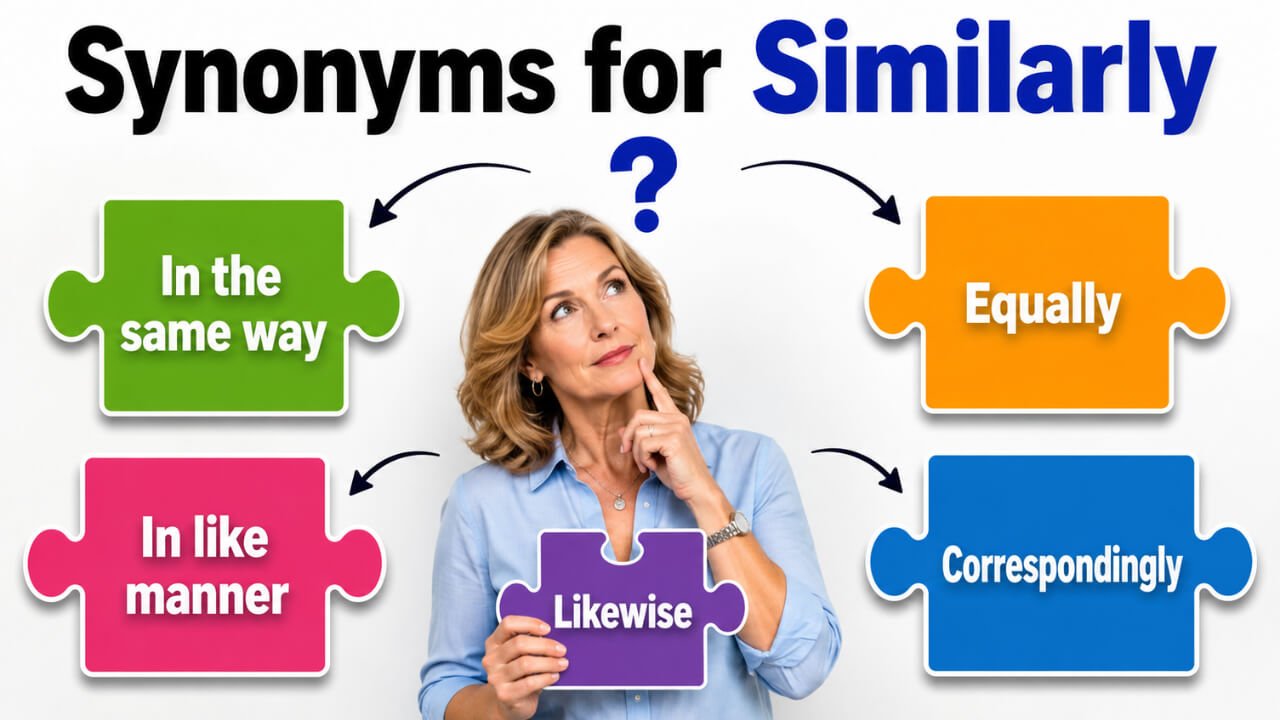
Quick Answer: The best synonyms for similarly include likewise, comparably, correspondingly, analogously, equally, equivalently, in the same way, in like manner, by the same token, and along similar lines. Use likewise when adding a related point, comparably when comparing qualities or results, and correspondingly when one change matches another. Analogously is useful in academic explanations, while equally works for the same degree or importance. In the same way is the clearest choice for everyday speech.
Pronunciation and Word Details
Word: Similarly.
Pronunciation: /ˈsɪmələrli/.
Part of Speech: Adverb.
Meaning: In a way that is the same as or closely resembles another action, situation, quality, or result.
US Pronunciation:
UK Pronunciation:
What Does “Similarly” Mean?
Similarly means in a way that is the same as or comparable to something already mentioned. It is an adverb formed from the adjective similar.
The word can describe two actions performed in nearly the same way. It can also connect related ideas, compare results, or show that two people, objects, or situations have matching qualities.
In the sentence “Both machines operate similarly,” the word explains how the machines operate. In “The first plan was expensive. Similarly, the second plan required a large budget,” it connects two related points.
Similarly is especially useful when a writer wants to show resemblance without claiming that two things are completely identical.
Meaning, Tone, and Context of “Similarly”
Similarly has a neutral and slightly formal tone. It is common in essays, reports, research papers, comparisons, explanations, reviews, professional emails, and educational writing.
In everyday conversation, people often replace it with in the same way, too, also, or just like that. These alternatives usually sound more natural in casual speech.
In academic and analytical writing, similarly helps connect comparable evidence, arguments, behaviors, and results. It shows that a new point follows a pattern already established.
The word does not always mean exactly the same. It usually suggests a meaningful resemblance. When complete equality is intended, equally, identically, or to the same degree may be more accurate.
Similarly can appear at the beginning, middle, or end of a sentence. When it introduces a new sentence, it is usually followed by a comma.
When and How to Use “Similarly”
For Comparing Actions: Use similarly when two people or things act in nearly the same way.
Example: The two students responded similarly to the question.
For Connecting Related Ideas: Use similarly to introduce a point that resembles the previous point.
Example: Exercise supports physical health. Similarly, regular sleep supports mental well being.
For Comparing Results: Use similarly when two situations produce comparable outcomes.
Example: Both treatments performed similarly during the study.
For Describing Matching Qualities: Use similarly before an adjective or past participle to show that things share comparable features.
Example: The two houses were similarly designed.
For Explaining an Analogy: Use similarly when one situation helps explain another.
Example: Just as plants need water, people similarly need proper nourishment.
For Expressing Equal Treatment: Use similarly when people or cases receive comparable treatment.
Example: All applicants should be treated similarly.
For Comparing Degree: Use similarly when two qualities exist at approximately the same level.
Example: The two products are similarly priced.
Best Synonyms for Similarly
1. Likewise
Synonym: Likewise means in the same way or also.
Example: The first proposal reduced costs. Likewise, the second proposal improved efficiency.
2. Comparably
Synonym: Comparably means in a way that can be reasonably compared.
Example: Both devices performed comparably during testing.
3. Correspondingly
Synonym: Correspondingly means in a matching or directly related way.
Example: As demand increased, prices rose correspondingly.
4. Analogously
Synonym: Analogously means in a way that is similar enough to form an analogy.
Example: The human brain can be described analogously as an information processing system.
5. Equally
Synonym: Equally means to the same degree, amount, or level.
Example: Both candidates were equally qualified for the position.
6. Equivalently
Synonym: Equivalently means in a way that has the same value, meaning, or effect.
Example: The statement can be expressed equivalently using simpler terms.
7. In the Same Way
Synonym: In the same way means by using a similar method or manner.
Example: Both teams approached the problem in the same way.
8. In Like Manner
Synonym: In like manner means in a similar way and is usually used in formal writing.
Example: The second group responded in like manner.
9. By the Same Token
Synonym: By the same token introduces a related point based on similar reasoning.
Example: Experience improves confidence. By the same token, regular practice improves ability.
10. Along Similar Lines
Synonym: Along similar lines means following a comparable idea, method, or pattern.
Example: The new policy was developed along similar lines.
50 Synonyms for Similarly with Short Meanings
- Likewise: In the same way or also.
- Comparably: In a way that allows reasonable comparison.
- Correspondingly: In a matching or related manner.
- Analogously: In a way that creates a useful analogy.
- Equally: To the same degree or level.
- Equivalently: With the same meaning, value, or effect.
- Alike: In a similar manner.
- Also: In addition or in a related way.
- Too: As well or in the same situation.
- As Well: In addition or in the same manner.
- In the Same Way: By a matching method or manner.
- In a Similar Way: By a method that closely resembles another.
- In Like Manner: In a comparable way.
- In the Same Manner: Using the same general method.
- In a Comparable Way: In a way suitable for comparison.
- In Much the Same Way: In a way that is nearly the same.
- In Similar Fashion: Following a comparable style or method.
- In the Same Fashion: Following the same general approach.
- Along Similar Lines: Following a related idea or pattern.
- By the Same Token: Based on the same reasoning.
- To the Same Degree: At an equal level or amount.
- To a Similar Degree: At a nearly equal level.
- To a Similar Extent: At approximately the same amount.
- In Equal Measure: To an equal degree.
- In Parallel: At the same time or in a comparable pattern.
- In a Parallel Way: Following a similar course or development.
- In a Corresponding Way: In a directly matching manner.
- In an Analogous Way: In a way that resembles another situation.
- In Equivalent Terms: Using words or ideas with the same meaning.
- On a Similar Basis: According to comparable conditions or principles.
- On the Same Basis: According to the same standard or reasoning.
- Under Similar Conditions: Within circumstances that closely resemble each other.
- In Similar Circumstances: In nearly matching situations.
- In the Same Sense: With a related meaning or interpretation.
- In a Related Way: Through a connected or comparable method.
- In Kind: In a similar form, type, or manner.
- In Comparison: When considered beside something similar.
- By Comparison: When showing a comparable quality or result.
- Comparatively: In relation to something else being compared.
- Proportionately: In a corresponding amount or degree.
- Commensurately: In a degree that matches another amount or level.
- Just As: In the same way that something else happens.
- Much As: In nearly the same way as.
- So Too: Used to show that the same point applies elsewhere.
- Equally So: In the same degree or with equal truth.
- In the Same Vein: Following the same style, subject, or idea.
- In a Similar Vein: Following a closely related style or idea.
- Following the Same Pattern: Developing or happening in a comparable way.
- In a Corresponding Manner: Acting or occurring in a matching way.
- On Comparable Terms: Under conditions that can be fairly compared.
Read Also:
Synonyms for Share
Synonyms for Similarly by Context
When Similarly Means in the Same Way
In the same way, in a similar way, in like manner, and likewise describe actions or methods that closely resemble one another.
Similarly: The second team completed the task similarly.
In the Same Way: The second team completed the task in the same way.
Likewise: The first group followed the instructions, and the second group did likewise.
In Like Manner: The remaining participants responded in like manner.
When Similarly Introduces a Related Point
Likewise, also, too, as well, and by the same token can introduce an additional point connected to the previous idea.
Similarly: Healthy food supports the body. Similarly, proper sleep supports the mind.
Likewise: Healthy food supports the body. Likewise, proper sleep supports the mind.
Also: Proper sleep also supports the mind.
By the Same Token: Exercise improves strength. By the same token, rest supports recovery.
When Similarly Means Comparably
Comparably, alike, to a similar degree, and on comparable terms are useful when comparing quality, price, size, performance, or ability.
Similarly: The two apartments are similarly priced.
Comparably: The two apartments are comparably priced.
To a Similar Degree: Both methods were successful to a similar degree.
On Comparable Terms: The companies competed on comparable terms.
When Similarly Means Correspondingly
Correspondingly, proportionately, commensurately, and in a corresponding way show that one change matches or follows another.
Similarly: As production increased, profits increased similarly.
Correspondingly: As production increased, profits increased correspondingly.
Proportionately: Employee numbers grew proportionately with demand.
Commensurately: Salaries increased commensurately with experience.
When Similarly Explains an Analogy
Analogously, in an analogous way, just as, and much as help explain one idea through comparison with another.
Similarly: A strong foundation supports a building. Similarly, basic knowledge supports advanced learning.
Analogously: Basic knowledge functions analogously to the foundation of a building.
Just As: Just as a foundation supports a building, basic knowledge supports advanced learning.
In an Analogous Way: The smaller system operates in an analogous way.
When Similarly Means to an Equal Degree
Equally, equivalently, in equal measure, and to the same degree are suitable when two things have equal value, importance, or intensity.
Similarly: Both options are similarly effective.
Equally: Both options are equally effective.
In Equal Measure: The decision requires patience and judgment in equal measure.
To the Same Degree: Both employees contributed to the same degree.
Another Word for Similarly
Another word for similarly is likewise. It is the strongest general replacement when adding a related idea or showing that the same statement applies to another person, object, or situation.
The best alternative still depends on context. Use comparably for measurable qualities, correspondingly for matching changes, and analogously for comparisons between related concepts.
Original: The first student completed the task quickly. Similarly, the second student finished early.
Better Option: The first student completed the task quickly. Likewise, the second student finished early.
Original: The two products are similarly priced.
Better Option: The two products are comparably priced.
Original: Sales increased, and profits increased similarly.
Better Option: Sales increased, and profits increased correspondingly.
Original: The smaller system operates similarly to the larger model.
Better Option: The smaller system operates analogously to the larger model.
When Not to Use “Similarly”
Do not use similarly when two things are completely identical. In that situation, identically, exactly, or in precisely the same way may be clearer.
Weak: The copies were similarly printed and contained no differences.
Better: The copies were identically printed and contained no differences.
Avoid similarly when the sentence shows contrast rather than resemblance.
Weak: The first plan was affordable. Similarly, the second plan was extremely expensive.
Better: The first plan was affordable. In contrast, the second plan was extremely expensive.
Similarly may sound repetitive when several paragraphs begin with it.
Weak: Similarly, the second method was effective. Similarly, the third method produced good results.
Better: Likewise, the second method was effective. The third method also produced good results.
Do not use similarly when you mean a direct result or consequence.
Weak: The temperature fell. Similarly, the lake froze.
Better: The temperature fell. Consequently, the lake froze.
In casual conversation, similarly may sound unnecessarily formal.
Weak: I enjoy reading. Similarly, my sister enjoys it.
Better: I enjoy reading, and my sister does too.
Words Commonly Confused With Similarly
Similarly vs Likewise: Both words can mean in the same way. Likewise is especially useful for adding a related statement, while similarly often emphasizes resemblance or comparison.
Similarly vs Comparably: Similarly has a broad meaning. Comparably is more specific and is commonly used with price, size, quality, ability, or performance.
Similarly vs Equally: Similarly means in a comparable manner. Equally means to exactly or nearly the same degree.
Similarly vs Correspondingly: Similarly shows resemblance. Correspondingly often shows that one change directly matches another change.
Similarly vs Analogously: Similarly compares actions, qualities, or situations. Analogously introduces a structured analogy between different concepts.
Similarly vs Also: Similarly shows resemblance between points. Also simply adds another fact and may not express comparison.
Similarly vs Identically: Similarly means almost the same or comparable. Identically means exactly the same without meaningful difference.
Similarly vs Consequently: Similarly introduces a comparable point. Consequently introduces a result caused by something mentioned earlier.
Which Synonym Should You Choose?
Choose likewise when adding a related sentence or showing that the same fact applies to another subject.
Choose comparably when discussing measurable qualities such as cost, size, quality, performance, or success.
Choose correspondingly when one change, amount, or result matches another.
Choose analogously when explaining a concept through a structured comparison.
Choose equally when two things have the same degree, value, importance, or intensity.
Choose equivalently when two expressions, values, or statements have the same meaning or effect.
Choose in the same way for clear and natural everyday communication.
Choose in like manner for formal reports, essays, and professional writing.
Choose by the same token when introducing a related conclusion based on the same reasoning.
Choose also, too, or as well in casual conversation when simple addition is more important than comparison.
Choose proportionately when amounts rise or fall according to the same ratio.
Choose along similar lines when discussing related ideas, plans, methods, or proposals.
Real Life Examples of “Similarly” in Sentences
Original: Both children reacted similarly to the announcement.
Better Option: Both children reacted in the same way to the announcement.
Original: The two phones are similarly priced.
Better Option: The two phones are comparably priced.
Original: The first department reduced expenses. Similarly, the second department lowered its costs.
Better Option: The first department reduced expenses. Likewise, the second department lowered its costs.
Original: The two treatments performed similarly.
Better Option: The two treatments performed equally well.
Original: As demand increased, production increased similarly.
Better Option: As demand increased, production increased correspondingly.
Original: Both reports were similarly organized.
Better Option: Both reports followed the same pattern of organization.
Original: The smaller company operates similarly to the larger business.
Better Option: The smaller company operates in much the same way as the larger business.
Original: The two problems can be solved similarly.
Better Option: The two problems can be solved using a comparable method.
Original: Adults and children were similarly affected by the change.
Better Option: Adults and children were affected to a similar degree by the change.
Original: The second proposal was developed similarly.
Better Option: The second proposal was developed along similar lines.
Synonym Groups and Usage Differences
General Similarity Group
Likewise, similarly, alike, in the same way, and in like manner describe general resemblance between actions, ideas, or situations.
Likewise often connects statements, while in the same way sounds more conversational. In like manner is more formal.
Example: The first group followed the instructions, and the second group acted likewise.
Comparison Group
Comparably, comparatively, on comparable terms, and on a similar basis are useful when evaluating two subjects according to shared standards.
Comparably suggests that qualities or results are close enough for a fair comparison. Comparatively often means relative to something else.
Example: Both machines performed comparably during the test.
Correspondence Group
Correspondingly, proportionately, commensurately, and in a corresponding manner describe matching changes or amounts.
Correspondingly is the broadest option. Proportionately refers to ratio, while commensurately often describes a suitable degree based on value or responsibility.
Example: Greater responsibility should be rewarded commensurately.
Analogy Group
Analogously, in an analogous way, just as, and much as compare different situations that share an important pattern.
These alternatives are especially useful in explanations, academic writing, and arguments.
Example: Just as regular exercise strengthens the body, regular study strengthens understanding.
Equal Degree Group
Equally, equivalently, in equal measure, and to the same degree express matching value, amount, importance, or intensity.
Equally is the clearest choice for most sentences. Equivalently is common in logical, mathematical, and technical explanations.
Example: Both solutions are equally practical.
Related Idea Group
Also, too, as well, so too, and by the same token add a connected point.
Also, too, and as well are common in everyday communication. By the same token is more formal and introduces reasoning that applies equally to another case.
Example: Clear instructions improve accuracy. By the same token, regular feedback improves performance.
Antonyms of Similarly
The opposite of similarly depends on whether the sentence refers to manner, degree, appearance, reasoning, or result.
Differently: In a manner that is not the same.
Dissimilarly: In an unlike or contrasting way.
Conversely: In an opposite or reversed manner.
Oppositely: In a directly contrary way.
Unlike: Different from another person or thing.
Otherwise: In a different way or situation.
Unequally: To different degrees or amounts.
Inconsistently: In a way that does not follow the same pattern.
Separately: Apart rather than together or comparably.
Independently: Without connection to another action or result.
Distinctly: In a clearly different manner.
Contrastingly: In a way that emphasizes differences.
Comparison: Similarly vs Related Words
Similarly vs Likewise
Similarly emphasizes resemblance between actions, qualities, or situations. Likewise often connects two related statements and means the same applies here.
Example With Similarly: Both employees responded similarly to the feedback.
Example With Likewise: The first employee accepted the feedback. Likewise, the second employee agreed to improve.
Similarly vs Comparably
Similarly is broad and can describe almost any resemblance. Comparably is best for qualities that can be measured or evaluated.
Example With Similarly: The children behaved similarly during the activity.
Example With Comparably: The two products were comparably priced.
Similarly vs Equally
Similarly means in a resembling way. Equally means to the same degree, amount, or level.
Example With Similarly: Both teams approached the task similarly.
Example With Equally: Both teams were equally successful.
Similarly vs Correspondingly
Similarly shows general resemblance. Correspondingly suggests that one change or result matches another.
Example With Similarly: The two regions developed similarly.
Example With Correspondingly: As the population grew, housing demand increased correspondingly.
Similarly vs Analogously
Similarly compares things directly. Analogously compares different concepts because they share a useful relationship or pattern.
Example With Similarly: Both systems respond similarly under pressure.
Example With Analogously: The system can be understood analogously as a network of connected roads.
Similarly vs Also
Similarly connects ideas through resemblance. Also adds information without necessarily making a comparison.
Example With Similarly: The first plan was expensive. Similarly, the second required a large budget.
Example With Also: The second plan also required additional workers.
Similarly vs Identically
Similarly suggests close resemblance. Identically means exactly the same.
Example With Similarly: The twins dressed similarly.
Example With Identically: The twins wore identically designed uniforms.
Common Phrases and Expressions With “Similarly”
Similarly Situated: Existing in comparable conditions or circumstances.
Similarly Priced: Costing approximately the same amount.
Similarly Sized: Having nearly the same dimensions or scale.
Similarly Designed: Created with comparable features or styles.
Similarly Structured: Organized according to a related pattern.
Similarly Affected: Experiencing comparable effects or consequences.
Similarly Treated: Receiving comparable treatment.
Similarly Worded: Written using nearly the same language.
Similarly Qualified: Possessing comparable abilities, education, or experience.
Similarly Minded: Having related opinions, attitudes, or interests.
Common Mistakes to Avoid
A common mistake is using similarly when the sentence actually presents a contrast. Use however, conversely, differently, or in contrast when the second point does not resemble the first.
Another mistake is assuming similarly means exactly the same. Similarity allows minor differences. Use identically when no meaningful difference exists.
Avoid beginning too many sentences or paragraphs with similarly. Excessive repetition makes writing sound mechanical. Alternate it with likewise, comparably, also, correspondingly, or in the same way.
Place a comma after similarly when it introduces a complete sentence.
Incorrect: Similarly the second method produced accurate results.
Correct: Similarly, the second method produced accurate results.
Do not confuse similarly with consequently. Similarly introduces comparison, while consequently introduces a result.
Incorrect: The road was flooded. Similarly, the event was cancelled.
Correct: The road was flooded. Consequently, the event was cancelled.
Choose alternatives according to context. People behave similarly, products may be comparably priced, quantities rise correspondingly, and two options may be equally effective.
Conclusion
The best synonyms for similarly include likewise, comparably, correspondingly, analogously, equally, and in the same way. Likewise is ideal for adding a related point, while comparably suits prices, qualities, and results. Use correspondingly for matching changes and analogously for structured comparisons. Equally expresses the same degree, while in the same way offers a clear casual alternative. Understanding these distinctions makes it easier to choose accurate synonyms for similarly in essays, reports, emails, explanations, and everyday conversations.
FAQs About Synonyms for Similarly
What Is the Best Synonym for Similarly?
Likewise is the best general synonym for similarly. It works well when adding a related point or showing that the same idea applies elsewhere.
What Is a Formal Synonym for Similarly?
Correspondingly, analogously, comparably, equivalently, and in like manner are useful formal alternatives.
What Is a Casual Synonym for Similarly?
In the same way, too, also, and as well are natural choices for casual speech and simple writing.
Can Likewise Replace Similarly?
Likewise can often replace similarly when connecting related ideas. However, comparably may be more precise when discussing measurable qualities.
What Is Another Word for Similarly in an Essay?
Likewise, comparably, correspondingly, analogously, and by the same token are strong choices for essay writing.
What Is the Difference Between Similarly and Equally?
Similarly means in a comparable way. Equally means to the same degree, amount, value, or level.
Is Similarly a Transition Word?
Yes. Similarly is a comparison transition that connects ideas, examples, results, or situations that share important qualities.
