
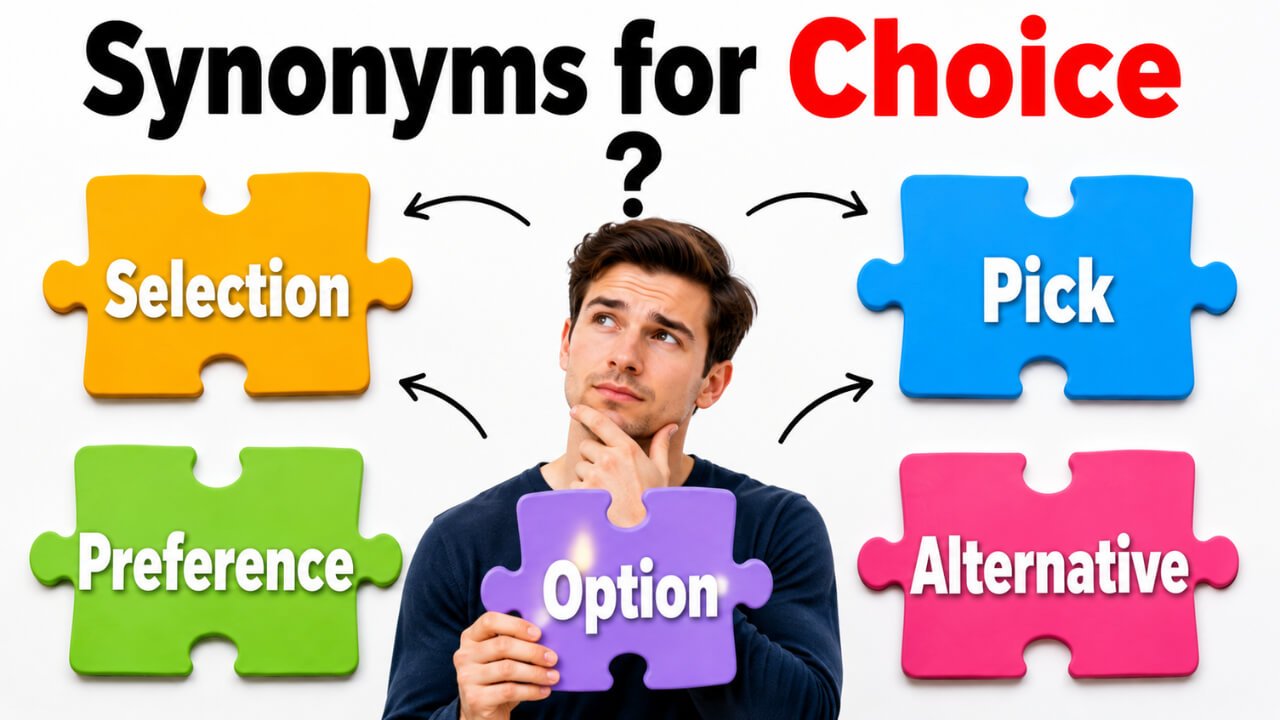
Quick Answer: The best synonyms for choice are option, selection, decision, preference, alternative, pick, discretion, possibility, judgment, and opportunity. Use option for something available, selection for something chosen from a group, and decision for a conclusion reached after thinking. Preference expresses personal liking, while alternative describes another possible course. Pick is suitable for casual conversation, discretion works in formal situations involving personal authority, and judgment emphasizes careful evaluation.
Pronunciation and Word Details
Word: Choice
Pronunciation: /tʃɔɪs/
Part of Speech: Noun and adjective
Meaning: Choice means an act of selecting, an available option, the freedom to decide, or something considered especially good.
US Pronunciation:
UK Pronunciation:
What Does “Choice” Mean?
Choice means the act, opportunity, or result of selecting one thing from two or more possibilities. It is most commonly used as a noun.
A choice may refer to the decision someone makes, the options available, or the freedom a person has to decide. For example, choosing between two courses involves making a choice, while having several courses available means having a choice of options.
Choice can also function as an adjective. In this use, it describes something selected for its excellent quality. A choice piece of fruit, for example, is considered especially fresh or desirable.
The exact meaning depends on the sentence. It may describe an option, a preference, a decision, a right, or a high quality item.
Meaning, Tone, and Context of “Choice”
Choice is a neutral and widely used word. It appears naturally in everyday conversation, formal writing, academic discussions, business communication, instructions, and personal advice.
When choice refers to available possibilities, it usually has a practical and neutral tone. Someone might discuss a choice of products, courses, colors, or methods.
When it refers to personal freedom, choice can carry a stronger or more emotional tone. Statements about freedom of choice often emphasize independence, control, rights, and personal responsibility.
Choice can also sound thoughtful when it describes an important decision. A career choice, financial choice, or educational choice may affect someone for many years.
As an adjective, choice has a positive tone because it suggests excellence, careful selection, or superior quality.
When and How to Use “Choice”
For Available Options
Use choice when discussing the possibilities available to someone.
Example: Customers have a choice of three payment methods.
For a Decision
Use choice when referring to the result of thinking about different possibilities.
Example: Moving closer to work was a practical choice.
For Personal Preference
Use choice when someone selects something because it suits their taste, needs, or interests.
Example: Her choice of music created a peaceful atmosphere.
For Freedom to Decide
Use choice when emphasizing that someone has control over a decision.
Example: Every student has the choice to join the optional workshop.
For an Important Life Direction
Use choice when a decision may produce meaningful or lasting consequences.
Example: Selecting a career is an important personal choice.
For Excellent Quality
Use choice as an adjective when describing something carefully selected or especially good.
Example: The chef prepared the meal using choice ingredients.
Best Synonyms for Choice
Option
Option: Something that may be selected from several possibilities.
Example: Taking the morning class is the most convenient option.
Selection
Selection: The act of choosing or the thing that has been chosen.
Example: Her selection was based on quality and durability.
Decision
Decision: A conclusion reached after considering different possibilities.
Example: Leaving early was a sensible decision.
Preference
Preference: A greater liking for one possibility over another.
Example: His preference is to work in a quiet environment.
Alternative
Alternative: Another possibility that can be used instead of the original one.
Example: Public transportation provides an affordable alternative.
Pick
Pick: A person or thing selected, especially in casual speech.
Example: The blue jacket was my first pick.
Discretion
Discretion: The freedom or authority to decide what should be done.
Example: The final schedule is left to the manager’s discretion.
Possibility
Possibility: Something that may happen or may be selected.
Example: Working remotely remains a possibility.
Judgment
Judgment: A decision formed through careful thought or evaluation.
Example: The committee trusted her professional judgment.
Opportunity
Opportunity: A suitable occasion or available chance to act or choose.
Example: The program gives students an opportunity to study abroad.
50 Synonyms for Choice with Short Meanings
- Option: Something available for selection.
- Selection: A person or thing that has been chosen.
- Decision: A conclusion reached after consideration.
- Preference: A stronger liking for one possibility.
- Alternative: Another available possibility or course.
- Pick: A casually selected person or thing.
- Discretion: Freedom or authority to decide.
- Possibility: Something that may be chosen or happen.
- Opportunity: A suitable chance to act or decide.
- Judgment: A conclusion based on careful evaluation.
- Election: The act of selecting between possibilities.
- Choosing: The process of deciding what to take.
- Determination: A firm decision or settled conclusion.
- Resolution: A definite decision about what to do.
- Conclusion: A final opinion reached after thought.
- Verdict: A final decision or judgment.
- Call: A decision, especially in informal communication.
- Say: The power to influence or make a decision.
- Will: A person’s intention or desire.
- Wish: Something a person wants or prefers.
- Desire: A strong feeling of wanting something.
- Inclination: A natural tendency or preference.
- Liking: A feeling of preference or enjoyment.
- Taste: Personal preference in style or quality.
- Favorite: The most preferred person or thing.
- Priority: Something chosen as more important.
- Course: A direction or method selected for action.
- Course of action: A planned way of dealing with something.
- Path: A selected direction toward a goal.
- Route: A particular way of reaching a result.
- Direction: A course selected for future action.
- Recourse: An available method used when difficulties arise.
- Candidate: A person or thing considered for selection.
- Nominee: Someone formally proposed for selection.
- Chosen item: The particular thing that was selected.
- Preferred option: The possibility considered most suitable.
- Range: A number of available possibilities.
- Variety: A collection of different available types.
- Assortment: A mixed group from which something can be selected.
- Array: A large or organized collection of possibilities.
- Lineup: A group of available people or things.
- Menu: A list of available items or possibilities.
- Offering: Something made available for selection.
- Set: A group of related available items.
- Collection: A group of things gathered together.
- Freedom: The ability to decide without control from others.
- Liberty: The right to act or decide independently.
- Right: A recognized ability to make a decision.
- Select: Carefully chosen for quality or suitability.
- Prime: Considered among the best available.
Read Also:
Synonyms for Monster

Synonyms for Choice by Context
When Choice Means an Available Option
Option is usually the clearest replacement when choice refers to something available for selection.
Alternative works well when another possibility can replace the original plan. Possibility is broader and may describe something that could happen even when no immediate decision is required.
Choice: We have several choices for the meeting date.
Option: We have several options for the meeting date.
Alternative: Friday is a useful alternative if Monday is unavailable.
Possibility: An online meeting is another possibility.
When Choice Means a Decision
Decision is the strongest synonym when choice refers to a conclusion reached after thinking.
Judgment emphasizes careful evaluation, while determination suggests a firm and settled decision. Resolution is appropriate when someone formally decides to take action.
Choice: Accepting the position was a difficult choice.
Decision: Accepting the position was a difficult decision.
Judgment: Her judgment was based on the available evidence.
Resolution: His resolution was to complete the project before leaving.
When Choice Means a Preference
Preference is the best alternative when choice reflects personal liking. Taste is useful when discussing style, design, food, art, or appearance.
Inclination describes a natural tendency, while favorite identifies the person or thing someone likes most.
Choice: Her choice is the quieter room.
Preference: Her preference is the quieter room.
Taste: His taste in furniture is simple and elegant.
Favorite: The green design is my favorite.
When Choice Means Freedom to Decide
Freedom, liberty, right, discretion, and say describe the power to make a decision.
Discretion is formal and often refers to professional authority. Say is conversational and usually appears in phrases such as having a say.
Choice: Employees have a choice about joining the program.
Freedom: Employees have the freedom to join the program.
Discretion: Attendance is left to each employee’s discretion.
Say: Everyone should have a say in the final decision.
When Choice Means a Course of Action
Course, path, route, direction, and course of action describe a selected way of moving toward a result.
Path often relates to personal development or long term progress. Route may refer to a physical journey or a method of achieving something.
Choice: Further education was the best choice for her career.
Path: Further education was the best path for her career.
Course of action: Seeking professional advice was the safest course of action.
When Choice Means High Quality
Select and prime can replace choice when it functions as an adjective meaning carefully chosen or excellent.
Choice: The restaurant uses choice ingredients.
Select: The restaurant uses select ingredients.
Prime: The store displays prime examples of local produce.
Another Word for Choice
Option is often the best single replacement for choice because it naturally describes something available for selection. However, the most accurate alternative depends on whether the sentence refers to an available possibility, a completed decision, a personal preference, or the freedom to decide.
Original: The evening session is another choice.
Better Option: The evening session is another option.
Original: Leaving the position was a painful choice.
Better Option: Leaving the position was a painful decision.
Original: Blue was her choice for the walls.
Better Option: Blue was her preference for the walls.
Original: The final choice belongs to the director.
Better Option: The final decision is left to the director’s discretion.
When Not to Use “Choice”
Choice should not be used automatically whenever someone selects something. A more precise synonym may communicate the intended meaning more clearly.
Avoid choice when you specifically mean a completed decision. Decision is usually more direct in formal reports, explanations, and serious discussions.
Weak: The committee announced its final choice about the policy.
Better: The committee announced its final decision about the policy.
Avoid choice when discussing personal liking rather than an active decision.
Weak: My choice is for simple designs.
Better: My preference is for simple designs.
Avoid choice when referring to another possible plan.
Weak: We need a choice in case the first method fails.
Better: We need an alternative in case the first method fails.
Avoid repeating choice several times in the same paragraph.
Weak: The first choice is affordable, but the second choice may be a better choice.
Better: The first option is affordable, but the second alternative may be a better decision.
Avoid using choice when no genuine possibility exists.
Weak: Paying the required fee is a personal choice.
Better: Paying the required fee is an obligation.
Words Commonly Confused With Choice
Choice vs Choose: Choice is usually a noun, while choose is a verb. You make a choice, but you choose an option.
Choice vs Option: Choice may describe the act of deciding, the freedom to decide, or the selected result. Option usually describes one available possibility.
Choice vs Decision: Choice often emphasizes selecting between possibilities. Decision emphasizes the conclusion reached after considering them.
Choice vs Preference: Choice can involve action and consequences. Preference describes what someone likes more, even when no decision is made.
Choice vs Selection: Choice is broader and may describe freedom, action, or result. Selection often refers to the process of choosing or the item selected from a group.
Choice vs Alternative: Choice may refer to any selection. Alternative usually describes another possibility that can replace the current one.
Choice vs Possibility: Choice involves selection or control. Possibility describes something that may happen or become available.
Choice vs Discretion: Choice is a general word. Discretion refers more formally to the authority or freedom to decide according to personal judgment.
Which Synonym Should You Choose?
Choose option when referring to one available possibility.
Choose selection when referring to an item chosen from a group or the process of choosing it.
Choose decision when emphasizing a final conclusion.
Choose preference when describing personal taste or liking.
Choose alternative when presenting another plan, method, or possibility.
Choose pick in relaxed conversation or informal writing.
Choose discretion when discussing professional authority or individual control.
Choose judgment when the decision requires knowledge, experience, or careful evaluation.
Choose possibility when something may happen but has not been selected.
Choose opportunity when discussing a favorable chance to act, learn, or progress.
Choose path when describing personal development, education, or a long term direction.
Choose course of action in formal writing about plans, problems, risks, or strategies.
Choose select or prime when choice functions as an adjective meaning excellent or carefully chosen.
Real Life Examples of “Choice” in Sentences
Original: Studying from home was the best choice for her schedule.
Better Option: Studying from home was the best option for her schedule.
Original: He made the choice to accept the new responsibility.
Better Option: He made the decision to accept the new responsibility.
Original: The final color was her personal choice.
Better Option: The final color reflected her personal preference.
Original: We need another choice if this method fails.
Better Option: We need another alternative if this method fails.
Original: Joining the discussion is your choice.
Better Option: Joining the discussion is at your discretion.
Original: The panel respected his choice about the winner.
Better Option: The panel respected his judgment about the winner.
Original: The blue notebook was my first choice.
Better Option: The blue notebook was my first pick.
Original: Students have a wide choice of subjects.
Better Option: Students have a wide range of subjects.
Original: She faced a difficult choice about her career.
Better Option: She faced a difficult decision about her career.
Original: This course gives learners the choice to study independently.
Better Option: This course gives learners the freedom to study independently.
Synonym Groups and Usage Differences
Available Options Group
Option, alternative, possibility, opportunity, range, and variety describe things that are available or may become available.
Option is the most direct word for one available possibility. Alternative usually replaces another plan. Range and variety emphasize the number or diversity of available choices.
Example: The program provides a wide range of learning options.
Decision Group
Decision, determination, resolution, conclusion, verdict, judgment, and call describe results reached after consideration.
Decision is the broadest term. Judgment suggests thoughtful evaluation, while verdict is more final and formal. Call is more conversational.
Example: Approving the proposal was a difficult decision.
Preference Group
Preference, liking, taste, inclination, favorite, wish, and desire describe what someone wants or likes.
Preference is neutral and versatile. Taste often concerns style or quality. Inclination describes a natural tendency rather than a firm decision.
Example: Her preference is to receive the information in writing.
Direction Group
Course, course of action, path, route, and direction describe a selected way of moving toward a result.
Course of action is useful in formal problem solving. Path is common when discussing careers, education, and personal progress.
Example: Seeking additional training may be the best career path.
Freedom Group
Freedom, liberty, right, discretion, say, and will describe control over a decision.
Freedom and liberty emphasize independence. Right suggests legal, moral, or recognized authority. Discretion is often used in professional communication.
Example: Participants have the freedom to leave the activity at any time.
Selection Group
Selection, pick, candidate, nominee, chosen item, and preferred option describe people or things considered or chosen.
Pick is informal, while selection is neutral. Candidate and nominee normally describe people or items being considered for a position, award, or role.
Example: Her final selection matched the project requirements.
Quality Group
Choice, select, and prime may describe something considered especially good.
Select suggests careful screening. Prime emphasizes excellent condition, position, or importance.
Example: The display included select examples of traditional artwork.
Antonyms of Choice
The opposite of choice depends on whether choice means an option, a decision, personal freedom, or high quality.
Necessity: Something that must be done or obtained.
Compulsion: Pressure or force that removes personal control.
Obligation: A duty that someone is required to fulfill.
Requirement: A condition that must be satisfied.
Restriction: A rule or limit that reduces available options.
Limitation: A condition that reduces freedom or possibility.
Constraint: Something that controls or limits action.
Indecision: An inability to reach a decision.
Refusal: An act of rejecting an available possibility.
Rejection: The act of not accepting a person, idea, or option.
Inferiority: A state of being lower in quality.
Imposition: Something forced on someone without meaningful choice.
Comparison: Choice vs Related Words
Choice vs Option
Choice is broader than option. It can mean the act of deciding, the result, the available possibilities, or the freedom to decide. Option usually means one possibility among several.
Example With Choice: Choosing a new career was an important choice.
Example With Option: Working part time is one available option.
Choice vs Decision
Choice emphasizes selecting between alternatives. Decision emphasizes reaching a conclusion after thought.
Example With Choice: She had a choice between two training programs.
Example With Decision: She made the decision after comparing both programs.
Choice vs Preference
Choice often involves an action, while preference describes what someone likes more.
Example With Choice: His final choice was the larger office.
Example With Preference: His preference was for a quieter office.
Choice vs Selection
Choice has several meanings, including freedom and decision. Selection usually describes choosing from a group or the result of that process.
Example With Choice: The final choice belongs to the project leader.
Example With Selection: The selection of candidates begins tomorrow.
Choice vs Alternative
Choice can refer to any act or result of choosing. Alternative normally means another plan or possibility that can replace the first one.
Example With Choice: She was pleased with her choice.
Example With Alternative: Taking the bus is a cheaper alternative.
Choice vs Judgment
Choice describes what someone selects. Judgment emphasizes the reasoning or evaluation behind a decision.
Example With Choice: The editor’s choice appeared on the first page.
Example With Judgment: The editor used professional judgment when reviewing the article.
Choice vs Discretion
Choice is suitable for general situations. Discretion is more formal and emphasizes authority, independence, or permission to decide.
Example With Choice: You have a choice about which task to complete first.
Example With Discretion: The order of the tasks is left to your discretion.
Common Phrases and Expressions With “Choice”
Make a Choice: Decide between two or more possibilities.
Have a Choice: Possess the freedom or opportunity to decide.
Have No Choice: Be unable to select another possibility.
Personal Choice: A decision based on individual wishes or values.
First Choice: The person or thing preferred above all others.
Best Choice: The option considered most suitable.
Right Choice: A decision expected to produce a good result.
Choice of Words: The particular language someone uses.
Freedom of Choice: The ability to decide independently.
Wide Choice: A large range of available possibilities.
Choice Candidate: A person considered highly suitable for a position.
Choice Selection: A group of carefully selected, high quality items.
Common Mistakes to Avoid
Confusing Choice and Choose
Choice is a noun, while choose is a verb.
Incorrect: I need to choice a new topic.
Correct: I need to choose a new topic.
Correct: I need to make a new choice.
Using Choice When Decision Is Clearer
Use decision when discussing a final conclusion, particularly in serious or formal contexts.
Less Precise: The board explained its choice about the new policy.
Better: The board explained its decision about the new policy.
Using Choice When Alternative Is Intended
An alternative is another possibility that can replace an existing plan.
Less Precise: We need a choice if the first plan fails.
Better: We need an alternative if the first plan fails.
Repeating Choice Too Often
Repeated use can make a paragraph sound limited or unnatural. Replace it with option, decision, preference, alternative, selection, or another contextually accurate word.
Repetitive: Her first choice was affordable, but her second choice was a safer choice.
Improved: Her first option was affordable, but her second selection was a safer decision.
Using a Weak or Vague Choice
A sentence may become unclear when the reader does not know what possibilities were available.
Vague: He made the right choice.
Clearer: He chose the training program that matched his career goals.
Confusing Preference With a Final Decision
A preference shows what someone likes, but it does not always mean that a final decision has been made.
Incorrect Meaning: My decision is for quieter working spaces.
Natural Meaning: My preference is for quieter working spaces.
Forgetting the Correct Singular or Plural Form
Use choice for one decision or possibility and choices for more than one.
Incorrect: The course gives students several choice.
Correct: The course gives students several choices.
Conclusion
Understanding synonyms for choice helps you describe decisions, options, preferences, and personal freedom more accurately. Option is best for an available possibility, while decision describes a conclusion reached after thought. Preference expresses personal liking, alternative introduces another course, and discretion emphasizes authority to decide. Selection, judgment, possibility, and opportunity also work in specific contexts. Choose the replacement that matches the intended meaning rather than using the same word repeatedly, and your writing will sound clearer, more natural, and more precise.
FAQs About Synonyms for Choice
What Is the Best Synonym for Choice?
Option is the best general synonym when choice means something available for selection. Decision is better when referring to a final conclusion.
Is Decision a Synonym for Choice?
Yes. Decision is a synonym when choice refers to a conclusion reached after considering different possibilities.
What Is a Formal Synonym for Choice?
Selection, decision, discretion, judgment, and course of action are useful formal alternatives, depending on the sentence.
What Is a Casual Synonym for Choice?
Pick is a common casual synonym. Option and call also work naturally in everyday conversation.
What Is Another Word for Personal Choice?
Preference, discretion, wish, inclination, and personal decision can replace personal choice in suitable contexts.
What Is the Difference Between Choice and Option?
Choice may describe the act, freedom, or result of selecting. An option is one specific possibility available for selection.
Can Choice Be Used as an Adjective?
Yes. As an adjective, choice means excellent, carefully selected, or high in quality. Select and prime are useful alternatives.
