
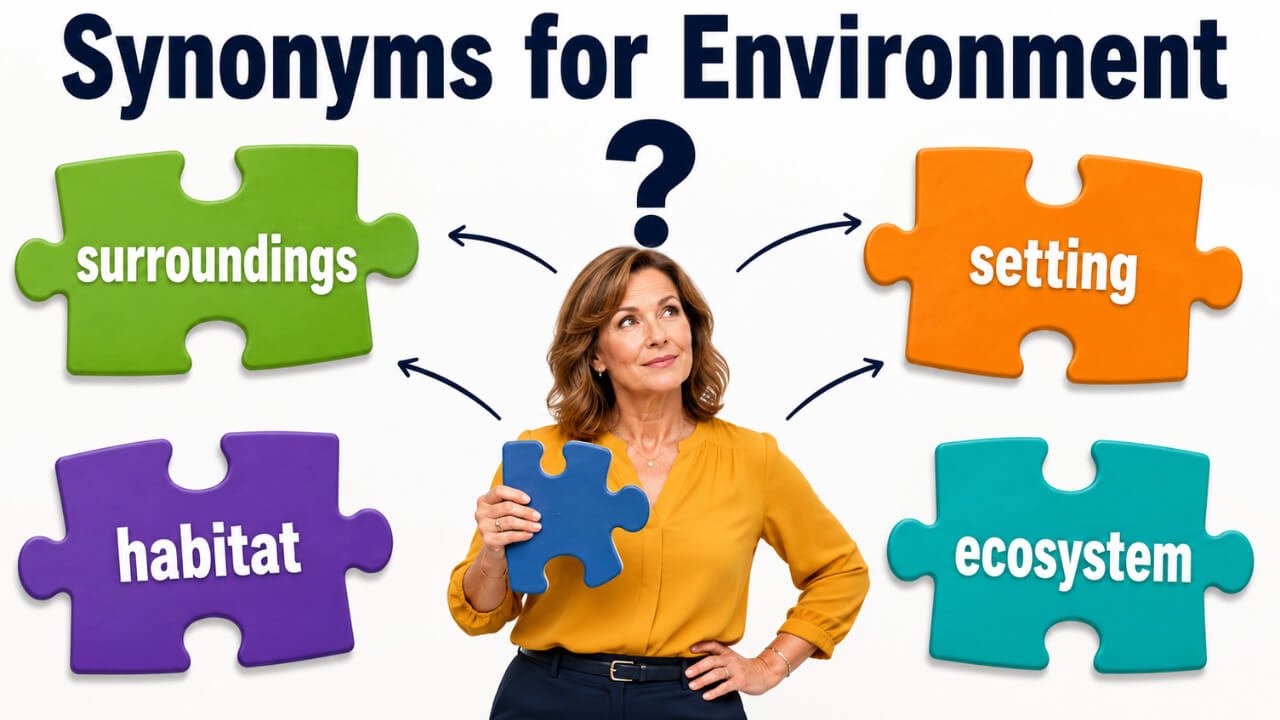
Quick Answer: The best synonyms for environment are surroundings, setting, habitat, ecosystem, atmosphere, climate, conditions, context, milieu, and natural world. Use surroundings for the physical area around someone or something. Use habitat for the natural home of plants or animals. Use ecosystem for a connected natural system. Use setting for the place or background of an event. Use atmosphere for mood or feeling. The right choice depends on whether you mean nature, place, social conditions, work culture, or general context.
Pronunciation and Word Details
Word: Environment
Pronunciation: /ɪnˈvaɪrənmənt/
Part of Speech: Noun
Meaning: Environment means the surroundings, conditions, or natural world in which a person, animal, plant, event, or activity exists.
US Pronunciation:
UK Pronunciation:
What Does “Environment” Mean?
Environment means the place, conditions, or surroundings around someone or something. It is a noun and can describe physical space, nature, society, culture, work, learning, or emotional conditions.
In nature, environment can mean the natural world, including air, water, land, plants, animals, and climate. In everyday speech, it can mean the place where something happens, such as a home environment, classroom environment, or work environment. In academic and professional writing, it often refers to the conditions that affect behavior, growth, health, performance, or development.
Meaning, Tone, and Context of “Environment”
Environment has a neutral and flexible tone. It works in formal writing, academic essays, business reports, school assignments, scientific discussion, and everyday conversation.
In environmental topics, the word often refers to nature and the planet. In social topics, it refers to surroundings, culture, or conditions that influence people. In workplaces, it describes the mood, structure, safety, and behavior within an organization. In education, it may describe the classroom, learning space, or emotional support around students.
The word is not overly casual or emotional. It is clear, useful, and widely understood, but it can become repetitive if used too many times. In some sentences, a more exact synonym such as habitat, setting, ecosystem, or atmosphere sounds stronger.
When and How to Use “Environment”
For Nature: Use environment when talking about air, water, land, wildlife, pollution, climate, or natural resources.
Example: Protecting the environment is important for future generations.
For Surroundings: Use it when describing the physical area around a person, place, or object.
Example: Children learn better in a clean and calm environment.
For Work Culture: Use it when describing workplace mood, safety, pressure, teamwork, or communication.
Example: A positive work environment helps employees feel motivated.
For Learning Conditions: Use it when describing classrooms, study spaces, teaching methods, or student support.
Example: A quiet learning environment can improve focus.
For Social Influence: Use it when discussing how family, community, culture, or society affects behavior.
Example: A supportive environment can help a person build confidence.
For Technical or Academic Writing: Use it when explaining conditions that affect a process, result, organism, system, or behavior.
Example: The experiment was tested in a controlled environment.
Best Synonyms for Environment
Surroundings: The physical things and conditions around someone or something.
Example: The hotel had peaceful surroundings near the lake.
Setting: The place or situation where something happens.
Example: The story takes place in a rural setting.
Habitat: The natural home of an animal, plant, or organism.
Example: Wetlands are an important habitat for many birds.
Ecosystem: A natural system where living things interact with each other and their surroundings.
Example: Pollution can damage the entire ecosystem.
Atmosphere: The mood, feeling, or emotional quality of a place.
Example: The cafe had a warm and friendly atmosphere.
Climate: The general conditions or mood in a place, group, or situation.
Example: The company created a climate of trust.
Conditions: The factors or circumstances that affect a person, place, or event.
Example: Plants need the right conditions to grow well.
Context: The situation or background that helps explain something.
Example: His behavior makes more sense in its social context.
Milieu: A person’s social, cultural, or professional surroundings.
Example: She grew up in an artistic milieu.
Natural World: Nature, including land, water, air, plants, and animals.
Example: The book teaches children to respect the natural world.
50 Synonyms for Environment with Short Meanings
- Surroundings: Things and conditions around a place or person.
- Setting: Place or situation where something happens.
- Habitat: Natural home of a plant or animal.
- Ecosystem: Connected natural system of living things.
- Atmosphere: Mood or feeling of a place.
- Climate: General conditions or social mood.
- Conditions: Factors affecting a situation or result.
- Context: Background or situation around something.
- Milieu: Social or cultural surroundings.
- Natural World: Nature and living systems.
- Nature: The physical world and living things.
- Ecology: Relationship between organisms and surroundings.
- Biosphere: Areas of Earth where life exists.
- Landscape: Visible natural or physical area.
- Terrain: Physical land or ground conditions.
- Location: Particular place or position.
- Place: Area or space where something exists.
- Area: Region or part of a larger space.
- Locale: Place connected with an event or activity.
- Scene: Place where something happens.
- Backdrop: Background setting for events or actions.
- Surrounding Area: Nearby space around a location.
- Vicinity: Area near a place.
- Locality: Particular area or neighborhood.
- Neighborhood: Nearby community or surrounding district.
- Community: People and social setting around someone.
- Society: Larger social environment and culture.
- Culture: Shared values, habits, and social surroundings.
- Sphere: Area of activity, influence, or life.
- World: Social, professional, or personal area of life.
- Realm: Field, area, or sphere of activity.
- Domain: Area of control, activity, or knowledge.
- Background: Conditions or situation behind an event.
- Circumstances: Conditions surrounding a situation.
- Situation: State of things around an event.
- Surrounding Conditions: Factors around a person or thing.
- Living Conditions: Conditions in which people live.
- Workplace: Professional environment where people work.
- Workspace: Physical area used for work.
- Classroom Setting: Learning environment in a classroom.
- Learning Space: Place or conditions for study.
- Home Setting: Family or house environment.
- Social Setting: Conditions involving people and relationships.
- Cultural Context: Cultural background around something.
- Physical Surroundings: Material space around a person or thing.
- Built Environment: Human made surroundings such as buildings and roads.
- Outdoor World: Natural space outside buildings.
- Green Space: Natural area with plants, grass, or trees.
- Habitation: Place where people, animals, or organisms live.
- Environment System: Connected conditions around a living or working system.
Read Also:
Synonyms for Challenging

Synonyms for Environment by Context
When Environment Means Surroundings
Use these synonyms when environment means the physical area around someone or something.
Useful Synonyms: Surroundings, setting, place, area, locale, vicinity, location.
Example: The hospital provides a calm environment for recovery.
Better Option: The hospital provides calm surroundings for recovery.
When Environment Means Nature
Use these words when environment refers to the natural world, pollution, climate, wildlife, or conservation.
Useful Synonyms: Nature, natural world, ecosystem, biosphere, ecology, landscape, green space.
Example: Factories must reduce damage to the environment.
Better Option: Factories must reduce damage to the natural world.
When Environment Means Habitat
Use these synonyms when talking about where animals, plants, or organisms live.
Useful Synonyms: Habitat, ecosystem, habitation, terrain, landscape, living area.
Example: The forest is the environment of many wild animals.
Better Option: The forest is the habitat of many wild animals.
When Environment Means Social Conditions
Use these words when describing family, society, culture, community, or emotional support.
Useful Synonyms: Community, society, culture, milieu, social setting, cultural context.
Example: A child’s environment can shape early behavior.
Better Option: A child’s social setting can shape early behavior.
When Environment Means Work or Study Setting
Use these synonyms when discussing offices, schools, classrooms, teams, or professional culture.
Useful Synonyms: Workplace, workspace, learning space, classroom setting, conditions, climate, atmosphere.
Example: A friendly environment improves teamwork.
Better Option: A friendly workplace improves teamwork.
When Environment Means Mood or Feeling
Use these words when describing the emotional quality of a place.
Useful Synonyms: Atmosphere, climate, mood, feeling, tone, ambience.
Example: The restaurant had a relaxed environment.
Better Option: The restaurant had a relaxed atmosphere.
Another Word for Environment
A strong general replacement for environment is surroundings. It works well when you mean the area, conditions, or things around a person or place. However, the best synonym depends on context. Use habitat for animals and plants, ecosystem for nature, setting for events, and atmosphere for mood.
Original: The students need a better environment for learning.
Better Option: The students need a better learning space.
Original: Pollution harms the environment.
Better Option: Pollution harms the natural world.
Original: The tiger lives in a forest environment.
Better Option: The tiger lives in a forest habitat.
Original: The office environment was stressful.
Better Option: The office atmosphere was stressful.
When Not to Use “Environment”
Do not use environment when a more exact word would make your sentence clearer. It can sound broad or vague if the reader does not know whether you mean nature, mood, location, culture, or conditions.
Weak: The environment of the meeting was serious.
Better: The atmosphere of the meeting was serious.
Weak: The fish needs a clean environment.
Better: The fish needs a clean habitat.
Weak: The environment of the story is a village.
Better: The setting of the story is a village.
Weak: The environment affected the data.
Better: The testing conditions affected the data.
Weak: She works in a good environment.
Better: She works in a supportive workplace.
Avoid repeating environment several times in one paragraph. Use clearer alternatives when the meaning changes from nature to place, mood, culture, or work conditions.
Words Commonly Confused With Environment
Environment vs Habitat: Environment is broader and can mean surroundings, conditions, nature, or social setting. Habitat usually means the natural home of a plant or animal.
Environment vs Ecosystem: Environment can describe any surroundings or conditions. Ecosystem means a connected natural system where living and nonliving parts interact.
Environment vs Atmosphere: Environment can be physical, natural, social, or professional. Atmosphere usually means the mood or feeling of a place.
Environment vs Climate: Environment is a broad word for surroundings or conditions. Climate can mean weather patterns or the general mood in a group or organization.
Environment vs Context: Environment describes surrounding conditions. Context describes the background information needed to understand something.
Environment vs Surroundings: Environment can include conditions, culture, and nature. Surroundings usually focuses on the physical area around someone or something.
Which Synonym Should You Choose?
Choose surroundings when describing the physical area around a person, object, or place.
Choose setting when writing about where a story, event, meeting, or activity happens.
Choose habitat when writing about the natural home of animals, plants, or organisms.
Choose ecosystem when describing connected natural systems, wildlife, plants, water, soil, and climate.
Choose atmosphere when talking about the mood or feeling of a room, event, office, or place.
Choose conditions when discussing factors that affect results, health, learning, growth, or performance.
Choose context when you need background information that explains a situation or meaning.
Choose milieu in formal or academic writing about social, cultural, artistic, or intellectual surroundings.
Choose workplace when referring directly to a professional environment.
Choose natural world when writing in a clear and reader friendly way about nature and environmental protection.
Real Life Examples of “Environment” in Sentences
Original: The environment in the classroom was calm.
Better Option: The classroom atmosphere was calm.
Original: Many animals depend on a healthy environment.
Better Option: Many animals depend on a healthy habitat.
Original: The company wants to improve its work environment.
Better Option: The company wants to improve its workplace culture.
Original: The environment around the lake is peaceful.
Better Option: The surroundings around the lake are peaceful.
Original: The environment of the novel feels realistic.
Better Option: The setting of the novel feels realistic.
Original: Children need a safe environment at home.
Better Option: Children need a safe home setting.
Original: The environment affected the experiment.
Better Option: The testing conditions affected the experiment.
Original: Pollution is damaging the environment.
Better Option: Pollution is damaging the natural world.
Original: She grew up in a creative environment.
Better Option: She grew up in a creative milieu.
Original: The office environment felt tense.
Better Option: The office atmosphere felt tense.
Synonym Groups and Usage Differences
Nature Group
This group includes nature, natural world, ecosystem, ecology, and biosphere. Use these words when talking about land, air, water, plants, animals, and conservation.
Example: Protecting the natural world should be a shared responsibility.
Place Group
This group includes surroundings, setting, location, place, area, locale, and vicinity. Use these when focusing on where something is or where something happens.
Example: The hotel’s surroundings were quiet and beautiful.
Habitat Group
This group includes habitat, ecosystem, habitation, terrain, and landscape. Use these when describing where living things survive and grow.
Example: The wetland habitat supports birds, fish, and insects.
Social Conditions Group
This group includes community, society, culture, milieu, and social setting. Use these when describing human influence, relationships, values, or shared behavior.
Example: A supportive community can shape a person’s confidence.
Work and Study Group
This group includes workplace, workspace, learning space, classroom setting, conditions, and climate. Use these for offices, schools, teams, and learning situations.
Example: A healthy workplace encourages trust and productivity.
Mood Group
This group includes atmosphere, climate, tone, ambience, and feeling. Use these when the meaning is emotional rather than physical.
Example: The room had a peaceful atmosphere.
Antonyms of Environment
Organism: A living thing considered separately from its surroundings.
Individual: A person or thing viewed apart from outside conditions.
Interior: The inside part, contrasted with outer surroundings.
Isolation: Separation from surrounding people, places, or influences.
Vacuum: A space lacking normal surrounding conditions.
Artificiality: An unnatural quality, often contrasted with nature or the natural environment.
Center: The middle point, contrasted with the surrounding area.
Separation: Distance or division from surrounding conditions.
Detachment: Lack of connection with one’s surroundings or context.
Enclosure: A closed area that may separate something from the wider environment.
Comparison: Environment vs Related Words
Environment vs Surroundings
Environment can include physical surroundings, social conditions, natural systems, or emotional factors. Surroundings usually means the visible or physical area around someone or something.
Example With Environment: A positive environment helps students learn.
Example With Surroundings: The cabin’s surroundings were quiet and green.
Environment vs Habitat
Environment is broad and can describe many types of surroundings. Habitat is more specific and usually refers to the natural home of a plant or animal.
Example With Environment: Pollution affects the environment.
Example With Habitat: The panda’s habitat includes bamboo forests.
Environment vs Ecosystem
Environment means surroundings or conditions. Ecosystem means a connected natural system where plants, animals, water, soil, and other elements interact.
Example With Environment: The environment needs better protection.
Example With Ecosystem: The coral reef ecosystem is fragile.
Environment vs Atmosphere
Environment can describe place, nature, or conditions. Atmosphere usually describes mood, feeling, or emotional tone.
Example With Environment: The school environment supports creativity.
Example With Atmosphere: The school atmosphere feels welcoming.
Environment vs Context
Environment describes the conditions around something. Context explains the background that helps people understand meaning, behavior, or events.
Example With Environment: His environment influenced his habits.
Example With Context: His actions make sense in the context of family pressure.
Environment vs Climate
Environment is a general word for surroundings or conditions. Climate can describe weather over time or the general mood of a group.
Example With Environment: The work environment became more flexible.
Example With Climate: The team created a climate of respect.
Common Phrases and Expressions With Environment
Natural Environment: The physical world, including land, air, water, plants, and animals.
Work Environment: Conditions, culture, and atmosphere in a workplace.
Learning Environment: The place and conditions where learning happens.
Safe Environment: A place or situation where people feel protected.
Healthy Environment: Conditions that support physical, mental, or social well being.
Home Environment: Family and living conditions inside a home.
Social Environment: People, relationships, culture, and community around someone.
Business Environment: Market, workplace, and external conditions affecting a business.
Built Environment: Human made surroundings such as buildings, roads, and cities.
Supportive Environment: Conditions that encourage growth, comfort, and confidence.
Common Mistakes to Avoid
One common mistake is using environment when a more specific synonym would be clearer. For animals and plants, habitat is often better. For mood, atmosphere is usually stronger. For a story or event, setting is more exact.
Another mistake is repeating environment too often in the same paragraph. Use surroundings, conditions, context, or natural world when the meaning changes.
Avoid confusing environment with ecosystem. An ecosystem is a specific natural system, while environment can be any surrounding condition. Also avoid vague phrases such as “good environment” without explaining what makes it good. A sentence becomes stronger when you say safe workplace, calm classroom, clean habitat, or supportive home setting.
Conclusion
Understanding synonyms for environment helps you choose clearer and more meaningful words in writing and speech. Use surroundings for physical areas, setting for places where events happen, habitat for plants and animals, ecosystem for connected natural systems, and atmosphere for mood. For social, work, and learning situations, words like conditions, context, milieu, and workplace can sound more precise. The best synonym always depends on what kind of environment you mean.
FAQs About Synonyms for Environment
What is the best synonym for environment?
The best general synonym for environment is surroundings. It works well when describing the area, place, or conditions around someone or something.
What is another word for environment in nature?
Another word for environment in nature is natural world. You can also use ecosystem, ecology, biosphere, or habitat, depending on the meaning.
What is another word for work environment?
Another word for work environment is workplace. You can also use workplace culture, office atmosphere, professional setting, or working conditions.
What is the difference between environment and habitat?
Environment is broader and can mean any surroundings or conditions. Habitat is more specific and means the natural home of a plant, animal, or organism.
Is ecosystem a synonym for environment?
Ecosystem can be a synonym in nature related contexts, but it is more specific. It means a connected natural system where living and nonliving parts interact.
What is a formal synonym for environment?
Formal synonyms for environment include milieu, context, conditions, setting, and surrounding conditions. The best choice depends on the sentence.
What is a simple synonym for environment?
A simple synonym for environment is place or surroundings. Use place for general location and surroundings for the area around someone or something
