
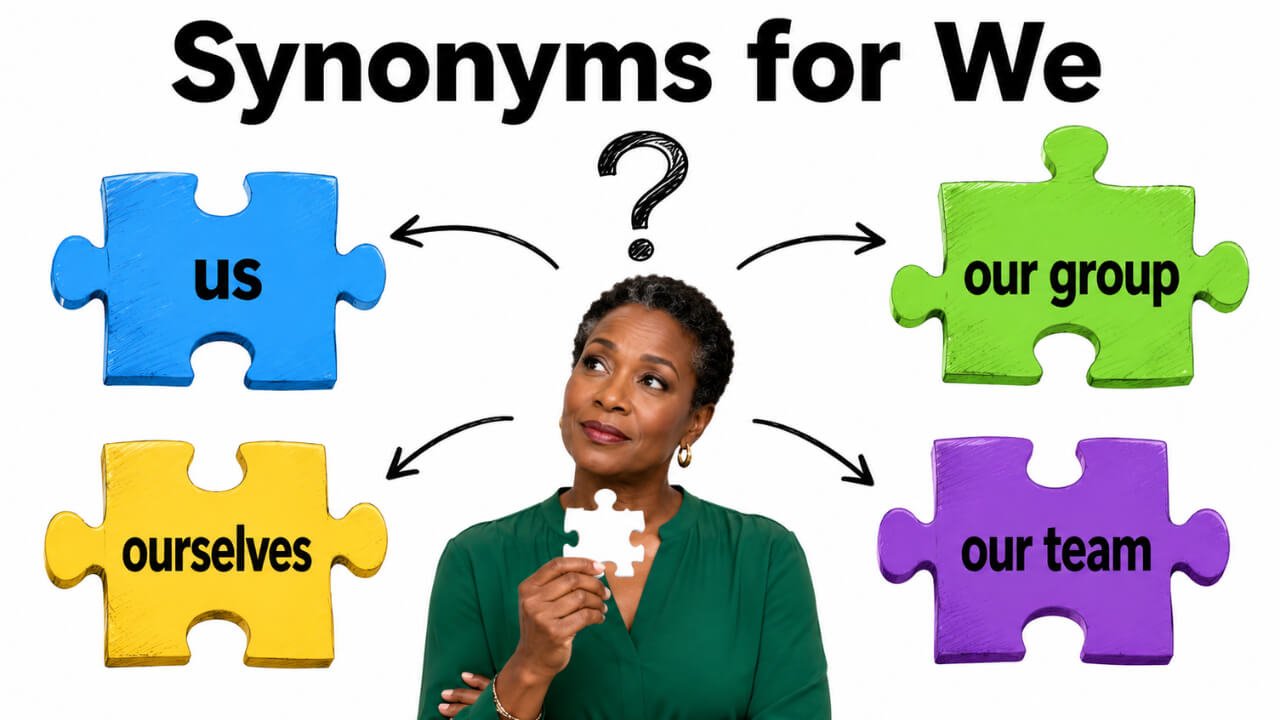
Quick Answer: Synonyms for we include all of us, both of us, the two of us, you and I, my team and I, our group, the team, the authors, the researchers, and people. Use all of us when emphasizing inclusion, you and I when referring to the speaker and listener, our team in workplace communication, the authors in formal writing, and people when making a general statement. Because we is a personal pronoun, most alternatives are context based phrases rather than exact one word synonyms.
Pronunciation and Word Details
Word: We.
Pronunciation: /wiː/.
Part of Speech: Personal pronoun.
Meaning: A pronoun used by a speaker to refer to themselves and one or more other people.
US Pronunciation:
UK Pronunciation:
What Does “We” Mean?
We means the speaker together with at least one other person. It is a first person plural pronoun and usually appears as the subject of a sentence.
The word can include the listener.
Example: We should leave before it gets dark.
In this sentence, we may mean the speaker and the person being addressed.
We can also exclude the listener.
Example: We will send your order tomorrow.
Here, we refers to the speaker and their team, but it does not include the customer.
We is commonly used for shared actions, group opinions, collective decisions, teamwork, family activities, academic research, and general human experiences.
Meaning, Tone, and Context of “We”
We is a neutral and common word that works in both formal and casual communication. It can sound friendly, inclusive, cooperative, professional, or authoritative depending on the sentence.
In casual conversation, we often refers to friends, family members, couples, or people sharing an activity.
Example: We are having dinner at home tonight.
In professional writing, we may represent a team, department, committee, or organization.
Example: We have reviewed your request.
In academic writing, we may refer to the authors or researchers.
Example: We examined the results carefully.
The word can sometimes sound vague when the reader does not know who is included. In such cases, a specific phrase such as the research team or the committee is clearer.
When and How to Use “We”
For Shared Actions: Use we when the speaker and other people perform an action together.
Example: We prepared the room before the guests arrived.
For Group Decisions: Use we when several people make or support the same decision.
Example: We decided to postpone the meeting.
For Teamwork: Use we when describing work completed by a group.
Example: We finished the project ahead of schedule.
For Inclusive Suggestions: Use we when inviting the listener to participate.
Example: We could discuss the problem after lunch.
For Family Activities: Use we when referring to yourself and your family members.
Example: We visit our grandparents every summer.
For Academic Writing: Use we when referring to the authors or researchers involved in a study.
Example: We compared the results from both groups.
For General Statements: Use we carefully when referring to people in general.
Example: We often learn from our mistakes.
Best Synonyms for We
All of us: Every person in a group that includes the speaker.
Example: All of us agreed with the final decision.
Both of us: The speaker and one other person.
Example: Both of us enjoyed the performance.
The two of us: Two people, including the speaker.
Example: The two of us completed the task together.
You and I: The speaker and the person being addressed.
Example: You and I need to discuss the schedule.
My team and I: The speaker together with their team members.
Example: My team and I reviewed every application.
Our group: A group that includes the speaker.
Example: Our group presented the findings first.
The team: People working together toward a common goal.
Example: The team completed the project successfully.
The authors: The people who wrote a text, report, or paper.
Example: The authors explain the main argument clearly.
The researchers: The people who conducted a study.
Example: The researchers collected information from several participants.
People: Human beings considered generally.
Example: People often remember emotional experiences clearly.
50 Synonyms for We with Short Meanings
- All of us: Every person in a group that includes the speaker.
- Both of us: The speaker and one other person.
- The two of us: Two people, including the speaker.
- The three of us: Three people, including the speaker.
- The four of us: Four people, including the speaker.
- You and I: The speaker and the person being addressed.
- He and I: The speaker and one male person.
- She and I: The speaker and one female person.
- They and I: The speaker and other previously mentioned people.
- My partner and I: The speaker together with their partner.
- My friend and I: The speaker together with one friend.
- My friends and I: The speaker together with several friends.
- My family and I: The speaker together with family members.
- My parents and I: The speaker together with their parents.
- My siblings and I: The speaker together with their brothers or sisters.
- My colleagues and I: The speaker together with workplace colleagues.
- My team and I: The speaker together with team members.
- My classmates and I: The speaker together with classmates.
- My neighbors and I: The speaker together with nearby residents.
- My partner and me: An object form referring to the speaker and partner.
- Us: The object form of we.
- Everyone here: Every person present with the speaker.
- Everyone present: All people attending or gathered in one place.
- Everyone in the group: Every member of a particular group.
- Our group: A group that includes the speaker.
- Our team: A team that includes the speaker.
- Our family: The family to which the speaker belongs.
- Our class: A class that includes the speaker.
- Our community: A community that includes the speaker.
- The group: A collection of people acting together.
- The team: People working toward a shared goal.
- The family: Related people acting collectively.
- The staff: Employees working together.
- The committee: People appointed to consider or manage a matter.
- The board: A group responsible for important decisions.
- The panel: A selected group discussing or judging something.
- The department: Members of one organizational division.
- The leadership: People responsible for directing a group.
- The administration: People responsible for managing an institution.
- The organization: A formal group acting collectively.
- The authors: People responsible for writing a text.
- The writers: People who created a written work.
- The researchers: People conducting a study or investigation.
- The participants: People taking part in an activity or study.
- The organizers: People arranging an event or activity.
- The representatives: People speaking or acting for a group.
- People: Human beings considered generally.
- One: An unspecified person in a formal general statement.
- Humanity: All human beings collectively.
- Society: People living together within an organized community.
Read Also:
Synonyms for Yelled
Synonyms for We by Context
When We Means All Members of a Group
Use these alternatives when every relevant person is included.
Useful Synonyms: All of us, everyone here, everyone present, everyone in the group, our group.
Example: All of us supported the new plan.
Example: Everyone present received a copy of the instructions.
When We Means the Speaker and Listener
Use these alternatives when we includes the person being addressed.
Useful Synonyms: You and I, both of us, the two of us.
Example: You and I can complete the work tomorrow.
Example: Both of us understood the instructions.
When We Means a Workplace Team
Use specific group nouns when writing about professional responsibilities.
Useful Synonyms: Our team, the team, the staff, the department, the committee.
Example: Our team has completed the first stage.
Example: The committee approved the revised policy.
When We Means Academic Writers
Use precise nouns in research papers, reports, and academic discussions.
Useful Synonyms: The authors, the writers, the researchers, the research team.
Example: The authors discuss the limitations of the study.
Example: The researchers compared the two sets of results.
When We Means People in General
Use broader alternatives when describing common human behavior or experience.
Useful Synonyms: People, one, humanity, society.
Example: People sometimes avoid difficult decisions.
Example: One should consider the consequences before acting.
Another Word for We
The best general alternative to we is all of us, but no single replacement works in every sentence. The best option depends on who the speaker includes.
Original: We agreed to change the meeting time.
Better Option: All of us agreed to change the meeting time.
Original: We completed the report yesterday.
Better Option: Our team completed the report yesterday.
Original: We examined the evidence carefully.
Better Option: The researchers examined the evidence carefully.
Original: We sometimes make decisions too quickly.
Better Option: People sometimes make decisions too quickly.
When Not to Use “We”
Do not use we when the reader cannot identify the people it represents. A specific noun usually makes the sentence clearer.
Weak: We decided that the schedule needed to change.
Better: The committee decided that the schedule needed to change.
Avoid we when making claims about every person.
Weak: We all prefer simple instructions.
Better: Many people prefer simple instructions.
Do not use we when only one person performed the action.
Weak: We wrote this article to explain the topic.
Better: I wrote this article to explain the topic.
Avoid using we repeatedly at the beginning of several sentences.
Weak: We reviewed the data. We found an error. We corrected the figures.
Better: After reviewing the data, the research team found an error and corrected the figures.
Do not use we in direct instructions when the reader must perform the action alone.
Weak: First, we enter our name in the box.
Better: First, enter your name in the box.
Words Commonly Confused With We
We vs Us: We is used as the subject of a sentence, while us is used as the object.
Example With We: We completed the assignment.
Example With Us: The teacher praised us.
We vs Our: We refers to people performing an action, while our shows possession.
Example: We submitted our work.
We vs Ours: Ours replaces a possessive noun phrase.
Example: The final responsibility was ours.
We vs Ourselves: Ourselves is used when the action returns to the group or when emphasis is needed.
Example: We completed the work ourselves.
We vs They: We includes the speaker, while they excludes the speaker.
Example With We: We will attend the meeting.
Example With They: They will attend the meeting.
Which Synonym Should You Choose?
Choose all of us when emphasizing that every group member is included.
Choose both of us when referring to the speaker and one other person.
Choose you and I when referring directly to yourself and the listener.
Choose my family and I when describing an action involving family members.
Choose my colleagues and I for professional situations involving coworkers.
Choose our team when discussing collaborative workplace tasks.
Choose the committee when a formal group made a decision.
Choose the authors in essays, reports, and academic writing.
Choose the researchers when discussing a study or investigation.
Choose people when describing general human behavior.
Choose one when making a formal and impersonal general statement.
Choose society when discussing people as an organized community.
Real Life Examples of “We” in Sentences
Original: We finished the project before the deadline.
Better Option: Our team finished the project before the deadline.
Original: We enjoyed the family gathering.
Better Option: My family and I enjoyed the gathering.
Original: We should discuss the problem privately.
Better Option: You and I should discuss the problem privately.
Original: We selected three candidates for the position.
Better Option: The panel selected three candidates for the position.
Original: We discovered a difference between the results.
Better Option: The researchers discovered a difference between the results.
Original: We approved the revised proposal.
Better Option: The committee approved the revised proposal.
Original: We are responsible for planning the event.
Better Option: The organizers are responsible for planning the event.
Original: We often learn through experience.
Better Option: People often learn through experience.
Original: We need to support one another.
Better Option: Everyone in the group needs to support one another.
Original: We wrote the report after reviewing the evidence.
Better Option: The authors wrote the report after reviewing the evidence.
Synonym Groups and Usage Differences
Inclusive Group
Synonyms: All of us, everyone here, everyone present, everyone in the group.
These alternatives emphasize that every relevant person is included.
Example: Everyone here has the right to express an opinion.
Two Person Group
Synonyms: Both of us, the two of us, you and I.
These phrases refer to the speaker and one other person.
Example: The two of us completed the work together.
Personal Relationship Group
Synonyms: My partner and I, my friend and I, my family and I, my siblings and I.
These alternatives identify the speaker’s relationship with the other people.
Example: My siblings and I planned a surprise celebration.
Workplace Group
Synonyms: Our team, the team, the staff, the department, the committee.
These alternatives are useful in professional and organizational writing.
Example: The department will review the request tomorrow.
Academic Group
Synonyms: The authors, the writers, the researchers, the participants.
These terms identify specific roles in academic and research contexts.
Example: The researchers recorded the results carefully.
General People Group
Synonyms: People, one, humanity, society.
These alternatives describe human behavior or experience more generally.
Example: Society benefits from clear and fair rules.
Antonyms of We
The opposite of we changes according to grammatical meaning and context.
I: One speaker rather than the speaker and others.
You: The person or people being addressed.
He: One male person who does not include the speaker.
She: One female person who does not include the speaker.
They: Other people who do not include the speaker.
An individual: One person acting independently.
One person: A single person rather than a group.
An outsider: Someone who does not belong to the speaker’s group.
The other group: People separated from the speaker’s group.
Nobody: No person at all.
Comparison We vs Related Words
We vs All of Us
We refers to the speaker and other people. All of us emphasizes that every member is included.
Example With We: We supported the decision.
Example With All of Us: All of us supported the decision.
We vs Our Team
We may refer to any group containing the speaker. Our team identifies a specific working group.
Example With We: We completed the task.
Example With Our Team: Our team completed the task.
We vs People
We may suggest a shared experience involving the speaker. People creates a more neutral general statement.
Example With We: We sometimes fear change.
Example With People: People sometimes fear change.
We vs One
We refers to a known group. One refers to an unspecified person in formal writing.
Example With We: We should consider every option.
Example With One: One should consider every option.
We vs They
We includes the speaker, while they refers to people outside the speaker’s group.
Example With We: We will prepare the room.
Example With They: They will prepare the room.
Common Phrases and Expressions With We
We Are Ready: The group is prepared to begin.
We Agree: The group shares the same opinion.
We Believe: The group holds a particular view.
We Understand: The group recognizes or comprehends something.
We Can Help: The group is able to provide assistance.
We Need to Talk: A discussion is necessary.
We Will See: The result will become clear later.
We Are Together: The group is united or present in the same place.
We Have Decided: A group decision has been made.
We All Know: The speaker presents something as shared knowledge.
Common Mistakes to Avoid
A common mistake is treating every group noun as an exact synonym for we. Words such as team, committee, and family can replace we only when they accurately identify the people involved.
Another mistake is confusing we with us. Use we when the group performs the action. Use us when the group receives the action.
Incorrect: Us completed the task.
Correct: We completed the task.
Writers should also avoid using we when the group is unclear.
Unclear: We have changed the rules.
Clear: The committee has changed the rules.
Do not assume that every reader shares the same experience or opinion.
Unclear: We all dislike waiting.
Clear: Many people dislike waiting.
Keep the grammatical point of view consistent. Avoid switching unnecessarily between we, you, one, and people within the same paragraph.
Conclusion
Understanding synonyms for we helps you choose clearer and more accurate language. Use all of us for inclusion, you and I for two specific people, our team for workplace communication, and the authors or the researchers in academic writing. Broader options such as people, one, society, and humanity work for general statements. Since we is a personal pronoun, its strongest alternatives are usually phrases that identify exactly who is included.
FAQs About Synonyms for We
What Is the Best Synonym for We?
Answer: All of us is the closest general alternative, but the best replacement depends on who is included.
Can Us Replace We?
Answer: Us cannot replace we in every sentence. We is a subject pronoun, while us is an object pronoun.
What Is a Formal Alternative to We?
Answer: Formal alternatives include the authors, the researchers, the committee, the organization, and one.
What Can Replace We in Academic Writing?
Answer: Use the authors, the researchers, the research team, or another specific noun that identifies who performed the action.
How Can I Avoid Repeating We?
Answer: Combine related sentences, change the sentence structure, or replace we with a specific noun such as the team or the group.
Is You and I a Synonym for We?
Answer: Yes. You and I can replace we when the pronoun refers specifically to the speaker and the listener.
Can People Replace We?
Answer: People can replace we when the sentence describes common human behavior rather than a specific group.
