
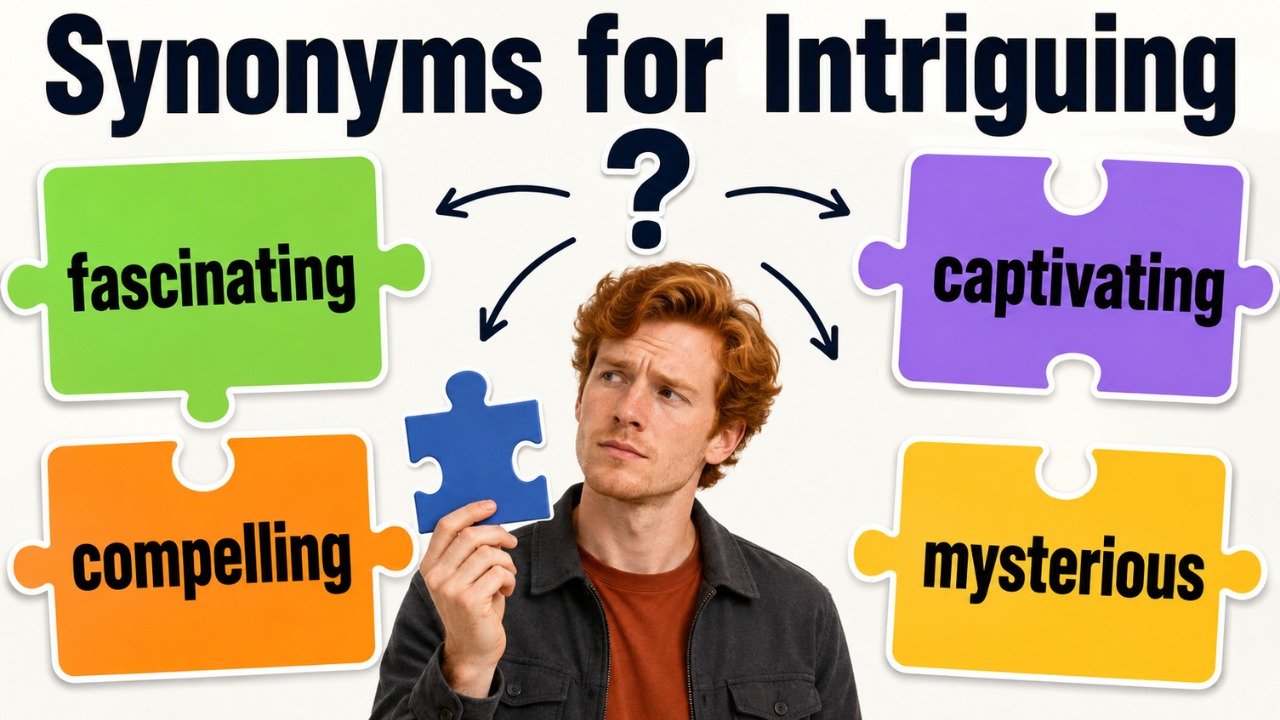
Quick Answer: Common synonyms for intriguing include fascinating, compelling, captivating, mysterious, engaging, absorbing, thought provoking, alluring, curious, and stimulating. Use fascinating for something that creates strong interest, compelling for something difficult to ignore, captivating for something that holds attention, and mysterious for something that raises unanswered questions. Engaging suits pleasant conversation or content, while thought provoking is best for ideas that encourage deeper thinking.
Pronunciation and Word Details
Word: Intriguing.
Pronunciation: /ɪnˈtriːɡɪŋ/
Part of Speech: Adjective.
Meaning: Extremely interesting because something is unusual, mysterious, attractive, or mentally stimulating.
US Pronunciation:
UK Pronunciation:
What Does “Intriguing” Mean?
Intriguing means very interesting because something creates curiosity, raises questions, or encourages a person to learn more.
It is an adjective used to describe people, ideas, stories, possibilities, discoveries, designs, conversations, and situations. The word often suggests that something is not fully understood at first.
In the sentence “The scientist presented an intriguing theory,” intriguing means the theory was unusual and interesting enough to deserve further attention.
The word can also describe something attractive or charming. An intriguing person may seem intelligent, mysterious, unusual, or difficult to understand completely.
Intriguing works in both positive and neutral contexts. It usually expresses curiosity rather than simple enjoyment.
Meaning, Tone, and Context of “Intriguing”
Intriguing usually has a positive, curious, and thoughtful tone. It suggests that something captures attention because it contains mystery, originality, complexity, or unexpected detail.
The word is suitable for formal writing, academic discussion, reviews, essays, professional communication, and everyday conversation.
In formal writing, intriguing often introduces an idea, result, question, or possibility that deserves further investigation.
Example: The research revealed an intriguing connection between sleep and memory.
In casual speech, intriguing can describe a person, plan, story, or suggestion that sounds unusually interesting.
Example: That sounds like an intriguing idea for the weekend.
Intriguing is generally stronger than interesting. Interesting shows that something deserves attention, while intriguing suggests that it creates curiosity or leaves unanswered questions.
The word is not usually highly emotional. However, it may carry a sense of excitement, suspense, attraction, or intellectual interest.
When and How to Use “Intriguing”
For Curiosity
Use intriguing when something makes people want to know more.
Example: The old letter contained an intriguing reference to a hidden room.
For Mystery
Use intriguing when a person, object, or event seems difficult to explain.
Example: The investigators discovered an intriguing pattern in the evidence.
For New Ideas
Use intriguing when an idea is original, unusual, or worthy of consideration.
Example: She proposed an intriguing solution to the transportation problem.
For Research Findings
Use intriguing when results suggest an important possibility but do not provide a complete answer.
Example: The study produced several intriguing findings.
For Stories and Entertainment
Use intriguing when a story, character, or plot holds attention through suspense or uncertainty.
Example: The opening chapter introduces an intriguing character.
For People
Use intriguing when someone appears interesting because of their personality, knowledge, appearance, or mystery.
Example: He was an intriguing speaker with an unusual perspective.
For Designs and Art
Use intriguing when something is visually unusual, creative, or thought provoking.
Example: The building has an intriguing combination of traditional and modern details.
For Possibilities
Use intriguing when an option deserves exploration because it may lead to an unexpected result.
Example: Moving the event outdoors is an intriguing possibility.
Best Synonyms for Intriguing
Fascinating: Extremely interesting and able to hold attention strongly.
Example: The documentary offered a fascinating look at ocean life.
Compelling: So interesting or convincing that it is difficult to ignore.
Example: The report presents a compelling argument for change.
Captivating: Charming or attractive enough to hold complete attention.
Example: She delivered a captivating performance.
Mysterious: Difficult to understand or explain, creating curiosity.
Example: A mysterious sound came from the empty room.
Engaging: Pleasant, interesting, and able to keep someone involved.
Example: The instructor gave an engaging presentation.
Absorbing: So interesting that it takes up all of someone’s attention.
Example: The novel was absorbing from the first page.
Thought Provoking: Encouraging careful or serious thought.
Example: The exhibition offered a thought provoking view of modern life.
Alluring: Powerfully attractive or tempting.
Example: The island has an alluring sense of peace and secrecy.
Curious: Unusual, strange, or worthy of investigation.
Example: They noticed a curious mark on the wall.
Stimulating: Encouraging interest, thought, energy, or discussion.
Example: The debate was intellectually stimulating.
50 Synonyms for Intriguing with Short Meanings
- Fascinating: Extremely interesting and attention holding.
- Compelling: Difficult to ignore because of strong interest.
- Captivating: Able to hold complete attention.
- Engaging: Pleasant and interesting to experience.
- Absorbing: Taking up all of someone’s attention.
- Mysterious: Difficult to explain or understand.
- Enigmatic: Mysterious in a complex or puzzling way.
- Alluring: Strongly attractive or tempting.
- Enticing: Encouraging interest or desire.
- Appealing: Attractive or pleasant to consider.
- Interesting: Worthy of attention or curiosity.
- Curious: Strange or unusual enough to investigate.
- Stimulating: Encouraging thought, interest, or activity.
- Thought Provoking: Causing careful or serious thought.
- Arresting: Immediately attracting attention.
- Gripping: Holding attention through excitement or suspense.
- Riveting: So interesting that attention remains fixed.
- Mesmerizing: Holding attention in an almost hypnotic way.
- Spellbinding: Completely capturing a person’s attention.
- Enchanting: Delightfully attractive or charming.
- Charming: Pleasantly attractive or appealing.
- Magnetic: Naturally able to attract attention.
- Attractive: Creating interest or admiration.
- Seductive: Tempting or strongly attractive.
- Tantalizing: Creating interest while remaining partly unavailable.
- Tempting: Appealing enough to encourage action.
- Provocative: Causing thought, discussion, or reaction.
- Puzzling: Difficult to understand or solve.
- Perplexing: Confusing in a way that encourages thought.
- Baffling: Very difficult to explain.
- Cryptic: Mysterious because the meaning is hidden.
- Unusual: Different from what is normal or expected.
- Unconventional: Different from accepted methods or ideas.
- Original: New, creative, and not copied.
- Remarkable: Unusual enough to deserve attention.
- Noteworthy: Important or interesting enough to notice.
- Striking: Immediately noticeable or impressive.
- Impressive: Creating admiration or strong interest.
- Memorable: Worth remembering because of a strong effect.
- Evocative: Bringing strong ideas, images, or feelings to mind.
- Suggestive: Hinting at deeper meanings or possibilities.
- Inviting: Attractive and encouraging further interest.
- Entertaining: Enjoyable and able to hold attention.
- Amusing: Pleasantly entertaining or funny.
- Enthralling: Holding attention through intense interest.
- Beguiling: Charming in a mysterious or deceptive way.
- Complicated: Containing details that require careful thought.
- Complex: Made of connected parts that invite analysis.
- Suspenseful: Creating uncertainty and excitement.
- Mind Bending: Challenging normal expectations or understanding.
Read Also:
Synonyms for Silent

Synonyms for Intriguing by Context
When Intriguing Means Highly Interesting
Fascinating, absorbing, engaging, compelling, riveting, and enthralling work well when something strongly holds attention.
Fascinating is suitable for subjects, facts, places, discoveries, and people.
Example: The museum contains a fascinating collection of ancient objects.
Absorbing is especially useful for books, activities, and detailed tasks.
Example: She found the historical novel completely absorbing.
Engaging often describes communication, teaching, writing, and conversation.
Example: His engaging style made the difficult topic easier to understand.
When Intriguing Means Mysterious
Mysterious, enigmatic, cryptic, puzzling, baffling, and perplexing describe something that is not easily understood.
Enigmatic is useful for people, expressions, works of art, and messages.
Example: The artist was known for her enigmatic paintings.
Cryptic describes information with a hidden or unclear meaning.
Example: He left a cryptic note on the desk.
Puzzling describes something that requires thought to understand.
Example: The sudden change in behavior was puzzling.
When Intriguing Means Attractive
Alluring, enticing, appealing, enchanting, charming, magnetic, and beguiling describe something that draws attention through beauty, charm, or promise.
Alluring often suggests mystery and strong attraction.
Example: The village has an alluring old world atmosphere.
Enticing suggests that something encourages desire or action.
Example: The restaurant offered an enticing selection of desserts.
Charming is softer and more pleasant.
Example: They stayed in a charming cottage near the river.
When Intriguing Means Thought Provoking
Thought provoking, stimulating, provocative, evocative, suggestive, and challenging describe ideas that encourage deeper thought.
Thought provoking is suitable for essays, films, questions, speeches, and discussions.
Example: The speaker raised a thought provoking question about responsibility.
Provocative often suggests that something causes debate or a strong reaction.
Example: The article makes a provocative claim about education.
Evocative describes something that brings memories, emotions, or images to mind.
Example: The poem uses evocative descriptions of childhood.
When Intriguing Means Suspenseful
Gripping, riveting, suspenseful, captivating, spellbinding, and enthralling suit stories, mysteries, performances, and dramatic events.
Gripping describes something emotionally intense or exciting.
Example: The book tells a gripping story of survival.
Suspenseful emphasizes uncertainty about what will happen next.
Example: The final scene was tense and suspenseful.
Spellbinding suggests complete attention and wonder.
Example: The storyteller gave a spellbinding performance.
When Intriguing Means Unusual
Curious, remarkable, unconventional, original, striking, unusual, and noteworthy describe something different from expectations.
Curious may describe an unusual object, event, habit, or detail.
Example: There was a curious symbol above the doorway.
Unconventional describes something that does not follow traditional methods.
Example: The architect proposed an unconventional design.
Original emphasizes creativity and newness.
Example: Her original approach impressed the judges.
Another Word for Intriguing
Fascinating is often the best single replacement for intriguing because both words describe something that creates strong interest. However, the most accurate alternative depends on why the subject attracts attention.
Use mysterious when something is difficult to explain, compelling when it is difficult to ignore, captivating when it holds attention through charm, and thought provoking when it encourages reflection.
Original: The researcher presented an intriguing theory.
Better Option: The researcher presented a fascinating theory.
Original: The novel begins with an intriguing disappearance.
Better Option: The novel begins with a mysterious disappearance.
Original: She made an intriguing argument about social responsibility.
Better Option: She made a compelling argument about social responsibility.
Original: The exhibition explores an intriguing question about identity.
Better Option: The exhibition explores a thought provoking question about identity.
When Not to Use “Intriguing”
Avoid using intriguing when you need to explain exactly why something is interesting. A more specific word can make the sentence clearer.
Weak: The results were intriguing.
Better: The results were unexpected and raised several important questions.
Do not use intriguing repeatedly in the same paragraph. Repetition can make writing sound vague.
Weak: The intriguing speaker shared an intriguing idea during an intriguing discussion.
Better: The engaging speaker shared an original idea during a stimulating discussion.
Avoid intriguing when something is simply enjoyable rather than mysterious or mentally stimulating.
Weak: We had an intriguing meal at the family gathering.
Better: We had an enjoyable meal at the family gathering.
Do not use intriguing when you mean confusing in a negative way.
Weak: The unclear instructions were intriguing.
Better: The unclear instructions were confusing.
Avoid using intriguing as a replacement for attractive in every context. Intriguing suggests curiosity or mystery, while attractive mainly describes appeal.
Weak: The chair has an intriguing price.
Better: The chair has an attractive price.
Words Commonly Confused With Intriguing
Intriguing vs Interesting: Interesting means worthy of attention. Intriguing is stronger and usually suggests curiosity, mystery, or unanswered questions.
Intriguing vs Fascinating: Both describe strong interest. Fascinating often shows intense admiration, while intriguing frequently suggests that more information is needed.
Intriguing vs Mysterious: Mysterious means difficult to explain. Intriguing may be mysterious, but it can also be attractive, original, or intellectually stimulating.
Intriguing vs Compelling: Compelling describes something that strongly demands attention or persuades. Intriguing mainly creates curiosity.
Intriguing vs Captivating: Captivating means charming enough to hold attention completely. Intriguing may hold attention because of complexity or mystery rather than charm.
Intriguing vs Curious: Curious can mean eager to know something or strange and unusual. Intriguing describes something that produces curiosity.
Intriguing vs Provocative: Provocative causes thought, debate, or a strong reaction. Intriguing creates interest without necessarily causing disagreement.
Intriguing vs Engaging: Engaging is pleasant and easy to follow. Intriguing may be more mysterious, complicated, or challenging.
Which Synonym Should You Choose?
Choose fascinating when something creates intense interest or admiration.
Choose compelling when an argument, story, reason, or piece of evidence is difficult to ignore.
Choose captivating when a person, performance, image, or story holds attention through charm.
Choose mysterious when something cannot be easily understood or explained.
Choose enigmatic for a person, expression, message, or artwork that seems deeply mysterious.
Choose engaging for presentations, lessons, conversations, articles, and speakers that maintain interest pleasantly.
Choose absorbing for books, activities, hobbies, or tasks that require complete attention.
Choose thought provoking for questions, essays, films, speeches, and ideas that encourage reflection.
Choose alluring when something is attractive because it combines beauty, mystery, or promise.
Choose provocative when an idea is intended to create debate or challenge accepted beliefs.
Choose gripping for emotional stories, investigations, and dramatic events.
Choose suspenseful when a story creates uncertainty about what will happen next.
Choose curious when describing an unusual detail, object, event, or situation.
Choose stimulating for academic discussions, debates, learning experiences, and intellectual activities.
Real Life Examples of “Intriguing” in Sentences
Original: The book presents an intriguing account of the expedition.
Better Option: The book presents a fascinating account of the expedition.
Original: She offered an intriguing explanation for the sudden change.
Better Option: She offered a compelling explanation for the sudden change.
Original: The abandoned house had an intriguing history.
Better Option: The abandoned house had a mysterious history.
Original: The speaker introduced an intriguing question.
Better Option: The speaker introduced a thought provoking question.
Original: The painting contains several intriguing symbols.
Better Option: The painting contains several enigmatic symbols.
Original: The opening scene was intriguing.
Better Option: The opening scene was gripping.
Original: He has an intriguing personality.
Better Option: He has a magnetic personality.
Original: The team discovered an intriguing connection between the two cases.
Better Option: The team discovered a fascinating connection between the two cases.
Original: The proposal offers an intriguing possibility.
Better Option: The proposal offers an appealing possibility.
Original: Her intriguing presentation kept everyone attentive.
Better Option: Her engaging presentation kept everyone attentive.
Synonym Groups and Usage Differences
Interest Group
Fascinating, interesting, engaging, absorbing, compelling, and stimulating describe subjects that hold attention.
Fascinating is stronger than interesting. Engaging suggests pleasant involvement, while absorbing suggests complete concentration.
Example: The lecture was both engaging and informative.
Mystery Group
Mysterious, enigmatic, cryptic, puzzling, baffling, and perplexing describe things that are difficult to understand.
Mysterious is broad, while enigmatic often describes something deeply puzzling. Cryptic usually relates to hidden or unclear messages.
Example: The note contained a cryptic warning.
Attraction Group
Alluring, enticing, appealing, charming, enchanting, beguiling, and magnetic describe strong appeal.
Alluring and beguiling may include mystery. Charming is friendlier and softer, while enticing suggests temptation.
Example: The town has a charming and inviting atmosphere.
Attention Group
Captivating, riveting, gripping, enthralling, spellbinding, and arresting describe something that strongly holds attention.
Riveting and gripping often describe stories. Arresting describes something that attracts attention immediately.
Example: The photograph was visually arresting.
Thought Group
Thought provoking, provocative, stimulating, evocative, suggestive, and complex describe something that encourages reflection.
Provocative may cause disagreement, while evocative brings images, memories, or emotions to mind.
Example: The essay provides a thought provoking examination of freedom.
Unusualness Group
Curious, unusual, unconventional, original, striking, remarkable, and noteworthy describe things that stand apart from what is expected.
Original emphasizes creativity, while unconventional emphasizes a departure from normal methods.
Example: The designer used an unconventional arrangement of materials.
Antonyms of Intriguing
The opposite of intriguing depends on whether the word refers to interest, mystery, attraction, or mental stimulation.
Boring: Unable to create interest or excitement.
Dull: Lacking energy, interest, or variety.
Uninteresting: Not worthy of attention or curiosity.
Tedious: Too long, slow, or repetitive to remain interesting.
Predictable: Easy to anticipate and lacking surprise.
Ordinary: Normal and not especially noticeable.
Commonplace: Familiar and lacking originality.
Obvious: Easy to understand without investigation.
Clear: Fully understandable and free from mystery.
Unremarkable: Not unusual or worthy of attention.
Monotonous: Repetitive and lacking variety.
Unappealing: Not attractive or inviting.
Repellent: Strongly unpleasant or unattractive.
Simple: Easy to understand and lacking complexity.
Forgettable: Not memorable or distinctive.
Comparison: Intriguing vs Related Words
Intriguing vs Fascinating
Intriguing creates curiosity and encourages further investigation. Fascinating expresses stronger and more complete interest.
Example With Intriguing: The report revealed an intriguing pattern.
Example With Fascinating: The documentary gave a fascinating account of the discovery.
Intriguing vs Interesting
Interesting is a broad word for anything that deserves attention. Intriguing adds mystery, originality, or curiosity.
Example With Intriguing: She raised an intriguing possibility.
Example With Interesting: She shared an interesting fact.
Intriguing vs Mysterious
Intriguing describes the effect something has on a person. Mysterious describes the unclear or unexplained nature of the thing itself.
Example With Intriguing: The message contained an intriguing detail.
Example With Mysterious: The message arrived under mysterious circumstances.
Intriguing vs Compelling
Intriguing makes people curious. Compelling strongly attracts attention or persuades people to believe or act.
Example With Intriguing: The lawyer introduced an intriguing possibility.
Example With Compelling: The lawyer presented compelling evidence.
Intriguing vs Captivating
Intriguing attracts attention through mystery or complexity. Captivating holds attention through charm, beauty, or emotional power.
Example With Intriguing: The character has an intriguing past.
Example With Captivating: The actor gave a captivating performance.
Intriguing vs Engaging
Intriguing often creates questions. Engaging creates pleasant and active interest.
Example With Intriguing: The article explores an intriguing theory.
Example With Engaging: The teacher used an engaging explanation.
Intriguing vs Provocative
Intriguing creates curiosity. Provocative deliberately causes thought, debate, or emotional reaction.
Example With Intriguing: The study offers an intriguing conclusion.
Example With Provocative: The writer makes a provocative argument about authority.
Common Phrases and Expressions With “Intriguing”
Intriguing Idea: An unusual or interesting thought worth considering.
Intriguing Possibility: An option that creates curiosity or excitement.
Intriguing Question: A question that encourages deeper thinking.
Intriguing Story: A narrative that holds attention through interest or mystery.
Intriguing Character: A person in a story who seems complex or mysterious.
Intriguing Detail: A small piece of information that raises curiosity.
Intriguing Discovery: A finding that appears unusual or important.
Intriguing Theory: An explanation that deserves further investigation.
Intriguing Proposal: A suggestion that appears original or promising.
Intriguing Combination: A mixture of elements that produces an unusual effect.
Common Mistakes to Avoid
One common mistake is using intriguing as a general replacement for good, enjoyable, or attractive. Intriguing should normally suggest curiosity, mystery, originality, or deeper interest.
Another mistake is repeating intriguing several times in one article. Use precise alternatives such as fascinating, mysterious, compelling, engaging, captivating, or thought provoking.
Writers sometimes use intriguing for ideas that are merely confusing. Confusing describes difficulty understanding something, while intriguing suggests that the difficulty creates interest.
Avoid treating intriguing and compelling as exact synonyms. A compelling argument persuades or demands attention, while an intriguing argument mainly makes the reader curious.
Do not use mysterious when the subject is fully understood. Choose engaging, appealing, unusual, or fascinating instead.
Be careful with alluring and seductive because they can suggest strong physical attraction or temptation. They may not suit academic or professional contexts.
Use thought provoking as two separate words. Avoid inserting a hyphen when following a style that does not use hyphenated compounds.
Choose a synonym according to the exact reason the subject attracts attention.
Conclusion
Understanding synonyms for intriguing helps you describe curiosity, mystery, attraction, and strong interest more accurately. Use fascinating for intense interest, compelling for arguments and evidence, captivating for charming experiences, and mysterious for unexplained situations. Thought provoking works well for ideas that encourage reflection, while engaging suits conversations, lessons, and presentations. The best synonym depends on what makes the subject interesting, so consider whether the sentence emphasizes suspense, beauty, complexity, originality, or intellectual curiosity.
FAQs About Synonyms for Intriguing
What is the best synonym for intriguing?
Fascinating is often the best general synonym. Compelling, captivating, mysterious, and engaging may be better in specific contexts.
Is intriguing stronger than interesting?
Yes. Intriguing usually suggests stronger curiosity, mystery, or a desire to learn more.
Can fascinating replace intriguing?
Fascinating can replace intriguing when something creates strong interest. It may not express the same sense of mystery.
What is a formal synonym for intriguing?
Compelling, thought provoking, stimulating, noteworthy, and provocative are useful formal alternatives.
What is another word for an intriguing person?
An intriguing person may be described as fascinating, mysterious, enigmatic, captivating, magnetic, or compelling.
What is the opposite of intriguing?
Common opposites include boring, dull, predictable, ordinary, uninteresting, tedious, and forgettable.
Is intriguing a positive word?
Intriguing is usually positive or neutral. It shows that something creates interest, curiosity, or a desire for more information.
