
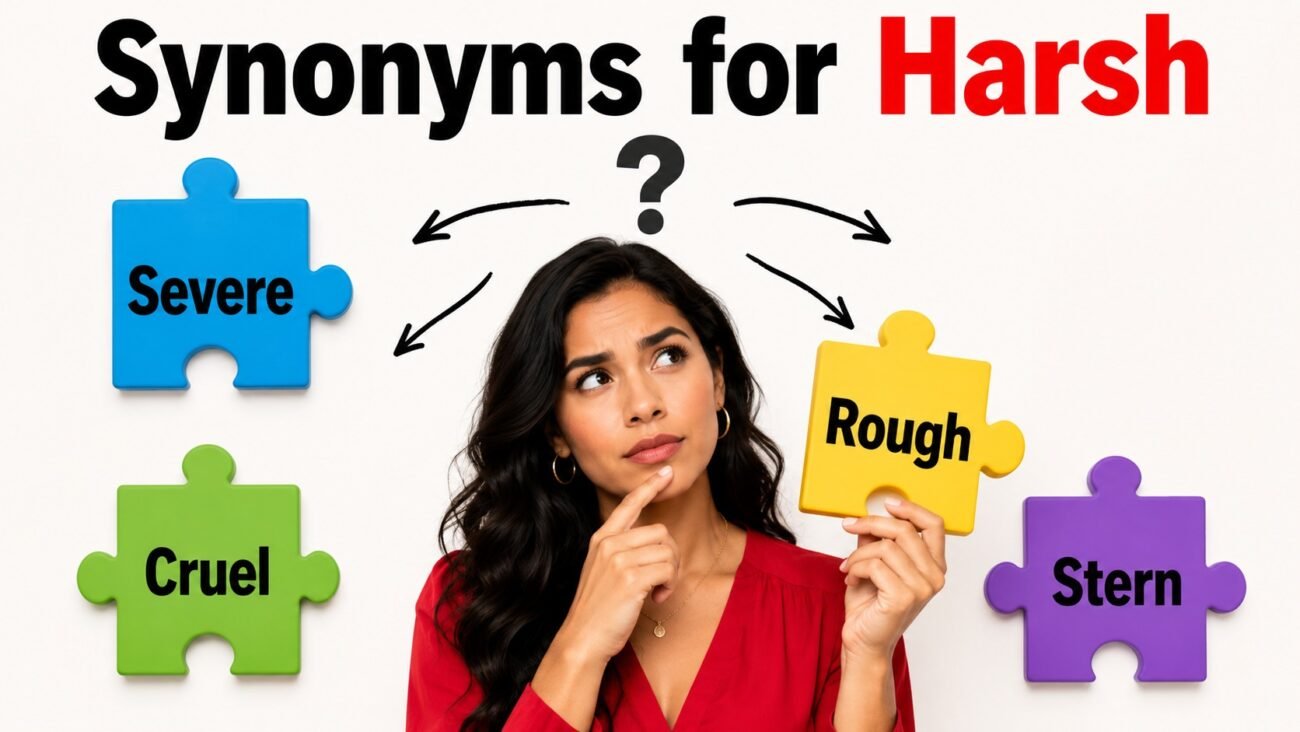
Quick Answer: The best synonyms for harsh include severe, strict, cruel, rough, sharp, bitter, stern, brutal, abrasive, and unpleasant. Use severe for serious conditions or punishment, strict for rules and discipline, cruel for unkind behavior, rough for texture or sound, sharp for tone, bitter for taste or feeling, and abrasive for rude speech or personality.
Pronunciation and Word Details
Word: Harsh.
Pronunciation: /hɑːrʃ/.
Part of Speech: Adjective.
Meaning: Harsh means unpleasant, severe, rough, cruel, or difficult to accept.
US Pronunciation:
UK Pronunciation:
What Does “Harsh” Mean?
Harsh means severe, rough, unpleasant, or unkind. It is an adjective used to describe words, behavior, weather, sounds, light, rules, punishments, conditions, criticism, and physical textures.
A harsh comment can hurt someone’s feelings. A harsh punishment is too severe. A harsh sound is unpleasant to hear. Harsh weather is difficult to live or travel in. Harsh light may be too bright or uncomfortable for the eyes.
The word changes slightly by context. In emotional writing, harsh often means cruel or unkind. In physical description, it can mean rough, sharp, or uncomfortable. In rules or discipline, it often means strict or severe.
Meaning, Tone, and Context of “Harsh”
Harsh is usually a negative word. It often suggests something is too strong, too strict, too rough, or too unkind. The tone can be emotional, serious, critical, or descriptive depending on the sentence.
In casual speech, harsh can describe rude words, difficult treatment, or painful truth. In formal writing, it can describe severe conditions, strict policies, strong criticism, or difficult environments. In sensory descriptions, harsh can describe light, sound, taste, smell, or texture.
Harsh is not always extreme, but it usually carries discomfort. For example, “a harsh voice” sounds unpleasant, while “a harsh decision” may sound strict, unfair, or difficult to accept.
When and How to Use “Harsh”
For Criticism: Use harsh when someone’s words are too strong, direct, or hurtful.
Example: Her harsh criticism upset the whole team.
For Rules: Use harsh when rules or punishments feel too strict or severe.
Example: The school introduced harsh penalties for late work.
For Weather: Use harsh when weather is difficult, cold, dry, windy, or unpleasant.
Example: The workers faced harsh weather in the mountains.
For Sound: Use harsh when a noise is rough, loud, sharp, or unpleasant.
Example: The machine made a harsh grinding sound.
For Light: Use harsh when light is too bright, strong, or uncomfortable.
Example: The harsh light made it hard to read.
For Behavior: Use harsh when someone acts unkindly or without softness.
Example: His harsh behavior made others avoid him.
For Reality: Use harsh when a fact or situation is painful but true.
Example: The harsh truth was difficult to accept.
Best Synonyms for Harsh
Severe: Very serious, strict, or intense.
Example: The judge gave a severe warning.
Strict: Demanding obedience to rules.
Example: The teacher was strict about deadlines.
Cruel: Intentionally unkind or hurtful.
Example: His cruel words hurt her deeply.
Rough: Not smooth, gentle, or pleasant.
Example: The fabric felt rough against the skin.
Sharp: Strong, direct, or cutting in tone.
Example: She gave a sharp reply.
Bitter: Painful, resentful, or unpleasant in taste.
Example: He spoke with a bitter tone.
Stern: Serious, firm, and not gentle.
Example: The coach gave the players a stern reminder.
Brutal: Extremely harsh, violent, or honest.
Example: The report gave a brutal assessment of the problem.
Abrasive: Rude, irritating, or rough in manner.
Example: His abrasive style made teamwork difficult.
Unpleasant: Not enjoyable, comfortable, or pleasing.
Example: The room had an unpleasant smell.
50 Synonyms for Harsh with Short Meanings
- Severe: Very serious, strict, or intense.
- Strict: Firm about rules or behavior.
- Cruel: Deliberately unkind or hurtful.
- Rough: Not smooth, soft, or gentle.
- Sharp: Cutting, strong, or direct.
- Bitter: Painful, resentful, or unpleasant.
- Stern: Firm, serious, and not gentle.
- Brutal: Extremely severe or painfully honest.
- Abrasive: Rude, irritating, or rough in manner.
- Unpleasant: Not nice, comfortable, or enjoyable.
- Hard: Difficult, strict, or not gentle.
- Tough: Difficult to deal with or endure.
- Unkind: Lacking kindness or sympathy.
- Mean: Intentionally rude or hurtful.
- Hostile: Unfriendly or aggressive.
- Merciless: Showing no pity or forgiveness.
- Ruthless: Cruel and without compassion.
- Unforgiving: Not allowing mistakes or weakness.
- Punishing: Extremely difficult or damaging.
- Oppressive: Harshly controlling or burdensome.
- Grueling: Very tiring and difficult.
- Demanding: Requiring great effort or discipline.
- Rigorous: Very strict, exact, or thorough.
- Rigid: Not flexible or gentle.
- Austere: Plain, strict, or severe.
- Bleak: Cold, gloomy, or discouraging.
- Grim: Serious, harsh, or depressing.
- Biting: Sharp, cold, or hurtful.
- Piercing: Very sharp in sound, feeling, or effect.
- Shrill: High, sharp, and unpleasant in sound.
- Rasping: Rough and unpleasant in sound.
- Grating: Irritating or unpleasant to hear.
- Jarring: Shocking, rough, or unpleasant.
- Coarse: Rough in texture, manner, or language.
- Gritty: Rough in texture or feeling.
- Rugged: Rough, difficult, or uneven.
- Raw: Exposed, rough, painful, or natural.
- Blunt: Very direct and not softened.
- Cutting: Hurtful, sharp, or critical.
- Caustic: Bitter, sarcastic, or sharply critical.
- Scathing: Extremely critical or damaging.
- Savage: Fierce, cruel, or intense.
- Ferocious: Fierce, violent, or intense.
- Intense: Strong, forceful, or extreme.
- Extreme: Going far beyond normal limits.
- Drastic: Severe and sudden.
- Heavy: Strong, serious, or difficult to bear.
- Unrelenting: Continuing without softness or pause.
- Hardline: Very strict and unwilling to compromise.
- Unsparing: Severe, honest, and without kindness.
Read Also:
Synonyms for Went

Synonyms for Harsh by Context
When Harsh Means Severe
Use these synonyms when harsh describes serious rules, punishment, conditions, judgment, or consequences.
Severe: The company faced severe criticism after the mistake.
Strict: The coach had strict training rules.
Punishing: The schedule was punishing for new workers.
Rigorous: The program had rigorous standards.
Drastic: The manager took drastic action.
When Harsh Means Cruel
Use these synonyms when harsh means unkind, hurtful, or lacking compassion.
Cruel: His cruel joke embarrassed his friend.
Unkind: Her unkind reply ended the conversation.
Mean: That was a mean thing to say.
Merciless: The review was merciless.
Ruthless: The leader made a ruthless decision.
When Harsh Means Rough
Use these synonyms when harsh describes texture, surface, sound, light, or physical feeling.
Rough: The blanket felt rough on the skin.
Coarse: The towel was coarse and uncomfortable.
Gritty: The floor had a gritty surface.
Rugged: The path was rugged and steep.
Raw: The cold air felt raw on his face.
When Harsh Means Sharp or Unpleasant
Use these synonyms when harsh describes a sharp sound, voice, light, smell, or taste.
Sharp: A sharp noise came from the engine.
Shrill: The alarm made a shrill sound.
Grating: His voice became grating after hours of shouting.
Jarring: The sudden sound was jarring.
Bitter: The medicine had a bitter taste.
When Harsh Means Direct or Critical
Use these synonyms when harsh describes blunt speech, criticism, feedback, or judgment.
Blunt: Her blunt answer surprised everyone.
Cutting: His cutting remark silenced the room.
Caustic: The article used caustic language.
Scathing: The report gave a scathing review.
Unsparing: The teacher gave an unsparing explanation of the errors.
Another Word for Harsh
The best single replacement for harsh is often severe, especially when describing punishment, weather, rules, criticism, or conditions. However, the best alternative depends on context. Use cruel for unkind behavior, rough for texture, sharp for tone or sound, and strict for rules.
Original: The judge gave a harsh sentence.
Better Option: The judge gave a severe sentence.
Original: His harsh words hurt her.
Better Option: His cruel words hurt her.
Original: The fabric felt harsh.
Better Option: The fabric felt rough.
Original: She spoke in a harsh voice.
Better Option: She spoke in a sharp voice.
When Not to Use “Harsh”
Do not use harsh when a more exact word can make your sentence clearer. Harsh is useful, but it can be too general if the reader needs to know whether something is cruel, strict, rough, sharp, bitter, or severe.
Weak: The rule was harsh.
Better: The rule was strict.
Weak: His words were harsh.
Better: His words were cruel.
Weak: The sound was harsh.
Better: The sound was shrill.
Weak: The road was harsh.
Better: The road was rugged.
Weak: The punishment was harsh.
Better: The punishment was severe.
Avoid using harsh for mild discomfort. For example, “The tea was harsh” may be unclear. If the taste is unpleasant, use bitter. If the smell is unpleasant, use strong or unpleasant.
Words Commonly Confused With Harsh
Harsh vs Severe: Harsh often means unpleasant, unkind, or rough. Severe means very serious, intense, or strict.
Harsh vs Strict: Harsh can sound unfair or too strong. Strict means firm about rules, but not always unfair.
Harsh vs Cruel: Harsh can be unkind, but cruel suggests intentional hurt or lack of compassion.
Harsh vs Rough: Harsh can describe sound, speech, weather, or treatment. Rough often describes texture, surface, movement, or manner.
Harsh vs Sharp: Harsh can mean generally unpleasant. Sharp often means sudden, cutting, direct, or piercing.
Harsh vs Bitter: Harsh can describe many unpleasant things. Bitter is more specific for taste, emotion, resentment, or tone.
Which Synonym Should You Choose?
Choose severe when writing about serious punishment, weather, damage, pain, criticism, or conditions.
Choose strict when writing about rules, discipline, policies, teachers, parents, or standards.
Choose cruel when someone is intentionally unkind, hurtful, or lacking compassion.
Choose rough when describing texture, surface, handling, movement, or physical discomfort.
Choose sharp when describing tone, voice, sound, pain, or direct replies.
Choose bitter when describing taste, resentment, disappointment, or painful feelings.
Choose stern when someone is serious, firm, and controlled but not necessarily cruel.
Choose abrasive when describing a rude personality, irritating manner, or unpleasant communication style.
Choose brutal when the meaning is extremely severe, honest, violent, or difficult.
Choose unpleasant when you need a simple, neutral word for something not enjoyable.
Real Life Examples of “Harsh” in Sentences
Original: The teacher gave a harsh warning.
Better Option: The teacher gave a stern warning.
Original: The weather was harsh in the desert.
Better Option: The weather was severe in the desert.
Original: His harsh words made her cry.
Better Option: His cruel words made her cry.
Original: The light in the room was harsh.
Better Option: The light in the room was sharp.
Original: The blanket felt harsh.
Better Option: The blanket felt rough.
Original: The review was harsh but honest.
Better Option: The review was blunt but honest.
Original: The sound from the speaker was harsh.
Better Option: The sound from the speaker was grating.
Original: The punishment seemed harsh.
Better Option: The punishment seemed severe.
Original: She had a harsh way of speaking.
Better Option: She had an abrasive way of speaking.
Original: The medicine had a harsh taste.
Better Option: The medicine had a bitter taste.
Synonym Groups and Usage Differences
Severity Group
This group includes words such as severe, strict, rigorous, drastic, and punishing. Use these when harsh describes rules, systems, punishments, or difficult conditions.
Example: The team followed a rigorous training plan.
Cruelty Group
This group includes cruel, mean, unkind, merciless, and ruthless. These words work best when harsh describes behavior that hurts people emotionally or physically.
Example: His unkind comment ruined the mood.
Texture Group
This group includes rough, coarse, gritty, rugged, and raw. Use these for surfaces, materials, roads, weather, and physical feeling.
Example: The coarse fabric scratched his arm.
Sound Group
This group includes shrill, rasping, grating, piercing, and jarring. These words are useful when harsh describes unpleasant noise or voice quality.
Example: The grating sound made everyone uncomfortable.
Criticism Group
This group includes blunt, cutting, caustic, scathing, and unsparing. Use these when harsh describes feedback, judgment, tone, or opinion.
Example: The editor gave a scathing review of the draft.
Emotional Hardness Group
This group includes stern, hard, unforgiving, unrelenting, and austere. Use these when harsh describes an attitude, environment, rule, or personality with little warmth.
Example: The manager had an unforgiving attitude toward mistakes.
Antonyms of Harsh
The opposite of harsh depends on context. If harsh means cruel, the opposite may be kind. If it means severe, the opposite may be mild. If it means rough, the opposite may be smooth or soft.
Gentle: Soft, calm, and not forceful.
Kind: Caring and not cruel.
Mild: Not strong, severe, or intense.
Soft: Smooth, quiet, or not harsh.
Smooth: Even, pleasant, and not rough.
Pleasant: Enjoyable or agreeable.
Polite: Respectful and well mannered.
Lenient: Not strict or severe.
Compassionate: Showing care and sympathy.
Tender: Soft, gentle, and emotionally warm.
Warm: Friendly, kind, and welcoming.
Soothing: Calming and comforting.
Comparison: Harsh vs Related Words
Harsh vs Severe
Harsh often suggests something is unpleasant, unkind, or difficult to accept. Severe means very serious, intense, or strict.
Example With Harsh: His harsh tone upset the students.
Example With Severe: The city faced severe flooding.
Harsh vs Strict
Strict means firm about rules. Harsh suggests the rules or treatment may feel too strong, unfair, or unkind.
Example With Harsh: The punishment felt harsh for a small mistake.
Example With Strict: The teacher was strict about attendance.
Harsh vs Cruel
Cruel is stronger than harsh because it suggests intentional hurt. Harsh can be unkind, but it may not always mean someone wanted to hurt another person.
Example With Harsh: Her harsh comment sounded unnecessary.
Example With Cruel: Her cruel comment was meant to hurt him.
Harsh vs Rough
Rough usually refers to texture, surface, movement, or handling. Harsh can describe roughness, but it also applies to speech, weather, rules, sound, and treatment.
Example With Harsh: The harsh wind made walking difficult.
Example With Rough: The rough stone scratched his hand.
Harsh vs Sharp
Sharp often means cutting, sudden, piercing, or direct. Harsh is broader and can mean unpleasant, severe, or unkind.
Example With Harsh: He gave a harsh response.
Example With Sharp: He gave a sharp response.
Harsh vs Bitter
Bitter is best for taste, resentment, disappointment, or painful emotion. Harsh is broader and can describe many unpleasant things.
Example With Harsh: The medicine had a harsh flavor.
Example With Bitter: The medicine had a bitter flavor.
Common Phrases and Expressions With Harsh
Harsh Words: Unkind or hurtful language.
Harsh Criticism: Strong and difficult feedback.
Harsh Reality: A painful or difficult truth.
Harsh Truth: An honest fact that is hard to accept.
Harsh Weather: Difficult or unpleasant weather conditions.
Harsh Punishment: A penalty that feels too severe.
Harsh Tone: A voice or manner that sounds sharp or unkind.
Harsh Light: Bright light that feels uncomfortable.
Harsh Sound: Noise that is sharp, rough, or unpleasant.
Harsh Conditions: Difficult, severe, or uncomfortable circumstances.
Common Mistakes to Avoid
A common mistake is using harsh when a more exact synonym would be stronger. If you mean unkind, use cruel or mean. If you mean strict, use strict or severe. If you mean rough to touch, use rough or coarse.
Another mistake is repeating harsh too often in one paragraph. Repetition can make writing sound flat. Replace repeated uses with context specific words such as stern, abrasive, grating, bitter, severe, or unpleasant.
Avoid using harsh for something that is only slightly uncomfortable. For mild situations, words like unpleasant, firm, direct, or strong may sound more natural.
Do not confuse harsh with strict. A strict teacher may be fair and organized, but a harsh teacher may sound unkind or too severe.
Also avoid unclear phrasing. Instead of writing “The situation was harsh,” explain whether it was difficult, severe, painful, unfair, or unforgiving.
Conclusion
The keyword synonyms for harsh includes many useful alternatives for different meanings. Use severe for serious conditions, strict for rules, cruel for unkind behavior, rough for texture, sharp for tone, bitter for taste or emotion, and abrasive for rude communication. Harsh is a clear and useful word, but choosing a more exact synonym can make your writing stronger, more natural, and easier to understand.
FAQs About Synonyms for Harsh
What are the best synonyms for harsh?
The best synonyms for harsh are severe, strict, cruel, rough, sharp, bitter, stern, brutal, abrasive, and unpleasant.
What is another word for harsh in writing?
Another word for harsh in writing is severe when describing serious conditions, punishment, or criticism. For unkind behavior, use cruel.
What is a formal synonym for harsh?
A formal synonym for harsh is severe. Other formal choices include stern, rigorous, austere, unsparing, and unforgiving.
What is a casual synonym for harsh?
A casual synonym for harsh is mean, especially when talking about unkind words or behavior. Rough is also common in everyday speech.
Is harsh the same as cruel?
No. Harsh can mean severe, rough, or unpleasant. Cruel specifically means intentionally unkind or hurtful.
What is the opposite of harsh?
The opposite of harsh can be gentle, kind, mild, soft, smooth, pleasant, polite, lenient, or compassionate, depending on context.
Can harsh describe weather?
Yes. Harsh can describe weather that is difficult, severe, cold, dry, windy, or uncomfortable. For example, “They survived the harsh winter.”
