

Quick Answer: The best synonyms for extremely include very, highly, exceptionally, exceedingly, immensely, incredibly, remarkably, intensely, profoundly, and extraordinarily. Use highly in formal writing, very in everyday speech, exceptionally for praise, exceedingly for polished emphasis, intensely for feelings or force, and profoundly for deep emotional or serious meaning.
Pronunciation and Word Details
Word: Extremely.
Pronunciation: /ɪkˈstriːmli/
Part of Speech: Adverb.
Meaning: To a very great degree or in a very strong way.
US Pronunciation:
UK Pronunciation:
What Does “Extremely” Mean?
Extremely means to a very high degree, level, or intensity. It is an adverb used to strengthen adjectives and other adverbs.
You can use extremely before words that describe quality, emotion, condition, difficulty, size, importance, or intensity.
Examples:
She was extremely tired after the long day.
The answer is extremely important for the final result.
He spoke extremely clearly during the meeting.
The word helps show that something is not just normal, mild, or moderate. It is much stronger than usual.
Meaning, Tone, and Context of “Extremely”
Extremely has a strong but neutral tone. It is suitable for formal writing, academic writing, professional communication, everyday conversation, and descriptive sentences.
It sounds stronger than very and more standard than casual words like really or super. It can describe positive, negative, emotional, factual, or serious situations.
Formal Use: The report is extremely detailed.
Casual Use: I am extremely happy for you.
Emotional Use: She felt extremely nervous before the exam.
Technical Use: The material is extremely sensitive to heat.
Because it is clear and widely understood, extremely is a useful intensifier when you want to make a description stronger without sounding strange or too dramatic.
When and How to Use “Extremely”
For Strong Degree: Use extremely when something is far above normal in level or intensity.
Example: The room was extremely cold.
For Serious Importance: Use it when something needs strong attention or careful thought.
Example: This instruction is extremely important.
For Positive Praise: Use it before positive adjectives to make praise stronger.
Example: Her explanation was extremely helpful.
For Negative Conditions: Use it before negative adjectives to show a serious problem or strong difficulty.
Example: The road became extremely dangerous after the storm.
For Feelings: Use it with emotional adjectives when the feeling is intense.
Example: He was extremely grateful for their support.
For Formal Emphasis: Use it in essays, reports, and professional writing when very sounds too plain.
Example: The results were extremely useful for the study.
Best Synonyms for Extremely
Synonym: Very.
Meaning: To a high degree, common in everyday language.
Example: The task was very difficult.
Synonym: Highly.
Meaning: To a great degree, often used in formal or professional writing.
Example: She is highly skilled in grammar and editing.
Synonym: Exceptionally.
Meaning: Much better, greater, or stronger than usual.
Example: His performance was exceptionally strong.
Synonym: Exceedingly.
Meaning: Very great in degree, with a polished or formal tone.
Example: The instructions were exceedingly clear.
Synonym: Immensely.
Meaning: To a very large or powerful degree.
Example: I am immensely thankful for your help.
Synonym: Incredibly.
Meaning: So great that it feels surprising or impressive.
Example: The story was incredibly moving.
Synonym: Remarkably.
Meaning: Noticeably or unusually great.
Example: She recovered remarkably quickly.
Synonym: Intensely.
Meaning: With strong force, feeling, or concentration.
Example: He was intensely focused on the final question.
Synonym: Profoundly.
Meaning: Deeply and seriously, often with emotion or thought.
Example: The speech was profoundly meaningful.
Synonym: Extraordinarily.
Meaning: Far beyond what is normal or expected.
Example: The painting was extraordinarily beautiful.
50 Synonyms for Extremely with Short Meanings
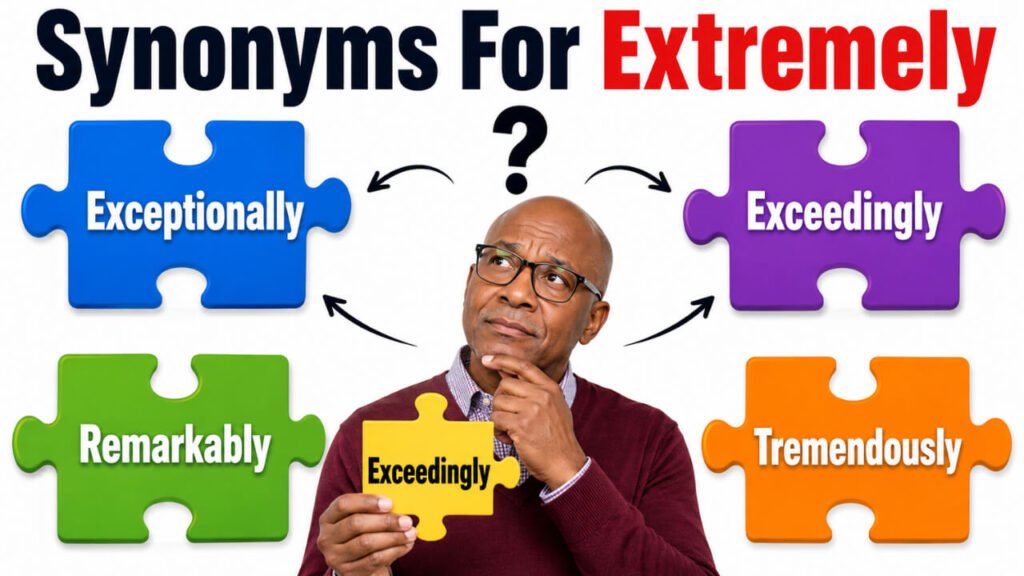
- Very: To a high degree.
- Highly: Greatly or strongly, often in formal use.
- Exceptionally: More than usual or better than normal.
- Exceedingly: Very greatly, with a formal tone.
- Immense: Very great in amount or effect.
- Immensely: To a very large degree.
- Incredibly: Surprisingly or impressively great.
- Remarkably: Noticeably and unusually.
- Profoundly: Deeply or seriously.
- Intensely: With strong force or feeling.
- Extraordinarily: Beyond ordinary level.
- Unusually: More than what is normal.
- Terribly: Very much, often in negative contexts.
- Awfully: Very much, often casual or emotional.
- Seriously: Very strongly or significantly.
- Really: Very, often in conversation.
- Truly: Genuinely and strongly.
- Greatly: To a large degree.
- Considerably: By a large amount.
- Enormously: To a very great extent.
- Tremendously: Very greatly or powerfully.
- Massively: To a huge degree.
- Vastly: By a very large amount.
- Hugely: Very greatly, often informal.
- Wildly: Extremely or intensely, often with emotion.
- Supremely: To the highest degree.
- Utterly: Completely or absolutely.
- Absolutely: Completely or strongly.
- Totally: Completely, often conversational.
- Completely: In every way or fully.
- Entirely: Fully and without exception.
- Thoroughly: Fully or in every detail.
- Fully: Completely or totally.
- Deeply: Strongly in emotion or meaning.
- Acutely: Strongly felt or clearly noticed.
- Severely: Very seriously, often negative.
- Desperately: Extremely, often with need or urgency.
- Fiercely: Strongly and intensely.
- Powerfully: With great force or effect.
- Overwhelmingly: So strongly that it feels hard to resist.
- Uncommonly: More than usual.
- Notably: In a clearly noticeable way.
- Strikingly: In a very noticeable or impressive way.
- Decidedly: Clearly and strongly.
- Especially: Particularly or very much in one case.
- Particularly: More than usual in a specific way.
- Unbelievably: So much that it is hard to believe.
- Ridiculously: Extremely, often informal or exaggerated.
- Brutally: Extremely, often harshly or directly.
- Remarkably: In a way that deserves attention.
Read Also:
Synonyms for Scared

Synonyms for Extremely by Context
When Extremely Means Very
Use these synonyms when you simply want to strengthen an adjective in a natural way.
Synonyms: Very, really, truly, highly, seriously.
Example: The answer is very helpful.
Example: The answer is highly helpful in this context.
When Extremely Means Exceptionally
Use these words when something is above average, impressive, or better than normal.
Synonyms: Exceptionally, extraordinarily, remarkably, unusually, uncommonly.
Example: She is exceptionally talented at explaining difficult ideas.
When Extremely Means Intensely
Use these choices for strong feelings, pressure, effort, focus, pain, heat, cold, or emotion.
Synonyms: Intensely, deeply, acutely, fiercely, powerfully.
Example: He was intensely aware of every sound in the room.
When Extremely Means Completely
Use these alternatives when extremely points toward totality or full degree.
Synonyms: Utterly, absolutely, completely, totally, entirely.
Example: The final answer was absolutely clear.
When Extremely Means Seriously
Use these words when the situation is important, difficult, harmful, or severe.
Synonyms: Severely, terribly, seriously, greatly, desperately.
Example: The patient was severely dehydrated.
Another Word for Extremely
The best single replacement for extremely is often very, because it is simple, natural, and works in most everyday sentences. However, the best alternative depends on context. In formal writing, highly or exceedingly may be better. For emotion, deeply or intensely may sound more exact.
Original: The test was extremely difficult.
Better Option: The test was exceedingly difficult.
Original: She was extremely happy with the result.
Better Option: She was incredibly happy with the result.
Original: The rule is extremely important.
Better Option: The rule is highly important.
Original: He was extremely moved by the letter.
Better Option: He was deeply moved by the letter.
When Not to Use “Extremely”
Do not use extremely when the sentence needs a more exact or natural word. It can sound repetitive if used too often. It can also feel too strong when the situation is mild.
Weak: The food was extremely good and the service was extremely nice.
Better: The food was excellent, and the service was very pleasant.
Weak: I am extremely okay with the plan.
Better: I am completely fine with the plan.
Weak: The number is extremely accurate.
Better: The number is precise.
Weak: She was extremely crying after the news.
Better: She was crying intensely after the news.
Use extremely before adjectives or adverbs, not before every verb. For many verbs, a stronger verb or a better adverb sounds more natural.
Words Commonly Confused With Extremely
Extremely vs Very: Very is simpler and more common. Extremely is stronger and more emphatic.
Extremely vs Highly: Highly sounds more formal and works well with words like skilled, effective, likely, respected, and important.
Extremely vs Exceptionally: Exceptionally suggests something is above normal or unusually good.
Extremely vs Intensely: Intensely is better for strong feelings, focus, pressure, pain, heat, or emotion.
Extremely vs Absolutely: Absolutely often means completely, while extremely means to a very high degree.
Extremely vs Deeply: Deeply is better for emotions, beliefs, respect, concern, and personal meaning.
Extremely vs Severely: Severely is usually negative and describes serious damage, pain, weather, punishment, or difficulty.
Which Synonym Should You Choose?
Choose very for simple everyday speech.
Choose highly when writing about ability, importance, value, respect, or professional judgment.
Choose exceptionally when something is much better than normal.
Choose exceedingly when you want a polished or formal tone.
Choose immensely when describing gratitude, pleasure, value, or large emotional effect.
Choose incredibly when the meaning feels surprising, impressive, or emotionally strong.
Choose intensely when writing about feelings, focus, pressure, heat, cold, or effort.
Choose profoundly when writing about deep emotion, serious meaning, influence, respect, or change.
Choose severely when the meaning is negative, serious, harmful, or damaging.
Choose absolutely when the sentence means completely, not just very.
Real Life Examples of “Extremely” in Sentences
Original: The weather was extremely hot yesterday.
Better Option: The weather was intensely hot yesterday.
Original: She was extremely kind to the new student.
Better Option: She was exceptionally kind to the new student.
Original: The instructions were extremely clear.
Better Option: The instructions were remarkably clear.
Original: He felt extremely sad after hearing the news.
Better Option: He felt deeply sad after hearing the news.
Original: The project is extremely important for our team.
Better Option: The project is highly important for our team.
Original: The room was extremely quiet during the exam.
Better Option: The room was unusually quiet during the exam.
Original: I am extremely grateful for your support.
Better Option: I am immensely grateful for your support.
Original: The answer was extremely wrong.
Better Option: The answer was completely wrong.
Original: She worked extremely hard on the assignment.
Better Option: She worked incredibly hard on the assignment.
Original: The problem became extremely serious.
Better Option: The problem became severely serious.
Synonym Groups and Usage Differences
Degree Group
This group includes words that simply increase the strength of an adjective or adverb.
Synonyms: Very, really, highly, greatly, considerably.
Example: The lesson was highly useful for beginners.
Excellence Group
This group works when something is better than normal or impressive.
Synonyms: Exceptionally, extraordinarily, remarkably, unusually, uncommonly.
Example: Her writing was exceptionally clear.
Emotion Group
This group is best for feelings, personal reactions, and emotional depth.
Synonyms: Deeply, profoundly, intensely, immensely, acutely.
Example: He was profoundly affected by the speech.
Complete Degree Group
This group works when the meaning is close to complete, total, or full.
Synonyms: Absolutely, totally, completely, entirely, utterly.
Example: The statement was completely false.
Serious Condition Group
This group is useful for negative, harmful, or serious situations.
Synonyms: Severely, terribly, desperately, seriously, brutally.
Example: The area was severely affected by the flood.
Antonyms of Extremely
Antonyms of extremely depend on the meaning. If extremely means very, the opposite is mild or slight. If it means completely, the opposite may be partly or barely.
Antonym: Slightly.
Short Meaning: Only a little.
Antonym: Mildly.
Short Meaning: In a gentle or not strong way.
Antonym: Somewhat.
Short Meaning: To a limited degree.
Antonym: Moderately.
Short Meaning: In a medium or balanced way.
Antonym: Barely.
Short Meaning: Almost not at all.
Antonym: Hardly.
Short Meaning: Almost not.
Antonym: Partly.
Short Meaning: Not completely.
Antonym: Minimally.
Short Meaning: To the smallest degree.
Antonym: Faintly.
Short Meaning: Weakly or not clearly.
Antonym: Inadequately.
Short Meaning: Not enough or not sufficiently.
Comparison Between Extremely and Related Words
Extremely vs Very
Extremely is stronger than very. Use very for normal emphasis and extremely when the degree is much higher.
Example With Extremely: The task was extremely difficult.
Example With Very: The task was very difficult.
Extremely vs Highly
Highly sounds more professional and is often used with qualities, opinions, skills, and importance.
Example With Extremely: She is extremely respected in her field.
Example With Highly: She is highly respected in her field.
Extremely vs Exceptionally
Exceptionally means something is not just strong but above the normal standard.
Example With Extremely: He is extremely good at solving problems.
Example With Exceptionally: He is exceptionally good at solving problems.
Extremely vs Intensely
Intensely is better for emotions, focus, pressure, heat, cold, and effort.
Example With Extremely: She was extremely focused during the exam.
Example With Intensely: She was intensely focused during the exam.
Extremely vs Absolutely
Absolutely often means completely, while extremely means to a very great degree.
Example With Extremely: The answer is extremely clear.
Example With Absolutely: The answer is absolutely clear.
Extremely vs Profoundly
Profoundly is deeper and more emotional or serious than extremely.
Example With Extremely: The loss was extremely painful.
Example With Profoundly: The loss was profoundly painful.
Common Phrases and Expressions With Extremely
Extremely Important: Very important or highly necessary.
Extremely Difficult: Very hard to do or understand.
Extremely Useful: Very helpful in a practical way.
Extremely Careful: Very cautious and attentive.
Extremely Rare: Very uncommon or hard to find.
Extremely Likely: Very probable or expected.
Extremely Dangerous: Very unsafe or risky.
Extremely Happy: Very pleased or joyful.
Extremely Sorry: Very regretful or apologetic.
Extremely Well: Very successfully or very skillfully.
Common Mistakes to Avoid
Avoid using extremely too many times in one paragraph. Repetition makes writing sound weak and less polished.
Do not use extremely before every adjective. Sometimes a stronger adjective is better.
Weak: The movie was extremely good.
Better: The movie was excellent.
Do not confuse extremely with completely. Extremely means very much, while completely means fully.
Weak: The door was extremely closed.
Better: The door was completely closed.
Do not use a formal synonym in a casual sentence when it sounds unnatural.
Weak: I am exceedingly hungry.
Better: I am really hungry.
Do not use casual intensifiers in formal writing when a precise word is better.
Weak: The findings were really important.
Better: The findings were highly important.
Always choose the synonym that matches the sentence tone, topic, and meaning.
Conclusion
The keyword synonyms for extremely includes many useful choices, but the best word depends on context. Use very for simple speech, highly for formal writing, exceptionally for above normal quality, intensely for strong feelings, profoundly for deep emotion, and severely for serious negative situations. Strong writing comes from choosing the synonym that gives the exact tone, degree, and meaning your sentence needs.
FAQs About Synonyms for Extremely
What is the best synonym for extremely?
The best synonym for extremely is very for general use. In formal writing, highly, exceedingly, or exceptionally may be better.
What is a formal synonym for extremely?
A formal synonym for extremely is highly. Other formal choices include exceedingly, exceptionally, profoundly, and considerably.
Is extremely stronger than very?
Yes, extremely is usually stronger than very. It shows a higher degree, stronger feeling, or more serious level.
Can I use extremely in academic writing?
Yes, you can use extremely in academic writing, but use it carefully. In many cases, highly, significantly, or considerably may sound more precise.
What is another word for extremely happy?
Another word for extremely happy is overjoyed. You can also say delighted, thrilled, ecstatic, or immensely happy.
What is another word for extremely important?
Another word for extremely important is crucial. You can also use essential, vital, highly important, or critically important.
What is the opposite of extremely?
The opposite of extremely can be slightly, mildly, somewhat, moderately, barely, or hardly, depending on the sentence.
