
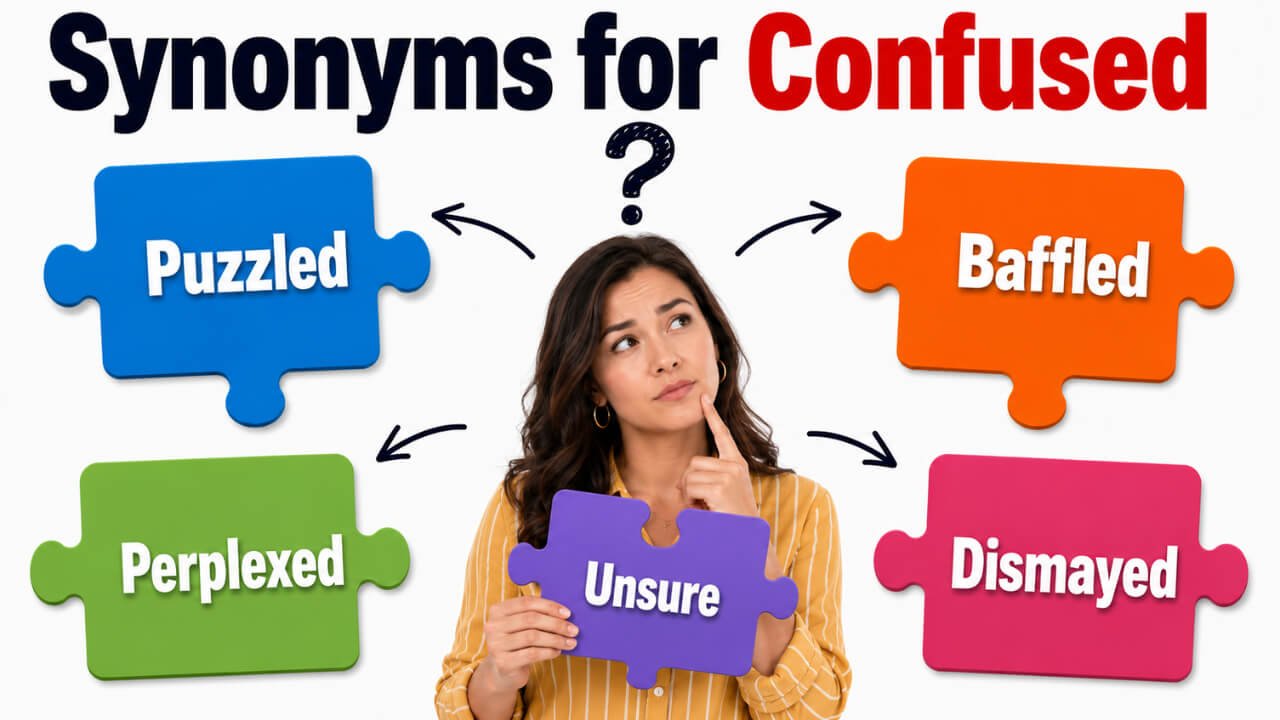
Quick Answer: Synonyms for confused include puzzled, baffled, perplexed, bewildered, uncertain, unsure, muddled, lost, flustered, and disoriented. Use puzzled for mild confusion, baffled for strong lack of understanding, perplexed for thoughtful uncertainty, bewildered for overwhelming confusion, uncertain for doubt, and disoriented when someone feels mentally or physically lost.
Pronunciation and Word Details
Word: Confused
Pronunciation: /kənˈfjuːzd/
Part of Speech: Adjective
Meaning: Unable to think clearly, understand something, or decide what is correct.
US Pronunciation:
UK Pronunciation:
What Does “Confused” Mean?
Confused means unable to understand something clearly or unable to think in an organized way. It is usually used as an adjective to describe a person, feeling, thought, situation, explanation, or expression.
A person can feel confused when information is unclear, instructions are difficult, choices are similar, or emotions are mixed. The word can describe simple uncertainty, deep mental disorder, or a temporary lack of clarity.
Example: She looked confused after reading the instructions.
Meaning, Tone, and Context of “Confused”
Confused is a neutral and common word. It works well in casual speech, school writing, workplace communication, and general explanations. It is not too formal or too emotional, which makes it useful in many situations.
The tone depends on context. In a simple sentence, it can mean unsure. In a serious sentence, it can suggest mental disorientation or emotional distress. In writing, confused can also describe unclear ideas, messy explanations, or mixed messages.
Example: The report was confusing, so the team felt confused about the next step.
When and How to Use “Confused”
For Lack of Understanding: Use confused when someone does not understand information, instructions, or meaning.
Example: I am confused about the final rule.
For Uncertainty: Use it when someone is not sure what to choose, believe, or do.
Example: He felt confused about which answer was correct.
For Mixed Emotions: Use it when feelings are unclear or difficult to explain.
Example: She was confused by her own reaction.
For Unclear Information: Use it when a message, plan, or explanation creates misunderstanding.
Example: The confused instructions made the task harder.
For Disorientation: Use it when someone feels mentally unclear or physically lost.
Example: After waking suddenly, he felt confused for a moment.
Best Synonyms for Confused
Puzzled: Unable to understand something clearly.
Example: She was puzzled by the strange answer.
Baffled: Completely unable to understand something.
Example: The difficult question baffled the students.
Perplexed: Confused because something is complicated or hard to explain.
Example: He looked perplexed by the unusual result.
Bewildered: Very confused and overwhelmed.
Example: The sudden change left everyone bewildered.
Mystified: Confused because something seems strange or mysterious.
Example: I was mystified by his silence.
Uncertain: Not sure about something.
Example: She was uncertain about the correct choice.
Unsure: Lacking confidence or certainty.
Example: He seemed unsure about the directions.
Muddled: Mixed up and unclear.
Example: His thoughts were muddled after a long day.
Lost: Unable to understand what is happening.
Example: I was lost during the explanation.
Disoriented: Confused about place, time, or situation.
Example: The traveler felt disoriented in the new city.
50 Synonyms for Confused with Short Meanings
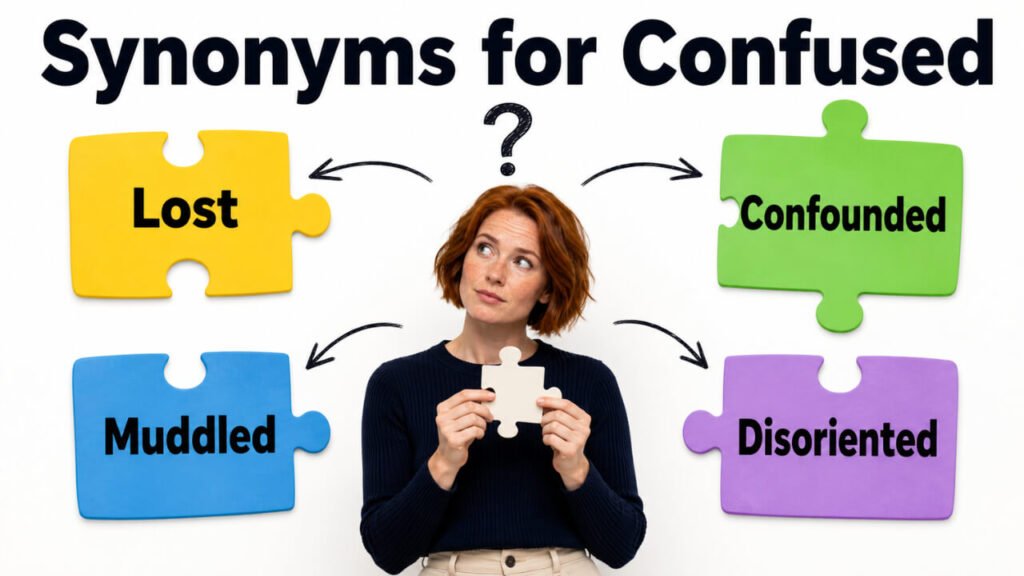
- Puzzled: Unable to understand something clearly.
- Baffled: Strongly confused by something difficult.
- Perplexed: Confused by a complex situation.
- Bewildered: Deeply confused and overwhelmed.
- Mystified: Confused by something strange or unclear.
- Bemused: Slightly confused or puzzled.
- Befuddled: Mentally confused or unclear.
- Confounded: Extremely confused or surprised.
- Nonplussed: Unsure how to react or respond.
- Stumped: Unable to find an answer.
- Disoriented: Confused about place, time, or direction.
- Muddled: Mixed up and unclear in thought.
- Mixed up: Unable to keep things clear or separate.
- Addled: Confused in the mind.
- Dazed: Unable to think clearly after shock or tiredness.
- Stupefied: Too shocked or confused to think clearly.
- Stunned: Temporarily unable to react clearly.
- Foggy: Mentally unclear or hard to understand.
- Hazy: Not clear in thought or memory.
- Unclear: Not easy to understand.
- Uncertain: Not sure about something.
- Unsure: Lacking confidence or certainty.
- Doubtful: Not fully convinced or certain.
- Hesitant: Unsure before acting or speaking.
- Indecisive: Unable to choose clearly.
- Conflicted: Having mixed thoughts or feelings.
- Ambivalent: Having opposite feelings at the same time.
- Torn: Unable to decide between choices.
- At a loss: Not knowing what to do or say.
- At sea: Completely unsure or confused.
- In doubt: Not certain about something.
- In a quandary: Confused about what decision to make.
- Lost: Unable to follow or understand.
- Thrown: Suddenly made confused or uncertain.
- Flustered: Nervous and confused under pressure.
- Rattled: Upset and unable to think clearly.
- Unsettled: Emotionally disturbed or uncertain.
- Disconcerted: Made uncomfortable and confused.
- Distracted: Unable to focus clearly.
- Scattered: Mentally unfocused or disorganized.
- Unfocused: Not thinking clearly or directly.
- Discombobulated: Informally confused and disorganized.
- Jumbled: Mixed together in a confusing way.
- Tangled: Complicated and hard to understand.
- Garbled: Confused or unclear in wording.
- Incoherent: Not expressed clearly or logically.
- Vague: Not clear or specific.
- Ambiguous: Having more than one possible meaning.
- Misled: Confused because of wrong information.
- Befogged: Mentally unclear or confused.
Read Also:
Synonyms for Demonstrate

Synonyms for Confused by Context
When Confused Means Puzzled
Use these synonyms when someone does not understand something but is trying to figure it out.
Puzzled: She was puzzled by the final clue.
Perplexed: He felt perplexed by the teacher’s question.
Bemused: The child looked bemused by the magic trick.
Stumped: I was stumped by the last problem.
When Confused Means Strongly Unable to Understand
Use these words when confusion is stronger or more intense.
Baffled: The strange result baffled the researchers.
Bewildered: The sudden announcement left us bewildered.
Confounded: He was confounded by the unexpected error.
Mystified: Everyone was mystified by the missing file.
When Confused Means Uncertain
Use these synonyms when the main meaning is doubt or lack of certainty.
Uncertain: She was uncertain about the answer.
Unsure: He was unsure which road to take.
Doubtful: They were doubtful about the plan.
Hesitant: I felt hesitant because the instructions were unclear.
When Confused Means Emotionally Mixed
Use these words when someone has unclear feelings or mixed emotions.
Conflicted: She felt conflicted about leaving.
Ambivalent: He was ambivalent about accepting the offer.
Torn: I was torn between two choices.
Unsettled: The news left her unsettled.
When Confused Means Mentally Disorganized
Use these synonyms when thoughts, words, or ideas are messy.
Muddled: His explanation sounded muddled.
Mixed up: I got mixed up with the dates.
Scattered: Her thoughts felt scattered after the meeting.
Jumbled: The notes were jumbled and hard to follow.
When Confused Means Disoriented
Use these words when someone feels unclear about place, time, or surroundings.
Disoriented: He felt disoriented after the long flight.
Dazed: She looked dazed after the loud noise.
Foggy: My mind felt foggy in the morning.
Lost: I felt lost in the unfamiliar building.
Another Word for Confused
The best single replacement for confused is often puzzled because it is natural, clear, and useful in many situations. However, the best alternative depends on context. Use baffled for stronger confusion, uncertain for doubt, muddled for unclear thinking, and disoriented for loss of direction or awareness.
Original: I was confused by the question.
Better Option: I was puzzled by the question.
Original: She felt confused about the decision.
Better Option: She felt uncertain about the decision.
Original: His thoughts were confused after the argument.
Better Option: His thoughts were muddled after the argument.
Original: The traveler was confused in the new city.
Better Option: The traveler was disoriented in the new city.
When Not to Use “Confused”
Do not use confused when a more exact word explains the situation better. If someone simply lacks confidence, unsure may be better. If someone is shocked, stunned may be more accurate. If the writing is unclear, vague, ambiguous, or garbled may fit better.
Weak: The data is confused.
Better: The data is unclear.
Weak: She was confused about choosing between two jobs.
Better: She was torn between two jobs.
Weak: His speech was confused.
Better: His speech was incoherent.
Weak: I am confused if this answer is correct.
Better: I am unsure whether this answer is correct.
Words Commonly Confused With Confused
Confused vs Confusing: Confused describes the person who does not understand. Confusing describes the thing that causes the lack of understanding.
Confused vs Puzzled: Confused is general. Puzzled suggests someone is thinking carefully about something they do not understand.
Confused vs Uncertain: Confused means unclear in understanding. Uncertain means not sure about a fact, choice, or result.
Confused vs Disoriented: Confused can be general mental uncertainty. Disoriented usually means unclear about place, time, direction, or surroundings.
Confused vs Bewildered: Confused can be mild or strong. Bewildered means strongly confused and overwhelmed.
Confused vs Muddled: Confused can describe a person or state. Muddled often describes unclear thoughts, speech, or organization.
Which Synonym Should You Choose?
Choose puzzled when someone is mildly confused and trying to understand.
Choose baffled when the confusion is strong and the answer is hard to find.
Choose perplexed for formal writing, essays, thoughtful descriptions, or complex problems.
Choose bewildered when someone is overwhelmed by too much information or sudden change.
Choose uncertain when the main idea is doubt or lack of confidence.
Choose unsure for casual speech and simple everyday situations.
Choose muddled when thoughts, memories, or explanations are mixed up.
Choose disoriented when someone is confused about time, place, direction, or surroundings.
Choose flustered when pressure, nervousness, or embarrassment causes confusion.
Choose ambiguous when a sentence, message, or instruction has more than one possible meaning.
Real Life Examples of “Confused” in Sentences
Original: I was confused by the new schedule.
Better Option: I was puzzled by the new schedule.
Original: She looked confused during the lesson.
Better Option: She looked perplexed during the lesson.
Original: The instructions made everyone confused.
Better Option: The instructions baffled everyone.
Original: He felt confused about his future.
Better Option: He felt uncertain about his future.
Original: My thoughts were confused after the long meeting.
Better Option: My thoughts were muddled after the long meeting.
Original: The tourist was confused in the busy station.
Better Option: The tourist was disoriented in the busy station.
Original: I am confused about which option is better.
Better Option: I am unsure which option is better.
Original: Her explanation was confused and hard to follow.
Better Option: Her explanation was incoherent and hard to follow.
Original: The sudden question made him confused.
Better Option: The sudden question threw him.
Original: They were confused by the mixed messages.
Better Option: They were bewildered by the mixed messages.
Synonym Groups and Usage Differences
Understanding Group
Words in this group describe not understanding something clearly. They are useful for questions, lessons, instructions, and problems.
Synonyms: Puzzled, perplexed, baffled, mystified.
Example: She was perplexed by the difficult answer.
Doubt Group
These words focus on uncertainty rather than deep confusion. Use them when someone is not sure what is true or correct.
Synonyms: Uncertain, unsure, doubtful, hesitant.
Example: He was unsure about the final choice.
Strong Confusion Group
These words show a higher level of confusion, especially when someone feels overwhelmed.
Synonyms: Bewildered, confounded, nonplussed, stupefied.
Example: The unexpected result left the team confounded.
Mixed Feelings Group
These words work best when the confusion is emotional or connected to a decision.
Synonyms: Conflicted, ambivalent, torn, unsettled.
Example: She felt torn between staying and leaving.
Mental Clarity Group
These words describe unclear thinking, messy ideas, or lack of focus.
Synonyms: Muddled, foggy, scattered, unfocused.
Example: His thoughts felt foggy after a sleepless night.
Wording and Meaning Group
These words describe unclear language, writing, or communication.
Synonyms: Vague, ambiguous, garbled, incoherent.
Example: The message was ambiguous, so people misunderstood it.
Antonyms of Confused
Clear: Easy to understand or think about.
Certain: Completely sure about something.
Sure: Confident and not doubtful.
Aware: Knowing what is happening.
Oriented: Knowing the place, time, or direction.
Focused: Thinking clearly about one thing.
Organized: Arranged in a clear and logical way.
Calm: Not upset, nervous, or mentally shaken.
Decisive: Able to make choices clearly.
Composed: Calm and in control.
Comparison: Confused vs Related Words
Confused vs Puzzled
Confused is more general and can describe unclear thinking, uncertainty, or disorder. Puzzled suggests a person is trying to solve or understand something.
Example With Confused: I was confused by the unclear directions.
Example With Puzzled: I was puzzled by the strange clue.
Confused vs Baffled
Confused can be mild or strong. Baffled means very confused and unable to find an explanation.
Example With Confused: She was confused by the new rule.
Example With Baffled: She was baffled by the impossible answer.
Confused vs Perplexed
Confused is common in everyday language. Perplexed is more formal and often used for thoughtful confusion.
Example With Confused: He felt confused about the problem.
Example With Perplexed: He felt perplexed by the complex problem.
Confused vs Uncertain
Confused means lacking clear understanding. Uncertain means lacking sure knowledge, confidence, or decision.
Example With Confused: I am confused by the explanation.
Example With Uncertain: I am uncertain about the result.
Confused vs Disoriented
Confused can refer to any unclear mental state. Disoriented usually means someone does not know where they are, what time it is, or what is happening around them.
Example With Confused: The student was confused by the topic.
Example With Disoriented: The patient felt disoriented after waking up.
Confused vs Muddled
Confused often describes a person. Muddled often describes thoughts, memories, plans, or explanations that are mixed up.
Example With Confused: She was confused after the discussion.
Example With Muddled: Her notes were muddled after the discussion.
Common Phrases and Expressions With Confused
Confused About: Unsure or unclear about a topic.
Confused By: Unable to understand because of something.
Look Confused: Appear unsure or puzzled.
Feel Confused: Experience uncertainty or lack of clarity.
Get Confused: Become unsure or mixed up.
Confused State: A condition of unclear thinking.
Confused Mind: A mind that cannot think clearly.
Confused Expression: A facial look showing uncertainty.
Confused Explanation: An unclear or poorly organized explanation.
Easily Confused: Likely to misunderstand things quickly.
Common Mistakes to Avoid
One common mistake is using confused when a more specific synonym is better. For example, use uncertain for doubt, puzzled for mild misunderstanding, baffled for strong confusion, and disoriented for loss of direction.
Another mistake is confusing confused with confusing. A person feels confused, but a difficult lesson is confusing. Also avoid repeating confused too often in the same paragraph. Use precise synonyms to make writing clearer and more natural.
Weak: I am confused because the confusing instructions confused me.
Better: I am puzzled because the unclear instructions made the task hard to follow.
Conclusion
Synonyms for confused help you describe different levels and types of uncertainty more clearly. Use puzzled for mild confusion, baffled for strong confusion, perplexed for thoughtful uncertainty, bewildered for overwhelming confusion, uncertain for doubt, and disoriented for unclear awareness of place or time. The best synonym depends on whether you are describing a person, feeling, idea, instruction, decision, or situation. Choosing the right word makes your writing more accurate, natural, and useful.
FAQs About Synonyms for Confused
What is the best synonym for confused?
The best synonym for confused is puzzled in many everyday situations. It is clear, natural, and easy to understand.
What is a stronger word for confused?
A stronger word for confused is baffled. It means someone is very confused and cannot understand something.
What is a formal synonym for confused?
A formal synonym for confused is perplexed. It works well in essays, reports, and serious writing.
What is a casual synonym for confused?
A casual synonym for confused is mixed up. It is common in everyday speech.
What is the difference between confused and confusing?
Confused describes the person who does not understand. Confusing describes the thing that causes misunderstanding.
Can confused mean uncertain?
Yes, confused can mean uncertain when someone is not sure what to think, choose, or believe.
What is the opposite of confused?
The opposite of confused can be clear, certain, sure, focused, aware, or oriented, depending on the context
