
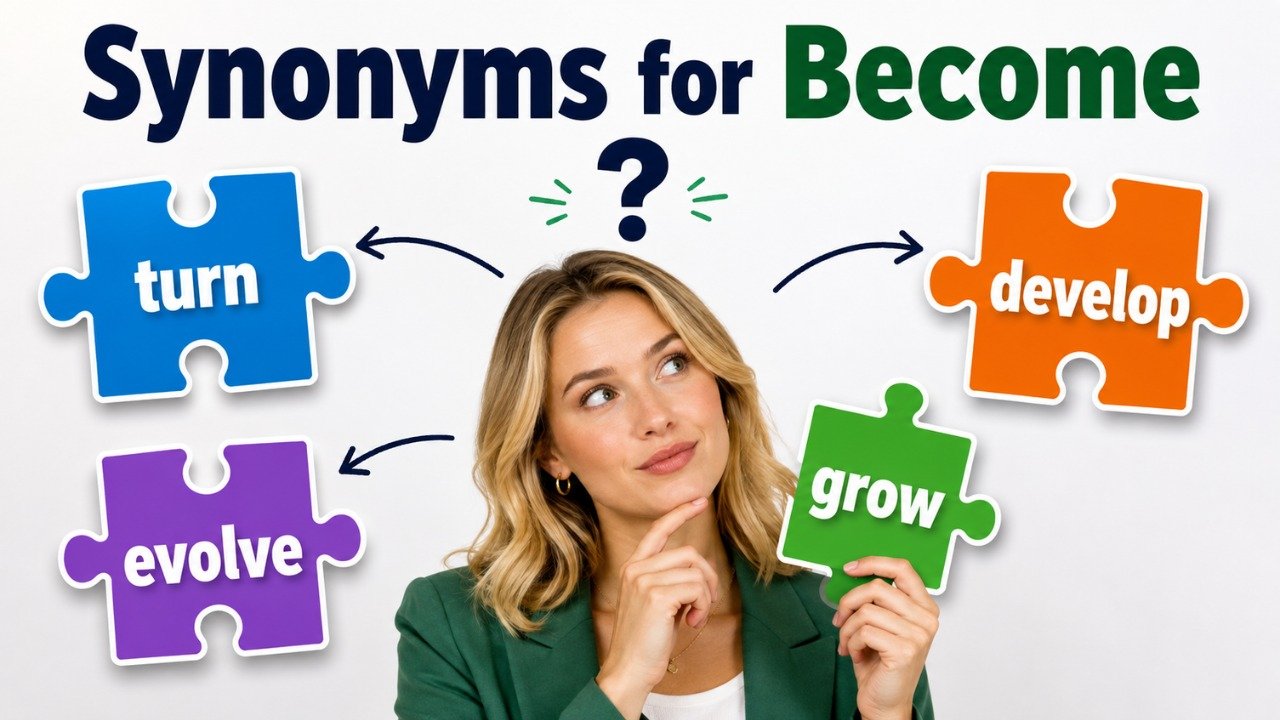
Quick Answer: The best synonyms for become include turn, grow, develop, evolve, transform, get, change, mature, emerge, and progress. Use turn for a noticeable change of condition, grow or develop for gradual change, transform for a major change, get in casual speech, and emerge when someone gains a new role, identity, or reputation. The right alternative depends on whether you are describing personal growth, a physical change, a new condition, or a professional position.
Pronunciation and Word Details
Word: Become.
Pronunciation: /bɪˈkʌm/.
Part of Speech: Verb.
Meaning: To begin to be something, develop into a new state, or gain a particular role or quality.
US Pronunciation:
UK Pronunciation:
What Does “Become” Mean?
Become means to begin to be something different from what a person, object, or situation was before. It is an irregular verb commonly used to describe a change in condition, identity, appearance, role, behavior, or quality.
Become often works as a linking verb. It connects the subject of a sentence with a noun or adjective that describes the subject’s new state.
Change of Condition: The weather became colder.
Change of Role: She became a teacher.
Change of Quality: The instructions became clearer.
Personal Development: He became more confident after gaining experience.
The present form is become, the past form is became, and the past participle is become.
Meaning, Tone, and Context of “Become”
Become has a neutral tone and can be used in formal, academic, professional, and conversational English. It does not normally sound emotional unless the sentence describes an important personal or social change.
In formal writing, become is useful for discussing development, trends, roles, conditions, and results. In casual conversation, speakers often replace it with get or turn.
Formal Context: The issue has become increasingly important.
Casual Context: It is getting late.
Academic Context: The material becomes unstable at high temperatures.
Professional Context: She became the department manager.
Emotional Context: He became deeply worried about his family.
Become can also mean that clothing, behavior, or an appearance suits someone. This meaning is less common in everyday speech.
Suitability Context: That color becomes you.
When and How to Use “Become”
Describing a Change of State
For Conditions: Use become when something enters a different physical, emotional, or general condition.
Example: The room became quiet when the speaker arrived.
Describing Gradual Development
For Growth: Use become when a quality or condition develops over time.
Example: She became more patient as she gained experience.
Describing a New Role
For Positions: Use become when someone gains a profession, title, responsibility, or social role.
Example: Daniel became the team leader.
Describing a Result
For Outcomes: Use become when a person or thing reaches a particular result.
Example: The small project became a successful business.
Describing Increased Awareness
For Understanding: Use become with words such as aware, clear, obvious, familiar, and certain.
Example: It became clear that the original plan would not work.
Describing Suitability
For Appearance: Use become when a style, color, or item of clothing suits someone.
Example: Dark blue becomes her.
Best Synonyms for Become
Turn
Synonym: To change from one state, condition, or form into another.
Example: The sky turned dark before the storm.
Grow
Synonym: To develop gradually into a different condition.
Example: He grew more confident with practice.
Develop
Synonym: To gradually gain a new quality, ability, or condition.
Example: The town developed into an important cultural center.
Evolve
Synonym: To change gradually into a more advanced or different form.
Example: The simple idea evolved into a complete plan.
Transform
Synonym: To change greatly in form, character, or appearance.
Example: The renovation transformed the old building.
Get
Synonym: To enter a new condition, especially in casual conversation.
Example: It is getting cold outside.
Change
Synonym: To become different in appearance, condition, behavior, or form.
Example: Her attitude changed after the meeting.
Mature
Synonym: To develop into a more complete, responsible, or advanced state.
Example: He matured into a thoughtful leader.
Emerge
Synonym: To become known, visible, or important.
Example: She emerged as the strongest candidate.
Progress
Synonym: To develop or advance toward a better or more complete state.
Example: The trainee progressed into a highly capable technician.
50 Synonyms for Become with Short Meanings
- Grow: To develop gradually into a new condition.
- Turn: To change from one state into another.
- Get: To enter a condition in casual speech.
- Develop: To gradually acquire a new quality or form.
- Evolve: To change gradually over time.
- Transform: To change greatly in form or character.
- Change: To become different.
- Mature: To develop into a more complete state.
- Progress: To move toward a more advanced condition.
- Convert: To change something into a different form or purpose.
- Come to Be: To begin existing in a particular state.
- Grow Into: To gradually become suitable for a role or condition.
- Turn Into: To change into a different form or state.
- Develop Into: To gradually become something more complete.
- Evolve Into: To gradually change into a different form.
- Transform Into: To change completely into something different.
- Change Into: To take a different form, state, or identity.
- Mature Into: To develop into a responsible or complete state.
- Convert Into: To change into another form, use, or system.
- Transition Into: To move from one condition or role into another.
- Shift Into: To move into a different condition, position, or mode.
- Move Into: To enter a new stage, role, or situation.
- Pass Into: To gradually enter another state or condition.
- Advance Into: To progress toward a higher role or stage.
- Progress Into: To develop into a more advanced condition.
- Emerge As: To become known or recognized in a particular role.
- Arise As: To appear or develop as something new.
- End Up As: To finally become something, often unexpectedly.
- Prove to Be: To be discovered as having a particular quality.
- Rise to Be: To advance until reaching an important position.
- Blossom Into: To develop attractively or successfully.
- Ripen Into: To develop gradually into a complete form.
- Take Shape As: To begin developing a clear form or identity.
- Establish Oneself As: To become recognized in a role or field.
- Make Oneself Into: To develop through personal effort.
- Assume: To take a role, position, or responsibility.
- Take On: To acquire a quality, appearance, duty, or role.
- Enter: To begin participating in a new state, field, or stage.
- Reach: To arrive at a particular condition or level.
- Attain: To achieve a desired state, rank, or quality.
- Acquire: To gain a quality, skill, characteristic, or status.
- Gain: To obtain a new ability, position, or quality.
- Be Appointed: To officially receive a position or responsibility.
- Be Elected: To gain a position through voting.
- Be Named: To receive an official title or role.
- Be Promoted: To advance to a higher position or rank.
- Qualify As: To gain the requirements for a role or description.
- Suit: To look appropriate or attractive on someone.
- Befit: To be suitable for a person, role, or situation.
- Flatter: To make someone appear more attractive.
Read Also:
Synonyms for Fall

Synonyms for Become by Context
When Become Means Entering a New State
Turn, get, change, shift, and transition describe movement from one condition into another.
Become: The water became cold.
Turn: The water turned cold.
Get: The water got cold.
Turn is useful for a clear change. Get sounds more conversational, while transition is more formal.
When Become Means Gradual Development
Grow, develop, evolve, mature, and progress describe a change that happens over time.
Become: She became more confident.
Grow: She grew more confident.
Develop: She developed greater confidence.
Grow is natural for personal qualities. Develop works well for abilities, habits, ideas, and systems.
When Become Means Changing Form
Transform, convert, change into, and turn into describe physical or structural change.
Become: The empty building became a community center.
Transform: The empty building was transformed into a community center.
Convert: They converted the empty building into a community center.
Transform suggests a major change. Convert often refers to a planned change in use or purpose.
When Become Means Gaining a Role
Assume, emerge as, be appointed, be elected, be named, and rise to be describe gaining a position or identity.
Become: She became the director.
Assume: She assumed the role of director.
Be Appointed: She was appointed director.
Assume is formal and emphasizes taking responsibility. Appointed shows that an authority selected the person.
When Become Means Reaching a Result
End up as, prove to be, come to be, and culminate in can describe a final state or outcome.
Become: The discussion became a serious argument.
End Up As: The discussion ended up as a serious argument.
Prove to Be: The discussion proved to be more serious than expected.
End up often suggests an unexpected result. Prove to be emphasizes what was eventually discovered.
When Become Means Looking Suitable
Suit, flatter, and befit describe something that is appropriate or attractive.
Become: That hairstyle becomes you.
Suit: That hairstyle suits you.
Flatter: That hairstyle flatters your face.
Suit is the most natural modern alternative. Flatter focuses specifically on improving appearance.
Another Word for Become
Turn is often the best simple replacement for become when describing a clear change of condition. However, the most accurate alternative depends on whether the change is gradual, dramatic, professional, physical, or emotional.
Original: The leaves became yellow in autumn.
Better Option: The leaves turned yellow in autumn.
Original: She became more confident with experience.
Better Option: She grew more confident with experience.
Original: The village became a busy town.
Better Option: The village developed into a busy town.
Original: He became the company director.
Better Option: He was appointed company director.
When Not to Use “Become”
Become is useful, but it can sound repetitive when used several times in one paragraph. A more precise verb can make the change clearer.
When Describing a Sudden Visible Change
Weak: The sky became black within minutes.
Better: The sky turned black within minutes.
Turn creates a stronger picture of the visible change.
When Describing Gradual Growth
Weak: She became better at public speaking over several years.
Better: She developed into a skilled public speaker over several years.
Develop emphasizes gradual improvement.
When Describing a Major Transformation
Weak: The renovation made the warehouse become a modern office.
Better: The renovation transformed the warehouse into a modern office.
Transform is clearer and more direct.
When Describing an Official Position
Weak: He became the chairperson after the board selected him.
Better: He was appointed chairperson by the board.
Appointed explains exactly how he received the position.
When Writing Casual Dialogue
Become may sound too formal in relaxed conversation.
Weak: It is becoming late, so we should leave.
Better: It is getting late, so we should leave.
When Using “Become Into”
Become normally takes a noun or adjective directly. It is not usually followed by into.
Weak: The child became into a confident adult.
Better: The child became a confident adult.
Better: The child grew into a confident adult.
Words Commonly Confused With Become
Become vs Became: Become is the present form and past participle. Became is the simple past form. Say “She became famous” and “She has become famous.”
Become vs Be: Be describes an existing state, while become describes movement into a new state. “He is tired” describes his condition. “He became tired” describes the change.
Become vs Get: Both can describe a change of condition. Become is neutral and suitable for formal writing, while get is more common in casual speech.
Become vs Turn: Become is broad and neutral. Turn often describes a clear, visible, or noticeable change, especially with colors, weather, and physical conditions.
Become vs Grow: Become can describe any kind of change. Grow normally suggests a gradual development in age, ability, emotion, or quality.
Become vs Develop: Become identifies the new state. Develop emphasizes the process through which that state or quality is created.
Become vs Transform: Become can describe a minor or major change. Transform usually suggests a complete, dramatic, or highly noticeable change.
Become vs Evolve: Become simply states that a change occurred. Evolve suggests a gradual process involving several stages.
Which Synonym Should You Choose?
Choose turn when describing a visible or noticeable change in color, weather, mood, or condition.
Choose grow when describing gradual changes in confidence, concern, strength, knowledge, or emotion.
Choose develop when discussing abilities, habits, ideas, systems, relationships, or personal qualities.
Choose evolve when describing a gradual change through several stages.
Choose transform when the change is dramatic, complete, or highly significant.
Choose get in casual speech when discussing feelings, weather, age, time, or everyday conditions.
Choose emerge as when someone gains recognition, importance, or a public identity.
Choose assume when someone formally takes a role, responsibility, or position.
Choose be appointed when a person receives an official position from an authority.
Choose convert when something is deliberately changed for a new use or purpose.
Choose suit or flatter when describing clothing, colors, hairstyles, or appearances.
For reports and essays, develop, evolve, transform, transition, and emerge are often more precise than become. For emails and everyday conversation, become, get, turn, and grow usually sound natural.
Real Life Examples of “Become” in Sentences
Original: The weather became colder after sunset.
Better Option: The weather turned colder after sunset.
Original: She became more confident during the course.
Better Option: She grew more confident during the course.
Original: The small club became a national organization.
Better Option: The small club developed into a national organization.
Original: The old factory became an art center.
Better Option: The old factory was converted into an art center.
Original: He became the new department head.
Better Option: He was appointed the new department head.
Original: The discussion became an argument.
Better Option: The discussion turned into an argument.
Original: The problem became more serious overnight.
Better Option: The problem grew more serious overnight.
Original: Her simple idea became a complete business plan.
Better Option: Her simple idea evolved into a complete business plan.
Original: The quiet student became a respected leader.
Better Option: The quiet student emerged as a respected leader.
Original: That shade of green becomes you.
Better Option: That shade of green suits you.
Synonym Groups and Usage Differences
Gradual Change Group
Grow, develop, evolve, mature, and progress describe changes that take place over time. They are useful for skills, personalities, ideas, organizations, and relationships.
Example: The beginner developed into an experienced designer.
Sudden or Noticeable Change Group
Turn, get, change, and shift describe changes that are noticeable or occur within a shorter period.
Example: His expression suddenly turned serious.
Major Transformation Group
Transform, convert, and change into describe important changes in appearance, structure, form, or purpose.
Example: The project transformed the neglected park into a welcoming public space.
Role and Status Group
Assume, emerge as, be appointed, be elected, be named, and be promoted describe changes in responsibility, identity, or professional position.
Example: She was promoted to regional manager.
Final Result Group
End up as, prove to be, come to be, and take shape as focus on the final condition or outcome.
Example: The temporary solution proved to be extremely effective.
Suitability Group
Suit, befit, and flatter describe whether something is appropriate or attractive for a person.
Example: The simple design suits the room perfectly.
Antonyms of Become
The opposite of become depends on whether the sentence refers to change, development, progress, or suitability.
Remain: To continue in the same condition.
Stay: To avoid changing from a particular state.
Continue: To keep existing or acting in the same way.
Persist: To remain present or continue despite difficulty.
Retain: To keep a quality, position, object, or condition.
Preserve: To maintain something in its original state.
Maintain: To keep something at the same level or condition.
Resist: To oppose or prevent change.
Revert: To return to an earlier state.
Decline: To become weaker, worse, or less successful instead of developing positively.
Mismatch: To fail to suit or complement something.
Clash: To look unsuitable when combined with something else.
Comparison of Become and Related Words
Become vs Turn
Become is a general verb for entering a new state. Turn is more vivid and often describes changes in color, weather, mood, or physical condition.
Example With Become: The leaves became brown.
Example With Turn: The leaves turned brown.
Become vs Get
Become is neutral and works in both formal and informal writing. Get is more conversational and common in everyday speech.
Example With Become: The situation became difficult.
Example With Get: The situation got difficult.
Become vs Grow
Become states that a change happened. Grow suggests that the change developed gradually.
Example With Become: She became anxious.
Example With Grow: She grew anxious as the hours passed.
Become vs Develop
Become focuses on the resulting state. Develop focuses on the process of gaining a quality, skill, or condition.
Example With Become: He became a strong writer.
Example With Develop: He developed into a strong writer through regular practice.
Become vs Transform
Become can describe an ordinary change. Transform suggests a major or complete change.
Example With Become: The room became more attractive.
Example With Transform: New lighting transformed the room.
Become vs Evolve
Become describes the result of a change. Evolve describes a gradual change through several stages.
Example With Become: The idea became a detailed proposal.
Example With Evolve: The idea evolved into a detailed proposal.
Become vs Emerge
Become can describe any new state or role. Emerge often means becoming visible, recognized, influential, or important.
Example With Become: She became a skilled researcher.
Example With Emerge: She emerged as a leading researcher in the field.
Common Phrases and Expressions With “Become”
Become Aware: To begin understanding or noticing something.
Become Clear: To begin making sense or appear certain.
Become Available: To begin being ready for use or access.
Become Involved: To begin participating in an activity or situation.
Become Familiar With: To gain knowledge or experience of something.
Become Accustomed To: To grow comfortable with a new condition or routine.
Become Known As: To gain a particular name, title, or reputation.
Become Part Of: To join a group, system, organization, or activity.
Become Interested In: To begin feeling curiosity or enthusiasm about something.
Become Increasingly: To develop a quality to a greater degree over time.
Common Mistakes to Avoid
Using Become Into
Do not normally place into directly after become. Use become followed by a noun or adjective, or replace it with turn into, grow into, or develop into.
Incorrect: She became into a confident leader.
Correct: She became a confident leader.
Correct: She developed into a confident leader.
Confusing Become and Became
Use became for a completed action in the past. Use become after has, have, or had.
Incorrect: He has became more responsible.
Correct: He has become more responsible.
Correct: He became more responsible last year.
Choosing an Unnatural Synonym
Not every synonym works in every sentence.
Unnatural: The weather evolved cold.
Natural: The weather became cold.
Natural: The weather turned cold.
Repeating Become Too Often
Using become repeatedly can make a paragraph sound dull.
Repetitive: The town became larger, became busier, and became more expensive.
Improved: The town grew larger, became busier, and gradually grew more expensive.
Using Become for an Action
Become describes a change of state. It does not replace action verbs such as create, build, start, make, or complete.
Unclear: She became a new project.
Clear: She started a new project.
Using an Adverb Instead of an Adjective
Become is often followed by an adjective that describes the subject.
Incorrect: The child became quietly.
Correct: The child became quiet.
Ignoring the Type of Change
Choose a synonym that shows whether the change was gradual, sudden, official, dramatic, or unexpected.
General: The building became a hotel.
More Precise: The building was converted into a hotel.
Conclusion
Synonyms for become include turn, grow, develop, evolve, transform, get, mature, emerge, and change. Turn works well for noticeable changes, while grow and develop describe gradual progress. Transform expresses a major change, get suits casual conversation, and emerge is useful for new roles or recognition. Choosing a precise alternative helps readers understand how the change happened, how long it took, and whether it involved a condition, quality, appearance, position, or final result.
FAQs About Synonyms for Become
What Is the Closest Synonym for Become?
Turn is one of the closest general synonyms when become means entering a different state. Grow, develop, and transform may be better in more specific contexts.
What Is a Formal Synonym for Become?
Develop, evolve, transform, transition, emerge, and assume are suitable formal alternatives. The best choice depends on the type of change.
What Is a Casual Synonym for Become?
Get is a common casual alternative. For example, “It became dark” can be changed to “It got dark.”
Can Turn Replace Become?
Turn can replace become when describing a noticeable change in condition, color, mood, or appearance. It may not work naturally for every role or profession.
Can Get Replace Become?
Get can replace become in many informal sentences, especially with adjectives such as tired, cold, angry, old, and nervous.
Is Become a Linking Verb?
Yes. Become often functions as a linking verb because it connects the subject with a noun or adjective describing its new state.
What Are the Past Forms of Become?
The simple past form is became. The past participle is become, as in “She has become more confident.”
