
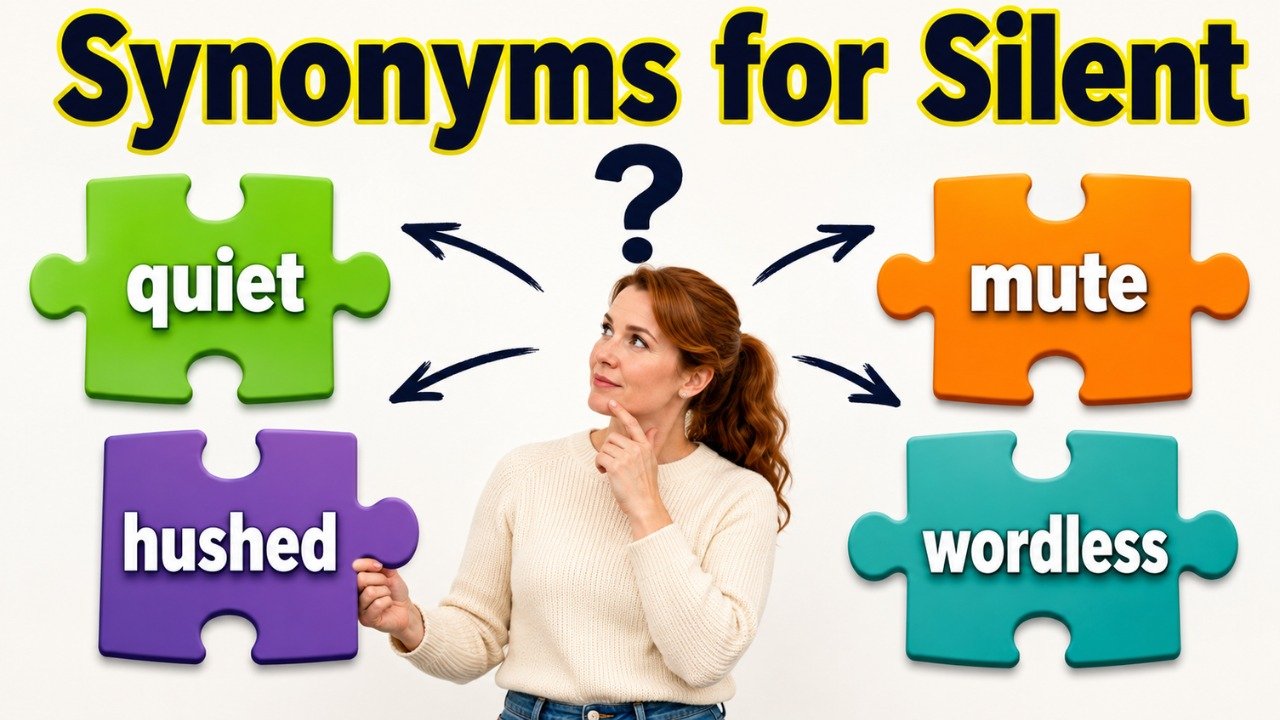
Quick Answer: Common synonyms for silent include quiet, mute, soundless, noiseless, hushed, speechless, wordless, unspoken, reticent, and tacit. Use quiet when there is little sound, soundless when there is no sound at all, and mute for a person or device that is not producing sound. Speechless describes someone unable or unwilling to speak, while reticent describes a person who avoids sharing thoughts. In formal writing, tacit and unspoken work well for ideas, agreements, or feelings that are understood but not directly expressed.
Pronunciation and Word Details
Word: Silent.
Pronunciation: /ˈsaɪlənt/
Part of Speech: Adjective.
Meaning: Making no sound, saying nothing, or remaining unexpressed or unknown.
US Pronunciation:
UK Pronunciation:
What Does “Silent” Mean?
Silent means making no sound, speaking no words, or remaining unexpressed. It is mainly used as an adjective to describe people, places, objects, actions, feelings, and information.
A silent room contains no noticeable sound. A silent person is not speaking. A silent agreement is understood without being stated directly. Silent feelings are emotions that someone experiences but does not communicate.
The word can also describe machines, devices, or systems that operate without producing noticeable noise. In another context, someone may remain silent about an issue because they do not want to reveal information or express an opinion.
The intended meaning depends on whether the sentence refers to sound, speech, secrecy, emotion, or communication.
Meaning, Tone, and Context of “Silent”
Silent is a neutral word, but its tone changes with the situation. It can sound peaceful when describing a calm landscape, serious when describing a quiet audience, or emotional when describing someone who refuses to speak.
In everyday conversation, silent often describes a complete absence of sound. Quiet is usually less absolute because a quiet place may still contain soft sounds.
In formal writing, silent can describe information, agreement, resistance, or emotional restraint. An unspoken rule may also be called a silent rule because people understand it without discussing it openly.
Silent can sometimes carry a negative tone. Remaining silent during an important discussion may suggest avoidance, secrecy, fear, or disagreement. In other situations, silence may communicate respect, reflection, sadness, or self control.
The word is common in descriptive writing, reports, stories, instructions, discussions about communication, and explanations of human behavior.
When and How to Use “Silent”
For Complete Absence of Sound: Use silent when a place, object, or person produces no noticeable noise.
Example: The library became silent after the announcement.
For Not Speaking: Use silent when someone chooses not to speak or has nothing to say.
Example: He remained silent throughout the meeting.
For Unexpressed Feelings: Use silent for emotions that are felt but not communicated openly.
Example: She carried her silent disappointment with dignity.
For Unspoken Agreement: Use silent when approval or understanding exists without direct words.
Example: Their silent agreement allowed the plan to continue.
For Secrecy: Use silent when someone refuses to reveal information.
Example: The witness stayed silent about what had happened.
For Quiet Operation: Use silent for a machine, device, or process that makes little or no noise.
Example: The new motor remained almost silent during operation.
For Reflection or Respect: Use silent when people avoid speaking during a serious or meaningful moment.
Example: The group stood silent in respectful remembrance.
For Inactive Communication: Use silent when a person, organization, or system stops responding.
Example: The office remained silent after receiving the complaint.
Best Synonyms for Silent
Quiet: Producing little or no sound.
Example: The street was quiet before sunrise.
Mute: Not speaking or not producing sound.
Example: She placed the device on mute during the discussion.
Soundless: Completely without sound.
Example: The bird made a soundless movement through the trees.
Noiseless: Making no noticeable noise.
Example: The door opened with a noiseless motion.
Hushed: Made very quiet, often because of seriousness or anticipation.
Example: The audience spoke in hushed voices before the performance.
Speechless: Unable or unwilling to speak because of emotion or surprise.
Example: The unexpected result left everyone speechless.
Unspoken: Understood, felt, or known without being expressed in words.
Example: There was an unspoken understanding between the two friends.
Reticent: Unwilling to share thoughts, feelings, or information.
Example: He remained reticent about his future plans.
Tacit: Understood or accepted without being directly stated.
Example: Their continued cooperation showed tacit approval.
Subdued: Quiet, restrained, or less intense than usual.
Example: Her voice was subdued after hearing the news.
50 Synonyms for Silent with Short Meanings
- Quiet: Making little or no sound.
- Mute: Not speaking or producing sound.
- Soundless: Completely free from sound.
- Noiseless: Making no noticeable noise.
- Hushed: Quiet because of seriousness or anticipation.
- Still: Calm and without movement or sound.
- Speechless: Unable or unwilling to speak.
- Wordless: Expressed without spoken or written words.
- Voiceless: Having no voice or spoken expression.
- Nonverbal: Communicated without spoken words.
- Unspoken: Understood but not said aloud.
- Unsaid: Not expressed in words.
- Unvoiced: Felt or considered but not spoken.
- Tacit: Understood without direct explanation.
- Inaudible: Too quiet to be heard.
- Muted: Made quieter or less noticeable.
- Subdued: Quiet, restrained, or controlled.
- Muffled: Made difficult to hear clearly.
- Soft: Low in volume or intensity.
- Faint: Barely noticeable or audible.
- Low: Quiet in volume or tone.
- Reticent: Unwilling to reveal thoughts or feelings.
- Reserved: Controlled and not openly expressive.
- Taciturn: Habitually using very few words.
- Uncommunicative: Unwilling to share information or feelings.
- Close mouthed: Unwilling to reveal private information.
- Tight lipped: Refusing to speak or disclose something.
- Mum: Remaining quiet about a matter.
- Unforthcoming: Not offering information willingly.
- Secretive: Hiding thoughts, plans, or information.
- Discreet: Careful not to reveal private information.
- Restrained: Controlled in speech, emotion, or behavior.
- Calm: Peaceful and free from disturbance.
- Tranquil: Quiet, peaceful, and undisturbed.
- Peaceful: Calm and without noise or conflict.
- Serene: Calm, still, and untroubled.
- Motionless: Remaining completely still.
- Inactive: Not currently working or operating.
- Dormant: Temporarily inactive or unnoticed.
- Stealthy: Quiet and careful to avoid attention.
- Unobtrusive: Not attracting attention or causing disturbance.
- Withdrawn: Quiet and unwilling to interact with others.
- Shy: Nervous or hesitant about speaking.
- Solemn: Serious, formal, and quietly respectful.
- Impassive: Showing no visible emotion or reaction.
- Undemonstrative: Not openly expressing emotion.
- Suppressed: Prevented from being expressed or heard.
- Concealed: Kept hidden from others.
- Hidden: Not visible, known, or revealed.
- Unexpressed: Felt or understood but not communicated.
Read Also:
Synonyms for Key
Synonyms for Silent by Context
When Silent Means Making No Sound
Quiet, soundless, noiseless, hushed, still, inaudible, muted, muffled, soft, and faint describe different levels of sound.
Soundless and noiseless suggest a complete or nearly complete absence of sound. Quiet allows for some gentle noise. Muted and muffled describe sounds that have been reduced or blocked.
Example: The soundless room made every movement feel unusually noticeable.
When Silent Means Not Speaking
Mute, speechless, wordless, voiceless, taciturn, reticent, reserved, and uncommunicative describe a lack of speech.
Speechless often results from shock or strong emotion. Taciturn describes someone who naturally speaks very little. Reticent suggests hesitation about sharing particular information.
Example: She became speechless when her name was announced.
When Silent Means Unexpressed
Unspoken, unsaid, unvoiced, tacit, unexpressed, suppressed, and concealed describe ideas or emotions that are not directly communicated.
Tacit is common in formal writing and often describes approval, permission, or agreement. Unspoken works naturally for feelings, expectations, and personal understanding.
Example: Their unspoken concern was clear from their expressions.
When Silent Means Keeping a Secret
Close mouthed, tight lipped, mum, secretive, discreet, and unforthcoming describe someone who does not reveal information.
Discreet has a positive meaning because it suggests good judgment and respect for privacy. Secretive may sound negative because it suggests intentional concealment.
Example: The employee remained discreet about the private discussion.
When Silent Means Calm or Undisturbed
Calm, tranquil, peaceful, serene, still, and subdued describe an atmosphere with little noise, movement, or emotional intensity.
Tranquil and serene often create a positive and soothing image. Subdued may suggest sadness, seriousness, or controlled emotion.
Example: The lake appeared serene in the early morning light.
Another Word for Silent
Quiet is the most flexible replacement for silent, but it is not always the most precise choice. Quiet means there is little noise, while silent often means there is no sound or speech at all.
Use soundless for complete absence of sound, reticent for someone unwilling to speak, and unspoken for thoughts or feelings that are not expressed.
Original: The classroom was silent during the test.
Better Option: The classroom was completely quiet during the test.
Original: He was silent about the disagreement.
Better Option: He was reticent about the disagreement.
Original: They shared a silent understanding.
Better Option: They shared an unspoken understanding.
Original: Her silent reaction revealed her disappointment.
Better Option: Her wordless reaction revealed her disappointment.
When Not to Use “Silent”
Do not use silent when some sound is clearly present. Quiet is more accurate when the sound level is low rather than completely absent.
Weak: Soft music played in the silent room.
Better: Soft music played in the quiet room.
Avoid calling a person silent when you mean that the person is naturally private or careful about speaking. Reserved, reticent, or taciturn may provide a clearer description.
Weak: He is a silent person who rarely discusses his feelings.
Better: He is a reserved person who rarely discusses his feelings.
Do not use silent when speechlessness is caused by surprise, fear, or emotion. Speechless usually communicates that meaning more effectively.
Weak: The unexpected announcement made her silent.
Better: The unexpected announcement left her speechless.
Avoid silent when discussing an idea or agreement that was understood but not spoken. Tacit or unspoken may sound more precise in formal writing.
Weak: The team gave silent approval to the proposal.
Better: The team gave tacit approval to the proposal.
Do not use silent repeatedly in descriptive writing. Select a synonym that communicates the exact atmosphere, sound level, or emotional state.
Weak: The silent room contained a silent audience waiting in silent anticipation.
Better: The hushed room contained a quiet audience waiting in tense anticipation.
Words Commonly Confused With Silent
Silent vs Quiet: Silent usually means no sound, while quiet means little sound. A silent room has no noticeable noise, but a quiet room may contain soft sounds.
Silent vs Mute: Silent describes a temporary or general absence of sound or speech. Mute often refers to a person, device, or control that does not produce sound.
Silent vs Speechless: Silent means not speaking, whether by choice or circumstance. Speechless usually means someone cannot speak because of surprise, fear, admiration, or another strong emotion.
Silent vs Still: Silent concerns sound, while still mainly concerns movement. A person can remain still while continuing to speak.
Silent vs Tacit: Silent describes a lack of sound or speech. Tacit describes something understood, accepted, or agreed upon without direct expression.
Silent vs Reticent: Silent means saying nothing. Reticent describes someone who is hesitant or unwilling to share specific thoughts or information.
Silent vs Inaudible: Silent means producing no sound. Inaudible means a sound exists but cannot be heard clearly.
Which Synonym Should You Choose?
Choose quiet when describing a place, person, activity, or object that produces little noise.
Choose soundless or noiseless when emphasizing a complete absence of sound.
Choose hushed when people deliberately lower their voices because of tension, respect, or anticipation.
Choose speechless when a strong emotion prevents someone from speaking.
Choose reticent when someone is hesitant to discuss personal thoughts, plans, or information.
Choose tacit for formal writing about approval, consent, understanding, or agreement that has not been directly stated.
Choose unspoken when describing feelings, expectations, rules, or understanding that people recognize without discussing.
Choose subdued when describing a quiet voice, mood, color, reaction, or atmosphere.
Choose discreet when someone remains silent to protect private or sensitive information.
Choose mute when referring to sound controls, devices, or something that has been prevented from producing sound.
Real Life Examples of “Silent” in Sentences
Original: The house was silent after everyone left.
Better Option: The house was soundless after everyone left.
Original: She remained silent when asked about the decision.
Better Option: She remained reticent when asked about the decision.
Original: The audience became silent as the speaker entered.
Better Option: The audience became hushed as the speaker entered.
Original: He gave a silent response to the surprising news.
Better Option: He gave a wordless response to the surprising news.
Original: There was a silent agreement between the two managers.
Better Option: There was a tacit agreement between the two managers.
Original: Her silent sadness was visible in her expression.
Better Option: Her unexpressed sadness was visible in her expression.
Original: The machine was silent throughout the demonstration.
Better Option: The machine was noiseless throughout the demonstration.
Original: The child stayed silent around unfamiliar guests.
Better Option: The child stayed shy and reserved around unfamiliar guests.
Original: They walked through the silent garden.
Better Option: They walked through the tranquil garden.
Original: He remained silent about the confidential matter.
Better Option: He remained discreet about the confidential matter.
Synonym Groups and Usage Differences
Sound Group
Quiet, soundless, noiseless, inaudible, muted, muffled, soft, and faint relate to the presence or level of sound.
Quiet means low noise, while soundless means no sound. Inaudible describes an existing sound that is too weak to hear. Muffled describes sound blocked by a surface or object.
Example: Her muffled voice came from behind the closed door.
Speech Group
Mute, speechless, wordless, taciturn, reticent, reserved, and uncommunicative describe people who are not speaking.
Mute describes an absence of speech or sound. Speechless usually follows strong emotion. Taciturn describes a person who regularly uses few words.
Example: The normally talkative student became speechless with surprise.
Understanding Group
Unspoken, unsaid, unvoiced, tacit, and unexpressed describe information, feelings, or ideas that have not been stated.
Tacit is especially useful for formal agreements or approval. Unspoken sounds more natural when discussing personal feelings or relationships.
Example: An unspoken understanding developed between the colleagues.
Secrecy Group
Secretive, discreet, close mouthed, tight lipped, mum, and unforthcoming relate to withholding information.
Discreet is generally positive, while secretive can imply suspicion or dishonesty. Tight lipped suggests a firm refusal to reveal details.
Example: The representative remained tight lipped about the private negotiations.
Peacefulness Group
Calm, peaceful, tranquil, serene, still, and subdued describe quiet surroundings or controlled emotional states.
Serene and tranquil create a peaceful image. Subdued may suggest sadness or seriousness rather than complete peace.
Example: The countryside appeared tranquil after the storm.
Antonyms of Silent
The opposite of silent depends on whether the word refers to sound, speech, expression, or secrecy.
Loud: Producing a strong or easily heard sound.
Noisy: Filled with unwanted or noticeable sound.
Audible: Clear enough to be heard.
Vocal: Expressing thoughts or opinions openly.
Talkative: Speaking frequently and willingly.
Outspoken: Expressing opinions directly and confidently.
Communicative: Willing to share thoughts, feelings, or information.
Expressive: Clearly showing emotions or ideas.
Revealing: Making hidden information known.
Open: Honest and willing to communicate.
Active: Operating, responding, or functioning normally.
Boisterous: Noisy, energetic, and difficult to ignore.
Comparison: Silent vs Related Words
Silent vs Quiet
Silent suggests a complete absence of sound or speech. Quiet means sound is present at a low level.
Example With Silent: The hall became silent when the ceremony began.
Example With Quiet: The hall remained quiet while guests found their seats.
Silent vs Soundless
Silent can describe sound, speech, communication, or secrecy. Soundless refers specifically to an absence of sound.
Example With Silent: She remained silent during the discussion.
Example With Soundless: The animal made a soundless movement across the floor.
Silent vs Speechless
Silent may result from choice, instruction, or circumstance. Speechless usually results from a strong emotional reaction.
Example With Silent: He stayed silent to protect the confidential information.
Example With Speechless: He was speechless after hearing the unexpected result.
Silent vs Reticent
Silent means not speaking at all. Reticent means unwilling or hesitant to discuss a particular subject.
Example With Silent: The witness remained silent in the room.
Example With Reticent: The witness was reticent about sharing personal details.
Silent vs Tacit
Silent describes a lack of sound or direct communication. Tacit refers to understanding or approval that is implied rather than stated.
Example With Silent: The committee remained silent after the proposal.
Example With Tacit: The committee’s lack of objection suggested tacit approval.
Common Phrases and Expressions With Silent
Silent Treatment: Deliberately refusing to speak to someone.
Silent Agreement: An understanding reached without spoken words.
Silent Consent: Approval suggested by a lack of objection.
Silent Prayer: A prayer expressed privately without speaking aloud.
Silent Witness: A person or object that provides indirect evidence without speaking.
Silent Partner: A business partner who invests but does not participate actively in management.
Silent Alarm: An alarm that sends a warning without creating audible noise.
Silent Mode: A setting that turns off audible alerts.
Silent Protest: A peaceful objection expressed without chanting or speaking.
Silent Letter: A written letter that is not pronounced in a word.
Common Mistakes to Avoid
One common mistake is treating silent and quiet as exact synonyms. Silent usually suggests no sound, while quiet allows a small amount of sound.
Writers also use silent for people when a more specific personality word would be clearer. Reserved, shy, reticent, and taciturn describe different reasons for speaking less.
Another mistake is using mute carelessly for a person. In many contexts, describing the specific communication situation is clearer and more respectful.
Do not confuse silent with speechless. A silent person may simply choose not to speak, while a speechless person is often unable to respond because of strong emotion.
Avoid using secretive when discreet is intended. Secretive can sound suspicious, while discreet suggests responsible protection of private information.
Repeating silent too often can weaken descriptive writing. Use soundless for complete absence of noise, hushed for lowered voices, unspoken for hidden feelings, and tacit for implied agreement.
Make sure the synonym matches the intended sense. A silent room can be soundless, but a silent agreement should be unspoken or tacit rather than noiseless.
Conclusion
The most suitable synonyms for silent depend on whether you are describing sound, speech, emotion, secrecy, or agreement. Quiet works for low noise, while soundless and noiseless emphasize complete silence. Speechless suits emotional reactions, reticent describes hesitation to speak, and tacit fits formal agreements or approval. Unspoken is effective for feelings and shared understanding, while discreet describes careful privacy. By choosing among these synonyms for silent according to context, you can make descriptions clearer, more natural, and more precise.
FAQs About Synonyms for Silent
What Is the Best Synonym for Silent?
Quiet is the most common general synonym. Soundless, mute, unspoken, or reticent may be more accurate in specific contexts.
What Word Means Completely Without Sound?
Soundless and noiseless both mean producing no noticeable sound. Soundless is often the strongest direct alternative.
Is Quiet the Same as Silent?
Not completely. Silent usually means no sound, while quiet means little sound or less noise than usual.
What Is a Formal Synonym for Silent?
Tacit is a formal choice for unspoken approval or understanding. Reticent works for someone unwilling to share information.
What Is a Synonym for Silent Feelings?
Unspoken, unexpressed, unvoiced, and suppressed can describe feelings that have not been communicated openly.
What Word Describes Someone Who Rarely Speaks?
Taciturn describes someone who naturally uses few words. Reserved and reticent may also fit, depending on the reason.
Can Silent Mean Secret?
Yes. Silent can describe someone who refuses to reveal information. Discreet, close mouthed, tight lipped, and secretive are related alternatives.
