
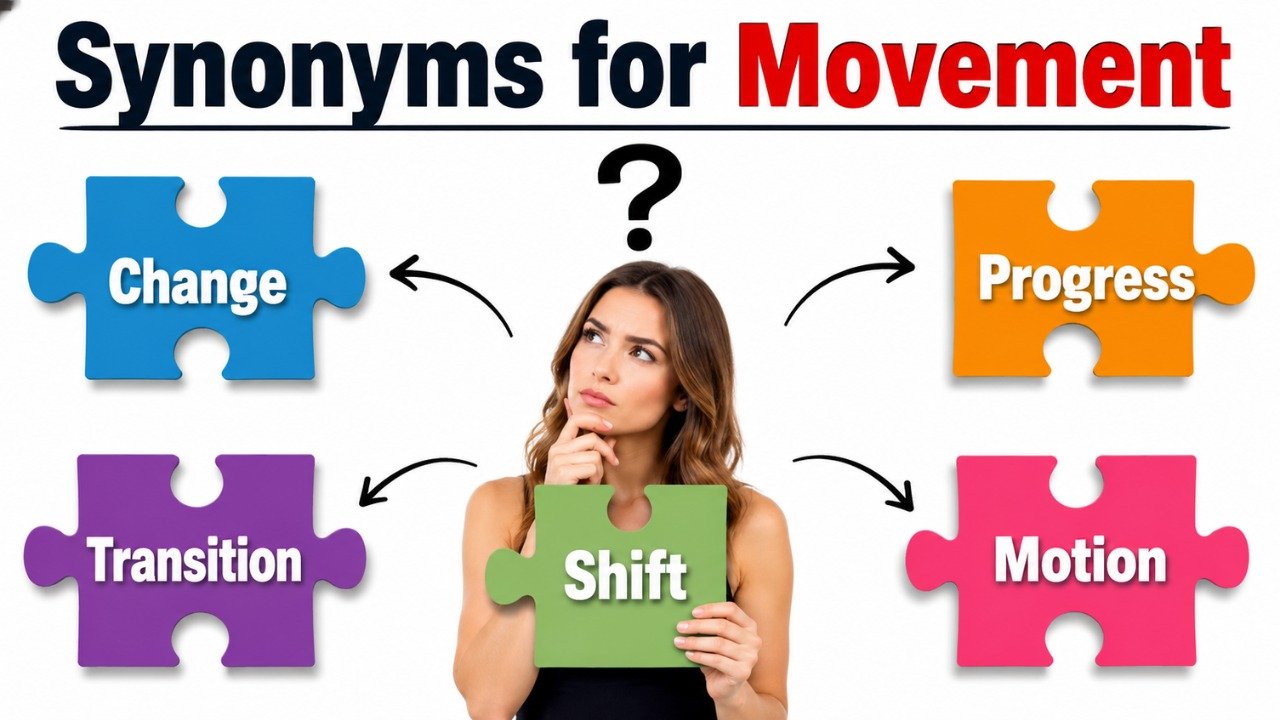
Quick Answer: Synonyms for movement include motion, activity, action, progress, change, shift, campaign, initiative, gesture, and mobility. Use motion for physical travel or a change in position, activity for something happening, and action for deliberate behavior. Progress describes forward development, while shift means a noticeable change. Campaign and initiative are suitable for organized efforts. Gesture works for a small bodily action, and mobility refers to the ability to move freely.
Pronunciation and Word Details
Word: Movement
Pronunciation: /ˈmuːvmənt/
Part of Speech: Noun
Meaning: Movement means the act of changing position, an organized effort, a developing change, or a particular artistic style.
US Pronunciation:
UK Pronunciation:
What Does “Movement” Mean?
Movement means the act, process, or result of moving from one position to another. It is a noun that can describe physical motion, bodily activity, social change, political action, artistic development, or emotional progress.
In a physical sentence, movement may refer to a person walking, a machine operating, or an object changing location. In a social context, it can describe an organized group working toward a shared goal. In music, literature, or visual art, a movement may be a major section of a composition or a recognized creative style.
The meaning depends heavily on context. A slight movement of the hand is a gesture, while a movement for reform is a campaign or cause. Movement can therefore describe both visible action and broader change.
Meaning, Tone, and Context of “Movement”
Movement is generally a neutral and flexible word. It can sound formal, academic, technical, artistic, political, or conversational depending on the sentence.
In everyday conversation, movement often refers to physical action or a change in position. In medicine and anatomy, it may describe the function of muscles, joints, or organs. In politics and sociology, it refers to organized action intended to produce social or institutional change.
In art and culture, movement describes a group of creators who share similar ideas, techniques, or values. In music, it may refer to a self contained section within a longer composition. The word can also carry a positive emotional tone when it suggests growth, progress, or improvement.
When and How to Use “Movement”
For Physical Motion: Use movement when a person, animal, object, or machine changes position.
Example: The sudden movement of the curtain caught her attention.
For Bodily Activity: Use movement when describing exercise, gestures, muscle action, or physical coordination.
Example: Gentle movement can help the body feel less stiff.
For Social Action: Use movement for an organized effort that supports a shared belief, cause, or reform.
Example: The community movement encouraged greater access to education.
For Progress: Use movement when a situation begins advancing toward a result.
Example: The discussion showed movement toward a practical agreement.
For Change: Use movement to describe a shift in opinion, policy, behavior, or direction.
Example: There has been noticeable movement in public attitudes.
For Creative Styles: Use movement for a recognized period, school, or style in art, literature, music, or architecture.
Example: The artistic movement introduced new approaches to color and form.
For Music: Use movement for one major section of a longer musical composition.
Example: The final movement created a powerful sense of resolution.
Best Synonyms for Movement
Motion: The act of changing position or location.
Example: The motion of the waves made the boat rise and fall.
Activity: Action or events occurring in a particular place.
Example: There was increased activity near the entrance.
Action: Something done intentionally or physically.
Example: Immediate action prevented the problem from becoming worse.
Progress: Forward development toward a goal.
Example: The team made steady progress throughout the month.
Shift: A noticeable change in position, opinion, or direction.
Example: The report revealed a shift in customer preferences.
Campaign: An organized series of actions supporting a goal.
Example: The awareness campaign encouraged healthier choices.
Initiative: A planned effort designed to solve a problem or create change.
Example: The new initiative supported local families.
Gesture: A movement of the body that communicates an idea or feeling.
Example: Her friendly gesture made the visitor feel welcome.
Mobility: The ability to move freely and easily.
Example: Regular exercise improved his mobility.
Development: A process of growth, change, or advancement.
Example: The development of the plan required careful research.
50 Synonyms for Movement with Short Meanings
- Motion: A change in position or location.
- Activity: Action taking place in an area.
- Action: Something done physically or intentionally.
- Mobility: The ability to move freely.
- Locomotion: Movement from one place to another.
- Travel: Movement across a distance.
- Passage: The act of moving through a place.
- Transit: Movement from one location to another.
- Progress: Forward advancement toward a goal.
- Advance: Movement toward a better or later position.
- Development: A process of growth or change.
- Change: The act of becoming different.
- Shift: A change in position, direction, or opinion.
- Transition: Movement from one condition to another.
- Transformation: A major change in form or character.
- Evolution: Gradual development over time.
- Turn: A change in direction or situation.
- Move: An action that changes position or circumstances.
- Step: A single action toward a result.
- Gesture: A bodily action expressing meaning.
- Signal: An action used to communicate information.
- Maneuver: A controlled or strategic movement.
- Operation: An organized action or process.
- Procedure: A planned series of actions.
- Process: A sequence of actions or changes.
- Flow: Smooth and continuous movement.
- Drift: Slow movement without firm control.
- Glide: Smooth and effortless movement.
- Rotation: Movement around a central point.
- Revolution: A complete turn or major social change.
- Oscillation: Repeated movement from side to side.
- Vibration: Rapid repeated movement.
- Rhythm: A regular pattern of movement or sound.
- Pace: The speed or rate of movement.
- Momentum: Continuing force or progress.
- Campaign: An organized effort toward a goal.
- Cause: A principle supported by organized action.
- Crusade: A determined campaign for change.
- Initiative: A planned action intended to improve something.
- Drive: A strong organized effort.
- Effort: An attempt to achieve a result.
- Reform: Organized change intended to improve a system.
- Uprising: Collective action against authority.
- Trend: A general direction of change.
- Current: A continuing direction of thought or activity.
- School: A group sharing an artistic style or philosophy.
- Style: A recognizable form of creative expression.
- Phase: A distinct stage in a process.
- Section: A major division of a musical work.
- Bowel Action: The process of passing waste from the body.
Read Also:
Synonyms for Divine

Synonyms for Movement by Context
When Movement Means Physical Motion
When movement refers to a person, object, animal, or machine changing position, the best synonyms include motion, locomotion, travel, transit, passage, glide, and maneuver.
Example: The motion of the train became smoother after it left the station.
Example: The dancer performed each maneuver with control.
Example: The bird’s glide across the water looked effortless.
When Movement Means Activity
Movement can describe activity occurring within a place, system, or organization. Useful alternatives include activity, action, operation, process, and procedure.
Example: Increased activity in the workshop suggested that production had begun.
Example: The operation required several trained workers.
Example: The process involved careful testing and observation.
When Movement Means Progress or Change
When movement refers to advancement or development, use progress, advance, shift, transition, development, evolution, or transformation.
Example: The negotiations showed progress after several difficult meetings.
Example: The company experienced a gradual shift in its priorities.
Example: The transition to the new system was carefully managed.
When Movement Means an Organized Cause
For a coordinated effort to achieve political, social, cultural, or environmental change, choose campaign, cause, initiative, drive, reform, crusade, or uprising.
Example: The literacy campaign provided books to rural communities.
Example: The reform improved access to essential services.
Example: The initiative encouraged greater public participation.
When Movement Means a Body Gesture
When movement refers to a small action of the hands, face, head, or body, gesture, signal, motion, or sign may be more precise.
Example: A simple gesture showed that she understood the request.
Example: He gave a signal for the group to begin.
Example: Her hand motion directed everyone toward the exit.
When Movement Means an Artistic Style
When movement describes a shared creative approach, choose school, style, trend, current, or tradition depending on the context.
Example: The new artistic school challenged traditional ideas about beauty.
Example: The style became known for its bold shapes and strong contrasts.
Example: The cultural trend influenced painting, poetry, and architecture.
When Movement Means a Musical Section
In music, movement refers to a distinct part of a larger composition. The closest alternatives are section, part, division, or passage.
Example: The second section begins with a quiet melody.
Example: The final part brings the musical themes together.
Example: The passage creates a calm mood before the conclusion.
Another Word for Movement
Another word for movement is motion when the meaning involves physical action or a change in position. However, the best alternative depends on the intended meaning. Progress works better for advancement, campaign for organized action, and shift for a change in opinion or direction.
Original: The movement of the leaves showed that the wind was growing stronger.
Better Option: The motion of the leaves showed that the wind was growing stronger.
Original: The project has shown some movement this week.
Better Option: The project has shown some progress this week.
Original: The movement encouraged changes in local policy.
Better Option: The campaign encouraged changes in local policy.
Original: Researchers noticed a movement in public opinion.
Better Option: Researchers noticed a shift in public opinion.
When Not to Use “Movement”
Avoid movement when a more precise word would make the sentence clearer. The term may sound vague if the reader cannot determine whether it refers to physical action, progress, social change, or an artistic style.
Do not use movement repeatedly in nearby sentences. Replace it with motion, action, shift, progress, or another context appropriate alternative.
Movement may also be too general in technical writing. A medical, scientific, or mechanical explanation may require a specific term such as rotation, vibration, contraction, or locomotion.
Weak: The machine made a strange movement during the test.
Better: The machine produced a sudden vibration during the test.
Weak: The proposal showed movement after the meeting.
Better: The proposal showed meaningful progress after the meeting.
Weak: She made a movement toward the door.
Better: She stepped toward the door.
Weak: The movement changed the law.
Better: The reform campaign helped change the law.
Words Commonly Confused With Movement
Movement vs Motion: Movement is a broad word that can describe physical action, social efforts, artistic styles, or progress. Motion mainly describes a change in physical position.
Movement vs Mobility: Movement is the act of moving, while mobility is the ability or freedom to move.
Movement vs Action: Movement may happen naturally or unintentionally. Action usually suggests something done deliberately.
Movement vs Activity: Movement often involves a change in position, while activity refers to things happening or being done.
Movement vs Progress: Movement can occur in any direction. Progress specifically suggests advancement toward a better condition or goal.
Movement vs Shift: Movement is broad, while shift usually describes a noticeable change in position, direction, attitude, or focus.
Movement vs Campaign: A movement is often broad and long lasting. A campaign is usually a planned effort with a specific goal and period of activity.
Movement vs Trend: A movement may involve organized beliefs and actions. A trend is a general direction in behavior, taste, or development.
Which Synonym Should You Choose?
Choose motion when describing a physical change in position.
Choose activity when describing events or actions taking place in an area.
Choose action when emphasizing deliberate behavior or a practical response.
Choose mobility when discussing someone’s ability to move freely.
Choose progress when describing advancement toward a goal.
Choose shift when referring to a change in direction, opinion, attitude, or focus.
Choose transition when describing a gradual change from one state to another.
Choose campaign when referring to an organized effort with a clear objective.
Choose initiative when describing a planned project intended to create improvement.
Choose gesture when referring to a meaningful movement of the body.
Choose trend when discussing a developing pattern in culture, business, or behavior.
Choose style or school when describing a shared form of artistic expression.
Choose section when movement refers to part of a musical composition.
Choose rotation, vibration, or oscillation in scientific and technical explanations.
Real Life Examples of “Movement” in Sentences
Original: The movement of the clouds suggested that a storm was approaching.
Better Option: The motion of the clouds suggested that a storm was approaching.
Original: The project finally showed movement after several delays.
Better Option: The project finally showed progress after several delays.
Original: Her movement toward the window was slow and careful.
Better Option: Her step toward the window was slow and careful.
Original: The movement worked to protect local wildlife.
Better Option: The campaign worked to protect local wildlife.
Original: The doctor examined the movement of his shoulder.
Better Option: The doctor examined the mobility of his shoulder.
Original: A slight movement of her hand caught his attention.
Better Option: A slight gesture of her hand caught his attention.
Original: The report identified movement in public opinion.
Better Option: The report identified a shift in public opinion.
Original: This movement influenced painters and writers.
Better Option: This artistic school influenced painters and writers.
Original: The first movement begins with a quiet melody.
Better Option: The first section begins with a quiet melody.
Original: The movement of water through the pipe was steady.
Better Option: The flow of water through the pipe was steady.
Synonym Groups and Usage Differences
Physical Motion Group
Motion, locomotion, travel, transit, glide, and maneuver describe physical movement. Motion is the broadest choice, while locomotion specifically means moving from one place to another. Glide suggests smooth movement, and maneuver implies control or planning.
Example: The smooth motion of the platform prevented sudden shaking.
Progress and Change Group
Progress, development, advance, transition, evolution, transformation, and shift describe changes over time. Progress and advance suggest improvement. Transition means moving between stages, while transformation indicates a major change.
Example: The gradual transition allowed everyone to adjust to the new routine.
Social Action Group
Campaign, cause, initiative, drive, reform, crusade, and uprising relate to collective efforts. Campaign and initiative usually have specific goals. Cause refers to an idea people support, while reform describes improvement to an existing system.
Example: The community initiative created safer public spaces.
Gesture and Communication Group
Gesture, signal, motion, and sign describe movements that communicate meaning. Gesture often expresses emotion or intention, while signal gives practical information or instructions.
Example: Her welcoming gesture helped the guests feel comfortable.
Artistic Style Group
School, style, current, trend, and tradition describe creative approaches. School often refers to artists sharing methods or beliefs. Style describes recognizable features, while trend suggests a popular direction that may change over time.
Example: The artistic style became known for natural forms and soft colors.
Technical Motion Group
Rotation, oscillation, vibration, flow, and drift describe particular kinds of motion. Rotation occurs around a point, oscillation moves repeatedly between positions, and vibration is rapid repeated motion.
Example: The vibration of the engine became stronger at higher speeds.
Antonyms of Movement
The opposite of movement depends on whether the word means physical motion, progress, activity, or change.
Stillness: A complete lack of physical movement.
Rest: A state in which activity stops.
Inactivity: The absence of action or operation.
Immobility: The inability to move.
Stability: A condition that remains steady and unchanged.
Stagnation: A lack of growth, progress, or development.
Standstill: A complete stop in activity or movement.
Pause: A temporary break in action.
Delay: A period in which progress is slowed or prevented.
Resistance: Opposition to change or advancement.
Decline: Movement toward a worse or lower condition.
Regression: A return to an earlier or less developed state.
Comparison: Movement vs Related Words
Movement vs Motion
Movement is broader than motion. It can describe physical action, social change, artistic styles, or progress. Motion mainly refers to a physical change in position.
Example With Movement: The movement encouraged people to support educational reform.
Example With Motion: The motion of the wheel powered the machine.
Movement vs Activity
Movement often involves changing position. Activity means that actions or events are occurring, even when nothing physically changes location.
Example With Movement: The camera detected movement near the gate.
Example With Activity: The camera recorded unusual activity near the gate.
Movement vs Progress
Movement may refer to any change, while progress suggests positive advancement toward a desired result.
Example With Movement: There has been some movement in the negotiations.
Example With Progress: There has been significant progress in the negotiations.
Movement vs Mobility
Movement is the act of moving. Mobility is the ability to move freely or easily.
Example With Movement: The movement of her arm caused mild discomfort.
Example With Mobility: The treatment improved the mobility of her arm.
Movement vs Shift
Movement is a general term for change. Shift is more precise when describing a change in direction, opinion, attention, or position.
Example With Movement: The survey showed movement in public attitudes.
Example With Shift: The survey showed a clear shift in public attitudes.
Movement vs Campaign
A movement is often a broad and continuing effort based on shared beliefs. A campaign is usually organized around a specific objective.
Example With Movement: The movement promoted equal access to education.
Example With Campaign: The campaign raised funds for new classrooms.
Movement vs Gesture
Movement can refer to any physical action. Gesture describes a bodily movement that communicates a feeling, idea, or intention.
Example With Movement: A sudden movement startled the animal.
Example With Gesture: A friendly gesture reassured the nervous child.
Common Phrases and Expressions With “Movement”
Freedom of Movement: The ability or right to travel and move without unnecessary restriction.
Range of Movement: The full amount a joint or body part can move.
Sudden Movement: A quick and unexpected physical action.
Forward Movement: Progress toward a goal or destination.
Political Movement: An organized effort seeking political or institutional change.
Social Movement: Collective action intended to change society or public behavior.
Art Movement: A group of artists connected by similar creative ideas or techniques.
Labor Movement: Organized action intended to improve conditions and rights for workers.
Bodily Movement: Any action or change in the position of the body.
Movement of People: The travel or migration of individuals between places.
Common Mistakes to Avoid
One common mistake is using movement when a more specific word is needed. In technical or descriptive writing, motion, rotation, vibration, gesture, progress, or shift may communicate the exact meaning more clearly.
Another mistake is treating all synonyms as interchangeable. A campaign is not the same as a physical motion, and mobility does not mean the same thing as action. Always identify the intended meaning before replacing the word.
Avoid repeating movement several times in one paragraph. Natural variation improves readability, but the replacement must fit the context.
Writers should also avoid vague expressions such as “there was movement” without explaining what changed. State whether there was progress, activity, physical motion, or a shift in opinion.
Be careful when using movement in medical contexts. The phrase bowel movement has a specific meaning and should not be replaced with general terms such as motion or activity.
Conclusion
Synonyms for movement vary according to whether the word describes physical motion, bodily action, progress, change, artistic style, or an organized cause. Motion is the best general alternative for physical movement, while progress suits advancement and shift suits a change in direction or opinion. Campaign and initiative describe organized efforts, gesture describes meaningful body language, and mobility refers to the ability to move. Choosing a context specific synonym makes writing clearer, more natural, and more precise.
FAQs About Synonyms for Movement
What Is the Best Synonym for Movement?
Motion is the best general synonym when movement refers to a physical change in position. Other meanings may require progress, shift, campaign, gesture, or mobility.
What Is Another Word for Physical Movement?
Useful alternatives include motion, locomotion, action, travel, transit, glide, and maneuver.
What Is a Synonym for Movement Toward a Goal?
Progress, advance, development, momentum, and forward movement can describe advancement toward a goal.
What Is Another Word for a Social Movement?
Campaign, cause, initiative, drive, reform effort, and organized action may be suitable depending on the purpose and scale.
Is Mobility a Synonym for Movement?
Mobility is related to movement, but it specifically means the ability or freedom to move rather than the action itself.
What Is a Synonym for a Small Body Movement?
Gesture, motion, sign, signal, twitch, or action may fit depending on the type and purpose of the movement.
What Is the Opposite of Movement?
Stillness is the most direct opposite of physical movement. Inactivity, immobility, stagnation, standstill, and rest are other useful antonyms.
