
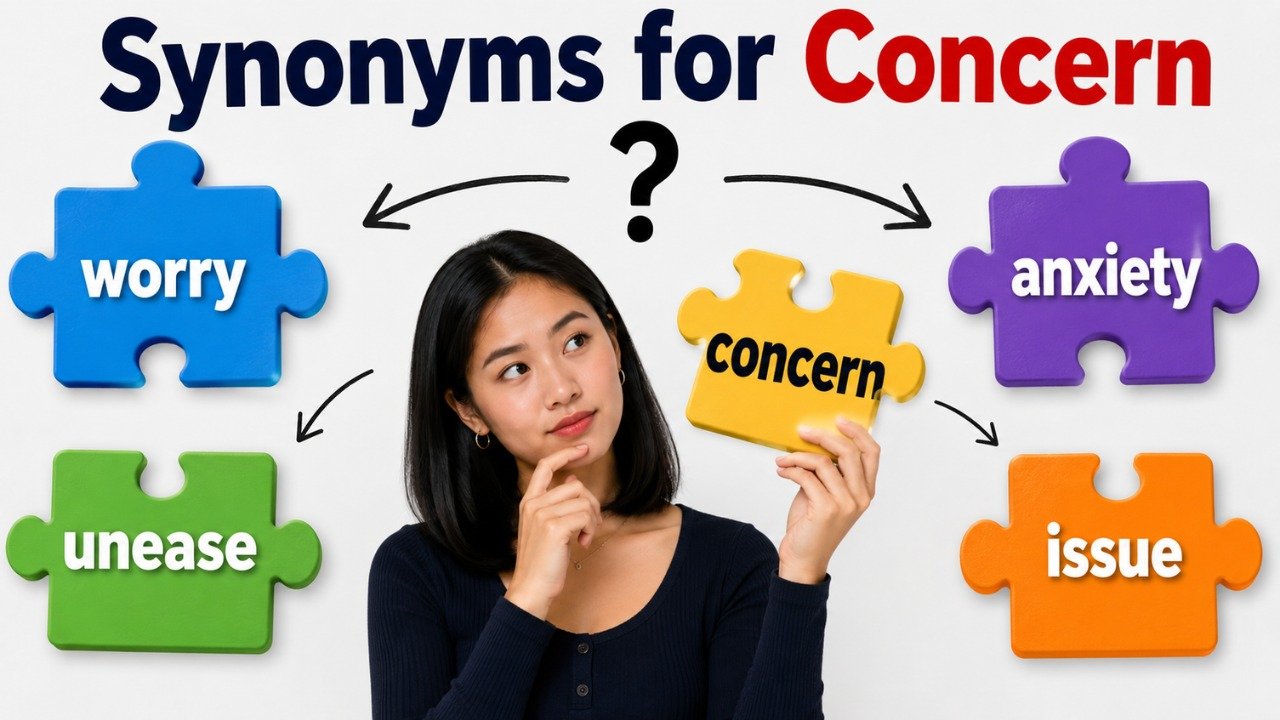
Quick Answer: The best synonyms for concern include worry, anxiety, care, interest, issue, matter, apprehension, attention, problem, and regard. Use worry or anxiety for emotional unease. Choose issue, matter, or problem when discussing something that needs attention. Care and regard work well when concern means thoughtful interest in someone. Attention is suitable when something deserves focus, while apprehension expresses nervousness about a possible future event.
Pronunciation and Word Details
Word: Concern
Pronunciation: /kənˈsɜːrn/
Part of Speech: Noun and verb
Meaning: Concern means a feeling of worry, an important matter, or an interest in someone or something.
US Pronunciation:
UK Pronunciation:
What Does “Concern” Mean?
Concern means worry, care, interest, or an important matter that requires attention. It can function as both a noun and a verb.
As a noun, concern may describe an uncomfortable feeling about a possible problem.
Example: Her main concern was the safety of the children.
It can also refer to a subject, issue, or responsibility.
Example: Protecting customer information is a serious concern.
Concern may also express thoughtful care for another person.
Example: He showed genuine concern for his injured neighbor.
As a verb, concern can mean to worry someone, involve someone, or relate to a particular subject.
Example: The sudden change concerned everyone in the group.
Example: These rules concern all new members.
The correct meaning depends on the sentence. In emotional contexts, concern usually means worry. In professional or academic writing, it often means an issue, matter, relevance, or area of responsibility.
Meaning, Tone, and Context of “Concern”
Concern usually has a neutral or serious tone. Its emotional strength depends on how it is used.
When concern means worry, it sounds calmer and more controlled than fear, panic, or distress. A person may express concern without feeling extreme anxiety.
Example: The teacher expressed concern about the student’s progress.
In formal writing, concern often refers to an issue, topic, responsibility, or area that requires attention.
Example: Data accuracy is a major concern in the report.
Concern can also sound caring and compassionate when it describes interest in another person’s health, safety, or happiness.
Example: Her concern for the elderly residents was sincere.
In conversation, concern is commonly used to discuss worries politely.
Example: I understand your concern, and I will look into the matter.
In technical or academic contexts, concern may describe relevance or connection.
Example: This chapter concerns the development of language.
The word is flexible, but writers should choose a more specific synonym when they need to show whether the meaning is worry, care, importance, relevance, or a practical problem.
When and How to Use “Concern”
For Worry
Use concern when describing a controlled feeling of unease about a person, event, or possible problem.
Example: There is growing concern about the lack of rainfall.
For Care
Use concern when showing thoughtful interest in someone’s health, comfort, or safety.
Example: The nurse treated every patient with concern and respect.
For an Important Issue
Use concern when referring to a matter that requires attention or action.
Example: Rising costs are a serious concern for many families.
For Personal Interest
Use concern when discussing something that matters to a person or group.
Example: Education has always been one of her main concerns.
For Relevance
Use concern as a verb when something relates to a person, subject, or situation.
Example: The final section concerns workplace communication.
For Involvement
Use concern when a matter includes or affects particular people.
Example: The new instructions concern all staff members.
For Polite Disagreement
Use concern to raise a problem without sounding aggressive.
Example: My concern is that the plan does not include enough time for testing.
For Serious Attention
Use concern when emphasizing that something deserves careful thought.
Example: Public safety should be our greatest concern.
Best Synonyms for Concern
Worry
Synonym: Worry means an uneasy feeling about a possible difficulty.
Example: Her worry increased when the storm became stronger.
Anxiety
Synonym: Anxiety means strong nervousness or uncertainty about what may happen.
Example: He experienced anxiety before receiving the results.
Care
Synonym: Care means thoughtful attention to someone’s needs or well being.
Example: She showed great care for the injured animal.
Interest
Synonym: Interest means attention, curiosity, or personal involvement in something.
Example: His interest in environmental protection began at school.
Issue
Synonym: Issue means an important subject or problem that requires discussion.
Example: Transportation remains an important issue for local residents.
Matter
Synonym: Matter means a subject, situation, or problem being considered.
Example: The financial matter will be discussed tomorrow.
Apprehension
Synonym: Apprehension means nervousness about something that may happen.
Example: She felt apprehension before entering the unfamiliar building.
Attention
Synonym: Attention means careful thought or focus given to something.
Example: This safety problem requires immediate attention.
Problem
Synonym: Problem means a difficult situation that needs a solution.
Example: Limited storage space is a common problem in small homes.
Regard
Synonym: Regard means care, respect, or consideration for someone or something.
Example: The manager showed little regard for the workers’ concerns.
50 Synonyms for Concern with Short Meanings
- Worry: Uneasiness about a possible problem.
- Anxiety: Strong nervousness about an uncertain situation.
- Unease: A mild feeling of discomfort or worry.
- Apprehension: Nervous expectation about something unpleasant.
- Fear: An emotional response to danger or threat.
- Distress: Strong emotional pain or worry.
- Disquiet: A feeling of anxiety or disturbance.
- Alarm: Sudden concern caused by possible danger.
- Nervousness: Uneasy excitement or worry.
- Trepidation: Fear or hesitation about a future event.
- Misgiving: A doubtful feeling about a decision or situation.
- Reservation: A concern or doubt that prevents full agreement.
- Doubt: Uncertainty about truth, success, or safety.
- Uncertainty: A lack of confidence about what will happen.
- Care: Thoughtful attention to someone’s needs.
- Interest: Attention or involvement in a subject.
- Regard: Respectful care or consideration.
- Attention: Careful focus given to something.
- Consideration: Careful thought about a person or matter.
- Sympathy: Understanding and care for another person’s difficulty.
- Compassion: Deep concern for someone who is suffering.
- Solicitude: Attentive care for another person’s welfare.
- Priority: Something considered especially important.
- Matter: A subject or situation being discussed.
- Issue: An important topic or difficulty.
- Problem: A situation that requires a solution.
- Question: A matter that needs thought or discussion.
- Subject: A topic being studied or discussed.
- Topic: A particular area of conversation or writing.
- Affair: A matter or situation involving particular people.
- Responsibility: A duty or matter someone must manage.
- Duty: An action or obligation that must be completed.
- Preoccupation: A matter that occupies someone’s thoughts.
- Relevance: A direct connection to the subject being considered.
- Importance: The quality of deserving attention.
- Connection: A relationship between people, ideas, or events.
- Relation: The way one thing is connected to another.
- Bearing: Relevance or influence on a particular matter.
- Impact: A strong effect on someone or something.
- Trouble: Difficulty, distress, or worry.
- Bother: A cause of worry, inconvenience, or annoyance.
- Disturb: To make someone worried or uncomfortable.
- Unsettle: To cause nervousness or uncertainty.
- Agitate: To make someone emotionally disturbed.
- Affect: To produce a change in someone or something.
- Involve: To include someone or something in a situation.
- Relate to: To have a connection with a subject.
- Pertain to: To be directly connected to something.
- Apply to: To be relevant to a person or situation.
- Deal with: To concern, discuss, or manage a subject.
Read Also:
Synonyms for as a Result

Synonyms for Concern by Context
When Concern Means Worry
Concern often describes a feeling that something may be wrong or could become difficult.
Useful alternatives include worry, anxiety, unease, apprehension, misgiving, distress, and disquiet.
Example With Concern: She expressed concern about the delayed medical results.
Example With Worry: She expressed worry about the delayed medical results.
Example With Apprehension: She felt apprehension while waiting for the medical results.
Worry is the most natural general replacement. Anxiety is stronger and may suggest continuing nervousness. Apprehension usually refers to fear about a future event.
When Concern Means an Important Issue
Concern may refer to a problem, matter, or subject that requires attention.
Useful alternatives include issue, matter, problem, question, subject, topic, and priority.
Example With Concern: Road safety is a major concern for residents.
Example With Issue: Road safety is a major issue for residents.
Example With Priority: Road safety is a major priority for residents.
Issue is useful when the subject needs discussion. Problem suggests that something is already wrong. Priority emphasizes that action should be taken first.
When Concern Means Care
Concern can express kindness, sympathy, or thoughtful attention toward another person.
Useful alternatives include care, compassion, sympathy, regard, consideration, and solicitude.
Example With Concern: He showed sincere concern for the struggling family.
Example With Compassion: He showed sincere compassion for the struggling family.
Example With Care: He showed sincere care for the struggling family.
Care is the clearest everyday alternative. Compassion is stronger and often relates to suffering. Regard can suggest respect as well as care.
When Concern Means Interest
Concern may refer to a subject that matters personally or professionally.
Useful alternatives include interest, attention, involvement, responsibility, and preoccupation.
Example With Concern: Local history is one of her main concerns.
Example With Interest: Local history is one of her main interests.
Example With Preoccupation: Local history has become her main preoccupation.
Interest sounds positive and curious. Preoccupation suggests that the subject takes up a large amount of someone’s attention.
When Concern Means Relevance
As a verb, concern can mean relate to, pertain to, apply to, involve, or deal with.
Example With Concern: The final rule concerns new applicants.
Example With Apply To: The final rule applies to new applicants.
Example With Pertain To: The final rule pertains to new applicants.
Apply to is natural when discussing rules and requirements. Pertain to sounds more formal. Relate to works well in both conversation and general writing.
When Concern Means Affect
Concern may describe something that influences or includes a person.
Useful alternatives include affect, involve, impact, trouble, disturb, and unsettle.
Example With Concern: The unexpected decision concerned the entire team.
Example With Unsettle: The unexpected decision unsettled the entire team.
Example With Affect: The unexpected decision affected the entire team.
Unsettle emphasizes emotional discomfort. Affect focuses on the result or influence of the decision.
Another Word for Concern
The best general replacement for concern is worry when the word describes emotional unease. However, the most accurate alternative depends on the intended meaning.
Use issue when concern refers to a subject that needs attention. Use care when it expresses kindness. Use interest when it describes personal involvement. Use relate to when concern functions as a verb meaning to have a connection with something.
Original: Her greatest concern was her daughter’s safety.
Better Option: Her greatest worry was her daughter’s safety.
Original: Cost remains an important concern.
Better Option: Cost remains an important issue.
Original: He showed concern for the injured player.
Better Option: He showed care for the injured player.
Original: This section concerns workplace safety.
Better Option: This section relates to workplace safety.
When Not to Use “Concern”
Avoid concern when a more specific word would make the sentence clearer.
When the Emotion Is Extreme
Concern may sound too mild when someone is experiencing severe fear or emotional pain.
Weak: She felt concern during the dangerous emergency.
Better: She felt intense fear during the dangerous emergency.
When Referring to a Clear Problem
Concern can sound vague when the sentence describes an existing difficulty.
Weak: The broken heating system is a concern.
Better: The broken heating system is a serious problem.
When Discussing a Formal Topic
Use issue, matter, question, or subject when the focus is discussion rather than emotion.
Weak: The report examines several concerns related to housing.
Better: The report examines several issues related to housing.
When Showing Deep Sympathy
Concern may not fully express emotional care for someone who is suffering.
Weak: She felt concern for the families who lost their homes.
Better: She felt compassion for the families who lost their homes.
When Explaining Relevance
Concern can create an unnecessarily formal sentence when relate to or apply to would be clearer.
Weak: These instructions concern every visitor.
Better: These instructions apply to every visitor.
When the Word Becomes Repetitive
Repeated use of concern can make a paragraph sound dull or imprecise.
Weak: The main concern is cost, while another concern is safety, and the final concern is time.
Better: The main issue is cost, while another priority is safety, and the final consideration is time.
Words Commonly Confused With Concern
Concern vs Worry: Concern can mean worry, but it may also mean care, interest, relevance, or an important issue. Worry usually refers only to emotional unease.
Concern vs Anxiety: Concern is often mild and controlled. Anxiety usually describes stronger or more persistent nervousness.
Concern vs Issue: Concern may describe a feeling or a subject. Issue usually refers to a matter that needs discussion or action.
Concern vs Problem: A concern may be a possible difficulty. A problem is usually an existing difficulty that requires a solution.
Concern vs Care: Concern can express emotional worry or thoughtful care. Care focuses more directly on attention, kindness, and protection.
Concern vs Interest: Concern may involve serious attention or responsibility. Interest often suggests curiosity, enjoyment, or personal involvement.
Concern vs Matter: Concern may carry emotional meaning. Matter is more neutral and refers to a subject, situation, or question.
Concern vs Relevance: Concern can mean a subject or connection. Relevance specifically describes how closely something relates to the topic.
Which Synonym Should You Choose?
Choose worry when discussing everyday emotional unease.
Choose anxiety when describing stronger nervousness or continuing uncertainty.
Choose apprehension when someone feels nervous about a future event.
Choose issue when discussing a subject that needs attention or debate.
Choose problem when something is already causing difficulty and needs a solution.
Choose matter when referring neutrally to a situation or subject.
Choose care when showing thoughtful attention to someone’s needs.
Choose compassion when describing deep sympathy for someone who is suffering.
Choose interest when discussing curiosity or personal involvement.
Choose regard when emphasizing respect and consideration.
Choose priority when the matter should receive attention before other tasks.
Choose relevance when explaining a connection to a particular subject.
Choose pertain to in formal, academic, legal, or technical writing.
Choose apply to when discussing rules, instructions, requirements, or conditions.
Choose affect when something influences a person, result, or situation.
Choose involve when a situation includes particular people, actions, or responsibilities.
Real Life Examples of “Concern” in Sentences
Original: The doctor expressed concern about the patient’s recovery.
Better Option: The doctor expressed worry about the patient’s recovery.
Original: Noise is a growing concern in the neighborhood.
Better Option: Noise is a growing issue in the neighborhood.
Original: She showed concern for her elderly neighbor.
Better Option: She showed care for her elderly neighbor.
Original: This rule concerns all new members.
Better Option: This rule applies to all new members.
Original: His sudden silence concerned his family.
Better Option: His sudden silence worried his family.
Original: The main concern is the rising cost of materials.
Better Option: The main problem is the rising cost of materials.
Original: Environmental protection is one of her greatest concerns.
Better Option: Environmental protection is one of her greatest interests.
Original: The report concerns changes in public behavior.
Better Option: The report deals with changes in public behavior.
Original: We understand your concern about the delay.
Better Option: We understand your anxiety about the delay.
Original: Safety should be everyone’s first concern.
Better Option: Safety should be everyone’s first priority.
Synonym Groups and Usage Differences
Worry Group
This group includes worry, anxiety, unease, apprehension, misgiving, disquiet, and trepidation. These words describe different levels of nervousness.
Worry is general. Anxiety is stronger. Unease is mild. Apprehension and trepidation usually relate to something expected in the future.
Example: He felt apprehension before giving the speech.
Care Group
This group includes care, compassion, sympathy, regard, consideration, and solicitude. These words describe thoughtful attention toward another person.
Care is broad and natural. Compassion is deep and emotional. Sympathy expresses understanding. Solicitude is formal and emphasizes attentive care.
Example: Her compassion comforted the grieving family.
Issue Group
This group includes issue, matter, problem, question, topic, subject, and affair. These alternatives refer to something that requires discussion, thought, or action.
Issue and matter are neutral. Problem suggests difficulty. Topic and subject are useful for areas of discussion or study.
Example: The meeting focused on the issue of public safety.
Importance Group
This group includes priority, importance, attention, responsibility, and duty. These words describe matters that deserve focus or action.
Priority emphasizes order. Responsibility and duty suggest obligation. Attention focuses on careful thought.
Example: Improving safety remains our highest priority.
Relevance Group
This group includes relevance, connection, relation, bearing, relate to, pertain to, and apply to. These alternatives explain how one thing connects with another.
Relate to is common and flexible. Pertain to is formal. Apply to is ideal for rules or conditions. Bearing describes influence or relevance.
Example: The evidence has no bearing on the final decision.
Effect Group
This group includes affect, impact, involve, disturb, unsettle, agitate, and trouble. These words describe influence or emotional disturbance.
Affect is broad. Impact suggests a strong result. Disturb and unsettle describe emotional discomfort. Involve means to include someone or something.
Example: The sudden change unsettled many residents.
Antonyms of Concern
The opposite of concern depends on whether concern means worry, care, relevance, or an important problem.
Calm: A peaceful state without worry.
Reassurance: Words or actions that remove fear or doubt.
Confidence: Belief that a situation will turn out well.
Certainty: Complete confidence without doubt.
Indifference: A lack of interest, care, or emotional involvement.
Disregard: A lack of attention or consideration.
Neglect: Failure to give proper care or attention.
Detachment: Emotional distance from a person or situation.
Irrelevance: A lack of connection to the subject.
Unimportance: The state of not deserving special attention.
Solution: An answer that removes a problem or concern.
Relief: Comfort that comes when worry ends.
Comparison of Concern and Related Words
Concern vs Worry
Concern is broader than worry. It can mean emotional unease, care, interest, an issue, or relevance. Worry mainly describes nervous thoughts about a possible problem.
Example With Concern: Her main concern was the cost of repairs.
Example With Worry: Her main worry was that the repairs would take several weeks.
Concern vs Anxiety
Concern is usually moderate and connected to a specific issue. Anxiety can be stronger and may continue even when the exact cause is unclear.
Example With Concern: He expressed concern about the upcoming test.
Example With Anxiety: He experienced anxiety throughout the week before the test.
Concern vs Issue
Concern may include an emotional reaction. Issue refers more directly to a topic or problem that needs attention.
Example With Concern: Parents expressed concern about classroom safety.
Example With Issue: Classroom safety became the main issue at the meeting.
Concern vs Problem
A concern may be a possible risk or something worth considering. A problem is an existing difficulty.
Example With Concern: Limited funding may become a concern next year.
Example With Problem: Limited funding is already a serious problem.
Concern vs Care
Concern may include worry, while care emphasizes protection, kindness, or thoughtful attention.
Example With Concern: She expressed concern about his health.
Example With Care: She provided daily care while he recovered.
Concern vs Interest
Concern often sounds serious and may involve responsibility. Interest commonly suggests curiosity or personal attention.
Example With Concern: Public health is one of his professional concerns.
Example With Interest: History has been a lifelong interest of his.
Concern vs Matter
Concern may suggest emotion or importance. Matter is neutral and simply identifies a subject or situation.
Example With Concern: Safety is our greatest concern.
Example With Matter: Safety is a matter that requires careful planning.
Concern vs Apprehension
Concern is a general feeling of worry. Apprehension is nervousness about a particular future event.
Example With Concern: She had concerns about moving to another city.
Example With Apprehension: She felt apprehension on the morning of the move.
Common Phrases and Expressions With “Concern”
Cause for Concern: A reason to feel worried.
Example: The sudden drop in attendance is cause for concern.
A Matter of Concern: An issue that deserves serious attention.
Example: Poor road conditions are a matter of concern.
Express Concern: To communicate worry or unease.
Example: Several residents expressed concern about the construction plan.
Show Concern: To demonstrate care or worry.
Example: She showed concern when her friend became ill.
Growing Concern: Worry that is becoming stronger or more widespread.
Example: There is growing concern about water shortages.
Serious Concern: An important worry or problem.
Example: The lack of emergency exits is a serious concern.
Main Concern: The most important worry, issue, or priority.
Example: Our main concern is protecting the children.
Public Concern: Worry shared by many members of a community.
Example: The proposed changes caused public concern.
Area of Concern: A particular subject that requires attention.
Example: Reading comprehension remains an area of concern.
Concern for Others: Care about the safety or happiness of other people.
Example: His concern for others earned their respect.
Common Mistakes to Avoid
Using Concern for Every Type of Problem
Concern can be vague when the sentence refers to a specific difficulty. Use issue or problem when the situation is clear.
Unclear: The damaged roof is a concern.
Clearer: The damaged roof is a serious problem.
Confusing Concern With Anxiety
Concern is usually moderate and specific. Anxiety often describes stronger or continuing nervousness.
Less Accurate: She experienced deep concern throughout the entire month.
More Accurate: She experienced intense anxiety throughout the entire month.
Using Concern When You Mean Care
Concern may suggest worry rather than kindness. Use care, compassion, or sympathy when the emotional meaning is important.
Unclear: He gave concern to the injured bird.
Natural: He cared for the injured bird.
Repeating Concern Too Often
Repeated use can weaken a paragraph and make different ideas sound identical.
Repetitive: Cost is a concern, safety is a concern, and timing is another concern.
Improved: Cost is an issue, safety is a priority, and timing requires careful consideration.
Choosing an Overly Formal Alternative
Pertain to and solicitude may sound unnatural in casual conversation.
Unnatural: This reminder pertains to everyone attending dinner.
Natural: This reminder applies to everyone attending dinner.
Confusing Concern With Affect
Concern can mean to worry or relate to. Affect means to influence or change something.
Incorrect: The new schedule concerned his sleeping habits.
Clearer: The new schedule affected his sleeping habits.
Using Concern Without Explaining the Cause
A vague concern may leave the reader unsure about the actual problem.
Vague: We have several concerns about the plan.
Specific: We are worried about the cost, timing, and safety of the plan.
Using the Wrong Preposition
Concern about is normally used for a source of worry. Concern for usually expresses care for a person. Concern with often refers to involvement or subject matter.
Concern About: She expressed concern about the delay.
Concern For: He showed concern for the injured child.
Concern With: The chapter is concerned with language development.
Conclusion
Synonyms for concern change according to meaning and context. Worry, anxiety, and apprehension describe emotional unease, while issue, matter, and problem identify subjects that need attention. Care, compassion, and regard express thoughtful interest in others. Interest and priority work well for important personal or professional matters. When concern means relevance, choose relate to, pertain to, or apply to. Selecting a precise alternative makes each sentence clearer, more natural, and better suited to its purpose.
FAQs About Synonyms for Concern
What Is the Best Synonym for Concern?
Worry is the best general synonym when concern describes emotional unease. Issue is better when concern refers to an important matter.
What Is a Formal Synonym for Concern?
Apprehension is formal when describing worry. Pertain to is a formal alternative when concern means relate to.
What Is Another Word for a Serious Concern?
A serious concern may be called a major issue, significant problem, urgent matter, or high priority.
Is Concern the Same as Worry?
Concern can mean worry, but it also has broader meanings, including care, interest, relevance, and an important issue.
What Is a Synonym for Showing Concern for Someone?
Care, compassion, sympathy, regard, and solicitude can describe concern for another person.
Can Concern Mean a Problem?
Yes. Concern can refer to an issue or possible problem that requires attention, discussion, or action.
What Is the Opposite of Concern?
Possible opposites include calm, reassurance, confidence, indifference, disregard, and irrelevance. The correct antonym depends on the intended meaning.
