
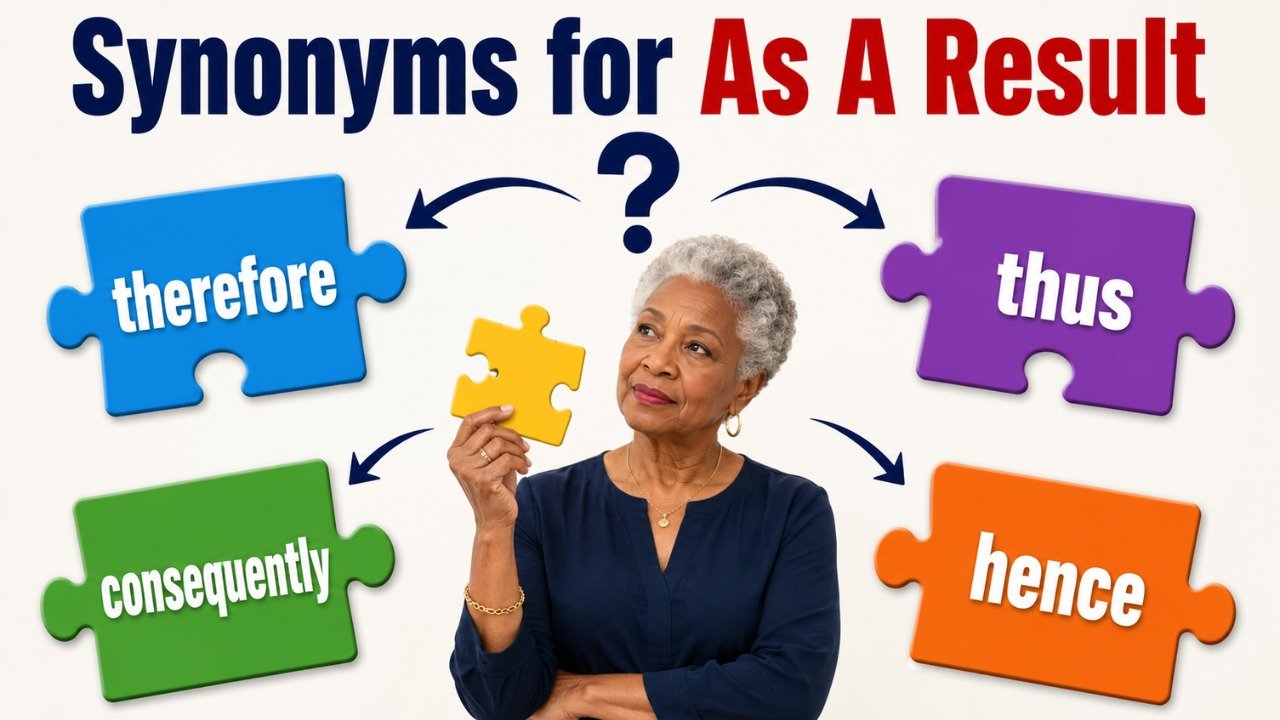
Quick Answer: The best synonyms for as a result include therefore, consequently, thus, hence, accordingly, so, for this reason, because of this, as a consequence, and that is why. Use therefore or consequently in formal writing, thus in academic explanations, so in casual conversation, and for this reason when you want to make the connection between a cause and its outcome especially clear.
Pronunciation and Word Details
Word: As a result
Pronunciation: /æz ə rɪˈzʌlt/
Part of Speech: Adverbial phrase and transition phrase
Meaning: A phrase used to introduce an effect, consequence, or outcome caused by something previously mentioned.
US Pronunciation:
UK Pronunciation:
What Does “As a Result” Mean?
As a result means that something happened because of an earlier action, event, situation, or condition.
It is an adverbial phrase commonly used to connect a cause with its consequence. It helps readers understand that the second event occurred because of the first one.
The phrase can begin a sentence, appear in the middle of a sentence, or connect two closely related ideas.
Beginning of a Sentence: The road was flooded. As a result, the school remained closed.
Middle of a Sentence: The road was flooded and, as a result, the school remained closed.
With As a Result Of: The school remained closed as a result of the flooding.
The phrase is useful in essays, reports, explanations, stories, business writing, academic writing, and everyday conversation.
Meaning, Tone, and Context of “As a Result”
As a result has a neutral and clear tone. It is neither highly formal nor overly casual, which makes it suitable for many writing situations.
In formal writing, it often introduces an outcome supported by facts, evidence, or previous information.
Formal Context: Sales increased significantly. As a result, the company expanded its production capacity.
In academic writing, the phrase explains relationships between causes, events, findings, and conclusions.
Academic Context: The temperature decreased rapidly. As a result, the liquid began to freeze.
In everyday speech, people often replace it with so, because of that, or that is why.
Conversational Context: I missed the bus, so I arrived late.
As a result can describe positive, negative, expected, unexpected, direct, or indirect consequences.
When and How to Use “As a Result”
For Showing a Consequence: Use the phrase when one event directly causes another event.
Example: Heavy rain continued throughout the night. As a result, several roads became inaccessible.
For Explaining an Outcome: Use it to introduce the final effect of a decision or situation.
Example: The team improved its training routine. As a result, its performance became more consistent.
For Connecting Ideas: Use it as a transition between a cause and its logical effect.
Example: The instructions were unclear. As a result, several participants completed the task incorrectly.
For Formal Writing: Use it when you need a neutral and professional transition.
Example: Demand increased during the summer. As a result, additional workers were hired.
For Academic Writing: Use it to explain findings, changes, or relationships.
Example: The plants received less sunlight. As a result, their growth slowed.
For Everyday Conversation: Use it when explaining why something happened.
Example: I forgot to charge my phone. As a result, I could not call anyone.
Best Synonyms for As a Result
Therefore: For that reason or because of what was just mentioned.
Example: The evidence was incomplete. Therefore, the investigation continued.
Consequently: As a direct or logical consequence.
Example: The flight was delayed. Consequently, we missed our connecting flight.
Thus: In this way or because of the stated reason.
Example: The material was exposed to heat and thus became softer.
Hence: For this reason or from this fact.
Example: The road was blocked, hence the long delay.
Accordingly: In a way that follows logically from the situation.
Example: The schedule changed, and the staff adjusted their plans accordingly.
So: Because of that, usually in casual speech or informal writing.
Example: It started raining, so we went inside.
For This Reason: Because of the reason that was just explained.
Example: The machine requires regular maintenance. For this reason, it is inspected every month.
Because of This: Due to the previously mentioned situation.
Example: The store opened late. Because of this, several customers left.
As a Consequence: As an effect of a previous action or event.
Example: The river overflowed. As a consequence, nearby homes were evacuated.
That Is Why: This explains the reason for a particular result.
Example: The road was icy. That is why the driver moved slowly.
50 Synonyms for As a Result with Short Meanings
- Therefore: For that reason.
- Consequently: As a consequence of something.
- Thus: Because of what was previously stated.
- Hence: For this reason.
- Accordingly: In a way that follows logically.
- So: Because of that.
- For This Reason: Due to the stated reason.
- Because of This: Caused by the previous situation.
- As a Consequence: As an effect or outcome.
- That Is Why: This explains the result.
- Which Is Why: Introducing the reason for an outcome.
- Due to This: Caused by this situation.
- Owing to This: Happening because of this.
- On Account of This: Because of the stated matter.
- Because of That: Caused by what happened earlier.
- For That Reason: Because of the previously stated cause.
- In Consequence: As a result of something.
- On That Account: For that particular reason.
- Thereby: By that action or means.
- In Turn: As a later effect in a sequence.
- Then: Introducing a logical result in some contexts.
- Ergo: Therefore, usually in formal reasoning.
- Wherefore: For which reason, usually in older or formal language.
- Thereupon: Immediately after or because of that event.
- As an Outcome: As the final effect of something.
- As an Effect: As something produced by a cause.
- As a Direct Result: As an immediate consequence.
- As an Indirect Result: As a less immediate consequence.
- As a Natural Result: As an expected outcome.
- As an Inevitable Result: As an unavoidable consequence.
- With the Result That: Producing the stated outcome.
- With the Consequence That: Causing the following effect.
- This Meant That: Showing what a situation caused.
- The Result Was: Introducing the outcome.
- The Outcome Was: Introducing the final effect.
- This Caused: Showing a direct cause.
- This Led To: Showing that one event produced another.
- This Resulted In: Showing the effect of an action.
- This Brought About: Showing that something created a change.
- This Produced: Showing what was created or caused.
- This Created: Showing that a situation formed an outcome.
- This Prompted: Showing that something encouraged an action.
- This Triggered: Showing that something started a reaction.
- Resulting In: Producing a particular effect.
- Leading To: Causing a later development.
- Giving Rise To: Causing something to begin or develop.
- Bringing About: Making something happen.
- Culminating In: Ending with a final outcome.
- Ending In: Having a particular final result.
- In Response: As an action caused by a situation.
Read Also:
Synonyms for They

Synonyms for As a Result by Context
Formal and Academic Alternatives
Formal and academic writing usually requires clear transitions that show logical cause and effect.
Therefore: Best for presenting a logical conclusion.
Example: The sample was too small. Therefore, further research was required.
Consequently: Best for describing a clear consequence.
Example: Several records were missing. Consequently, the final total could not be confirmed.
Thus: Best for concise academic explanations.
Example: The pressure increased, thus changing the material’s structure.
Hence: Best for brief formal reasoning.
Example: The evidence was unreliable, hence the need for another test.
Conversational Alternatives
Casual speech usually sounds more natural with shorter and simpler alternatives.
So: The most common conversational replacement.
Example: I was feeling tired, so I went home early.
That Is Why: Useful when explaining the reason for an outcome.
Example: The traffic was terrible. That is why we arrived late.
Because of That: Useful for referring back to an earlier situation.
Example: She missed several classes. Because of that, she needed extra help.
Which Is Why: Useful when connecting two ideas in one sentence.
Example: The room was too cold, which is why we moved outside.
Cause and Effect Alternatives
Some alternatives directly emphasize that one event produced another.
This Led To: Shows a developing consequence.
Example: The company reduced its prices. This led to higher demand.
This Resulted In: Clearly connects an action with an outcome.
Example: The pipe burst. This resulted in serious water damage.
This Caused: Expresses a direct cause.
Example: The power failed. This caused the system to shut down.
This Triggered: Describes an immediate reaction or event.
Example: The announcement triggered a sudden increase in applications.
Alternatives for Strong Consequences
Some phrases emphasize that the result was direct, unavoidable, or especially important.
As a Direct Result: Shows an immediate and clear connection.
Example: Production increased as a direct result of the new equipment.
As an Inevitable Result: Shows that the outcome could not be avoided.
Example: Costs rose as an inevitable result of the shortage.
As a Natural Result: Shows an expected consequence.
Example: Her confidence improved as a natural result of regular practice.
Culminating In: Shows the final result of a longer process.
Example: Months of negotiation continued, culminating in a successful agreement.
Another Word for As a Result
The best single replacement for as a result is often therefore. It is concise, clear, and appropriate for formal, academic, and professional writing.
However, the best alternative depends on the tone and sentence structure. So is more natural in casual conversation, while consequently emphasizes a direct consequence.
Original: The weather became worse. As a result, the event was cancelled.
Better Option: The weather became worse. Therefore, the event was cancelled.
Original: I did not sleep well. As a result, I felt tired all morning.
Better Option: I did not sleep well, so I felt tired all morning.
Original: The company lost several major clients. As a result, its revenue declined.
Better Option: The company lost several major clients. Consequently, its revenue declined.
Original: The instructions were incomplete. As a result, many people made mistakes.
Better Option: The instructions were incomplete, which is why many people made mistakes.
When Not to Use “As a Result”
Avoid using as a result when the relationship between two ideas is not truly based on cause and effect.
Weak: I visited the museum. As a result, the paintings were beautiful.
Better: I visited the museum, where I saw several beautiful paintings.
Do not repeat the phrase several times in the same paragraph. Repetition can make writing sound mechanical.
Weak: The road was closed. As a result, traffic increased. As a result, many workers arrived late.
Better: The road was closed. Consequently, traffic increased, causing many workers to arrive late.
Avoid using as a result of before a complete clause.
Weak: The match was cancelled as a result of it was raining.
Better: The match was cancelled because it was raining.
Better: The match was cancelled as a result of the rain.
In casual speech, the phrase may sound more formal than necessary.
Weak: I forgot my wallet. As a result, I could not buy lunch.
Better: I forgot my wallet, so I could not buy lunch.
Words Commonly Confused With As a Result
As a Result vs Because: As a result introduces an effect, while because introduces a cause.
Example With As a Result: The road was blocked. As a result, we took another route.
Example With Because: We took another route because the road was blocked.
As a Result vs Therefore: Both show a consequence, but therefore is usually more concise and formal.
Example With As a Result: The data was incomplete. As a result, the report was delayed.
Example With Therefore: The data was incomplete. Therefore, the report was delayed.
As a Result vs Consequently: Consequently often suggests a direct or serious outcome, while as a result is more neutral.
Example With As a Result: Attendance increased. As a result, a larger room was needed.
Example With Consequently: The organization lost its funding. Consequently, several programs ended.
As a Result vs So: So is more conversational and usually connects clauses within one sentence.
Example With As a Result: The shop was closed. As a result, we returned home.
Example With So: The shop was closed, so we returned home.
Result In vs Result From: Result in introduces an effect, while result from introduces a cause.
Example With Result In: Poor planning can result in unnecessary delays.
Example With Result From: Unnecessary delays can result from poor planning.
Which Synonym Should You Choose?
Choose therefore when presenting a logical conclusion in formal writing, reports, essays, or professional communication.
Choose consequently when you want to emphasize a direct, important, or sometimes negative consequence.
Choose thus when writing a concise academic explanation or showing how something happened.
Choose hence when presenting a brief conclusion or explanation in formal writing.
Choose so in casual speech, informal messages, stories, and simple explanations.
Choose for this reason when you want the cause and effect relationship to be especially clear.
Choose because of this when referring directly to a previously mentioned situation.
Choose that is why when explaining an outcome in natural conversation.
Choose this led to when describing a developing effect or chain of events.
Choose this resulted in when describing a clear and measurable outcome.
Real Life Examples of “As a Result” in Sentences
Original: The alarm did not ring. As a result, I woke up late.
Better Option: The alarm did not ring, so I woke up late.
Original: The business improved its customer service. As a result, complaints decreased.
Better Option: The business improved its customer service. Consequently, complaints decreased.
Original: The road was covered with snow. As a result, drivers moved slowly.
Better Option: The road was covered with snow. For this reason, drivers moved slowly.
Original: The student practised every day. As a result, her speaking skills improved.
Better Option: The student practised every day, which is why her speaking skills improved.
Original: The equipment was not maintained. As a result, it stopped working.
Better Option: The equipment was not maintained. Therefore, it stopped working.
Original: The temperature dropped suddenly. As a result, the water froze.
Better Option: The temperature dropped suddenly, thus causing the water to freeze.
Original: The store offered lower prices. As a result, more customers visited.
Better Option: The store offered lower prices. This led to an increase in customer visits.
Original: The team communicated clearly. As a result, the project finished on time.
Better Option: The team communicated clearly. Accordingly, the project finished on time.
Original: Several employees received additional training. As a result, productivity improved.
Better Option: Several employees received additional training. This resulted in improved productivity.
Original: The child touched the hot surface. As a result, he quickly pulled his hand away.
Better Option: The child touched the hot surface, triggering an immediate reaction.
Synonym Groups and Usage Differences
Logical Conclusion Group
Therefore, thus, hence, and accordingly introduce conclusions that logically follow from earlier information.
These words are useful in reports, essays, explanations, and structured arguments.
Example: The figures could not be verified. Therefore, they were removed from the report.
Direct Consequence Group
Consequently, as a consequence, as a direct result, and this resulted in emphasize a clear outcome.
These alternatives work well when the connection between an action and its effect is strong.
Example: The factory reduced its operating hours. Consequently, total production decreased.
Conversational Group
So, that is why, which is why, and because of that sound natural in everyday conversation.
They are easier and less formal than therefore or consequently.
Example: I had an early meeting, so I went to bed before ten.
Cause and Effect Group
This caused, this led to, this triggered, and this brought about focus on how one event produced another.
These phrases are useful when describing processes, changes, and developments.
Example: The new policy reduced unnecessary steps. This led to faster approvals.
Final Outcome Group
Culminating in, ending in, the result was, and the outcome was introduce a final result.
These alternatives are useful when describing a series of events.
Example: The teams worked together for several months, culminating in a successful launch.
Antonyms of As a Result
The opposites of as a result are expressions that show contrast, absence of consequence, or an unexpected outcome.
Nevertheless: In spite of what happened.
Nonetheless: Despite the previous situation.
However: Introducing a contrasting idea.
Even So: Showing that something happened despite the circumstances.
Regardless: Without being affected by something.
In Spite of This: Despite the previously mentioned event.
Despite This: Showing that the expected consequence did not occur.
Unrelatedly: Without a cause and effect connection.
Independently: Without being influenced by the previous factor.
Coincidentally: Happening by chance rather than as a consequence.
Comparison As a Result vs Related Words
As a Result vs Therefore
As a result is a neutral phrase that clearly introduces an outcome. Therefore is shorter and often sounds more formal or logical.
Example With As a Result: The documents were incomplete. As a result, the application was rejected.
Example With Therefore: The documents were incomplete. Therefore, the application was rejected.
As a Result vs Consequently
Consequently emphasizes a logical or direct consequence. As a result has a more neutral tone and works in both formal and everyday writing.
Example With As a Result: The shop extended its hours. As a result, more customers visited.
Example With Consequently: The company ignored repeated warnings. Consequently, it experienced serious losses.
As a Result vs So
So is shorter, simpler, and more conversational. As a result sounds more structured and is often used to begin a new sentence.
Example With As a Result: The train was delayed. As a result, we missed the meeting.
Example With So: The train was delayed, so we missed the meeting.
As a Result vs Thus
Thus is concise and common in academic or formal explanations. It can mean as a result or in this way, depending on context.
Example With As a Result: The metal was heated. As a result, it expanded.
Example With Thus: The metal was heated, thus causing it to expand.
As a Result vs Because
As a result introduces the effect. Because introduces the reason or cause.
Example With As a Result: The computer stopped working. As a result, the file could not be saved.
Example With Because: The file could not be saved because the computer stopped working.
Common Phrases and Expressions With As a Result
As a Direct Result: As an immediate and clearly connected consequence.
As a Natural Result: As an expected outcome.
As an Immediate Result: As something that happened without delay.
As a Final Result: As the eventual outcome.
As a Positive Result: As a beneficial consequence.
As a Negative Result: As an unfavourable consequence.
As a Result Of: Because of a particular action, situation, or event.
Largely As a Result: Mainly because of something.
Partly As a Result: To some extent because of something.
Primarily As a Result: Mainly or chiefly because of something.
Common Mistakes to Avoid
One common mistake is using as a result when there is no clear cause and effect relationship. Make sure the second statement is truly caused by the first.
Another mistake is confusing as a result with because. As a result introduces an effect, while because introduces the cause.
Do not write as a result of before a complete sentence. It should normally be followed by a noun or noun phrase.
Incorrect: The event was delayed as a result of the speaker arrived late.
Correct: The event was delayed because the speaker arrived late.
Correct: The event was delayed as a result of the speaker’s late arrival.
Avoid repeating as a result too frequently. Use alternatives such as therefore, consequently, so, this led to, and because of this to create smoother writing.
Use punctuation carefully when the phrase begins a sentence.
Correct: The weather became worse. As a result, the flight was cancelled.
Do not choose a formal synonym such as hence or ergo in casual conversation unless the tone suits the situation.
Conclusion
Synonyms for as a result help writers express consequences clearly without repeating the same transition. Therefore, consequently, thus, and hence work well in formal or academic writing, while so, that is why, and because of this sound more natural in conversation. Use this led to or this resulted in when explaining a direct cause and effect relationship. The best choice depends on tone, sentence structure, and the strength of the connection between the cause and its outcome.
FAQs About Synonyms for As a Result
What Is the Best Synonym for As a Result?
Therefore is one of the best general synonyms because it is clear, concise, and suitable for formal writing.
Can I Use So Instead of As a Result?
Yes. So is a natural replacement in casual speech and informal writing, especially when connecting two clauses in one sentence.
Is Consequently the Same as As a Result?
Consequently has a similar meaning, but it often emphasizes a stronger or more direct consequence.
Is As a Result Formal?
As a result has a neutral tone. It is suitable for formal, academic, professional, and general writing.
Should a Comma Come After As a Result?
A comma usually follows as a result when it appears at the beginning of a sentence.
Example: As a result, the meeting was postponed.
What Is the Difference Between As a Result and Because?
As a result introduces an effect, while because introduces the cause of that effect.
Can As a Result Begin a Sentence?
Yes. It commonly begins a sentence and connects the new outcome to information in the previous sentence.
