
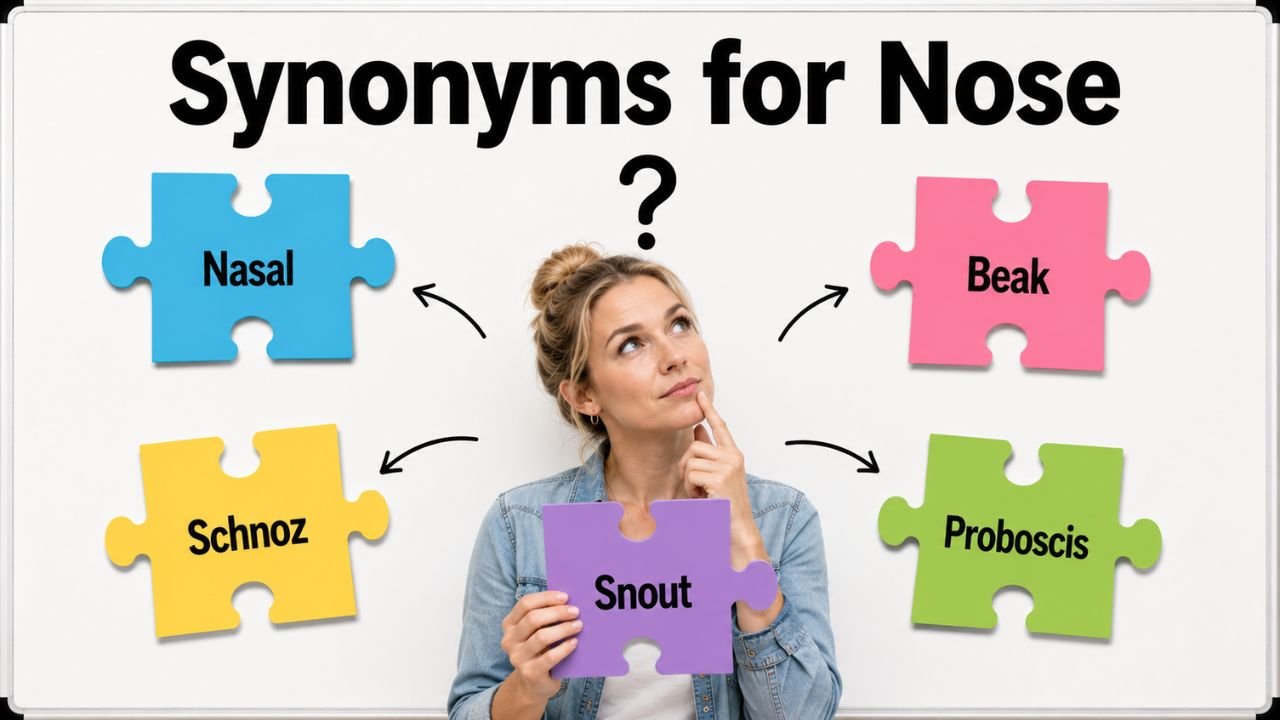
Quick Answer: Common synonyms for nose include snout, muzzle, beak, bill, proboscis, trunk, rostrum, schnoz, honker, and snoot. The best alternative depends on the context. Use snout or muzzle for many animals, beak or bill for birds, proboscis for certain insects, trunk for an elephant, and rostrum in scientific or technical descriptions. Schnoz, honker, and snoot are informal words for a human nose. When nose is used as a verb, sniff, detect, pry, investigate, and edge forward may be better choices.
Pronunciation and Word Details
Word: Nose
Pronunciation: /noʊz/ in US English and /nəʊz/ in UK English
Part of Speech: Noun and verb
Meaning: The part of the face used for breathing and smelling, or the front part of an object.
US Pronunciation:
UK Pronunciation:
What Does “Nose” Mean?
Nose means the facial organ used for breathing and smelling. It is commonly used as a noun, but it can also function as a verb.
As a noun, nose usually refers to the part of a person’s or animal’s face above the mouth. It may also describe the front or pointed part of an aircraft, vehicle, tool, ship, or other object.
In descriptions of food, drinks, flowers, and perfumes, nose can refer to an aroma or scent. For example, someone may describe a drink as having a fruity nose.
As a verb, nose can mean to smell something, search carefully, interfere in another person’s affairs, or move slowly forward.
Anatomical Use: She touched the tip of her nose.
Animal Use: The dog pressed its nose against the door.
Object Use: The nose of the aircraft pointed toward the runway.
Smell Use: The drink had a fresh and floral nose.
Verb Use: The curious dog nosed around the garden.
Meaning, Tone, and Context of “Nose”
Nose is normally a neutral and conversational word. It is appropriate in everyday speech, school writing, medical explanations, descriptions, stories, and instructions.
In formal medical or scientific writing, terms such as nasal organ, olfactory organ, nasal structure, and rostrum may be more precise.
Words such as schnoz, honker, and snoot are informal. They can sound humorous, playful, or insulting when used to describe a person. These alternatives should therefore be chosen carefully.
Animal terms also depend on the species. Snout is common for pigs, dogs, and similar animals. Muzzle describes the projecting nose and mouth area of an animal. Beak and bill are used for birds, while trunk refers specifically to the long nose of an elephant.
When nose refers to the front of an object, words such as tip, point, front, prow, bow, cone, or projection may be more suitable.
When and How to Use “Nose”
For Human Anatomy: Use nose when referring to the facial organ used for breathing and smelling.
Example: His nose became red in the cold weather.
For Animal Features: Use nose generally, or choose a more specific word such as snout, muzzle, beak, bill, proboscis, or trunk.
Example: The horse lowered its muzzle toward the water.
For Smell: Use nose when discussing the ability to recognize aromas or scents.
Example: She has a good nose for fresh herbs.
For Food and Drinks: Use nose to describe the aroma noticed before tasting something.
Example: The drink has a rich nose of berries and spices.
For Aircraft and Vehicles: Use nose for the front part of an aircraft, spacecraft, train, or vehicle.
Example: The nose of the plane lifted from the runway.
For Investigation: Use nose as a verb when someone searches, investigates, or interferes.
Example: He was nosing through documents that did not belong to him.
For Forward Movement: Use nose when something moves slightly or carefully ahead.
Example: The runner nosed ahead near the finish line.
Best Synonyms for Nose
Snout: The projecting nose and mouth of certain animals.
Example: The pig pushed its snout into the soft soil.
Muzzle: The forward part of an animal’s head containing its nose and mouth.
Example: The horse had a small white mark on its muzzle.
Beak: The hard projecting mouth and nose structure of a bird.
Example: The eagle held the fish firmly in its beak.
Proboscis: A long nose or feeding organ found on certain animals and insects.
Example: The butterfly used its proboscis to collect nectar.
Trunk: The long flexible nose of an elephant.
Example: The elephant lifted water with its trunk.
Rostrum: A technical term for a beaklike or projecting structure.
Example: The researcher examined the insect’s rostrum.
Prow: The front projecting part of a ship.
Example: Water splashed against the prow of the boat.
Scent: A smell detected through the nose.
Example: The dog followed the scent through the field.
Sniff: To draw air through the nose to detect a smell.
Example: She sniffed the flower gently.
Detect: To notice or discover something, sometimes through smell.
Example: The trained dog detected smoke inside the building.
50 Synonyms for Nose with Short Meanings
The following words are synonyms or close alternatives for nose according to anatomy, animals, objects, smell, investigation, and movement.
- Snout: The projecting nose and mouth of an animal.
- Muzzle: The front area of an animal’s face.
- Beak: The hard projecting mouth structure of a bird.
- Bill: A bird’s beak, especially one that is broad or flat.
- Proboscis: A long nose or feeding organ.
- Trunk: The long flexible nose of an elephant.
- Rostrum: A beaklike or projecting anatomical structure.
- Schnoz: An informal word for a human nose.
- Honker: A humorous term for a large nose.
- Snoot: An informal or playful word for a nose.
- Nasal Organ: The physical organ used for smelling and breathing.
- Olfactory Organ: The organ connected with the sense of smell.
- Nasal Region: The area surrounding the nose.
- Nasal Structure: The physical form and parts of the nose.
- Tip: The pointed or outer end of something.
- Point: A narrow or projecting end.
- Front: The forward part of an object.
- Forefront: The most forward or leading position.
- Forepart: The front section of something.
- Prow: The front part of a ship.
- Bow: The forward section of a boat or ship.
- Leading Edge: The foremost edge of a moving object.
- Cone: A pointed front structure, especially on an aircraft.
- Radome: A protective covering at the nose of certain aircraft.
- Projection: A part that extends outward.
- Peak: A pointed or prominent end.
- Scent: A smell noticed through the nose.
- Smell: An odor detected by the nose.
- Aroma: A noticeable and usually pleasant smell.
- Fragrance: A sweet or pleasant scent.
- Odor: A particular smell, pleasant or unpleasant.
- Bouquet: The combined aroma of a drink, flower, or food.
- Perfume: A pleasant or deliberately created fragrance.
- Whiff: A brief or light smell.
- Trace: A very small sign of a scent.
- Hint: A slight suggestion of an aroma.
- Sniff: An act of drawing air through the nose.
- Scent Out: To discover something by following its smell.
- Smell Out: To locate or discover through smell.
- Detect: To notice or discover something.
- Discover: To find something previously unknown or hidden.
- Discern: To recognize something through careful attention.
- Identify: To determine what something is.
- Track: To follow signs, scent, or movement.
- Trail: To follow someone or something.
- Investigate: To search for information or evidence.
- Probe: To examine something carefully.
- Pry: To interfere or search into private matters.
- Nudge: To push something gently with the front.
- Edge Forward: To move slowly or slightly ahead.
Read Also:
Synonyms for Forever

Synonyms for Nose by Context
When Nose Means an Animal’s Facial Feature
Snout and muzzle are the most useful alternatives for many mammals. Beak and bill are appropriate for birds. Trunk is used for an elephant, while proboscis can describe certain insects and animals.
Snout Example: The pig placed its snout near the fence.
Muzzle Example: The dog rested its muzzle on her knee.
Beak Example: The bird carried a seed in its beak.
Trunk Example: The elephant curled its trunk around the branch.
When Nose Means the Front of an Object
Front, tip, point, forepart, prow, bow, cone, projection, and leading edge can replace nose when referring to the forward part of an object.
Front Example: The front of the train entered the tunnel.
Prow Example: The ship’s prow cut through the waves.
Cone Example: Engineers inspected the aircraft’s nose cone.
Tip Example: The tip of the tool was slightly damaged.
When Nose Refers to Smell
Scent, smell, aroma, fragrance, odor, bouquet, perfume, whiff, trace, and hint are useful when nose refers to an aroma or the experience of smelling.
Aroma Example: The bread released a warm aroma.
Bouquet Example: The drink had a delicate floral bouquet.
Whiff Example: She noticed a whiff of smoke.
Hint Example: The sauce contained a hint of garlic.
When Nose Means to Smell or Detect
Sniff, scent out, smell out, detect, identify, discern, track, and discover can replace nose as a verb.
Sniff Example: The dog sniffed the package.
Detect Example: She detected a faint burning smell.
Track Example: The animal tracked its prey through the forest.
Discover Example: The investigators discovered a hidden entrance.
When Nose Means to Investigate or Interfere
Investigate, probe, pry, search, and examine may replace nose when someone looks into a subject or another person’s private affairs.
Investigate Example: The journalist investigated the unusual claim.
Probe Example: The committee probed the cause of the problem.
Pry Example: It is impolite to pry into private conversations.
When Nose Means to Move Ahead
Edge forward, advance, nudge, push, and move ahead may replace nose when describing slow or slight movement.
Edge Forward Example: The car edged forward in heavy traffic.
Advance Example: The team advanced into first place.
Nudge Example: The horse nudged the gate with its muzzle.
Another Word for Nose
There is no single replacement that works for every meaning of nose. For a human facial feature, nose is usually the clearest and most natural word. Snout is best for many animals, beak for birds, trunk for elephants, prow for ships, and cone for the pointed front of an aircraft.
As a verb, sniff is suitable for smelling, detect for discovering, pry for interfering, and edge forward for slight movement.
Original: The dog placed its nose against the window.
Better Option: The dog placed its snout against the window.
Original: The nose of the ship rose above the waves.
Better Option: The prow of the ship rose above the waves.
Original: She nosed the flower carefully.
Better Option: She sniffed the flower carefully.
Original: He kept nosing into their private discussion.
Better Option: He kept prying into their private discussion.
When Not to Use “Nose”
Do not replace nose with an animal term when describing a person unless the tone is humorous or intentionally insulting. Snout, muzzle, schnoz, honker, and snoot can sound rude when applied to someone.
Avoid using scent, aroma, fragrance, or odor when you mean the physical body part. These words describe smells, not the organ itself.
Do not use nostril as a complete replacement for nose. A nostril is only one of the external openings of the nose.
Technical alternatives should also match the subject. Radome belongs to aviation equipment, while prow and bow refer mainly to ships.
Weak: The woman touched her snout after the accident.
Better: The woman touched her nose after the accident.
Weak: The bird cleaned its nose on the branch.
Better: The bird cleaned its beak on the branch.
Weak: The aroma of the aircraft was damaged.
Better: The nose of the aircraft was damaged.
Weak: He investigated ahead of the other runner.
Better: He nosed ahead of the other runner.
Words Commonly Confused With Nose
Nose vs Nostril: Nose refers to the entire facial organ, while a nostril is one of its two external openings.
Nose vs Snout: Nose is the general term, while snout usually describes the projecting nose and mouth of an animal.
Nose vs Muzzle: Nose refers mainly to the smelling organ. Muzzle includes both the nose and mouth area of an animal.
Nose vs Beak: Nose is used for people and many animals. Beak refers to the hard projecting structure of a bird.
Nose vs Scent: Nose is the organ that detects a smell. Scent is the smell being detected.
Nose vs Aroma: Nose is a body part or smelling ability. Aroma is a noticeable and usually pleasant smell.
Nose vs Prow: Nose can describe the front of many objects. Prow specifically refers to the forward part of a ship.
Nose vs Smell: Nose can be a noun or verb. Smell may refer to an odor, the ability to detect odors, or the act of detecting them.
Which Synonym Should You Choose?
Choose nose for ordinary descriptions of the human facial organ.
Choose snout when describing the projecting nose and mouth of a pig, dog, bear, or similar animal.
Choose muzzle when referring to the entire forward area of an animal’s face.
Choose beak or bill when writing about birds.
Choose proboscis for a long feeding or smelling organ found on certain insects and animals.
Choose trunk when referring to an elephant’s long flexible nose.
Choose rostrum for scientific, biological, or technical writing.
Choose schnoz, honker, or snoot for humorous and highly informal conversation.
Choose prow or bow for the front of a ship.
Choose cone or radome when discussing the front structure of an aircraft.
Choose aroma, scent, fragrance, bouquet, or odor when discussing smells.
Choose sniff when describing the physical act of drawing air through the nose.
Choose detect, identify, or discern when describing the discovery of a smell or clue.
Choose pry, probe, or investigate when nose means searching into private or hidden matters.
Choose edge forward when nose describes slow movement ahead.
Real Life Examples of “Nose” in Sentences
Original: The dog pushed its nose under the gate.
Better Option: The dog pushed its snout under the gate.
Original: The horse had a white mark on its nose.
Better Option: The horse had a white mark on its muzzle.
Original: The bird held a twig in its nose.
Better Option: The bird held a twig in its beak.
Original: The elephant sprayed water from its nose.
Better Option: The elephant sprayed water from its trunk.
Original: The nose of the ship struck a large wave.
Better Option: The prow of the ship struck a large wave.
Original: She put her nose near the soup to check it.
Better Option: She sniffed the soup to check it.
Original: The dog nosed out the hidden package.
Better Option: The dog detected the hidden package.
Original: He was nosing into his colleague’s personal files.
Better Option: He was prying into his colleague’s personal files.
Original: The blue car nosed ahead at the crossing.
Better Option: The blue car edged forward at the crossing.
Original: The drink had a light citrus nose.
Better Option: The drink had a light citrus bouquet.
Synonym Groups and Usage Differences
Human Anatomy Group
Nose, nasal organ, olfactory organ, nasal region, and nasal structure relate to the human body. Nose is the most natural everyday word, while the other terms are more formal, medical, or scientific.
Example: The nasal structure helps filter and warm incoming air.
Animal Feature Group
Snout, muzzle, beak, bill, proboscis, trunk, and rostrum describe different animal structures. The correct term depends on the animal and the shape or function of the feature.
Example: The butterfly extended its proboscis toward the flower.
Informal Nose Group
Schnoz, honker, and snoot are casual terms. They often create humor but may sound disrespectful when used to describe another person.
Example: The costume included a bright red honker.
Front and Projection Group
Front, tip, point, forepart, prow, bow, cone, radome, and projection describe the forward or extended part of an object.
Example: The aircraft’s nose cone was designed to reduce resistance.
Smell and Aroma Group
Scent, smell, aroma, fragrance, odor, bouquet, perfume, whiff, trace, and hint describe something detected through the nose.
Example: A faint whiff of smoke entered the room.
Detection and Investigation Group
Sniff, detect, discover, identify, discern, track, investigate, probe, and pry relate to searching or finding information.
Example: The dog tracked the scent across the field.
Movement Group
Edge forward, advance, nudge, and push describe movement connected with the verb nose.
Example: The vehicle edged forward toward the entrance.
Antonyms of Nose
Nose has no single direct antonym because it has several meanings. Its opposites depend on whether it refers to position, movement, discovery, or investigation.
Rear: The back part of an object.
Back: The part opposite the front or nose.
Tail: The rear section of an aircraft or animal.
Stern: The rear part of a ship, opposite the bow or prow.
Retreat: To move backward instead of moving ahead.
Withdraw: To move away from a position.
Overlook: To fail to notice or detect something.
Ignore: To deliberately avoid noticing something.
Conceal: To hide something instead of discovering it.
Avoid: To stay away from a subject instead of investigating it.
Comparison of Nose and Related Words
Nose vs Snout
Nose is the general anatomical term for people and animals. Snout refers to the projecting nose and mouth of many animals.
Example With Nose: The child covered his nose because of the smell.
Example With Snout: The pig pushed its snout through the fence.
Nose vs Muzzle
Nose refers mainly to the smelling and breathing organ. Muzzle includes the nose, jaws, and mouth area of an animal.
Example With Nose: The dog’s nose was wet.
Example With Muzzle: The dog rested its muzzle on the floor.
Nose vs Beak
Nose is appropriate for humans and many mammals. Beak describes the hard projecting mouth structure of a bird.
Example With Nose: She touched the bridge of her nose.
Example With Beak: The parrot cracked the seed with its beak.
Nose vs Scent
Nose is the body part used for smelling. Scent is the odor that the nose detects.
Example With Nose: His nose became sensitive during spring.
Example With Scent: The scent of flowers filled the garden.
Nose vs Aroma
Nose may mean the smelling organ or the smell of a food or drink. Aroma specifically refers to a noticeable smell, usually a pleasant one.
Example With Nose: The drink had a warm and spicy nose.
Example With Aroma: The aroma of cinnamon filled the kitchen.
Nose vs Prow
Nose can describe the front of many vehicles or objects. Prow specifically describes the projecting front of a ship or boat.
Example With Nose: The nose of the plane pointed upward.
Example With Prow: The prow of the boat cut through the water.
Common Phrases and Expressions With “Nose”
Under Your Nose: In an obvious place that is still overlooked.
Turn Up Your Nose: To show dislike or disapproval.
Keep Your Nose Out: To avoid interfering in another person’s affairs.
Follow Your Nose: To trust your sense of smell or natural judgment.
Nose Around: To search curiously or secretly.
Have a Nose for Something: To have a natural ability to find or recognize something.
On the Nose: Exactly correct or precisely on time.
Pay Through the Nose: To pay an extremely high price.
Nose Ahead: To move slightly into the lead.
Nose to Nose: Extremely close or directly facing someone.
Common Mistakes to Avoid
Using Animal Words for People: Snout and muzzle can sound insulting when used for a human nose. Use them only when the tone clearly supports humor or criticism.
Treating Nostril as the Whole Nose: A nostril is only an opening. It does not refer to the entire nose.
Using Smell Words for Anatomy: Aroma, scent, fragrance, and odor describe what the nose detects. They do not normally replace the anatomical word nose.
Ignoring the Animal Species: Beak, bill, trunk, muzzle, proboscis, and snout are not interchangeable. Select the word that matches the animal.
Using Informal Words in Formal Writing: Schnoz, honker, and snoot are unsuitable for medical, academic, or professional descriptions.
Choosing the Wrong Object Term: Prow and bow belong mainly to ships, while cone and radome are more suitable for aircraft.
Forcing a Synonym: Nose is often the clearest word. Do not replace it merely to avoid repetition when the alternative changes the meaning.
Conclusion
Synonyms for nose vary according to anatomy, animals, objects, smell, investigation, and movement. Snout and muzzle are useful for animals, while beak, bill, trunk, and proboscis apply to particular species. Prow, bow, cone, and front describe the nose of an object. Scent, aroma, bouquet, and fragrance relate to smell, while sniff, detect, pry, and edge forward replace nose as a verb. Choosing the correct alternative makes every sentence clearer, more natural, and more precise.
FAQs About Synonyms for Nose
What Is the Most Common Synonym for Nose?
Snout is one of the most common alternatives for an animal’s nose. For a person, nose usually remains the clearest word.
Is Snout Another Word for Nose?
Yes, snout can replace nose when describing the projecting nose and mouth of animals such as pigs, dogs, and bears.
What Is an Informal Word for Nose?
Schnoz, honker, and snoot are informal words for nose. They are usually humorous and may sometimes sound rude.
What Is the Scientific Word for Nose?
Nasal organ and olfactory organ are formal scientific alternatives. Rostrum may describe a projecting structure in certain animals.
What Is Another Word for the Nose of a Ship?
Prow and bow describe the front part of a ship. Prow emphasizes the projecting front section.
What Is Another Word for Nose as a Verb?
Sniff, detect, investigate, pry, nudge, and edge forward may replace nose as a verb, depending on the sentence.
Are Aroma and Nose the Same?
They can be related in descriptions of food and drinks. Nose may describe the complete smell, while aroma refers to the scent itself.
