
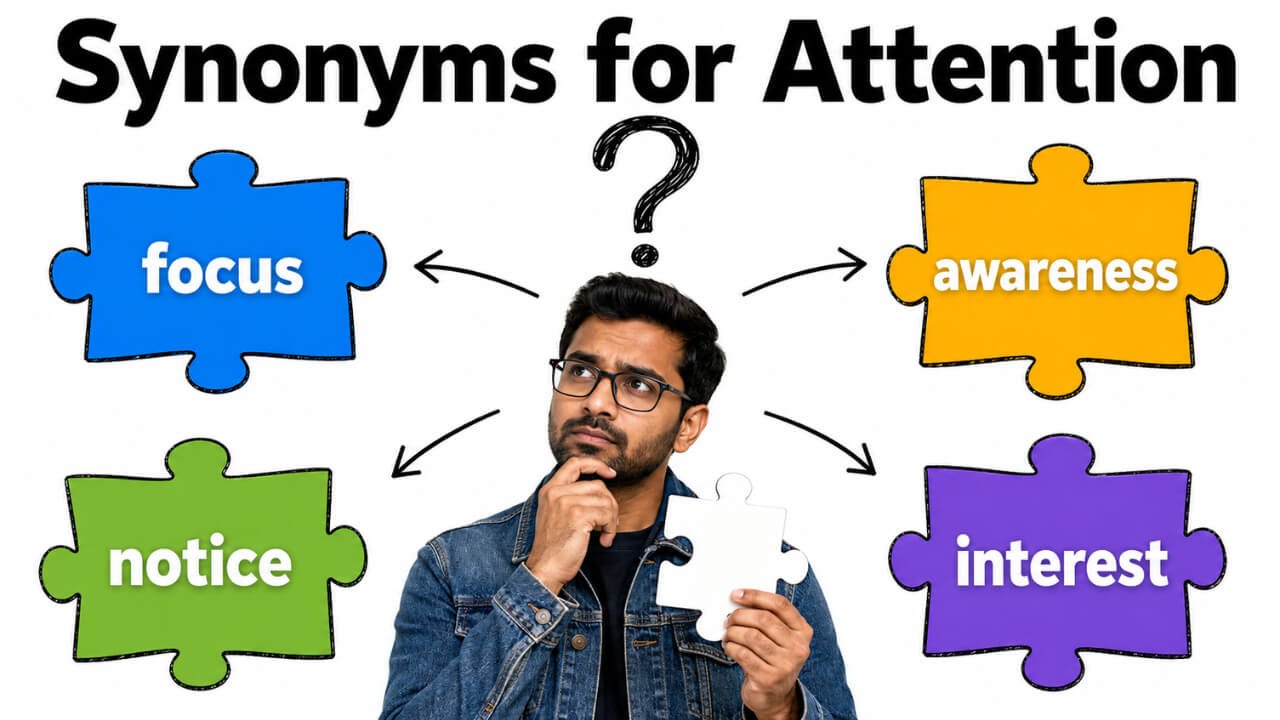
Quick Answer: Common synonyms for attention include focus, concentration, notice, awareness, consideration, interest, care, observation, regard, and mindfulness. Use focus or concentration when referring to mental effort. Choose notice or awareness when someone becomes conscious of something. Consideration and regard work well in formal writing, while care describes help or treatment. Interest is best when discussing curiosity or public response.
Pronunciation and Word Details
Word: Attention.
Pronunciation: /əˈten.ʃən/
Part of Speech: Noun.
Meaning: The act of focusing the mind, noticing something, showing care, or giving consideration.
US Pronunciation:
UK Pronunciation:
What Does “Attention” Mean?
Attention means focused awareness, careful thought, notice, or concern directed toward someone or something. It is mainly used as a noun.
The word can describe mental concentration, as in giving attention to a lesson. It can also refer to care, as in receiving medical attention, or public interest, as in attracting attention from an audience.
In formal communication, attention may mean consideration or notice. In everyday conversation, it often means listening, looking, or concentrating on what is happening.
The exact meaning depends on the sentence. A teacher may ask for attention, a patient may need attention, and an unusual event may receive public attention.
Meaning, Tone, and Context of “Attention”
Attention is a neutral and widely used word. It works naturally in formal writing, academic discussions, workplace communication, instructions, reports, and everyday conversation.
When attention refers to mental focus, its tone is practical and direct. When it refers to care, the word may sound supportive or serious. When it describes public interest, it can have a positive or negative meaning depending on the situation.
In professional writing, attention often appears in phrases such as attention to detail, immediate attention, careful attention, and public attention.
In conversational English, people frequently use expressions such as pay attention, get someone’s attention, and give someone your full attention.
When and How to Use “Attention”
For Mental Focus: Use attention when someone needs to concentrate on an activity, lesson, conversation, or responsibility.
Example: The students gave their full attention to the instructions.
For Noticing Something: Use attention when you want someone to observe or become aware of a particular fact.
Example: The report draws attention to several safety concerns.
For Care or Treatment: Use attention when a person, animal, object, or problem requires help or care.
Example: The injured passenger needed immediate medical attention.
For Consideration: Use attention when an idea or issue deserves careful thought.
Example: The proposal requires further attention from the committee.
For Public Interest: Use attention when something becomes noticeable or receives interest from many people.
Example: The unusual artwork attracted considerable attention.
For Respectful Listening: Use attention when someone listens carefully and responds thoughtfully.
Example: She gave the speaker her complete attention.
Best Synonyms for Attention
Focus: Direct mental effort toward one subject or activity.
Example: Maintaining focus helped her complete the assignment.
Concentration: Deep and continuous mental effort.
Example: The difficult calculation required complete concentration.
Notice: Awareness or recognition of something.
Example: The damaged sign escaped everyone’s notice.
Awareness: Knowledge or understanding that something exists.
Example: The campaign increased awareness of road safety.
Consideration: Careful thought given to a person, idea, or decision.
Example: The manager gave the request serious consideration.
Interest: Curiosity or a desire to know more.
Example: The discovery created interest among researchers.
Care: Concern, protection, or treatment provided to someone or something.
Example: The plant needs regular care during hot weather.
Observation: Careful watching or examination.
Example: Close observation revealed a change in the pattern.
Regard: Respectful thought or consideration.
Example: The policy was created with regard for public safety.
Mindfulness: Conscious attention to the present situation.
Example: Mindfulness helped him remain calm and attentive.
50 Synonyms for Attention with Short Meanings
- Focus: Mental effort directed toward something.
- Concentration: Deep and sustained mental focus.
- Notice: Awareness of a person, object, or event.
- Awareness: Knowledge that something exists or is happening.
- Regard: Respectful attention or consideration.
- Consideration: Careful thought before making a decision.
- Interest: Curiosity or concern about something.
- Care: Concern, protection, or treatment.
- Observation: Careful watching or examination.
- Mindfulness: Conscious awareness of the present moment.
- Heed: Serious attention given to advice or warnings.
- Attentiveness: The quality of listening or observing carefully.
- Alertness: Readiness to notice and respond.
- Vigilance: Careful attention to possible danger or problems.
- Watchfulness: The act of observing something closely.
- Scrutiny: Detailed and critical examination.
- Inspection: Careful checking for problems or details.
- Examination: Detailed consideration or investigation.
- Study: Careful observation or investigation of a subject.
- Thought: Mental consideration given to something.
- Reflection: Serious and careful thinking.
- Contemplation: Deep thought about an idea or situation.
- Absorption: Complete involvement in an activity or subject.
- Engagement: Active interest and involvement.
- Immersion: Deep involvement that captures the mind completely.
- Intentness: Strong and serious concentration.
- Concern: Interest connected with care or worry.
- Respect: Positive regard shown toward someone.
- Courtesy: Polite and considerate behavior.
- Politeness: Respectful attention to proper behavior.
- Recognition: Acknowledgement of importance or existence.
- Acknowledgment: Acceptance or notice of a fact or contribution.
- Support: Help or encouragement given to someone.
- Assistance: Practical help provided to a person.
- Service: Work or care performed for someone.
- Tending: The act of caring for a person or thing.
- Devotion: Strong and continuing care or commitment.
- Publicity: Public notice created around an event or subject.
- Exposure: The state of being seen or noticed publicly.
- Spotlight: A position that receives strong public attention.
- Prominence: The state of being important or noticeable.
- Acclaim: Strong public approval and attention.
- Fame: Widespread public recognition.
- Audience: The people giving attention to a speaker or performance.
- Reception: The way an idea or event is received.
- Coverage: Public reporting or discussion of a subject.
- Consciousness: Awareness of thoughts, surroundings, or events.
- Perception: The ability to notice or understand something.
- Carefulness: Close attention intended to prevent errors.
- Thoughtfulness: Considerate attention to other people’s needs.
Read Also:
Synonyms for We
Synonyms for Attention by Context
When Attention Means Mental Focus
Focus, concentration, mindfulness, absorption, immersion, intentness, and engagement describe mental effort directed toward an activity.
Focus is the most flexible choice. Concentration suggests stronger and more continuous mental effort. Absorption and immersion describe becoming deeply involved.
Example: The complex task required complete concentration.
Example: She became absorbed in the book.
When Attention Means Notice or Awareness
Notice, awareness, observation, recognition, consciousness, and perception describe becoming aware of something.
Notice often refers to seeing or recognizing a specific detail. Awareness describes broader knowledge. Observation suggests careful watching.
Example: The error came to the editor’s notice.
Example: Careful observation revealed the cause of the problem.
When Attention Means Care
Care, support, assistance, service, tending, concern, and devotion describe helping or looking after someone.
Care is the broadest alternative. Assistance refers to practical help. Tending usually describes regular care given to a person, animal, or plant.
Example: The patient received excellent care.
Example: The young trees require regular tending.
When Attention Means Consideration
Consideration, regard, thought, reflection, contemplation, and scrutiny refer to careful thinking.
Consideration is suitable for decisions and requests. Reflection and contemplation suggest deeper personal thought. Scrutiny means critical examination.
Example: The proposal deserves serious consideration.
Example: The financial records came under close scrutiny.
When Attention Means Public Interest
Interest, publicity, exposure, spotlight, prominence, acclaim, fame, reception, and coverage describe notice from the public.
Publicity and exposure describe visibility. Spotlight suggests becoming the main subject of interest. Acclaim means enthusiastic public approval.
Example: The discovery received widespread publicity.
Example: Her performance earned international acclaim.
Another Word for Attention
Focus is usually the best single replacement when attention means mental concentration. However, the most suitable alternative depends on whether the sentence refers to focus, notice, care, respect, thought, or public interest.
Original: Please give your attention to the presentation.
Better Option: Please focus on the presentation.
Original: The matter needs immediate attention.
Better Option: The matter needs immediate consideration.
Original: The child requires constant attention.
Better Option: The child requires constant care.
Original: The announcement received considerable attention.
Better Option: The announcement generated considerable interest.
When Not to Use “Attention”
Attention can sound vague when a more specific word would explain what kind of response is needed. Choose concentration for mental effort, care for treatment, consideration for careful thought, and publicity for public notice.
Avoid repeating attention several times in the same paragraph. Repetition can make writing sound basic or unclear.
Weak: The issue needs attention, and the team must give attention to it immediately.
Better: The issue requires immediate consideration from the team.
Do not use attention when you specifically mean curiosity or enthusiasm.
Weak: He showed great attention in the new subject.
Better: He showed great interest in the new subject.
Avoid attention when describing detailed investigation.
Weak: The accounts received attention from the auditor.
Better: The accounts underwent careful examination by the auditor.
Words Commonly Confused With Attention
Attention vs Intention: Attention means mental focus or notice. Intention means a plan or purpose.
Example: Her attention was on the road.
Example: Her intention was to arrive early.
Attention vs Awareness: Attention is directed focus, while awareness is knowledge that something exists.
Example: The teacher directed attention to the final question.
Example: The lesson raised awareness of environmental problems.
Attention vs Concentration: Attention may be brief or general. Concentration usually describes deeper and longer mental effort.
Example: The sudden noise caught my attention.
Example: The calculation required intense concentration.
Attention vs Interest: Attention means noticing or focusing. Interest means curiosity or enthusiasm.
Example: The warning attracted his attention.
Example: He developed an interest in history.
Attention vs Consideration: Attention can mean general focus, while consideration involves careful thought before a decision.
Example: The problem requires attention.
Example: The application is under consideration.
Which Synonym Should You Choose?
Choose focus when describing general mental effort directed toward a task, lesson, or goal.
Choose concentration when strong and continuous mental effort is required.
Choose notice when someone sees, hears, or recognizes a particular detail.
Choose awareness when discussing broader knowledge of an issue or situation.
Choose consideration in formal writing about decisions, proposals, applications, or requests.
Choose care when describing treatment, protection, or support.
Choose regard when expressing respect or thoughtful concern.
Choose scrutiny when referring to detailed and critical examination.
Choose interest when describing curiosity, enthusiasm, or public response.
Choose publicity or exposure when discussing widespread public attention.
Choose mindfulness when describing conscious awareness of the present moment.
Choose observation in reports, research, experiments, and detailed descriptions.
Real Life Examples of “Attention” in Sentences
Original: The teacher asked the class to pay attention.
Better Option: The teacher asked the class to focus.
Original: This problem requires immediate attention.
Better Option: This problem requires immediate action and consideration.
Original: The nurse gave attention to the injured child.
Better Option: The nurse provided care to the injured child.
Original: The unusual sound caught my attention.
Better Option: The unusual sound attracted my notice.
Original: The report received attention from local officials.
Better Option: The report received consideration from local officials.
Original: Her work attracted international attention.
Better Option: Her work gained international recognition.
Original: He completed the task with great attention.
Better Option: He completed the task with great carefulness.
Original: The speaker held the audience’s attention.
Better Option: The speaker maintained the audience’s interest.
Original: The details deserve closer attention.
Better Option: The details deserve closer scrutiny.
Original: The garden needs regular attention.
Better Option: The garden needs regular care.
Synonym Groups and Usage Differences
Mental Focus Group
Focus, concentration, attentiveness, absorption, immersion, and intentness describe the mind being directed toward something.
Focus is broad and flexible. Concentration is stronger, while absorption and immersion suggest complete involvement.
Example: Deep concentration allowed her to finish the complex design.
Awareness Group
Notice, awareness, consciousness, perception, alertness, and observation relate to seeing, understanding, or recognizing something.
Notice is specific, while awareness is broader. Alertness includes readiness to respond.
Example: His alertness helped him notice the approaching vehicle.
Care Group
Care, support, assistance, service, tending, concern, and devotion refer to helping or protecting someone.
Care is general, while assistance usually involves practical help. Devotion suggests lasting commitment.
Example: The elderly resident received daily care and assistance.
Consideration Group
Regard, consideration, thought, reflection, contemplation, and scrutiny describe careful thinking.
Consideration is suitable for formal decisions. Reflection is thoughtful and personal. Scrutiny is detailed and critical.
Example: The suggestion deserves further consideration.
Public Interest Group
Interest, recognition, publicity, exposure, spotlight, prominence, acclaim, and fame describe public notice.
Recognition may be positive and professional. Publicity can be positive or negative. Acclaim expresses strong approval.
Example: The artist gained recognition for her original work.
Antonyms of Attention
The opposite of attention depends on whether the word means focus, notice, care, or interest.
Distraction: Something that takes focus away from a task.
Inattention: A lack of careful mental focus.
Neglect: Failure to provide necessary care.
Disregard: Deliberate lack of consideration.
Indifference: Lack of care, concern, or interest.
Carelessness: Failure to pay enough attention to details.
Unawareness: Lack of knowledge about something.
Obliviousness: Complete failure to notice what is happening.
Disinterest: Lack of curiosity or involvement.
Avoidance: Deliberately refusing to consider or deal with something.
Comparison: Attention vs Related Words
Attention vs Focus
Attention is the general act of noticing or directing the mind. Focus is more specific and usually refers to concentrating on one main subject.
Example With Attention: The announcement caught everyone’s attention.
Example With Focus: Her focus remained on completing the project.
Attention vs Concentration
Attention may be brief, while concentration usually continues for a longer period and requires greater mental effort.
Example With Attention: The bright light attracted his attention.
Example With Concentration: Solving the puzzle required intense concentration.
Attention vs Awareness
Attention involves actively directing the mind toward something. Awareness means knowing that something exists or is happening.
Example With Attention: Please direct your attention to the chart.
Example With Awareness: The lesson created awareness of the problem.
Attention vs Interest
Attention means noticing or focusing. Interest includes curiosity, enjoyment, or a desire to learn more.
Example With Attention: The movement caught her attention.
Example With Interest: She developed an interest in painting.
Attention vs Consideration
Attention is a broad term for focus or notice. Consideration refers to careful thought before making a choice or judgment.
Example With Attention: The complaint needs immediate attention.
Example With Consideration: The committee gave the complaint careful consideration.
Common Phrases and Expressions With “Attention”
Pay Attention: Listen, watch, or think carefully.
Attract Attention: Cause someone to notice something.
Draw Attention To: Make a particular fact or detail noticeable.
Call Attention To: Ask people to notice or consider something.
Give Attention To: Focus on or deal with something.
Full Attention: Complete mental focus without distraction.
Close Attention: Careful observation of details.
Immediate Attention: Urgent action, care, or consideration.
Medical Attention: Professional care for illness or injury.
Public Attention: Notice or interest from many people.
Attention to Detail: Careful consideration of small features or facts.
Common Mistakes to Avoid
A common mistake is using attention when a more precise synonym would communicate the meaning better. Use concentration for deep mental effort, care for treatment, and consideration for decision making.
Avoid confusing attention with intention. Attention refers to focus, while intention refers to a goal or plan.
Do not assume that focus and awareness always mean the same thing. A person can be aware of several things while focusing attention on only one of them.
Avoid unnatural expressions such as make attention. The correct expression is pay attention or give attention.
Repetition is another common problem. Replace repeated uses of attention with focus, notice, interest, care, consideration, or scrutiny when those words match the intended meaning.
Always examine the complete sentence before selecting a synonym because the meaning of attention changes across different situations.
Conclusion
Synonyms for attention vary according to whether the word means mental focus, notice, care, consideration, or public interest. Focus and concentration are best for mental effort, while notice and awareness describe recognition. Care and support suit treatment or assistance, and consideration works well in formal decisions. Interest, recognition, and publicity describe public response. Choosing the most accurate alternative makes sentences clearer, reduces repetition, and helps readers understand exactly what kind of attention is being discussed.
FAQs About Synonyms for Attention
What is the best synonym for attention?
Focus is the best general synonym when attention refers to mental effort. The best choice may also be notice, care, interest, or consideration depending on the context.
What is a formal synonym for attention?
Consideration, regard, scrutiny, and observation are suitable formal alternatives. Consideration works especially well for decisions and requests.
What is another word for paying attention?
Focusing, concentrating, listening, observing, and taking notice are natural alternatives for paying attention.
What synonym describes careful attention?
Scrutiny, attentiveness, vigilance, carefulness, and close observation describe careful attention.
Is interest a synonym for attention?
Interest can replace attention when the sentence refers to curiosity, enthusiasm, or public response. It does not always describe mental concentration.
What is another word for attention to detail?
Carefulness, precision, thoroughness, attentiveness, and close observation can express attention to detail.
What is the opposite of attention?
Common opposites include distraction, inattention, neglect, disregard, indifference, and carelessness. The correct antonym depends on the meaning of attention.
