
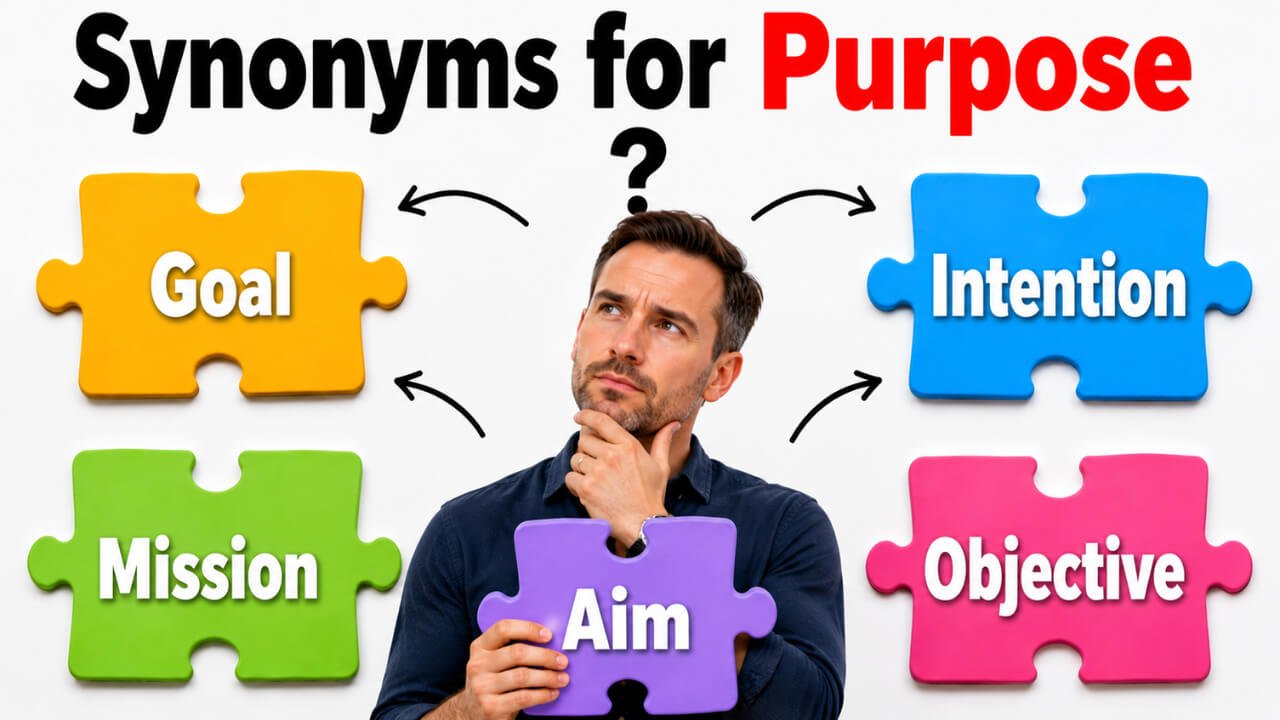
Quick Answer: The best synonyms for purpose are aim, goal, objective, intention, reason, function, mission, motive, role, and point. Use aim or goal for something a person wants to achieve, objective for a formal or measurable result, and intention for a planned action. Reason explains why something exists or happens, while function describes what an object, system, or process does. Mission suits an important responsibility, motive explains what drives an action, and role describes the part something performs.
Pronunciation and Word Details
Word: Purpose
Pronunciation: /ˈpɜː.pəs/
Part of Speech: Noun and verb
Meaning: Purpose means the reason something exists, the result someone wants to achieve, or the function something performs.
US Pronunciation:
UK Pronunciation:
What Does “Purpose” Mean?
Purpose means the reason for doing something, the goal someone wants to achieve, or the function that a person, object, action, or system is intended to perform.
As a noun, purpose commonly refers to an aim or intention. A student may study with the purpose of improving a skill, while a tool may have the purpose of completing a particular task.
Purpose can also describe personal meaning or direction. Someone who feels that their work helps others may describe that work as giving them a sense of purpose.
As a verb, purpose means to intend or plan something, although this use is less common in everyday communication. The noun form is much more widely used.
The exact meaning depends on context. Purpose may refer to a goal, reason, intention, function, mission, or source of personal direction.
Meaning, Tone, and Context of “Purpose”
Purpose is a neutral and versatile word used in casual conversation, formal writing, academic work, professional communication, instructions, reports, and personal development discussions.
When purpose means an aim or goal, it often has a practical and focused tone. A project purpose explains what the project is expected to accomplish.
When purpose means reason, it answers why something exists, happens, or is being done. This meaning is common in explanations, reports, research, and instructions.
When purpose refers to function, it describes what an object, feature, rule, or process is designed to do. This use is common in technical and educational writing.
Purpose may also carry a thoughtful or emotional tone when it describes personal meaning, direction, or motivation. Phrases such as sense of purpose often relate to values, fulfillment, responsibility, and long term direction.
When and How to Use “Purpose”
For a Goal
Use purpose when describing something a person, team, or organization wants to achieve.
Example: The purpose of the training is to improve communication skills.
For an Intention
Use purpose when explaining what someone plans or intends to do.
Example: She visited the office with the purpose of discussing her application.
For a Reason
Use purpose when explaining why something exists, happens, or is necessary.
Example: The purpose of the rule is to protect confidential information.
For a Function
Use purpose when describing what an object, system, feature, or process is designed to do.
Example: The purpose of this button is to save the document.
For a Mission
Use purpose when discussing an important responsibility, cause, or long term commitment.
Example: The group’s purpose is to provide educational support.
For Personal Meaning
Use purpose when referring to a sense of direction, fulfillment, or value in life.
Example: Helping younger students gave him a stronger sense of purpose.
For Deliberate Action
Use the phrase on purpose when an action is intentional rather than accidental.
Example: She left the final section blank on purpose.
Best Synonyms for Purpose
Aim
Synonym: A result that someone wants to achieve.
Example: The main aim of the lesson is to improve vocabulary.
Goal
Synonym: A desired result toward which effort is directed.
Example: Her goal is to complete the course before December.
Objective
Synonym: A specific and often measurable result.
Example: The project achieved its primary objective.
Intention
Synonym: Something that a person plans or means to do.
Example: His intention was to resolve the issue calmly.
Reason
Synonym: An explanation of why something happens or exists.
Example: The main reason for the change was improved safety.
Function
Synonym: The particular job or activity something performs.
Example: The function of the filter is to remove unwanted material.
Mission
Synonym: An important task, duty, or long term goal.
Example: The team’s mission is to make learning more accessible.
Motive
Synonym: The underlying reason that causes someone to act.
Example: Investigators wanted to understand his motive.
Role
Synonym: The part or function performed by someone or something.
Example: Clear communication plays an important role in teamwork.
Point
Synonym: The main reason, meaning, or value of something.
Example: The point of the activity is to encourage creative thinking.
50 Synonyms for Purpose with Short Meanings
- Aim: A result someone wants to achieve.
- Goal: A desired result toward which effort is directed.
- Objective: A specific result that someone intends to accomplish.
- Intention: Something a person plans or means to do.
- Intent: A firm plan or desired result behind an action.
- Reason: An explanation of why something exists or happens.
- Function: The job or activity something is designed to perform.
- Role: The part performed by a person, object, or process.
- Use: The practical job or value of something.
- Point: The main reason, meaning, or value of an action.
- Mission: An important task or long term purpose.
- Motive: The reason that causes someone to act.
- Motivation: The desire or reason that encourages action.
- Plan: A detailed intention for reaching a result.
- Design: A deliberate intention or planned function.
- Target: A particular result someone is trying to reach.
- End: A result toward which an action is directed.
- End Goal: The final result someone wants to achieve.
- Ambition: A strong desire to accomplish something important.
- Aspiration: A hope or desire to achieve a valued result.
- Direction: A chosen path or general course of action.
- Focus: The main subject, concern, or area of attention.
- Meaning: The importance or idea represented by something.
- Significance: The importance or value of something.
- Value: The usefulness, importance, or benefit of something.
- Utility: The practical usefulness of an object or action.
- Application: The practical way something is used.
- Duty: A task or responsibility someone is expected to perform.
- Responsibility: Something a person is required to manage or complete.
- Assignment: A particular task given to someone.
- Task: A specific piece of work that must be completed.
- Agenda: A set of aims, plans, or intended actions.
- Cause: A principle, goal, or mission that someone supports.
- Resolve: A firm intention to achieve or complete something.
- Determination: A strong decision to continue toward a result.
- Drive: Strong motivation that pushes someone toward a goal.
- Commitment: A firm promise or dedication to a purpose.
- Dedication: Strong effort and loyalty toward a goal or responsibility.
- Calling: Work or responsibility that feels personally meaningful.
- Vocation: Work regarded as a meaningful life direction.
- Rationale: The reasoning behind a decision, action, or plan.
- Justification: A valid reason supporting an action or decision.
- Basis: The main reason or foundation for something.
- Vision: A clear idea of a desired future result.
- Priority: A goal or responsibility considered especially important.
- Destination: A final place or result toward which someone moves.
- Intended Outcome: The result an action is designed to produce.
- Desired Result: The result someone hopes or plans to achieve.
- Object: An aim or goal toward which effort is directed.
- Reason for Being: The central reason someone or something exists.
Read Also:
Synonyms for Choice

Synonyms for Purpose by Context
When Purpose Means a Goal
Aim, goal, objective, target, ambition, aspiration, and end goal describe something a person wants to accomplish.
Aim and goal are general and natural in most situations. Objective is more formal and often refers to a specific or measurable result. Target is useful when progress can be measured.
Purpose: The purpose of the campaign is to increase awareness.
Aim: The aim of the campaign is to increase awareness.
Objective: The primary objective is to reach new readers.
Target: The team reached its monthly target.
When Purpose Means an Intention
Intention, intent, plan, design, resolve, and agenda describe what someone means or plans to do.
Intention is neutral and common. Intent often sounds stronger or more formal. Design may describe a deliberate plan behind an action.
Purpose: She contacted the department with the purpose of requesting information.
Intention: She contacted the department with the intention of requesting information.
Intent: His intent was to complete the work honestly.
Plan: Their plan was to finish the review before Friday.
When Purpose Means a Reason
Reason, motive, rationale, justification, basis, and point explain why something happens or why an action is taken.
Reason is the broadest alternative. Motive usually refers to the personal force behind someone’s behavior. Rationale is appropriate in formal explanations.
Purpose: What is the purpose of changing the schedule?
Reason: What is the reason for changing the schedule?
Rationale: The report explains the rationale behind the change.
Motive: Her motive was to help the entire team succeed.
When Purpose Means a Function
Function, role, use, utility, and application explain what something does or how it is used.
Function is best for systems, objects, processes, and body parts. Role describes how someone or something contributes to a larger situation.
Purpose: The purpose of the alarm is to warn users.
Function: The function of the alarm is to warn users.
Role: The alarm plays an important role in workplace safety.
Use: The primary use of the tool is to measure distance.
When Purpose Means a Mission
Mission, cause, calling, vocation, duty, and responsibility describe an important task or meaningful commitment.
Mission often relates to an important long term aim. Calling and vocation describe work that feels personally meaningful.
Purpose: Her purpose is to help students develop confidence.
Mission: Her mission is to help students develop confidence.
Calling: Teaching has always felt like her calling.
Cause: The volunteers worked together for a shared cause.
When Purpose Means Personal Direction
Meaning, direction, focus, significance, drive, and vision describe a sense of personal value or forward movement.
Meaning and significance relate to importance. Direction describes a path, while drive refers to the motivation that keeps someone moving.
Purpose: The new responsibility gave him a sense of purpose.
Meaning: The new responsibility gave his work greater meaning.
Direction: The training helped her find a clearer direction.
Drive: His desire to improve gave him the drive to continue.
Another Word for Purpose
Aim is often the best single replacement for purpose when discussing a result someone wants to achieve. However, the most accurate alternative depends on the sentence.
Use reason when explaining why something exists, function when describing what something does, intention when discussing a plan, and mission when referring to an important responsibility.
Original: The purpose of the lesson is to improve writing skills.
Better Option: The aim of the lesson is to improve writing skills.
Original: What is the purpose of this feature?
Better Option: What is the function of this feature?
Original: She arrived with the purpose of speaking to the manager.
Better Option: She arrived with the intention of speaking to the manager.
Original: The group’s purpose is to support local families.
Better Option: The group’s mission is to support local families.
When Not to Use “Purpose”
Purpose is broad and useful, but a more precise synonym may communicate the meaning more clearly.
Avoid purpose when referring to a measurable project result. Objective or target may be more specific.
Weak: The first purpose of the project is to reduce processing time by ten percent.
Better: The first objective of the project is to reduce processing time by ten percent.
Avoid purpose when discussing the practical job performed by an object.
Weak: The purpose of this switch is controlling the main light.
Better: The function of this switch is to control the main light.
Avoid purpose when explaining a personal cause behind behavior.
Weak: Nobody understood his purpose for hiding the information.
Better: Nobody understood his motive for hiding the information.
Avoid repeating purpose several times in one paragraph.
Weak: The purpose of the course is to explain the purpose of each tool so learners understand its purpose.
Better: The aim of the course is to explain the function of each tool so learners understand its practical use.
Avoid purpose when the sentence requires a simpler word such as reason.
Weak: What was your purpose for leaving early?
Better: What was your reason for leaving early?
Words Commonly Confused With Purpose
Purpose vs Goal: Purpose explains the broader reason behind an action, while goal describes a particular result someone wants to achieve.
Purpose vs Objective: Purpose may be broad and long term, while an objective is usually specific, practical, and measurable.
Purpose vs Intention: Purpose may explain why something exists or what it is designed to do. Intention describes what someone plans or means to do.
Purpose vs Reason: Purpose often involves an intended aim or function. Reason explains why something happened, exists, or was done.
Purpose vs Function: Purpose explains why something was created or used. Function describes the actual job it performs.
Purpose vs Motive: Purpose may be stated openly as an aim. Motive is the underlying personal reason that drives an action.
Purpose vs Mission: Purpose is a broad term for an aim, reason, or function. Mission describes an important and often long term responsibility.
Purpose vs Meaning: Purpose concerns direction, aim, or function. Meaning concerns importance, interpretation, or personal value.
Purpose vs Point: Purpose is more neutral and suitable for formal writing. Point is more conversational when referring to the reason or value of something.
Which Synonym Should You Choose?
Choose aim for a general result that someone wants to achieve.
Choose goal for personal, educational, professional, or long term achievements.
Choose objective for specific and measurable results in reports, essays, projects, and formal plans.
Choose intention when explaining what someone plans or means to do.
Choose intent when the planned action needs stronger or more formal wording.
Choose reason when explaining why something exists, happens, or changes.
Choose function when describing the practical job of an object, feature, process, or system.
Choose role when describing how someone or something contributes to a larger activity.
Choose motive when discussing the personal reason behind someone’s behavior.
Choose mission when referring to an important responsibility or long term commitment.
Choose point in casual speech when discussing the value or main reason for something.
Choose rationale when explaining the logic behind a professional decision, policy, or method.
Choose calling when work or responsibility feels deeply meaningful.
Choose vision when discussing a desired future or broad direction.
Real Life Examples of “Purpose” in Sentences
Original: The purpose of the workshop is to improve leadership skills.
Better Option: The aim of the workshop is to improve leadership skills.
Original: The purpose of this report is to present the results.
Better Option: The objective of this report is to present the results.
Original: She entered the room with the purpose of asking a question.
Better Option: She entered the room with the intention of asking a question.
Original: What is the purpose of this button?
Better Option: What is the function of this button?
Original: His purpose for changing the plan was unclear.
Better Option: His reason for changing the plan was unclear.
Original: The purpose of the team is to support new employees.
Better Option: The mission of the team is to support new employees.
Original: Nobody understood the purpose behind his actions.
Better Option: Nobody understood the motive behind his actions.
Original: The purpose of the introduction is to prepare the reader.
Better Option: The role of the introduction is to prepare the reader.
Original: Helping others gave her a sense of purpose.
Better Option: Helping others gave her life greater meaning.
Original: The purpose of the meeting was to approve the budget.
Better Option: The main objective of the meeting was to approve the budget.
Synonym Groups and Usage Differences
Goal Group
Aim, goal, objective, target, end goal, ambition, and aspiration describe desired achievements.
Aim and goal work in most situations. Objective is formal and measurable, while ambition and aspiration often describe important personal hopes.
Example: Her main goal is to become a more confident speaker.
Intention Group
Intention, intent, plan, design, agenda, and resolve describe planned or deliberate actions.
Intention is neutral, while intent is stronger and more formal. Agenda may suggest a set of goals or, in some contexts, a private aim.
Example: His intention was to provide a clear and honest explanation.
Reason Group
Reason, motive, rationale, justification, basis, and point explain why something exists or happens.
Reason is general. Motive usually concerns behavior, while rationale explains the logic supporting a decision.
Example: The report provides the rationale for changing the procedure.
Function Group
Function, role, use, utility, and application describe practical activity or usefulness.
Function explains what something does. Role explains how it contributes, and utility emphasizes practical value.
Example: The main function of the filter is to improve water quality.
Mission Group
Mission, cause, duty, responsibility, calling, and vocation describe important work or commitment.
Mission and cause often concern a larger social or professional aim. Calling and vocation describe work that feels personally meaningful.
Example: Providing useful guidance became her professional mission.
Motivation Group
Motivation, drive, determination, commitment, and dedication describe the energy or resolve behind an aim.
Motivation explains why someone acts. Drive suggests strong internal energy, while dedication emphasizes continued effort.
Example: Her determination helped her complete the difficult assignment.
Meaning Group
Meaning, significance, value, direction, focus, and vision relate to importance and personal guidance.
Meaning and significance concern importance. Direction and vision concern the path someone intends to follow.
Example: The new responsibility gave his career greater meaning.
Antonyms of Purpose
The opposite of purpose depends on whether purpose means intention, direction, function, or a desired result.
Aimlessness: A lack of clear goals or direction.
Meaninglessness: A lack of value, importance, or significance.
Accident: Something that happens without intention.
Chance: An event that occurs without deliberate planning.
Uncertainty: A lack of confidence about what should be done.
Confusion: A lack of clear understanding or direction.
Indecision: An inability to choose a goal or course of action.
Distraction: Something that moves attention away from the main aim.
Irrelevance: A lack of connection to the main subject or objective.
Uselessness: A lack of practical function or value.
Futility: A condition in which effort is unlikely to achieve a useful result.
Pointlessness: A lack of clear reason, benefit, or value.
Comparison: Purpose vs Related Words
Purpose vs Aim
Purpose often explains the broader reason for doing something. Aim usually describes the result someone wants to achieve.
Example With Purpose: The purpose of the course is to support new writers.
Example With Aim: The aim of the course is to improve writing accuracy.
Purpose vs Goal
Purpose explains why an activity matters, while goal identifies a result that can be reached.
Example With Purpose: Her purpose is to help children enjoy reading.
Example With Goal: Her goal is to provide one hundred books this year.
Purpose vs Objective
Purpose is often broad, while objective is more specific and measurable.
Example With Purpose: The purpose of the program is to improve workplace communication.
Example With Objective: The first objective is to reduce response times.
Purpose vs Intention
Purpose may describe a reason, goal, or function. Intention describes what a person plans to do.
Example With Purpose: The purpose of the visit was to review the building.
Example With Intention: She visited with the intention of asking several questions.
Purpose vs Reason
Purpose often refers to an intended aim. Reason explains why an event, condition, or decision exists.
Example With Purpose: The purpose of the rule is to improve safety.
Example With Reason: Safety was the main reason for introducing the rule.
Purpose vs Function
Purpose describes why something was created or used. Function describes the job it actually performs.
Example With Purpose: The purpose of the device is to improve security.
Example With Function: The function of the device is to detect movement.
Purpose vs Motive
Purpose is usually a stated aim or intended result. Motive is the underlying personal reason for someone’s behavior.
Example With Purpose: His purpose was to collect accurate information.
Example With Motive: His motive for hiding the information remained unclear.
Purpose vs Mission
Purpose is broad and may describe any aim or function. Mission usually refers to an important duty or long term commitment.
Example With Purpose: The purpose of the project is to support learners.
Example With Mission: The team’s mission is to make education more accessible.
Common Phrases and Expressions With “Purpose”
Main Purpose: The most important reason, goal, or function.
Primary Purpose: The first or most significant intended use.
Clear Purpose: An aim or reason that is easy to understand.
Specific Purpose: A clearly defined and limited aim.
Common Purpose: A shared goal that connects different people.
Sense of Purpose: A feeling of meaning, direction, or motivation.
Serve a Purpose: Perform a useful role or function.
For This Purpose: For the particular aim already mentioned.
On Purpose: Deliberately rather than accidentally.
Purpose in Life: A meaningful direction or reason for living.
Common Mistakes to Avoid
Confusing Purpose With Goal
Purpose explains the broader reason behind an activity, while a goal describes a result someone wants to achieve.
Less Precise: My purpose is to finish the report by noon.
Better: My goal is to finish the report by noon.
Using Purpose Instead of Function
Function is usually clearer when discussing what an object, system, or feature does.
Less Precise: The purpose of the key is opening the cabinet.
Better: The function of the key is to open the cabinet.
Using Purpose Instead of Motive
Use motive when discussing the personal reason that drives someone’s behavior.
Less Precise: The investigator examined his purpose for taking the file.
Better: The investigator examined his motive for taking the file.
Repeating Purpose Too Often
Repeated use can make writing sound limited and unnatural.
Repetitive: The purpose of the project is to explain the purpose of each feature and show its purpose.
Improved: The aim of the project is to explain the function of each feature and demonstrate its practical use.
Using a Weak Purpose Statement
A purpose statement should clearly identify the intended aim, reason, or result.
Weak: The purpose of this report is to discuss several things.
Better: The purpose of this report is to evaluate the causes of declining attendance.
Confusing On Purpose With For the Purpose Of
On purpose means intentionally. For the purpose of means in order to achieve a particular result.
On Purpose: He removed the sentence on purpose.
For the Purpose Of: The data was collected for the purpose of evaluating performance.
Using Purpose Where Reason Is More Natural
Purpose can sound overly formal in simple everyday questions.
Unnatural: What was your purpose for calling me?
Natural: What was your reason for calling me?
Conclusion
Understanding synonyms for purpose helps you describe goals, intentions, reasons, functions, and meaningful responsibilities more precisely. Aim and goal work well for desired achievements, while objective suits formal and measurable results. Use intention for a plan, reason for an explanation, function for a practical job, and mission for an important commitment. Motive explains what drives behavior, while meaning and direction express personal value. Choosing the right alternative makes every sentence clearer, more natural, and better suited to its context.
FAQs About Synonyms for Purpose
What Is the Best Synonym for Purpose?
Aim is the best general synonym when purpose means a desired result. Reason, function, and intention may be better in other contexts.
What Is a Formal Synonym for Purpose?
Objective, intention, rationale, function, and mission are useful formal synonyms, depending on the sentence.
What Is Another Word for Life Purpose?
Calling, vocation, meaning, direction, mission, and reason for being can describe a person’s life purpose.
Are Purpose and Goal the Same?
Not completely. Purpose explains why something matters, while goal describes a particular result someone wants to achieve.
What Is the Difference Between Purpose and Function?
Purpose explains why something exists or was created. Function describes the practical job it performs.
Can Reason Replace Purpose?
Reason can replace purpose when the sentence explains why something exists, happens, or is done. It cannot replace purpose in every context.
Is Purpose a Noun or a Verb?
Purpose is mainly used as a noun. It can also be a verb meaning to intend or plan, but that use is less common.
