
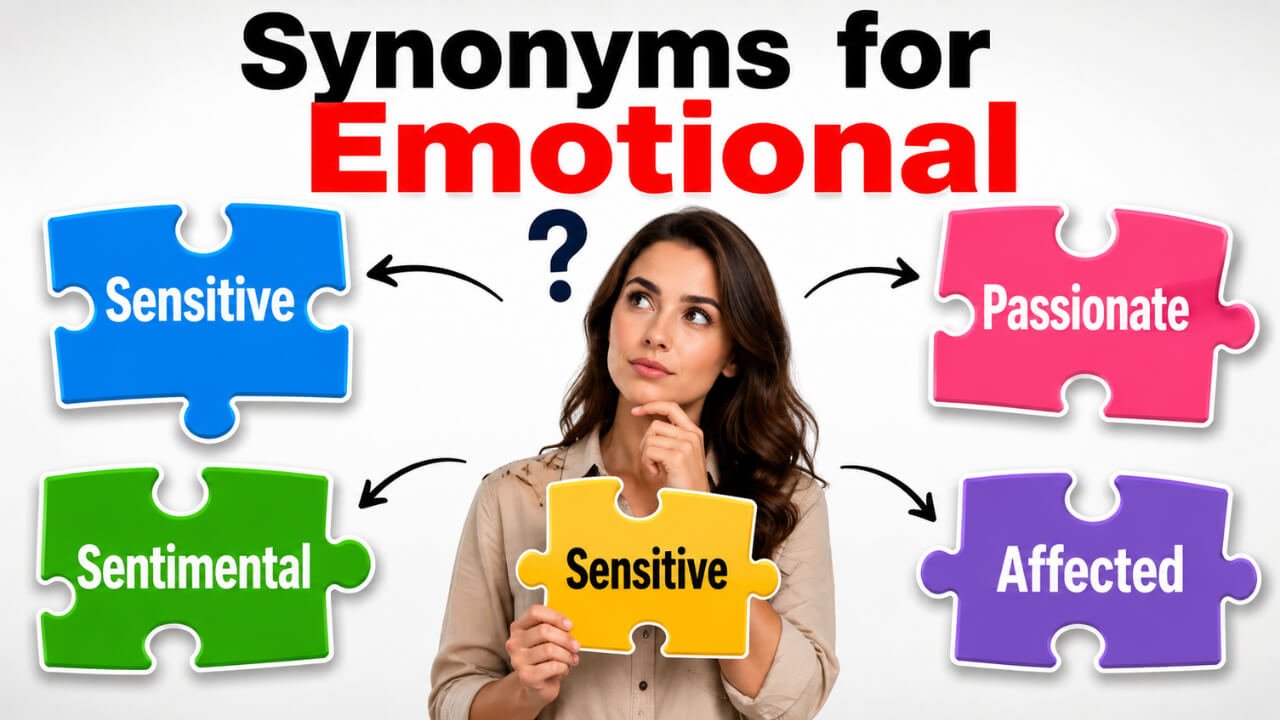
Quick Answer: The best synonyms for emotional are sensitive, expressive, passionate, sentimental, heartfelt, moving, touching, intense, tearful, and overwhelmed. Use sensitive for a person who is easily affected by feelings, expressive for someone who openly shows emotion, and passionate for strong enthusiasm or belief. Heartfelt describes sincere feelings, while moving and touching describe experiences that create emotion. Tearful and overwhelmed are better for visible or powerful reactions. The best choice among synonyms for emotional depends on whether you are describing a person, reaction, message, memory, decision, or experience.
Pronunciation and Word Details
Word: Emotional
Pronunciation: /ɪˈmoʊʃənəl/
Part of Speech: Adjective
Meaning: Connected with feelings or showing strong feelings.
US Pronunciation:
UK Pronunciation:
What Does “Emotional” Mean?
Emotional means connected with feelings or strongly affected by them. It is an adjective that can describe a person, reaction, experience, relationship, memory, speech, decision, or situation.
When emotional describes a person, it may mean that the person shows feelings openly or becomes affected easily. When it describes an event, story, or speech, it means the experience creates powerful feelings in others.
The word can communicate happiness, sadness, anger, affection, excitement, fear, or sympathy. Its precise meaning depends on the sentence.
Person: She became emotional while discussing her childhood.
Reaction: His emotional response showed how deeply the news affected him.
Experience: The reunion was an emotional occasion for the entire family.
Speech: She delivered an emotional message about courage and hope.
Decision: Avoid making an emotional decision while you are angry.
Meaning, Tone, and Context of “Emotional”
Emotional usually has a neutral tone, but its meaning can become positive or negative depending on the context.
It sounds positive when it describes sincerity, compassion, affection, passion, or a meaningful connection. An emotional speech may be honest and heartfelt. An emotional reunion may be touching and joyful.
It may sound negative when it suggests that someone is reacting without enough control or allowing feelings to influence judgment. In this context, words such as reactive, upset, agitated, or overwhelmed may communicate the intended meaning more accurately.
The word is common in everyday conversation, personal writing, professional communication, psychology, education, relationships, storytelling, and discussions about behavior.
Neutral Context: She felt emotional after reading the letter.
Positive Context: His emotional speech brought the audience together.
Negative Context: The discussion became emotional and difficult to manage.
Formal Context: Emotional factors may influence the decision making process.
Conversational Context: I always get emotional during family celebrations.
When and How to Use “Emotional”
For Strong Feelings
Use emotional when someone is experiencing powerful feelings such as happiness, sadness, fear, affection, or anger.
Example: He became emotional when his daughter received the award.
For Visible Reactions
Use emotional when feelings become noticeable through tears, facial expressions, tone of voice, or behavior.
Example: She gave an emotional response and struggled to continue speaking.
For Meaningful Experiences
Use emotional for an event or moment that creates deep personal feelings.
Example: Returning to his childhood home was an emotional experience.
For Moving Stories or Speeches
Use emotional when a story, message, performance, or speech strongly affects an audience.
Example: The speaker shared an emotional account of the family’s journey.
For Sensitive People
Use emotional when describing someone who is easily affected by situations or openly expresses feelings.
Example: He is an emotional person who cares deeply about others.
For Feeling Based Decisions
Use emotional when feelings influence a choice more strongly than facts or careful reasoning.
Example: Her decision was emotional rather than practical.
For Personal Connections
Use emotional when describing bonds based on affection, trust, memory, or shared experience.
Example: The friends developed a strong emotional connection.
For Difficult Discussions
Use emotional when a conversation includes intense personal feelings.
Example: The meeting became emotional when the participants discussed the loss.
Best Synonyms for Emotional
Sensitive
Synonym: Sensitive means easily affected by feelings, comments, or experiences.
Example: She is sensitive to criticism and takes harsh comments seriously.
Expressive
Synonym: Expressive means showing thoughts and feelings clearly.
Example: His expressive face revealed his excitement immediately.
Passionate
Synonym: Passionate means having or showing strong enthusiasm, love, or belief.
Example: She gave a passionate speech about protecting the environment.
Sentimental
Synonym: Sentimental means influenced by tender feelings, memories, or affection.
Example: He became sentimental while looking through old family photographs.
Heartfelt
Synonym: Heartfelt means deeply sincere and honestly felt.
Example: She offered a heartfelt apology for her mistake.
Moving
Synonym: Moving means causing strong feelings, especially sympathy or sadness.
Example: The ceremony included a moving tribute to the volunteers.
Touching
Synonym: Touching means creating feelings of affection, sympathy, or tenderness.
Example: His thoughtful letter was deeply touching.
Intense
Synonym: Intense means extremely strong in feeling or effect.
Example: She experienced intense sadness after hearing the news.
Tearful
Synonym: Tearful means crying or close to crying because of strong feelings.
Example: The actor gave a tearful farewell to the audience.
Overwhelmed
Synonym: Overwhelmed means strongly affected by feelings that are difficult to manage.
Example: He felt overwhelmed by the support he received.
50 Synonyms for Emotional with Short Meanings
- Sensitive: Easily affected by feelings, words, or experiences.
- Expressive: Showing feelings clearly through words, actions, or appearance.
- Passionate: Filled with strong enthusiasm, love, or belief.
- Sentimental: Influenced by tender feelings or personal memories.
- Heartfelt: Deeply sincere and honestly felt.
- Moving: Causing strong feelings of sympathy, sadness, or admiration.
- Touching: Producing tenderness, affection, or sympathy.
- Tearful: Crying or nearly crying because of strong feelings.
- Overwhelmed: Strongly affected by feelings that are difficult to control.
- Affected: Emotionally influenced by an event or experience.
- Stirred: Made to feel strong emotion or excitement.
- Moved: Deeply affected by something meaningful or touching.
- Intense: Extremely strong in feeling or effect.
- Dramatic: Showing feelings in a powerful or noticeable way.
- Demonstrative: Openly showing affection or other emotions.
- Excitable: Becoming enthusiastic or emotional very easily.
- Reactive: Responding quickly and strongly to events or feelings.
- Vulnerable: Open to being emotionally hurt or affected.
- Tender: Gentle, caring, and full of affection.
- Compassionate: Showing concern for another person’s pain or difficulty.
- Empathetic: Able to understand and share another person’s feelings.
- Sympathetic: Showing care and understanding toward someone’s situation.
- Affectionate: Showing love, warmth, or fondness.
- Loving: Feeling or expressing deep care and affection.
- Fervent: Showing very strong and sincere feeling.
- Ardent: Filled with intense enthusiasm, love, or devotion.
- Impassioned: Expressed with powerful and sincere emotion.
- Emotive: Designed or able to create strong feelings.
- Poignant: Creating a powerful feeling of sadness or tenderness.
- Evocative: Bringing strong feelings, memories, or images to mind.
- Sincere: Honest and genuine in feeling or expression.
- Soulful: Expressing deep and thoughtful emotion.
- Agitated: Troubled, excited, or emotionally disturbed.
- Upset: Unhappy, worried, or emotionally disturbed.
- Distressed: Experiencing serious worry, sadness, or pain.
- Troubled: Worried or emotionally affected by problems.
- Anxious: Feeling worried, nervous, or uneasy.
- Sorrowful: Filled with sadness or grief.
- Mournful: Expressing deep sadness, especially after a loss.
- Melancholy: Quietly and thoughtfully sad.
- Joyful: Filled with happiness and positive emotion.
- Elated: Extremely happy and excited.
- Thrilled: Very excited and pleased.
- Angry: Feeling strong displeasure or annoyance.
- Irate: Extremely angry.
- Fearful: Feeling afraid or worried about danger.
- Nervous: Worried, tense, or emotionally uneasy.
- Nostalgic: Feeling affection or sadness about the past.
- Enthusiastic: Showing strong interest, excitement, or approval.
- Zealous: Showing intense energy and commitment toward a cause.
Read Also:
Synonyms for Compassion

Synonyms for Emotional by Context
When Emotional Means Sensitive
Sensitive is the best choice when describing someone who is easily affected by comments, events, criticism, or other people’s feelings. Vulnerable suggests that the person may be easily hurt, while tender describes gentle and caring emotion.
Useful Synonyms: Sensitive, vulnerable, tender, empathetic, sympathetic.
Example: She is sensitive to criticism from people she respects.
Example: He felt vulnerable after sharing his personal experience.
When Emotional Means Expressive
Expressive describes someone who communicates feelings openly. Demonstrative is especially useful for someone who openly shows affection through actions, words, or physical gestures.
Useful Synonyms: Expressive, demonstrative, open, passionate, sincere.
Example: Her expressive voice made the story more powerful.
Example: He is demonstrative and openly shows affection toward his family.
When Emotional Means Passionate
Passionate is suitable when strong feelings are connected with an idea, cause, activity, relationship, or belief. Fervent, ardent, impassioned, enthusiastic, and zealous communicate different levels of energy and commitment.
Useful Synonyms: Passionate, fervent, ardent, impassioned, enthusiastic, zealous.
Example: She delivered an impassioned argument for educational reform.
Example: He is passionate about improving opportunities for young people.
When Emotional Means Moving
Moving and touching describe something that creates strong feelings in an audience. Poignant often combines sadness with tenderness, while evocative brings memories, feelings, or images to mind.
Useful Synonyms: Moving, touching, poignant, evocative, emotive.
Example: The final scene was moving without being overly dramatic.
Example: Her words offered a poignant reminder of the sacrifices people had made.
When Emotional Means Upset
Upset is a broad word for emotional discomfort. Distressed communicates greater suffering, while agitated suggests visible worry, anger, or restlessness.
Useful Synonyms: Upset, distressed, agitated, troubled, anxious.
Example: She became upset after receiving the unexpected message.
Example: The patient appeared agitated and unable to remain calm.
When Emotional Means Tearful
Tearful is appropriate when someone is crying or nearly crying. Overwhelmed describes feelings that have become difficult to manage, whether those feelings are positive or negative.
Useful Synonyms: Tearful, overwhelmed, moved, affected, stirred.
Example: He gave a tearful speech at the farewell ceremony.
Example: She was overwhelmed with happiness when her family arrived.
When Emotional Means Sentimental
Sentimental describes tender feelings connected with affection, memories, relationships, or meaningful objects. Nostalgic specifically refers to feelings about the past.
Useful Synonyms: Sentimental, nostalgic, affectionate, loving, tender.
Example: She felt nostalgic when she visited her former school.
Example: He keeps the watch for sentimental reasons.
When Emotional Means Intensely Happy
Emotional does not always mean sad. It can describe powerful happiness, excitement, relief, or gratitude.
Useful Synonyms: Joyful, elated, thrilled, excited, overwhelmed.
Example: The family was elated by the wonderful announcement.
Example: She felt overwhelmed with gratitude after receiving their support.
Another Word for Emotional
Sensitive is often the best single replacement for emotional when describing a person who is easily affected by feelings. However, it is not suitable in every sentence.
Use passionate for strong enthusiasm, moving for an affecting experience, heartfelt for sincere words, sentimental for tender memories, and overwhelmed for feelings that are difficult to manage.
Original: She became emotional after reading the message.
Better Option: She became tearful after reading the message.
Original: He gave an emotional speech about the project.
Better Option: He gave a passionate speech about the project.
Original: It was an emotional story about friendship.
Better Option: It was a moving story about friendship.
Original: She sent an emotional message of thanks.
Better Option: She sent a heartfelt message of thanks.
When Not to Use “Emotional”
Avoid emotional when a more precise word can explain the exact feeling, reaction, or effect. The word can become vague when the reader does not know whether the person feels sad, angry, happy, afraid, or excited.
It may also sound judgmental when used to dismiss another person’s concerns. Calling someone emotional can imply that the person is unreasonable, even when their reaction is understandable.
When the Exact Feeling Is Known
Weak: She felt emotional about the result.
Better: She felt disappointed about the result.
When Describing Strong Happiness
Weak: He was emotional after winning the competition.
Better: He was thrilled after winning the competition.
When Describing Sadness
Weak: The family was emotional after the loss.
Better: The family was deeply sorrowful after the loss.
When Describing Anger
Weak: The customer became emotional during the discussion.
Better: The customer became agitated during the discussion.
When Describing a Moving Experience
Weak: The ceremony was very emotional.
Better: The ceremony was deeply moving.
When Writing Formal Reports
Weak: The participant gave an emotional answer.
Better: The participant gave a distressed and tearful answer.
When the Word Sounds Judgmental
Weak: She is too emotional to understand the issue.
Better: She is currently upset and may need time to consider the issue.
Words Commonly Confused With Emotional
Emotional vs Sensitive: Emotional describes a connection with feelings or a strong display of feelings. Sensitive describes someone who notices feelings easily or is strongly affected by experiences and comments.
Emotional vs Sentimental: Emotional is a broad word for strong feelings. Sentimental usually refers to tender affection, memories, or personal meaning.
Emotional vs Passionate: Emotional can describe any strong feeling. Passionate usually communicates enthusiasm, devotion, love, or commitment.
Emotional vs Moving: Emotional can describe a person, reaction, or event. Moving usually describes something that creates strong feelings in another person.
Emotional vs Touching: Emotional has a broad meaning. Touching specifically describes something that creates tenderness, sympathy, or affection.
Emotional vs Dramatic: Emotional focuses on genuine feelings. Dramatic may suggest that feelings are shown in an exaggerated or highly noticeable way.
Emotional vs Irrational: Emotional means influenced by feelings. Irrational means not based on clear reasoning. Emotional behavior is not automatically irrational.
Emotional vs Empathetic: Emotional means feeling or showing emotion. Empathetic means understanding and sharing another person’s feelings.
Emotional vs Emotive: Emotional describes feelings or people affected by feelings. Emotive usually describes language, images, or subjects that are designed to create emotion.
Which Synonym Should You Choose?
Choose sensitive when describing someone who is easily affected by feelings, criticism, or difficult experiences.
Choose expressive when someone communicates feelings clearly through words, facial expressions, gestures, or tone.
Choose passionate when describing strong enthusiasm, commitment, love, or belief.
Choose heartfelt when a message, apology, wish, or expression is deeply sincere.
Choose sentimental when feelings are connected with affection, memories, family objects, or meaningful traditions.
Choose moving when a story, speech, event, or performance creates deep emotion.
Choose touching when something creates warmth, tenderness, sympathy, or affection.
Choose poignant when an experience creates a mixture of sadness, beauty, and tenderness.
Choose distressed when someone is experiencing serious emotional pain or worry.
Choose agitated when someone appears visibly worried, restless, angry, or disturbed.
Choose overwhelmed when feelings become so strong that they are difficult to manage.
Choose tearful when someone is crying or close to crying.
Choose impassioned in formal writing when describing a powerful speech, argument, or appeal.
Choose emotive when language, imagery, or a subject is intended to create an emotional response.
Choose empathetic when describing the ability to understand and share another person’s feelings.
Real Life Examples of “Emotional” in Sentences
Original: She became emotional while discussing her childhood.
Better Option: She became sentimental while discussing her childhood.
Original: He delivered an emotional speech about equal opportunities.
Better Option: He delivered an impassioned speech about equal opportunities.
Original: The final chapter was highly emotional.
Better Option: The final chapter was deeply moving.
Original: She wrote an emotional letter to her parents.
Better Option: She wrote a heartfelt letter to her parents.
Original: He felt emotional when he returned to his hometown.
Better Option: He felt nostalgic when he returned to his hometown.
Original: The manager became emotional during the disagreement.
Better Option: The manager became agitated during the disagreement.
Original: She was emotional after receiving the award.
Better Option: She was overwhelmed with happiness after receiving the award.
Original: The audience became emotional during the performance.
Better Option: The audience was deeply moved during the performance.
Original: He is emotional and understands other people’s pain.
Better Option: He is empathetic and understands other people’s pain.
Original: They shared an emotional goodbye at the station.
Better Option: They shared a tearful goodbye at the station.
Synonym Groups and Usage Differences
Sensitivity Group
Sensitive, vulnerable, tender, empathetic, and sympathetic describe different forms of emotional awareness. Sensitive means easily affected, while empathetic means understanding another person’s feelings. Vulnerable suggests openness to emotional pain.
Example: Her empathetic response helped the child feel understood.
Expression Group
Expressive, demonstrative, sincere, heartfelt, and soulful describe feelings that are openly or meaningfully communicated. Expressive focuses on clear communication, while heartfelt emphasizes honesty and sincerity.
Example: He gave a heartfelt expression of gratitude.
Passion Group
Passionate, fervent, ardent, impassioned, enthusiastic, and zealous describe strong energy, belief, or commitment. Impassioned is particularly useful for speeches and arguments.
Example: The advocate made an impassioned appeal for change.
Moving Experience Group
Moving, touching, poignant, evocative, and emotive describe things that create feelings in others. Poignant often includes sadness, while evocative brings memories or images to mind.
Example: The photograph was evocative of peaceful childhood summers.
Distress Group
Upset, distressed, troubled, anxious, agitated, and overwhelmed describe emotional difficulty. Distressed is stronger than upset, while agitated suggests visible restlessness or tension.
Example: She appeared distressed after hearing the unexpected news.
Sadness Group
Sorrowful, mournful, melancholy, tearful, and nostalgic relate to sadness in different ways. Mournful suggests grief, while melancholy describes quiet and reflective sadness.
Example: The music created a gentle, melancholy atmosphere.
Happiness Group
Joyful, elated, thrilled, enthusiastic, and overwhelmed can describe powerful positive emotion. Elated is stronger than happy, while thrilled combines happiness with excitement.
Example: The students were elated when their project was selected.
Anger and Fear Group
Angry, irate, fearful, nervous, reactive, and agitated describe strong uncomfortable feelings. Irate means extremely angry, while nervous describes worry or unease.
Example: The passenger became irate after the repeated delay.
Antonyms of Emotional
The opposite of emotional changes according to the intended meaning. It may describe someone who remains calm, a decision based on logic, or an experience that does not create strong feelings.
Antonym: Calm means peaceful and not visibly upset.
Antonym: Composed means able to control feelings and behavior.
Antonym: Unemotional means showing little or no visible feeling.
Antonym: Detached means not personally or emotionally involved.
Antonym: Indifferent means not interested, concerned, or affected.
Antonym: Impassive means showing no emotion through expression or behavior.
Antonym: Stoic means enduring difficulty without openly showing pain.
Antonym: Rational means guided by reasoning rather than emotion.
Antonym: Logical means based on clear and organized reasoning.
Antonym: Objective means influenced by facts instead of personal feelings.
Antonym: Reserved means not openly showing thoughts or emotions.
Antonym: Unaffected means not emotionally changed or influenced.
Comparison: Emotional vs Related Words
Emotional vs Sensitive
Emotional is a general word connected with feelings. Sensitive describes someone who is easily affected or highly aware of feelings.
Example With Emotional: She became emotional during the farewell.
Example With Sensitive: She is sensitive to criticism about her work.
Emotional vs Passionate
Emotional can refer to sadness, joy, anger, fear, or affection. Passionate usually describes intense enthusiasm, love, or commitment.
Example With Emotional: He became emotional while thanking his family.
Example With Passionate: He is passionate about improving public education.
Emotional vs Sentimental
Emotional covers many kinds of feelings. Sentimental focuses on tender feelings related to affection, memories, or meaningful objects.
Example With Emotional: She had an emotional reaction to the news.
Example With Sentimental: She became sentimental while reading old letters.
Emotional vs Heartfelt
Emotional can describe any strong feeling. Heartfelt describes feelings or words that are deeply sincere.
Example With Emotional: He gave an emotional response.
Example With Heartfelt: He offered a heartfelt apology.
Emotional vs Moving
Emotional can describe the person feeling the emotion or the event creating it. Moving mainly describes something that affects other people deeply.
Example With Emotional: She became emotional during the ceremony.
Example With Moving: The ceremony included a moving tribute.
Emotional vs Touching
Emotional is broad and may include pleasant or unpleasant feelings. Touching usually creates sympathy, tenderness, affection, or warmth.
Example With Emotional: The reunion was emotional for everyone.
Example With Touching: The child’s message was simple but touching.
Emotional vs Dramatic
Emotional describes genuine feeling. Dramatic describes feelings or actions that are powerful, noticeable, or possibly exaggerated.
Example With Emotional: She cried because the moment held personal meaning.
Example With Dramatic: His dramatic reaction surprised everyone in the room.
Emotional vs Emotive
Emotional usually describes a person, reaction, or experience. Emotive often describes words, images, topics, or techniques that create strong feelings.
Example With Emotional: The speaker became emotional while sharing the story.
Example With Emotive: The speaker used emotive language to influence the audience.
Common Phrases and Expressions With “Emotional”
Emotional Support: Comfort, care, and understanding given during a difficult time.
Emotional Response: A reaction based on feelings.
Emotional Connection: A strong bond based on affection, trust, or shared experience.
Emotional Intelligence: The ability to recognize, understand, and manage emotions.
Emotional Wellbeing: A person’s ability to understand feelings and cope with challenges.
Emotional Experience: An event that creates powerful feelings.
Emotional Reaction: A visible or internal response caused by feelings.
Emotional Moment: A brief experience filled with strong feeling.
Emotional Speech: A speech that expresses or creates powerful feelings.
Emotional Decision: A choice influenced mainly by feelings rather than careful reasoning.
Common Mistakes to Avoid
Using Emotional Without Naming the Feeling
Emotional can become vague when the exact feeling is already known. Use joyful, anxious, angry, sorrowful, or thrilled when greater precision is needed.
Vague: She was emotional after the announcement.
Clear: She was thrilled after the announcement.
Treating Emotional as Automatically Negative
Being emotional does not always mean being upset, weak, or unreasonable. A person may become emotional because of happiness, gratitude, relief, pride, or affection.
Incorrect Idea: He became emotional, so he must have been sad.
Better Understanding: He may have been joyful, grateful, relieved, or deeply moved.
Using Emotional and Sensitive as Exact Matches
Emotional refers broadly to feelings. Sensitive specifically suggests that someone is easily affected or aware of feelings.
Weak: The moving story was sensitive.
Better: The moving story was emotional.
Confusing Emotional With Emotive
Use emotional for feelings, people, and reactions. Use emotive for language, images, or subjects that create emotion.
Incorrect: The article used emotional language to influence readers.
Better: The article used emotive language to influence readers.
Repeating Emotional Too Often
Repeating emotional can make a paragraph sound general and monotonous. Replace it with words that identify the exact feeling or effect.
Repetitive: It was an emotional event with emotional speeches and emotional reactions.
Better: It was a moving event with heartfelt speeches and tearful reactions.
Using a Strong Synonym in a Mild Situation
Words such as distressed, irate, overwhelmed, and impassioned communicate powerful feelings. Do not use them when the reaction is mild.
Unnatural: She was distressed because her tea became cold.
Better: She was slightly disappointed because her tea became cold.
Calling Someone Too Emotional
This phrase can sound dismissive or judgmental. Describe the person’s observable feeling or behavior more respectfully.
Judgmental: He is too emotional to discuss the problem.
Better: He is currently upset and may need time before discussing the problem.
Conclusion
The best synonyms for emotional depend on the feeling, reaction, person, or experience being described. Choose sensitive for someone easily affected, expressive for openly shown feelings, passionate for strong enthusiasm, and heartfelt for sincerity. Moving, touching, poignant, and evocative suit stories or experiences that affect an audience. Tearful, distressed, agitated, and overwhelmed describe visible or difficult reactions. Using precise synonyms for emotional makes writing clearer, more respectful, and more meaningful while helping readers understand the exact emotion involved.
FAQs About Synonyms for Emotional
What Is the Best Synonym for Emotional?
Sensitive is a useful replacement when describing a person. Moving works better for an experience, while heartfelt is best for sincere words or feelings.
What Is a Positive Synonym for Emotional?
Heartfelt, passionate, expressive, compassionate, empathetic, loving, and joyful are positive alternatives, depending on the context.
What Is a Formal Synonym for Emotional?
Impassioned, emotive, affected, distressed, and expressive can work in formal writing. Choose the word that identifies the exact feeling or effect.
What Is Another Word for an Emotional Person?
Sensitive, expressive, demonstrative, passionate, vulnerable, or excitable may describe an emotional person. The best choice depends on how the person experiences or shows feelings.
What Is Another Word for an Emotional Story?
Moving, touching, poignant, evocative, or emotive can describe a story that creates strong feelings.
Is Sentimental the Same as Emotional?
Not exactly. Emotional refers broadly to strong feelings, while sentimental usually describes tender feelings connected with affection, memories, or meaningful objects.
Can Emotional Describe Happiness?
Yes. Emotional can describe happiness, gratitude, relief, pride, excitement, or love. It does not refer only to sadness or distress.
