
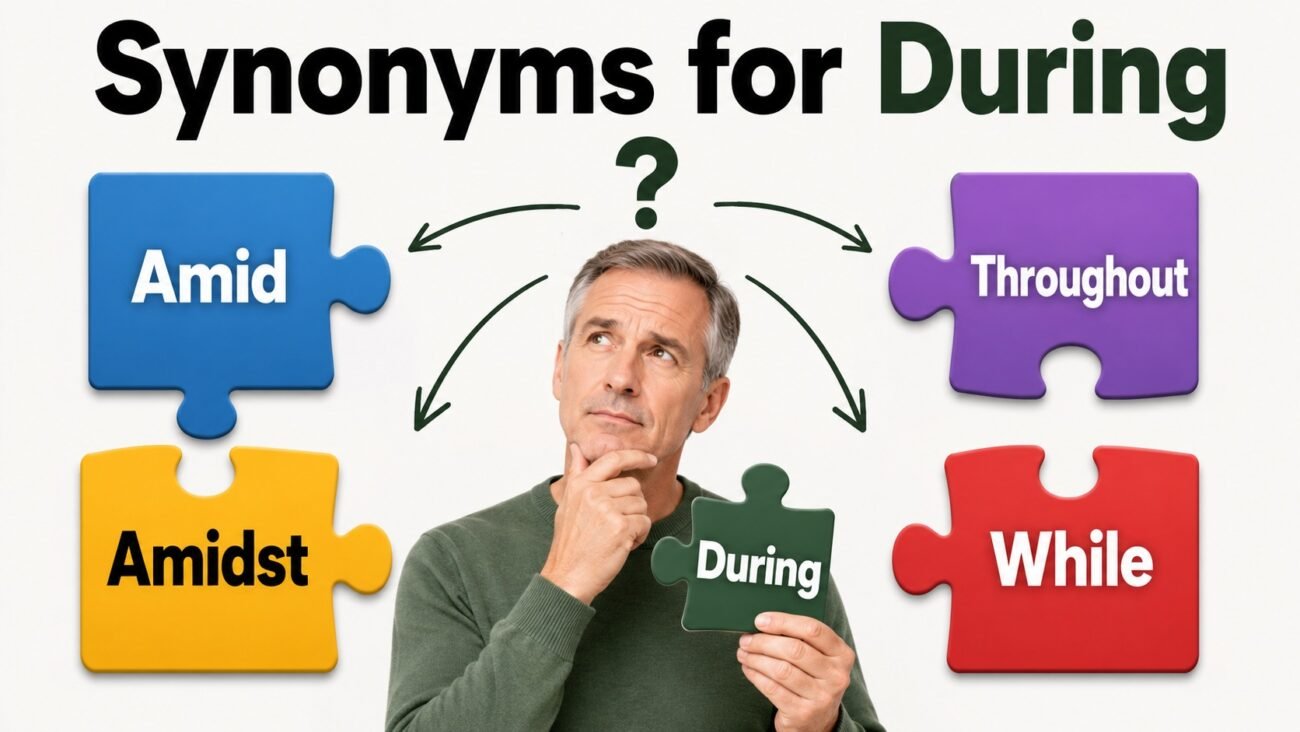
Quick Answer: The best synonyms for during include throughout, in, within, over, amid, while, as, through, in the course of, and for the duration of. Use throughout when something happens from beginning to end, in or within when something happens inside a time period, amid when something happens in the middle of a situation, and while when two actions happen at the same time. The best synonym depends on whether you mean a full period, a specific moment, a background situation, or a simultaneous action.
Pronunciation and Word Details
Word: During
Pronunciation: /ˈdʊrɪŋ/
Part of Speech: Preposition
Meaning: During means at some time in the period when an event, action, or situation is happening.
US Pronunciation:
UK Pronunciation:
What Does “During” Mean?
Direct Answer: “During” means at some point within the time of an event, action, activity, or situation.
“During” is a preposition. It usually comes before a noun or noun phrase, such as during the meeting, during the summer, during class, or during the trip. It does not normally come before a full clause with a subject and verb.
Example: She took notes during the lecture.
In this sentence, the note taking happened while the lecture was happening. The word can describe one short moment inside a longer event, an action that continues through a whole period, or something that happens in the middle of a situation.
Time Context: He called me during lunch.
Event Context: The lights went out during the show.
Situation Context: Many people stayed calm during the storm.
Meaning, Tone, and Context of “During”
Tone: “During” is neutral, clear, and common in both formal and casual English.
It is not emotional, harsh, poetic, or overly academic. It works well in everyday speech, school writing, business writing, reports, instructions, essays, stories, and explanations. Because it is simple and direct, it is often the safest choice when describing time.
Formal Context: The issue appeared during the final review.
Casual Context: I fell asleep during the movie.
Academic Context: The data changed during the experiment.
Professional Context: Please keep your phone silent during the meeting.
“During” is most useful when the focus is not the exact second something happened, but the fact that it happened inside a larger time period or event.
When and How to Use “During”
For Events: Use “during” when something happens inside an event.
Example: The speaker answered questions during the seminar.
For Time Periods: Use “during” when something happens within a named time period.
Example: We visited the museum during the afternoon.
For Activities: Use “during” when one action happens while an activity is taking place.
Example: She drank water during the workout.
For Situations: Use “during” when something happens in the middle of a condition or circumstance.
Example: The team stayed focused during the crisis.
For Formal Writing: Use “during” when you need a clean and professional way to connect an action with a time period.
Example: Several changes were made during the review process.
Best Synonyms for During
Throughout: From the beginning to the end of a period.
Example: Rain continued throughout the night.
In: At some time inside a period.
Example: The meeting happened in the morning.
Within: Inside the limits of a time period.
Example: The report was completed within the week.
Over: Across a period of time.
Example: Sales improved over the summer.
Amid: In the middle of a situation.
Example: The city stayed calm amid the storm.
While: At the same time as another action.
Example: She listened while he explained the plan.
As: At the same time that something happens.
Example: The crowd cheered as the team entered.
Through: From the start to the end of a time period.
Example: He worked through the night.
In the Course Of: While something is happening or developing.
Example: New facts appeared in the course of the investigation.
For the Duration Of: For the whole time that something lasts.
Example: The road stayed closed for the duration of the event.
50 Synonyms for During with Short Meanings
- Throughout: From beginning to end.
- In: Inside a time period.
- Within: Inside the limits of time.
- Over: Across a period.
- Amid: In the middle of a situation.
- Amidst: In the middle of events or conditions.
- While: At the same time as.
- As: At the time that.
- Through: From start to finish.
- For: Over a length of time.
- In the Course Of: While something is happening.
- Over the Course Of: Across the progress of a period.
- Throughout the Course Of: From start to end of a process.
- For the Duration Of: For the whole time.
- In the Period Of: Inside a named time period.
- Within the Period Of: Inside a set period.
- At the Time Of: When something happens.
- Around the Time Of: Near the time of an event.
- In the Middle Of: At a point inside an event.
- In the Midst Of: In the middle of a situation.
- At Some Point In: At an unspecified time inside a period.
- At Some Stage Of: At a certain part of a process.
- Along the Way: During the progress of something.
- All Through: During the whole period.
- The Whole Time: For the entire time.
- From Start to Finish: Through the complete period.
- From Beginning to End: Across the full time.
- In Between: During the space between two times or events.
- Between: In the time separating two points.
- At: Used for a specific time or event.
- On: Used for a specific day or occasion.
- When: At the time that something happens.
- Whenever: At any time that something happens.
- Meanwhile: At the same time.
- At the Same Time As: While another thing is happening.
- Simultaneously With: Happening at the same time as.
- Concurrent With: Existing or happening at the same time.
- Coinciding With: Happening at the same time as another event.
- In Conjunction With: Happening together with something else.
- Alongside: Happening at the same time as something else.
- Under: During the rule, control, or condition of something.
- Under the Conditions Of: While certain conditions exist.
- In Times Of: During a particular type of situation.
- At the Height Of: During the most intense part of something.
- At the Peak Of: During the highest or strongest point.
- In the Event Of: During or if a situation happens.
- In the Process Of: While an action is being done.
- Through the Period Of: Across the full period.
- In the Span Of: Within a particular length of time.
- Across: Spread over a period or range.
Read Also:
Synonyms for Insight

Synonyms for During by Context
When During Means Throughout a Period
Use these synonyms when something continues from the beginning to the end of a time period.
Throughout: The best choice when something lasts the whole time.
Example: The baby slept throughout the flight.
Through: Useful when an action continues until the end of a period.
Example: He studied through the night.
All Through: A more conversational phrase for the whole period.
Example: She stayed cheerful all through the trip.
For the Duration Of: A formal phrase meaning for the entire time.
Example: The entrance remained closed for the duration of the ceremony.
When During Means Inside a Time Period
Use these synonyms when something happens at one point or several points inside a larger period.
In: Best for general time periods, months, years, seasons, and parts of the day.
Example: We met in the evening.
Within: Best when something happens before the end of a time limit.
Example: The answer arrived within an hour.
At Some Point In: Useful when the exact time is not known.
Example: The mistake happened at some point in the process.
In the Period Of: A formal option for reports or explanations.
Example: The change occurred in the period of review.
When During Means Amid a Situation
Use these synonyms when something happens in the middle of a condition, event, crisis, change, or busy situation.
Amid: Best for serious, formal, or news style contexts.
Example: The company continued operating amid uncertainty.
Amidst: Similar to amid, but slightly more formal or literary.
Example: They found hope amidst difficulty.
In the Midst Of: Good for active or intense situations.
Example: She remained calm in the midst of confusion.
At the Height Of: Best for the strongest or busiest part of a situation.
Example: The decision was made at the height of the crisis.
When During Means While Something Happens
Use these synonyms when two actions or events happen at the same time.
While: Best when followed by a full clause.
Example: She cooked while he cleaned the table.
As: Best when two actions happen together or one action happens at the moment another begins.
Example: The audience stood as the singer walked in.
Meanwhile: Best when describing a separate action happening at the same time.
Example: The team prepared the room. Meanwhile, the guests waited outside.
Simultaneously With: Best for formal or technical writing.
Example: The update ran simultaneously with the backup process.
Another Word for During
Best Single Replacement: The best single replacement for “during” is usually throughout when you mean the whole time, and in when you mean inside a general time period.
The best alternative depends on the sentence. “During” is often followed by a noun, while “while” is usually followed by a full clause. That means you should choose the replacement based on grammar as well as meaning.
Original: She felt nervous during the interview.
Better Option: She felt nervous throughout the interview.
Original: The package arrived during the morning.
Better Option: The package arrived in the morning.
Original: He stayed calm during the emergency.
Better Option: He stayed calm amid the emergency.
Original: They talked during dinner.
Better Option: They talked over dinner.
When Not to Use “During”
Do not use “during” when another word gives a clearer meaning. It can sound weak or vague if the sentence needs exact timing, full duration, or simultaneous action.
Weak: I finished the report during two hours.
Better: I finished the report within two hours.
Weak: She was reading during I was cooking.
Better: She was reading while I was cooking.
Weak: The rain lasted during the night.
Better: The rain lasted throughout the night.
Weak: He called during 5 p.m.
Better: He called at 5 p.m.
Weak: We learned many things during the way.
Better: We learned many things along the way.
Use “during” before a noun phrase, not before a full subject and verb clause. Use “while” when you need to connect two complete actions.
Words Commonly Confused With During
During vs While: “During” comes before a noun or noun phrase. “While” comes before a subject and verb.
Example: She slept during the movie.
Example: She slept while the movie was playing.
During vs For: “During” tells when something happens. “For” tells how long something lasts.
Example: I felt tired during class.
Example: I slept for two hours.
During vs In: “During” points to an event or period while it is happening. “In” often points to a general time period.
Example: He spoke during the meeting.
Example: He spoke in the morning.
During vs Throughout: “During” can mean at one point or several points inside a period. “Throughout” means from beginning to end.
Example: I checked my phone during the movie.
Example: The child talked throughout the movie.
During vs Amid: “During” focuses on time. “Amid” focuses on being in the middle of a situation or condition.
Example: They left during the storm.
Example: They stayed calm amid the storm.
Which Synonym Should You Choose?
Choose throughout when something happens from the beginning to the end of a period.
Choose in when writing about a general time period, such as the morning, evening, summer, or year.
Choose within when something happens before the end of a time limit.
Choose over when something develops across a period of time.
Choose amid when something happens in the middle of a serious, busy, or changing situation.
Choose while when two complete actions happen at the same time.
Choose as when one action happens at the same moment another action happens.
Choose through when something continues until the end of a period.
Choose in the course of for formal writing, reports, essays, and professional explanations.
Choose for the duration of when something lasts the entire time an event continues.
Real Life Examples of “During” in Sentences
Original: She stayed quiet during the meeting.
Better Option: She stayed quiet throughout the meeting.
Original: I received your message during lunch.
Better Option: I received your message at lunch.
Original: The lights went off during the storm.
Better Option: The lights went off amid the storm.
Original: He worked during the night.
Better Option: He worked through the night.
Original: We learned new skills during the training.
Better Option: We learned new skills in the course of the training.
Original: Sales increased during the summer.
Better Option: Sales increased over the summer.
Original: She smiled during the speech.
Better Option: She smiled while the speech was being delivered.
Original: The rules changed during the process.
Better Option: The rules changed at some stage of the process.
Original: He stayed inside during the rain.
Better Option: He stayed inside while it was raining.
Original: The shop was closed during the event.
Better Option: The shop was closed for the duration of the event.
Synonym Groups and Usage Differences
Accuracy Group
This group helps when you want to explain when something happened inside a specific time period.
Useful Words: In, within, at the time of, at some point in.
Example: The decision was made within the review period.
Duration Group
This group is best when something continues for the full length of time.
Useful Words: Throughout, through, all through, for the duration of.
Example: The alarm rang throughout the night.
Situation Group
This group works when something happens in the middle of a condition, crisis, change, or event.
Useful Words: Amid, amidst, in the midst of, at the height of.
Example: The team remained organized amid the pressure.
Simultaneous Action Group
This group is useful when two actions happen at the same time.
Useful Words: While, as, meanwhile, simultaneously with.
Example: She wrote notes while the teacher explained the lesson.
Progress Group
This group fits processes, development, projects, studies, investigations, and long activities.
Useful Words: In the course of, over the course of, along the way, in the process of.
Example: Several errors were found in the course of testing.
Antonyms of During
The opposite of “during” depends on the meaning. Since “during” refers to something happening inside a time period, its antonyms often refer to time before, after, outside, or beyond that period.
Before: Earlier than a time or event.
After: Later than a time or event.
Outside: Not within a particular time, place, or situation.
Beyond: Past the limits of a period or range.
Following: Coming after an event or time.
Prior To: Before something happens.
Subsequent To: After something happens.
Apart From: Separate from a time, event, or situation.
Not During: Outside the time when something is happening.
Later Than: After a stated time or event.
Comparison: During vs Related Words
During vs While
“During” is followed by a noun or noun phrase. “While” is followed by a subject and verb.
Example With During: She took notes during the lecture.
Example With While: She took notes while the teacher was speaking.
During vs Throughout
“During” can mean at one point inside a period. “Throughout” means from the beginning to the end.
Example With During: He checked his phone during the movie.
Example With Throughout: He talked throughout the movie.
During vs For
“During” tells when something happened. “For” tells how long something lasted.
Example With During: I felt sleepy during class.
Example With For: I slept for one hour.
During vs In
“During” often refers to an event or activity. “In” often refers to a more general time period.
Example With During: We discussed the issue during the meeting.
Example With In: We discussed the issue in the morning.
During vs Amid
“During” focuses on time. “Amid” focuses on being in the middle of a situation.
Example With During: They left during the storm.
Example With Amid: They remained hopeful amid the storm.
Common Phrases and Expressions With During
During the Day: At some time between morning and evening.
During the Night: At some time in the night.
During the Week: At some time from Monday to the end of the week.
During the Meeting: While the meeting is happening.
During Class: While a class is taking place.
During Lunch: While lunch is happening.
During the Trip: At some time while traveling.
During the Process: While a process is happening.
During the Summer: At some time in the summer season.
During Difficult Times: While facing a hard period or situation.
Common Mistakes to Avoid
One common mistake is using “during” before a full clause. Since “during” is a preposition, it should be followed by a noun or noun phrase.
Incorrect: During I was studying, my phone rang.
Correct: While I was studying, my phone rang.
Another mistake is using “during” when the sentence needs length of time. Use “for” when you mean how long something lasted.
Incorrect: I waited during two hours.
Correct: I waited for two hours.
Avoid using “during” too many times in one paragraph. Repetition can make writing sound flat.
Weak: During the meeting, during the discussion, several questions came up during the review.
Better: During the meeting, several questions came up throughout the review.
Also avoid choosing a synonym without checking grammar. “While” and “as” usually need a full clause, but “during” needs a noun phrase.
Incorrect: He listened during she explained.
Correct: He listened while she explained.
Conclusion
Understanding synonyms for during helps you describe time with more accuracy and variety. Use during for a general event or period, throughout for the whole time, within for time limits, over for gradual change, amid for situations, and while for actions happening at the same time. The best choice depends on grammar, tone, and meaning. When you choose the right synonym, your writing becomes clearer, smoother, and more natural.
FAQs About Synonyms for During
What is the best synonym for during?
The best synonym for “during” depends on context. Use “throughout” for the whole period, “in” for a general time, “within” for a time limit, and “while” for two actions happening together.
Can I use while instead of during?
Yes, but only in the right grammar structure. Use “during” before a noun phrase and “while” before a full clause.
Example: She slept during the movie.
Example: She slept while the movie was playing.
What is a formal synonym for during?
Formal synonyms for “during” include “in the course of,” “over the course of,” “within the period of,” and “for the duration of.” These work well in reports, essays, and professional writing.
What is another word for during a meeting?
Another word for “during a meeting” can be “in a meeting,” “throughout the meeting,” “in the course of the meeting,” or “over the course of the meeting,” depending on the meaning.
What is the difference between during and throughout?
“During” can mean at one point or several points within a period. “Throughout” means from the beginning to the end of the period.
Example: He spoke during the class.
Example: He spoke throughout the class.
Is during formal or informal?
“During” is neutral. It works in both formal and informal writing. You can use it in conversation, emails, essays, reports, stories, and instructions.
What is the opposite of during?
Opposites of “during” include “before,” “after,” “outside,” “beyond,” “prior to,” and “subsequent to.” The correct antonym depends on whether you mean time before, time after, or outside a period.
