
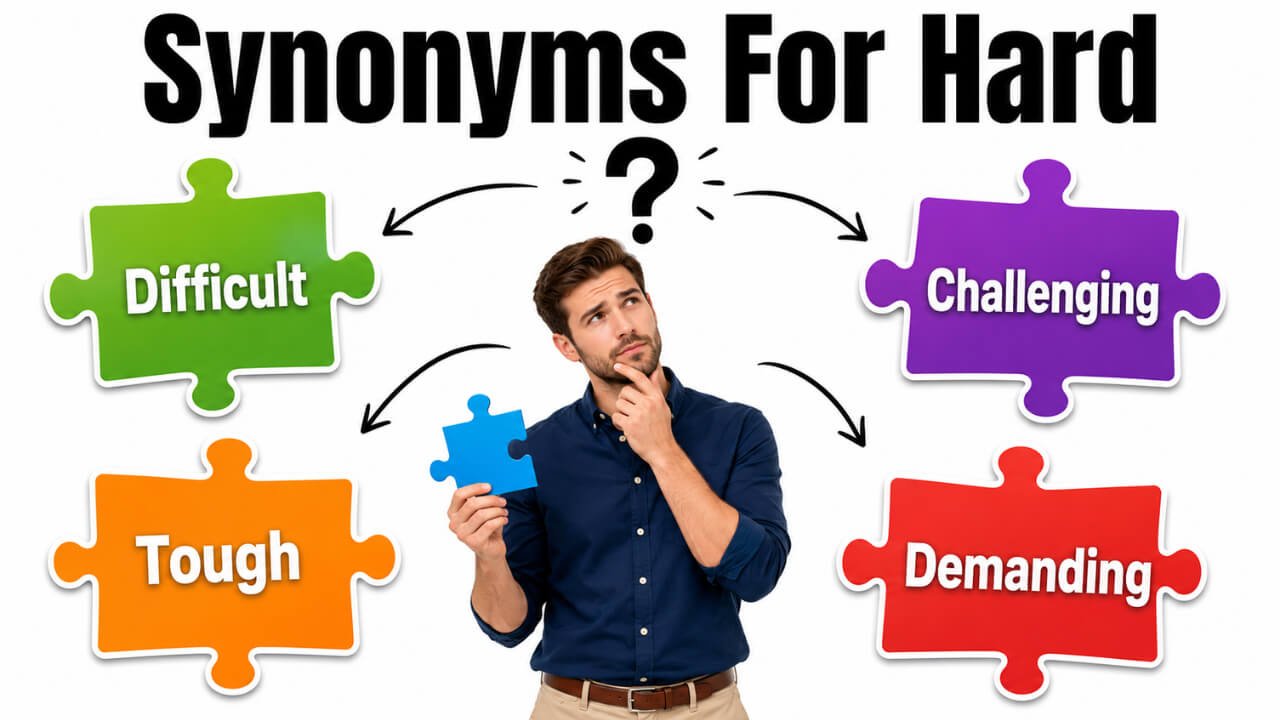
Quick Answer: Synonyms for hard include difficult, challenging, tough, demanding, strenuous, arduous, complicated, harsh, firm, and solid. Use difficult for general problems, challenging for tasks that require skill, tough in casual speech, demanding for work that needs effort, arduous for long and tiring tasks, harsh for severe conditions or criticism, and firm or solid when hard means not soft.
Pronunciation and Word Details
Word: Hard.
Pronunciation: /hɑːrd/.
Part of Speech: Adjective and adverb.
Meaning: Hard means difficult to do, understand, or deal with, or firm and not soft.
US Pronunciation:
UK Pronunciation:
What Does “Hard” Mean?
Hard means difficult, firm, strong, severe, or done with great effort. It can work as an adjective, as in “a hard question,” or as an adverb, as in “she worked hard.”
As an adjective, hard can describe a task, surface, person, situation, sound, rule, or feeling. As an adverb, it often describes effort, force, or intensity. The meaning changes by context, so the best synonym depends on whether you mean difficult, solid, strict, harsh, intense, or effortful.
Meaning, Tone, and Context of “Hard”
Hard is a common and neutral word. It works in casual conversation, school writing, workplace communication, and everyday descriptions. However, it can sound too simple when stronger or more exact vocabulary is needed.
In formal writing, words like difficult, challenging, demanding, complex, and arduous may sound clearer. In casual speech, tough often feels more natural. When describing physical texture, firm, solid, rigid, or stiff may be more accurate. When describing behavior, rules, weather, or criticism, harsh, severe, strict, or stern may fit better.
When and How to Use “Hard”
For Difficulty: Use hard when something takes effort, skill, patience, or time.
Example: The exam was hard, but I studied enough to pass.
For Physical Firmness: Use hard when something is not soft or easy to bend.
Example: The floor was too hard to sit on for long.
For Strong Effort: Use hard as an adverb when someone works with focus and energy.
Example: He worked hard to improve his writing.
For Harsh Conditions: Use hard when a situation feels severe, uncomfortable, or emotionally difficult.
Example: It was a hard winter for the small village.
For Strict Behavior: Use hard when someone is severe or unforgiving.
Example: The coach was hard on the players during training.
Best Synonyms for Hard
Difficult: Not easy to do, understand, or solve.
Example: The puzzle was difficult for beginners.
Challenging: Difficult in a way that tests skill or effort.
Example: The project was challenging but rewarding.
Tough: Hard to deal with, often used in casual speech.
Example: It was a tough decision for the whole family.
Demanding: Requiring a lot of time, effort, or attention.
Example: The job is demanding and requires patience.
Strenuous: Requiring strong physical or mental effort.
Example: The hike was strenuous because of the steep path.
Arduous: Very hard, tiring, and usually long.
Example: They completed an arduous journey through the mountains.
Complicated: Hard because it has many parts or details.
Example: The instructions were complicated and confusing.
Harsh: Hard in a severe, rough, or unkind way.
Example: The teacher gave harsh feedback on the essay.
Firm: Hard in texture or shape, but not necessarily uncomfortable.
Example: The mattress was firm and supportive.
Solid: Hard, strong, and not easily broken or changed.
Example: The table was made from solid wood.
50 Synonyms for Hard with Short Meanings
- Difficult: Not easy to do or understand.
- Challenging: Testing skill, patience, or effort.
- Tough: Hard to handle or complete.
- Demanding: Requiring much effort or attention.
- Strenuous: Needing strong physical or mental effort.
- Arduous: Very difficult and tiring.
- Complicated: Hard because of many details.
- Complex: Made of many connected parts.
- Tricky: Difficult because care or skill is needed.
- Problematic: Causing difficulty or concern.
- Taxing: Tiring because it requires effort.
- Trying: Difficult to bear or manage.
- Onerous: Heavy, difficult, and unpleasant.
- Laborious: Requiring long and careful effort.
- Grueling: Extremely tiring and difficult.
- Exhausting: Making someone very tired.
- Formidable: Difficult because it seems powerful or serious.
- Toughgoing: Slow, difficult, and tiring.
- Uphill: Difficult because progress is not easy.
- Burdensome: Difficult because it feels like a heavy responsibility.
- Intricate: Hard because of detailed parts.
- Thorny: Difficult because it involves problems.
- Knotty: Complicated and hard to solve.
- Troublesome: Causing problems or difficulty.
- Daunting: Difficult because it feels intimidating.
- Exacting: Requiring careful effort and high standards.
- Harsh: Severe, rough, or unkind.
- Severe: Very strict, intense, or serious.
- Strict: Firm about rules or standards.
- Stern: Serious, strict, and not gentle.
- Rigid: Stiff, strict, or not flexible.
- Firm: Solid and not soft.
- Solid: Strong, hard, and stable.
- Stiff: Hard to bend or move.
- Dense: Thick, compact, or hard to pass through.
- Unyielding: Not bending, changing, or giving in.
- Resistant: Hard to affect, change, or damage.
- Durable: Strong and able to last.
- Rugged: Rough, strong, or difficult.
- Rough: Not smooth, gentle, or easy.
- Coarse: Rough in texture or manner.
- Brutal: Extremely harsh or difficult.
- Bitter: Harsh, painful, or unpleasant.
- Intense: Very strong or powerful.
- Heavy: Serious, strong, or difficult to carry.
- Forceful: Strong and powerful.
- Powerful: Strong in effect or force.
- Uncomfortable: Difficult because it causes unease.
- Painful: Hard because it causes hurt or sadness.
- Diligent: Showing steady and careful effort.
Read Also:
Synonyms for Complex

Synonyms for Hard by Context
When Hard Means Difficult
Use these synonyms when hard describes a task, question, problem, lesson, decision, or situation that is not easy.
Difficult: The most direct and common replacement.
Example: The test was difficult for most students.
Challenging: Best when the task is difficult but useful or rewarding.
Example: Learning a new language can be challenging.
Complicated: Best when something has many parts or confusing details.
Example: The process was complicated for new users.
Tricky: Best for something that requires care, skill, or attention.
Example: The question was tricky because the answer looked simple.
When Hard Means Firm or Solid
Use these synonyms when hard describes texture, shape, surface, or material.
Firm: Solid but not always uncomfortable.
Example: The chair had a firm seat.
Solid: Strong and not hollow or weak.
Example: The door was made of solid material.
Rigid: Stiff and not flexible.
Example: The frame was too rigid to bend.
Stiff: Hard to move, bend, or relax.
Example: My neck felt stiff after sleeping badly.
When Hard Means Harsh or Severe
Use these synonyms when hard describes criticism, rules, weather, punishment, tone, or treatment.
Harsh: Severe, rough, or unkind.
Example: His words sounded harsh.
Severe: Very serious or strict.
Example: The area faced severe weather.
Strict: Firm about rules and behavior.
Example: The school has strict attendance rules.
Stern: Serious and not gentle.
Example: She gave him a stern warning.
When Hard Means Strong or Intense
Use these synonyms when hard describes pressure, impact, effort, sound, work, or feeling.
Intense: Very strong in degree or feeling.
Example: The meeting involved intense discussion.
Heavy: Strong, serious, or difficult to carry emotionally.
Example: The news brought a heavy silence.
Forceful: Strong and direct.
Example: He made a forceful argument.
Powerful: Strong in effect or influence.
Example: The speech had a powerful message.
When Hard Means Done With Effort
Use these alternatives when hard works as an adverb, especially in phrases like “work hard” or “try hard.”
Diligently: With careful and steady effort.
Example: She worked diligently on the report.
Seriously: With focus and importance.
Example: He trained seriously for the competition.
Steadily: With continuous effort.
Example: They worked steadily until the task was done.
Earnestly: With sincere and serious effort.
Example: She studied earnestly before the exam.
Another Word for Hard
Another word for hard is difficult when you mean something is not easy. However, the best replacement depends on context. Use firm for texture, harsh for severe treatment, challenging for tasks that test ability, and diligently when hard means effort.
Original: The assignment was hard.
Better Option: The assignment was difficult.
Original: The bed was hard.
Better Option: The bed was firm.
Original: His reply was hard.
Better Option: His reply was harsh.
Original: She worked hard all week.
Better Option: She worked diligently all week.
When Not to Use “Hard”
Do not use hard when a more exact word would make the meaning clearer. It can sound weak if repeated too often or vague if the reader does not know whether you mean difficult, firm, strict, harsh, or intense.
Weak: The project was hard and the schedule was hard too.
Better: The project was demanding, and the schedule was strict.
Weak: The teacher was hard.
Better: The teacher was strict with deadlines.
Weak: The chair was hard.
Better: The chair was firm and uncomfortable.
Weak: The problem was hard.
Better: The problem was complicated because it had several hidden steps.
Weak: She worked hard on the design.
Better: She worked diligently on the design.
Words Commonly Confused With Hard
Hard vs Difficult: Hard is more general and casual, while difficult is clearer in formal writing.
Hard vs Challenging: Hard can sound negative, while challenging often suggests growth, effort, and skill.
Hard vs Tough: Tough is more casual and conversational. It often describes problems, people, choices, or emotional situations.
Hard vs Firm: Firm usually describes texture, support, or a steady position. Hard can mean firm, but it may sound less precise.
Hard vs Harsh: Harsh means severe, rough, or unkind. Use it for criticism, weather, rules, sounds, or treatment.
Hard vs Strict: Strict refers to rules, discipline, or control. Hard is broader and less specific.
Hard vs Complex: Complex means made of many connected parts. A complex issue is hard because it has many details.
Hard vs Arduous: Arduous means very difficult and tiring, often over a long period.
Which Synonym Should You Choose?
Choose difficult when writing about a general task, problem, question, lesson, or decision.
Choose challenging when the difficulty tests ability but may lead to improvement.
Choose tough when writing in casual speech about a hard situation, person, or choice.
Choose demanding when something requires time, focus, discipline, or energy.
Choose strenuous when the difficulty involves physical or mental effort.
Choose arduous when something is long, tiring, and very hard.
Choose complicated when something has many steps, parts, or details.
Choose complex when writing about systems, ideas, subjects, or issues with connected parts.
Choose harsh when describing severe words, weather, conditions, rules, or treatment.
Choose firm when describing a surface, object, or texture that is solid but not soft.
Choose diligently when replacing hard as an adverb in the meaning of steady effort.
Real Life Examples of “Hard” in Sentences
Original: The final exam was hard.
Better Option: The final exam was difficult.
Original: It was hard to explain the rule.
Better Option: It was challenging to explain the rule.
Original: The instructions were hard to follow.
Better Option: The instructions were complicated to follow.
Original: She had a hard time adjusting to the new routine.
Better Option: She had a tough time adjusting to the new routine.
Original: The coach was hard on the team.
Better Option: The coach was strict with the team.
Original: His comments were hard and unfair.
Better Option: His comments were harsh and unfair.
Original: The ground was hard after the dry season.
Better Option: The ground was firm after the dry season.
Original: He worked hard to finish the report.
Better Option: He worked diligently to finish the report.
Original: The climb was hard for beginners.
Better Option: The climb was strenuous for beginners.
Original: The decision was hard for everyone.
Better Option: The decision was difficult for everyone.
Synonym Groups and Usage Differences
Difficulty Group
This group includes difficult, challenging, tough, tricky, and complicated. Use these when something is not easy to do, solve, understand, or manage.
Example: The task was challenging because it required careful planning.
Physical Firmness Group
This group includes firm, solid, rigid, stiff, and dense. Use these when describing texture, material, surface, or structure.
Example: The mattress was firm enough to support his back.
Harshness Group
This group includes harsh, severe, stern, strict, and brutal. Use these when describing strong conditions, serious rules, rough treatment, or unkind words.
Example: The review was harsh but partly fair.
Effort Group
This group includes diligent, strenuous, laborious, taxing, and exacting. Use these when effort, attention, or energy is the main meaning.
Example: The research was laborious but useful.
Intensity Group
This group includes intense, heavy, powerful, forceful, and bitter. Use these when the word hard means strong in feeling, effect, impact, or pressure.
Example: The team faced intense pressure during the final minutes.
Antonyms of Hard
The opposite of hard depends on meaning. When hard means difficult, the opposite is easy. When it means firm, the opposite is soft. When it means harsh, the opposite may be gentle or kind.
Easy: Not difficult to do or understand.
Simple: Clear and not complicated.
Effortless: Done with little or no difficulty.
Soft: Not firm or solid.
Flexible: Able to bend or change easily.
Gentle: Mild, kind, or not harsh.
Kind: Caring and not severe.
Lenient: Not strict or severe.
Light: Not heavy, intense, or serious.
Mild: Not strong, harsh, or extreme.
Comparison: Hard vs Related Words
Hard vs Difficult
Hard is common and works in many contexts. Difficult is more exact when talking about tasks, problems, questions, and situations.
Example With Hard: The lesson was hard for new students.
Example With Difficult: The lesson was difficult for new students.
Hard vs Challenging
Hard can sound negative or general. Challenging often suggests that the task is difficult but meaningful, useful, or worth doing.
Example With Hard: The training was hard.
Example With Challenging: The training was challenging but helpful.
Hard vs Tough
Tough is more conversational and often describes emotional situations, choices, people, or problems.
Example With Hard: It was a hard week.
Example With Tough: It was a tough week.
Hard vs Firm
Hard and firm can both describe texture. Firm is usually more specific and often sounds more neutral or positive.
Example With Hard: The pillow was hard.
Example With Firm: The pillow was firm.
Hard vs Harsh
Hard can mean strict or severe, but harsh is better when describing unkind words, severe weather, rough sound, or unfair treatment.
Example With Hard: His response was hard.
Example With Harsh: His response was harsh.
Hard vs Complex
Hard describes difficulty in a general way. Complex means difficult because many connected parts or ideas are involved.
Example With Hard: The case was hard.
Example With Complex: The case was complex.
Common Phrases and Expressions With Hard
Hard Work: Serious effort used to complete something.
Hard Time: A difficult period or experience.
Hard Question: A question that is difficult to answer.
Hard Decision: A choice that is not easy to make.
Hard Truth: A fact that is difficult to accept.
Hard Lesson: An experience that teaches through difficulty.
Hard Surface: A firm or solid surface.
Hard Evidence: Strong proof that is difficult to deny.
Hard Feelings: Anger, resentment, or emotional discomfort.
Hard to Believe: Difficult to accept as true.
Common Mistakes to Avoid
One common mistake is using hard too often when a more precise synonym would improve the sentence. Instead of repeating hard, choose difficult, challenging, firm, harsh, strict, or complex based on the meaning.
Another mistake is using the wrong synonym for the context. Firm works for texture, but not for a difficult exam. Harsh works for criticism, but not for a complicated rule. Diligently can replace hard in “work hard,” but not in “a hard chair.”
Avoid vague writing when the meaning is unclear. A sentence like “He is hard” may confuse readers. Say strict, difficult to please, tough, or unyielding if that is what you mean.
Also avoid unnatural phrasing. “A strenuous question” sounds awkward, while “a difficult question” sounds natural. Good synonym choice depends on grammar, meaning, tone, and sentence flow.
Conclusion
The best synonyms for hard depend on what you want to say. Use difficult for general problems, challenging for tasks that test skill, tough for casual situations, demanding for effort, complicated for many details, harsh for severe treatment, and firm for physical texture. Choosing the right synonym makes your writing clearer, more natural, and more specific. Instead of using hard repeatedly, match the word to the exact meaning and tone of your sentence.
FAQs About Synonyms for Hard
What are the best synonyms for hard?
The best synonyms for hard are difficult, challenging, tough, demanding, strenuous, arduous, complicated, harsh, firm, and solid.
What is another word for hard in writing?
Another word for hard in writing is difficult. It is clear, natural, and useful in both formal and everyday sentences.
What is a formal synonym for hard?
Formal synonyms for hard include difficult, challenging, demanding, arduous, complex, and strenuous.
What is a casual synonym for hard?
A casual synonym for hard is tough. For example, “It was a tough day” sounds natural in conversation.
What is a synonym for hard when describing texture?
When describing texture, good synonyms for hard include firm, solid, rigid, stiff, and dense.
What is a synonym for hard work?
A good synonym for hard work is diligent effort. You can also use serious effort, steady effort, or laborious work depending on the sentence.
Is hard the same as difficult?
Hard and difficult are often similar, but hard is broader. Difficult usually refers to tasks, problems, or situations that are not easy.
