
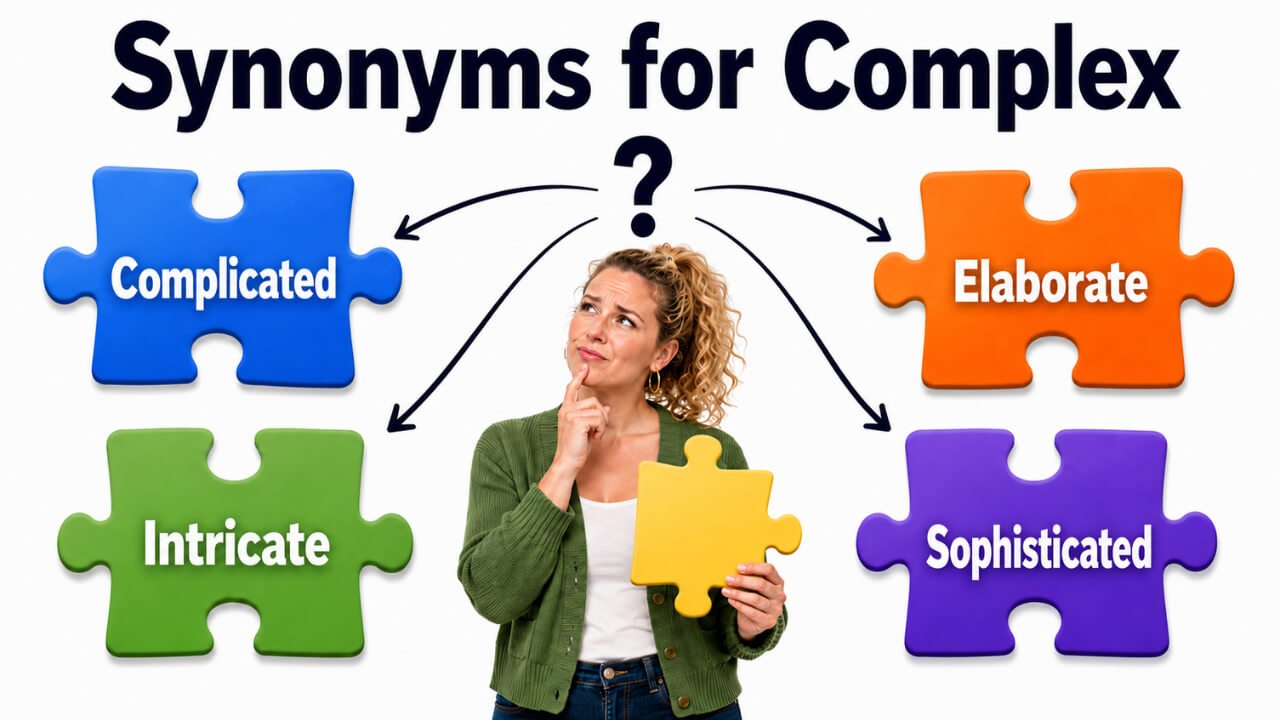
Quick Answer: Synonyms for complex include complicated, intricate, involved, elaborate, sophisticated, multifaceted, nuanced, difficult, advanced, and tangled. Use complicated for something hard to understand, intricate for detailed design or structure, sophisticated for advanced systems or ideas, multifaceted for something with many sides, and nuanced for meaning that needs careful understanding.
Pronunciation and Word Details
Word: Complex.
Pronunciation: /kəmˈpleks/.
Part of Speech: Adjective and noun.
Meaning: Something complex has many connected parts, details, ideas, or layers that make it difficult to understand, explain, or solve.
US Pronunciation:
UK Pronunciation:
What Does “Complex” Mean?
Complex means made of many connected parts, ideas, details, or processes that are not simple.
As an adjective, complex describes something difficult to understand because it has several layers or elements. For example, a complex problem may involve data, causes, effects, and possible solutions.
As a noun, complex can mean a group of related buildings, ideas, emotions, or systems. For example, a housing complex is a group of buildings, while an emotional complex refers to a pattern of thoughts or feelings.
The word works in many contexts, including grammar, science, education, business, psychology, technology, law, relationships, and everyday conversation.
Meaning, Tone, and Context of “Complex”
Complex is a neutral and flexible word. It does not always mean bad. A complex idea can be impressive, detailed, advanced, or simply hard to explain.
In formal writing, complex often means detailed, layered, or made of many parts. In casual speech, it usually means hard to understand or not simple.
In academic and technical contexts, complex is useful for systems, theories, structures, processes, data, arguments, and problems. In emotional or personal contexts, it can describe feelings, relationships, decisions, and motives that are not easy to explain.
When and How to Use “Complex”
For Difficult Ideas: Use complex when an idea has many parts and needs careful explanation.
Example: The theory is complex, but the teacher explained it clearly.
For Detailed Structures: Use complex when something has many connected details.
Example: The machine has a complex internal design.
For Problems With Many Causes: Use complex when a situation cannot be solved by one simple action.
Example: Poverty is a complex issue with social, economic, and educational causes.
For Advanced Systems: Use complex when a system has many working parts.
Example: The software manages complex financial data.
For Emotions and Relationships: Use complex when feelings or human behavior are layered and hard to describe.
Example: Her reaction came from a complex mix of fear, guilt, and hope.
Best Synonyms for Complex
Complicated: Difficult to understand because many parts are involved.
Example: The instructions were complicated and needed clearer steps.
Intricate: Very detailed, with many small connected parts.
Example: The artist created an intricate pattern on the wall.
Involved: Difficult because it has many stages, details, or conditions.
Example: The approval process was more involved than expected.
Elaborate: Detailed and carefully developed.
Example: They prepared an elaborate plan for the event.
Sophisticated: Advanced, refined, or developed in a complex way.
Example: The lab uses sophisticated equipment for testing.
Multifaceted: Having many sides, features, or parts.
Example: The debate is multifaceted and cannot be reduced to one cause.
Nuanced: Having small but important differences in meaning or detail.
Example: The article gives a nuanced view of the issue.
Difficult: Hard to understand, solve, or deal with.
Example: The question was difficult because it had several possible answers.
Advanced: Developed beyond a basic level.
Example: Students studied advanced grammar patterns in the lesson.
Tangled: Confused, mixed, or hard to separate.
Example: The legal case became tangled after new evidence appeared.
50 Synonyms for Complex with Short Meanings
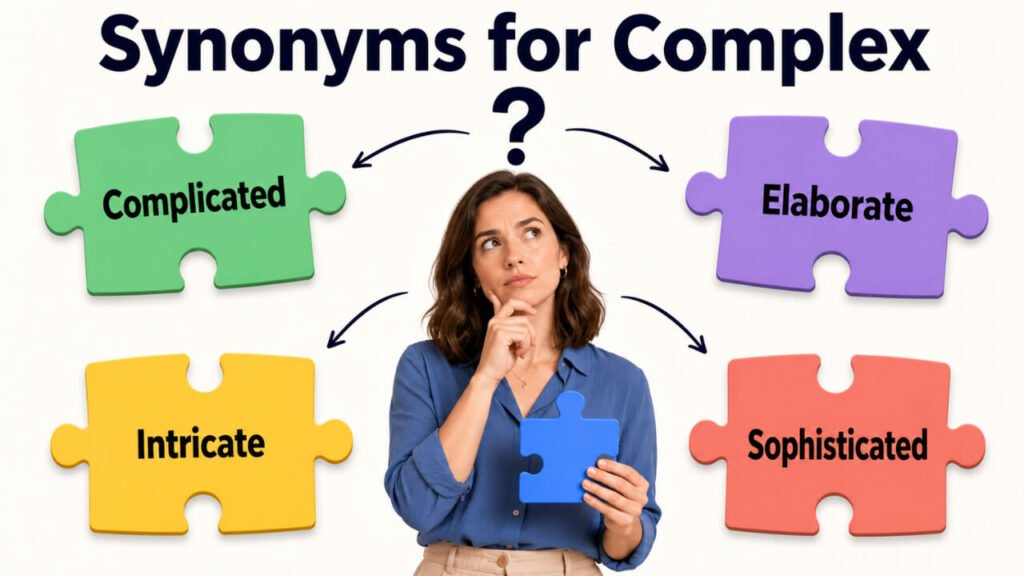
- Complicated: Hard to understand because of many parts.
- Intricate: Full of fine details and connected parts.
- Involved: Containing many steps, details, or conditions.
- Elaborate: Carefully developed with many details.
- Sophisticated: Advanced, refined, or highly developed.
- Multifaceted: Having many different sides or features.
- Nuanced: Containing subtle differences in meaning.
- Difficult: Hard to understand, do, or solve.
- Advanced: Beyond a simple or basic level.
- Tangled: Confused or hard to separate.
- Convoluted: Too complicated or hard to follow.
- Compounded: Made more difficult by added factors.
- Detailed: Containing many specific facts or parts.
- Layered: Having several levels of meaning or structure.
- Technical: Related to specialized knowledge or methods.
- Challenging: Requiring effort, skill, or thought.
- Demanding: Requiring strong attention, ability, or effort.
- Deep: Having serious, difficult, or important meaning.
- Dense: Packed with information or detail.
- Subtle: Not obvious and needing careful attention.
- Abstract: Based on ideas rather than physical things.
- Analytical: Involving careful study of parts or details.
- Labyrinthine: Very confusing because of many turns or parts.
- Knotty: Difficult to solve or explain.
- Tricky: Difficult because it may confuse or mislead.
- Perplexing: Confusing and hard to understand.
- Puzzling: Difficult to explain or solve.
- Confusing: Not clear or easy to follow.
- Obscure: Hard to understand because meaning is unclear.
- Ambiguous: Having more than one possible meaning.
- High level: Advanced or not basic.
- Intellectual: Requiring careful thinking or knowledge.
- Rigorous: Requiring careful, exact, and serious work.
- Systematic: Organized through connected steps or parts.
- Interconnected: Linked together in several ways.
- Interwoven: Mixed together closely.
- Composite: Made from different parts.
- Compound: Made of more than one element.
- Mixed: Containing different parts, feelings, or ideas.
- Delicate: Requiring careful handling or judgment.
- Sensitive: Requiring care because small changes matter.
- Diverse: Containing different types or elements.
- Broad: Covering many areas or ideas.
- Expansive: Large in scope or detail.
- Extensive: Covering many parts or a wide area.
- Thorny: Difficult, sensitive, or troublesome.
- Problematic: Causing difficulty or uncertainty.
- Hard: Not easy to understand, do, or solve.
- Exacting: Requiring great care and attention.
- Sophisticate: A more refined or developed form, usually used as a noun.
Read Also:
Synonyms for Focus
Synonyms for Complex by Context
When Complex Means Difficult to Understand
Use these synonyms when something is confusing, hard to solve, or not easy to explain.
Complicated: The case became complicated after new details appeared.
Difficult: The math problem was difficult for many students.
Perplexing: His sudden decision was perplexing.
Puzzling: The results were puzzling at first.
Confusing: The instructions were confusing because they skipped important steps.
When Complex Means Detailed or Intricate
Use these words when the focus is on fine details, design, structure, or arrangement.
Intricate: The necklace had an intricate pattern.
Elaborate: The report included an elaborate explanation.
Detailed: She gave a detailed account of the process.
Layered: The novel has a layered plot.
Interwoven: The story has interwoven themes of loyalty and regret.
When Complex Means Advanced or Sophisticated
Use these synonyms when something is developed, technical, or beyond a basic level.
Sophisticated: The system uses sophisticated security tools.
Advanced: The course covers advanced writing skills.
Technical: The manual contains technical language.
High level: The discussion included high level concepts.
Rigorous: The study used a rigorous method.
When Complex Means Having Many Sides
Use these words when something includes different angles, causes, features, or viewpoints.
Multifaceted: The issue is multifaceted and needs careful study.
Diverse: The project involves diverse opinions and goals.
Broad: The question has broad social importance.
Expansive: The plan is expansive and covers several departments.
Composite: The final score is a composite of several tests.
When Complex Means Subtle or Nuanced
Use these words when meaning is not obvious and small differences matter.
Nuanced: Her answer was nuanced and thoughtful.
Subtle: The poem has subtle emotional shifts.
Ambiguous: The statement was ambiguous and could mean two things.
Delicate: The discussion required delicate wording.
Sensitive: The topic is sensitive and needs care.
Another Word for Complex
Another word for complex is complicated, especially when you mean something is hard to understand or solve. However, the best replacement depends on the context. Use intricate for detailed design, sophisticated for advanced systems, multifaceted for many sided issues, and nuanced for subtle meaning.
Original: The problem is complex.
Better Option: The problem is complicated.
Original: The design is complex.
Better Option: The design is intricate.
Original: The software is complex.
Better Option: The software is sophisticated.
Original: The debate is complex.
Better Option: The debate is multifaceted.
When Not to Use “Complex”
Do not use complex when a more specific word would explain the meaning better. Complex can sound vague if readers do not know whether you mean difficult, detailed, advanced, confusing, or many sided.
Weak: The plan is complex.
Better: The plan is complicated because it has too many approval steps.
Weak: The pattern is complex.
Better: The pattern is intricate and full of small details.
Weak: The argument is complex.
Better: The argument is nuanced because it includes several viewpoints.
Weak: The machine is complex.
Better: The machine is sophisticated and uses advanced sensors.
Complex may also sound too formal in simple conversation. In casual speech, hard, tricky, or confusing can feel more natural.
Words Commonly Confused With Complex
Complex vs Complicated: Complex means something has many connected parts. Complicated usually means something is hard to understand or deal with.
Complex vs Intricate: Complex can describe ideas, systems, problems, or emotions. Intricate usually describes fine details, patterns, designs, or structures.
Complex vs Sophisticated: Complex focuses on many parts or difficulty. Sophisticated suggests advanced development, refinement, or skill.
Complex vs Confusing: Complex does not always mean unclear. Confusing means difficult to understand because it lacks clarity.
Complex vs Nuanced: Complex refers to many parts or layers. Nuanced refers to subtle differences in meaning, tone, or interpretation.
Complex vs Difficult: Difficult is broader and simpler. Complex often explains why something is difficult, because many parts or factors are involved.
Which Synonym Should You Choose?
Choose complicated when something is hard to understand, explain, or complete.
Choose intricate when writing about detailed patterns, designs, structures, or arrangements.
Choose involved when a process has many steps, requirements, or conditions.
Choose elaborate when something is carefully planned, decorated, or explained in detail.
Choose sophisticated when writing about advanced systems, tools, technology, methods, or ideas.
Choose multifaceted when a topic has many sides, causes, effects, or viewpoints.
Choose nuanced when discussing subtle meanings, emotions, opinions, or interpretations.
Choose technical when specialized knowledge is needed.
Choose confusing when the main problem is lack of clarity.
Choose difficult when you want a simple and general word for something hard.
Real Life Examples of “Complex” in Sentences
Original: The project became complex after the budget changed.
Better Option: The project became complicated after the budget changed.
Original: The artist created a complex design.
Better Option: The artist created an intricate design.
Original: The company uses a complex security system.
Better Option: The company uses a sophisticated security system.
Original: The issue is complex and needs more discussion.
Better Option: The issue is multifaceted and needs more discussion.
Original: Her feelings about the decision were complex.
Better Option: Her feelings about the decision were nuanced.
Original: The instructions were complex for beginners.
Better Option: The instructions were confusing for beginners.
Original: The case involved complex legal questions.
Better Option: The case involved technical legal questions.
Original: The repair process was complex.
Better Option: The repair process was involved.
Original: The explanation was complex and hard to follow.
Better Option: The explanation was convoluted and hard to follow.
Original: The topic is complex but important.
Better Option: The topic is challenging but important.
Synonym Groups and Usage Differences
Difficulty Group
Words in this group show that something is hard to understand, solve, or manage. Use complicated, difficult, tricky, perplexing, and puzzling when effort or confusion is the main idea.
Example: The problem was complicated because it had several hidden causes.
Detail Group
Words in this group focus on structure, design, and small connected parts. Use intricate, detailed, elaborate, layered, and interwoven when detail is more important than difficulty.
Example: The story has a layered plot with many connected events.
Advanced Group
Words in this group describe systems, methods, or ideas that are developed beyond a basic level. Use sophisticated, advanced, technical, rigorous, and high level in formal, academic, or professional writing.
Example: The team used a sophisticated model to study the results.
Many Sided Group
Words in this group describe topics with several angles, causes, or features. Use multifaceted, diverse, broad, expansive, and composite for issues, debates, identities, and systems.
Example: Education reform is a multifaceted topic with social and economic effects.
Subtle Meaning Group
Words in this group describe meaning that requires careful reading or interpretation. Use nuanced, subtle, ambiguous, delicate, and sensitive when small differences matter.
Example: The writer gave a nuanced explanation of the character’s motives.
Antonyms of Complex
Simple: Easy to understand or use.
Plain: Clear and without extra detail.
Basic: At an easy or beginner level.
Easy: Not hard to do, understand, or solve.
Straightforward: Clear, direct, and not complicated.
Clear: Easy to understand.
Obvious: Easy to notice or recognize.
Uncomplicated: Not difficult or involved.
Elementary: Simple and suitable for beginners.
Transparent: Easy to see, understand, or explain.
Direct: Going straight to the point.
Simplex: Having one part or direction, often used in technical contexts.
Comparison: Complex vs Related Words
Complex vs Complicated
Complex means something has many connected parts. Complicated means something is difficult to understand or manage.
Example With Complex: The human brain is a complex organ.
Example With Complicated: The application process is complicated.
Complex vs Intricate
Complex can describe ideas, systems, problems, emotions, or structures. Intricate usually describes something with fine details and careful arrangement.
Example With Complex: The topic requires a complex explanation.
Example With Intricate: The bracelet has an intricate design.
Complex vs Sophisticated
Complex emphasizes many parts or layers. Sophisticated emphasizes advanced quality, refinement, or development.
Example With Complex: The system has a complex structure.
Example With Sophisticated: The system uses sophisticated technology.
Complex vs Nuanced
Complex means not simple because of many parts. Nuanced means not simple because of subtle differences in meaning or tone.
Example With Complex: The situation is complex because many people are involved.
Example With Nuanced: Her opinion is nuanced and carefully balanced.
Complex vs Difficult
Complex explains structure or depth. Difficult simply means hard.
Example With Complex: The report covers a complex network of causes.
Example With Difficult: The report was difficult to finish.
Common Phrases and Expressions With Complex
Complex Problem: A problem with many causes, parts, or possible solutions.
Complex Issue: A topic that cannot be explained in a simple way.
Complex System: A system made of many connected elements.
Complex Process: A process with several stages or requirements.
Complex Relationship: A relationship with complicated emotions, history, or conditions.
Complex Sentence: A sentence with one independent clause and at least one dependent clause.
Complex Structure: A structure made of many connected parts.
Complex Situation: A situation with many factors that affect the outcome.
Complex Emotions: Feelings that are mixed, layered, or difficult to explain.
Complex Meaning: A meaning that needs careful thought or interpretation.
Common Mistakes to Avoid
A common mistake is using complex too often when a more exact synonym would be clearer. Instead of repeating complex in every sentence, choose words like complicated, intricate, sophisticated, multifaceted, or nuanced based on the meaning.
Another mistake is using complex when the real meaning is only confusing. Something can be complex but still clear if it is well explained. Confusing means the reader cannot easily understand it.
Avoid using complex for simple difficulty when hard or difficult sounds more natural. Also avoid weak phrases like very complex when a stronger word, such as convoluted or labyrinthine, gives a more exact meaning.
Conclusion
Synonyms for complex help you describe ideas, systems, problems, designs, and emotions with more accuracy. Use complicated for difficulty, intricate for detailed structure, sophisticated for advanced systems, multifaceted for many sided issues, and nuanced for subtle meaning. The best synonym depends on what you want to emphasize. When you choose the right word, your writing becomes clearer, more precise, and easier for readers to understand.
FAQs About Synonyms for Complex
What is the best synonym for complex?
The best synonym for complex is complicated when you mean difficult to understand. Use intricate for detailed design and sophisticated for advanced systems.
What is another word for complex in formal writing?
In formal writing, good alternatives include multifaceted, sophisticated, intricate, nuanced, technical, and involved.
Is complex the same as complicated?
Complex and complicated are related, but not exactly the same. Complex means having many connected parts, while complicated means hard to understand or manage.
What is a simple word for complex?
A simple word for complex is hard or difficult. These words work well in everyday speech when you do not need a more formal synonym.
What is a positive synonym for complex?
Positive synonyms for complex include sophisticated, advanced, intricate, elaborate, and nuanced. These words can show skill, depth, or careful design.
What is the opposite of complex?
The opposite of complex is simple. Other antonyms include plain, basic, easy, clear, straightforward, and uncomplicated.
Can complex describe a person?
Complex can describe a person’s thoughts, emotions, personality, or motives. For example, a complex character has layered feelings, mixed motivations, or deep inner conflict.
