
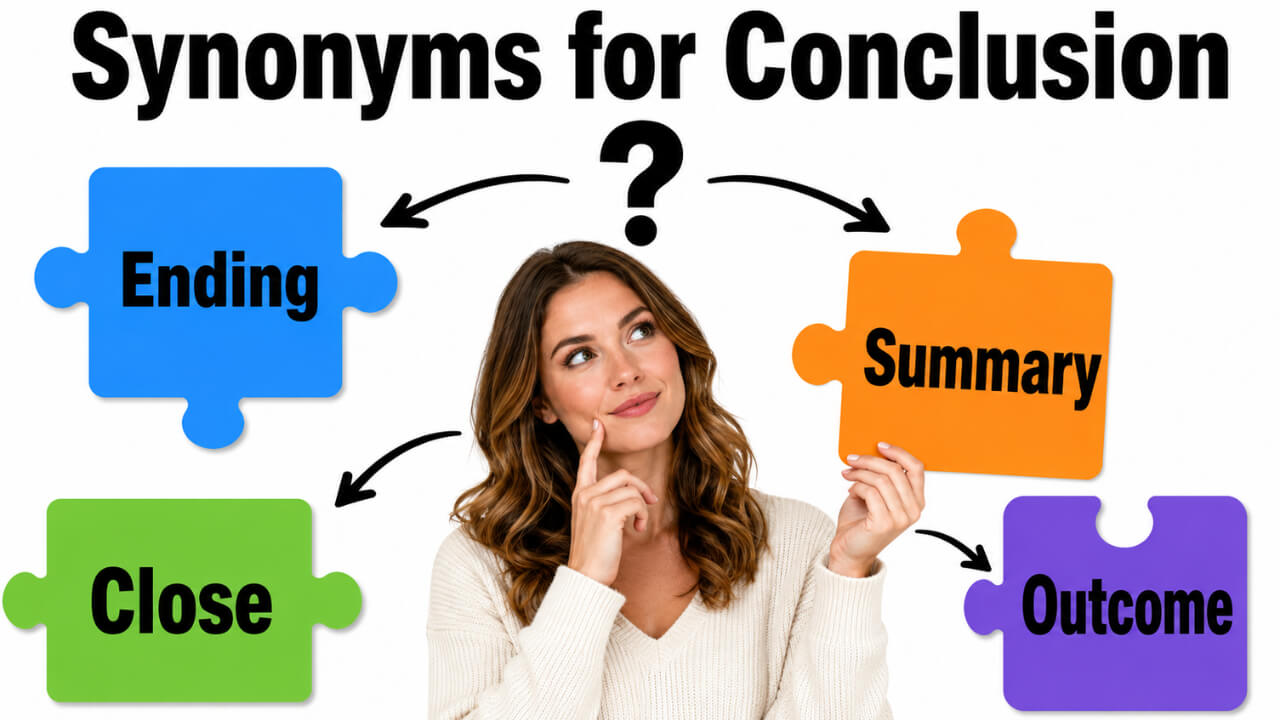
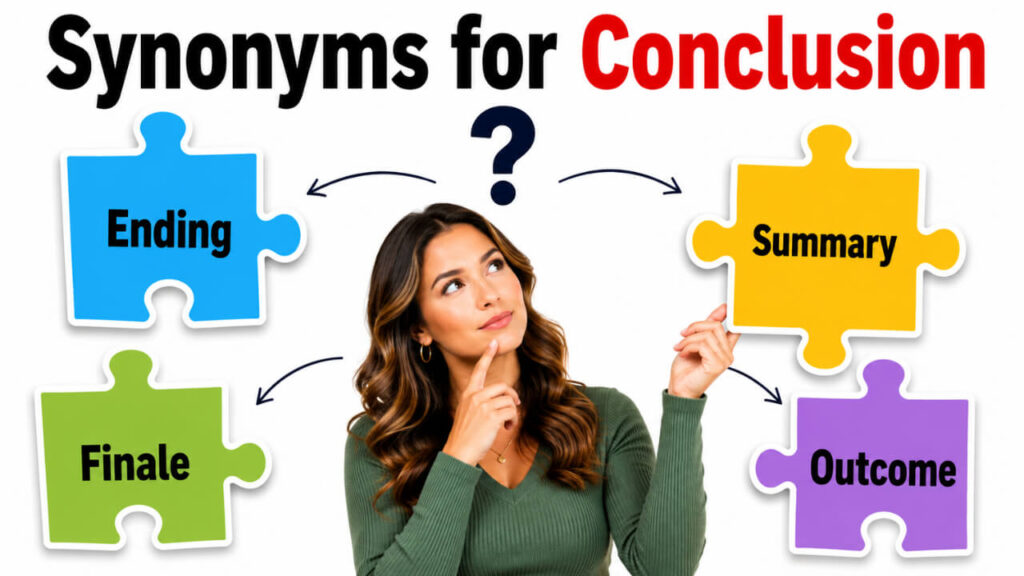
Quick Answer: The best synonyms for in conclusion include to conclude, in summary, to sum up, overall, finally, ultimately, in closing, as a final point, all things considered, and the bottom line is. Use to conclude in formal writing, in summary when reviewing main ideas, overall for general evaluation, finally for the last point in a sequence, and the bottom line is when giving a direct final message
Pronunciation and Word Details
Word: In conclusion.
Pronunciation: /ɪn kənˈkluːʒən/
Part of Speech: Transitional phrase.
Meaning: A phrase used to introduce the final point, summary, or ending statement in writing or speech.
US Pronunciation:
UK Pronunciation:
What Does “In Conclusion” Mean?
Direct Answer: “In conclusion” means that the speaker or writer is ending a discussion, summarizing the main points, or giving a final thought.
In conclusion is a transitional phrase. It usually appears near the end of an essay, speech, report, article, or formal explanation. It signals that the main discussion is finished and that the final message is coming.
The phrase works well when you need to connect ideas clearly. In academic writing, it introduces the final paragraph. In speeches, it tells listeners that the speaker is about to finish. In everyday communication, it can sound formal, so shorter alternatives like overall or to sum up may feel more natural.
Meaning, Tone, and Context of “In Conclusion”
Meaning: “In conclusion” introduces a closing idea, final summary, or last judgment.
Tone: The phrase is formal, clear, and organized.
Context: It is common in essays, reports, presentations, speeches, and structured explanations.
Formality: “In conclusion” is more formal than so, overall, or to wrap up.
Best Use: It works best when ending a serious or organized piece of writing.
Weak Use: It can sound repetitive or basic when used too often, especially in short writing.
When and How to Use “In Conclusion”
For Ending an Essay: Use “in conclusion” before the final paragraph of an essay or article.
Example: In conclusion, healthy habits can improve both physical energy and mental focus.
For Summarizing Main Points: Use it when you want to bring several ideas together.
Example: In conclusion, the results show that planning, practice, and patience all matter.
For Formal Writing: Use it in school assignments, research explanations, and professional documents.
Example: In conclusion, the policy may help reduce confusion among new employees.
For Speeches and Presentations: Use it to show the audience that the final message is coming.
Example: In conclusion, every team member has a role in making this project successful.
For Final Opinion: Use it before giving a final judgment after explaining evidence.
Example: In conclusion, the benefits of the new system are stronger than the drawbacks.
Best Synonyms for In Conclusion
To conclude: A formal and direct way to introduce a final statement.
Example: To conclude, regular reading can improve vocabulary and concentration.
In summary: A clear phrase used when reviewing the main points.
Example: In summary, the plan saves time, lowers costs, and improves results.
To sum up: A simple and natural phrase for giving a short final review.
Example: To sum up, the meeting focused on deadlines, roles, and next steps.
Overall: A concise word used to give a general final view.
Example: Overall, the article explains the topic in a simple and useful way.
Finally: A useful word for introducing the last point in a sequence.
Example: Finally, students should review their work before submitting it.
Ultimately: A stronger word used for a final result, decision, or main truth.
Example: Ultimately, success depends on effort, timing, and consistency.
In closing: A polished phrase often used in speeches, letters, and formal messages.
Example: In closing, I want to thank everyone for their support.
As a final point: A helpful phrase for adding one last important idea.
Example: As a final point, clear instructions can prevent many mistakes.
All things considered: A balanced phrase used after looking at several sides of a topic.
Example: All things considered, the decision seems fair and practical.
The bottom line is: A direct phrase used before the most important final message.
Example: The bottom line is that better planning leads to better results.
50 Synonyms for In Conclusion with Short Meanings
- To conclude: To bring the discussion to an end.
- In summary: To briefly restate the main points.
- To sum up: To give a short final review.
- Overall: To give a general final view.
- Finally: To introduce the last point.
- Ultimately: To show the final result or main truth.
- In closing: To begin a final statement.
- To finish: To mark the end of a discussion.
- As a final point: To add one last important idea.
- All things considered: After thinking about all sides.
- The bottom line is: The most important final point is.
- In brief: In a short final form.
- In short: Said in a simple and quick way.
- In the end: After everything has been considered.
- As a result: Used before a final outcome.
- Therefore: Used before a logical final result.
- Thus: Used before a conclusion based on evidence.
- Hence: Used before a formal result or conclusion.
- Consequently: Used before the effect of earlier points.
- For this reason: Used before a conclusion based on cause.
- For these reasons: Used before a final judgment based on several points.
- Taking everything into account: After considering all details.
- Considering everything: After looking at the full situation.
- When all is said and done: After all facts have been reviewed.
- At last: At the final stage.
- Lastly: Used before the final item or idea.
- To close: To end a message or discussion.
- To end: To bring the topic to a finish.
- By way of conclusion: A formal way to introduce closing thoughts.
- As a closing thought: A final idea before ending.
- As a final observation: A last comment based on what was discussed.
- As a final remark: A last statement before finishing.
- The final point is: The last important idea is.
- The main takeaway is: The most useful lesson is.
- The key point is: The most important idea is.
- The final message is: The last idea the reader should remember.
- In final analysis: After careful thought and review.
- On the whole: Looking at the subject generally.
- Broadly speaking: Giving a general final view.
- Simply put: Said in a clearer and simpler way.
- To put it simply: To express the final idea in easy words.
- In essence: Focusing on the central meaning.
- Essentially: In the most basic sense.
- In other words: Restating the final meaning more clearly.
- What this means is: Explaining the final meaning directly.
- It follows that: Showing a logical conclusion.
- This shows that: Introducing what the evidence proves.
- This suggests that: Introducing a likely final idea.
- This proves that: Introducing a strong final claim.
- The conclusion is: Stating the final answer directly.
Read Also:
Synonyms for Ensure

Synonyms for In Conclusion by Context
When In Conclusion Means To End a Discussion
Best Synonyms: To conclude, in closing, to finish, to end, to close.
Use: These options are useful when you want to clearly show that your writing or speech is ending.
Example: To conclude, small daily improvements can create meaningful long term progress.
When In Conclusion Means To Summarize
Best Synonyms: In summary, to sum up, in short, in brief, simply put.
Use: These phrases help when you want to repeat the main ideas in fewer words.
Example: In summary, the topic is easier to understand when each part is explained clearly.
When In Conclusion Means Final Result
Best Synonyms: Ultimately, in the end, therefore, thus, consequently.
Use: These choices work when the closing sentence explains a result, effect, or final outcome.
Example: Ultimately, strong communication reduces confusion and improves teamwork.
When In Conclusion Means Final Opinion
Best Synonyms: Overall, all things considered, on the whole, taking everything into account.
Use: These phrases are useful when giving a balanced final judgment.
Example: All things considered, the method is simple, practical, and effective.
When In Conclusion Means Final Important Point
Best Synonyms: The bottom line is, the key point is, the main takeaway is, the final message is.
Use: These options are strong when you want readers to remember one central idea.
Example: The main takeaway is that clear writing helps readers understand faster.
Another Word for In Conclusion
Direct Answer: The best single replacement for “in conclusion” is to conclude because it is formal, clear, and suitable for essays, reports, and speeches.
The best alternative depends on context. Use in summary when repeating main points. Use overall when giving a general judgment. Use ultimately when explaining the final result. Use in closing when ending a speech or formal message.
Original: In conclusion, practice improves writing skills.
Better Option: To conclude, practice improves writing skills.
Original: In conclusion, the plan has several benefits.
Better Option: Overall, the plan has several benefits.
Original: In conclusion, the evidence supports the claim.
Better Option: Ultimately, the evidence supports the claim.
Original: In conclusion, we should focus on clearer communication.
Better Option: The main takeaway is that we should focus on clearer communication.
When Not to Use “In Conclusion”
Do not use “in conclusion” when the writing is very short, casual, or already clearly ending. It can sound too formal in everyday messages and too predictable in essays if repeated often.
Weak: In conclusion, I will call you tomorrow.
Better: I will call you tomorrow.
Weak: In conclusion, the food was good.
Better: Overall, the food was good.
Weak: In conclusion, the conclusion is clear.
Better: The final point is clear.
Weak: In conclusion, I think this is okay.
Better: All things considered, this seems acceptable.
Weak: In conclusion, the report concludes that sales increased.
Better: The report shows that sales increased.
Words Commonly Confused With In Conclusion
In Conclusion vs Finally: “In conclusion” introduces a final summary or closing thought, while “finally” usually introduces the last item in a sequence.
In Conclusion vs In Summary: “In conclusion” ends the discussion, while “in summary” briefly reviews the main points.
In Conclusion vs Therefore: “In conclusion” signals the ending, while “therefore” shows a logical result.
In Conclusion vs Overall: “In conclusion” is more formal, while “overall” gives a general opinion or judgment.
In Conclusion vs Ultimately: “In conclusion” marks the close, while “ultimately” focuses on the final result or most important truth.
In Conclusion vs To Sum Up: “In conclusion” sounds more formal, while “to sum up” feels simpler and more conversational.
Which Synonym Should You Choose?
Choose to conclude when writing essays, reports, formal paragraphs, or academic style content.
Choose in summary when you want to briefly repeat the main points.
Choose to sum up when you want a natural and simple closing phrase.
Choose overall when giving a general opinion, review, or final evaluation.
Choose finally when introducing the last item in a list or sequence.
Choose ultimately when explaining the final result, truth, or decision.
Choose in closing when ending a speech, letter, or formal message.
Choose all things considered when comparing several points before giving a final opinion.
Choose the bottom line is when you want a direct, strong, and practical final statement.
Choose therefore when the final sentence follows logically from the evidence.
Real Life Examples of “In Conclusion” in Sentences
Original: In conclusion, exercise helps improve both strength and mood.
Better Option: To conclude, exercise helps improve both strength and mood.
Original: In conclusion, the survey shows that customers prefer faster service.
Better Option: In summary, the survey shows that customers prefer faster service.
Original: In conclusion, the project was successful.
Better Option: Overall, the project was successful.
Original: In conclusion, the evidence supports the main argument.
Better Option: Ultimately, the evidence supports the main argument.
Original: In conclusion, students should manage their time carefully.
Better Option: The main takeaway is that students should manage their time carefully.
Original: In conclusion, the new rule may reduce confusion.
Better Option: Therefore, the new rule may reduce confusion.
Original: In conclusion, communication is important for every team.
Better Option: In closing, communication is important for every team.
Original: In conclusion, both choices have advantages and disadvantages.
Better Option: All things considered, both choices have advantages and disadvantages.
Original: In conclusion, clear instructions make tasks easier.
Better Option: Simply put, clear instructions make tasks easier.
Original: In conclusion, the results are useful but limited.
Better Option: On the whole, the results are useful but limited.
Synonym Groups and Usage Differences
Formal Closing Group
Synonyms: To conclude, in closing, by way of conclusion, as a final remark.
Use: These phrases are best for formal essays, speeches, reports, and professional messages.
Example: To conclude, the findings support the need for better training.
Summary Group
Synonyms: In summary, to sum up, in brief, in short.
Use: These options work well when you want to compress the main points into a short final statement.
Example: In short, the lesson explains how word choice changes tone.
Result Group
Synonyms: Therefore, thus, consequently, as a result.
Use: These words show that the final sentence follows from earlier evidence or reasoning.
Example: Therefore, the data supports the original claim.
Opinion Group
Synonyms: Overall, all things considered, on the whole, considering everything.
Use: These phrases help when giving a final judgment after reviewing several points.
Example: Overall, the paragraph is clear, useful, and easy to follow.
Main Message Group
Synonyms: The bottom line is, the main takeaway is, the key point is, the final message is.
Use: These expressions are useful when you want readers to remember the most important idea.
Example: The key point is that simple wording often improves understanding.
Antonyms of In Conclusion
Beginning: The first part of a discussion or piece of writing.
Introduction: The opening section that presents the topic.
At first: A phrase used to describe the early stage of something.
Initially: At the start of a process or explanation.
To begin: A phrase used to introduce the first point.
First of all: A phrase used before the first main idea.
At the outset: At the beginning of a formal discussion.
Opening point: The first idea in a speech, essay, or explanation.
Preliminary remark: An early comment before the main discussion.
Starting statement: The first sentence or idea in a message.
Comparison: In Conclusion vs Related Words
In Conclusion vs To Conclude
Difference: “In conclusion” is a common closing phrase, while “to conclude” sounds slightly smoother and more formal.
Example With In Conclusion: In conclusion, the essay explains the value of discipline.
Example With To Conclude: To conclude, the essay explains the value of discipline.
In Conclusion vs In Summary
Difference: “In conclusion” signals the final part, while “in summary” focuses on repeating the main ideas briefly.
Example With In Conclusion: In conclusion, the plan can improve daily productivity.
Example With In Summary: In summary, the plan improves time use, focus, and organization.
In Conclusion vs Finally
Difference: “In conclusion” introduces a closing statement, while “finally” introduces the last item in an order.
Example With In Conclusion: In conclusion, teamwork helps solve complex problems.
Example With Finally: Finally, teamwork helps complete the final stage of the project.
In Conclusion vs Ultimately
Difference: “In conclusion” marks the end of a discussion, while “ultimately” highlights the final truth or result.
Example With In Conclusion: In conclusion, the decision was fair.
Example With Ultimately: Ultimately, the decision was fair because it considered all sides.
In Conclusion vs Overall
Difference: “In conclusion” is more formal, while “overall” gives a general view or evaluation.
Example With In Conclusion: In conclusion, the lesson was useful.
Example With Overall: Overall, the lesson was useful.
In Conclusion vs Therefore
Difference: “In conclusion” closes a discussion, while “therefore” shows a logical result.
Example With In Conclusion: In conclusion, the rule should be followed.
Example With Therefore: Therefore, the rule should be followed.
Common Phrases and Expressions With In Conclusion
In Conclusion: Used to introduce the final statement.
In Conclusion Paragraph: The final paragraph of an essay or article.
In Conclusion Statement: A closing sentence that summarizes the main message.
In Conclusion Sentence: A sentence that begins or supports the final idea.
In Conclusion Section: The final section of a structured piece of writing.
In Conclusion Example: A sample sentence showing how to end a discussion.
In Conclusion Synonym: A word or phrase that can replace “in conclusion.”
In Conclusion Meaning: The idea of ending, summarizing, or closing a discussion.
In Conclusion Phrase: A transition used before the final thought.
In Conclusion Alternative: Another phrase used to avoid repetition.
Common Mistakes to Avoid
Repeating The Same Phrase: Do not use “in conclusion” in every article, essay, or paragraph ending. Use alternatives like to conclude, overall, or in summary.
Using It Too Early: Do not write “in conclusion” before the main ideas are fully explained. It should appear near the end.
Choosing The Wrong Synonym: Do not use therefore unless the sentence shows a logical result. Use in summary when reviewing main points.
Sounding Too Formal: In casual writing, “in conclusion” may sound stiff. Use overall or to sum up instead.
Adding Weak Final Sentences: A conclusion should not simply repeat the title. It should give a final useful thought.
Confusing Summary And Result: In summary repeats main ideas, while therefore explains what follows from them.
Overloading The Final Paragraph: Keep the ending clear. Do not introduce too many new ideas in the conclusion.
Conclusion
The best synonyms for in conclusion depend on the tone and purpose of your sentence. Use to conclude for formal writing, in summary when reviewing key points, overall for a general judgment, ultimately for a final result, and the bottom line is for a direct final message. A strong closing phrase helps readers understand that your discussion is ending and that the final idea is important, clear, and worth remembering.
FAQs About Synonyms for In Conclusion
What is the best synonym for in conclusion?
Answer: The best synonym for “in conclusion” is to conclude because it is clear, formal, and useful in essays, reports, and speeches.
What can I say instead of in conclusion in an essay?
Answer: You can say to conclude, in summary, overall, ultimately, or all things considered in an essay.
Is in conclusion formal?
Answer: Yes, “in conclusion” is formal and works well in academic writing, reports, speeches, and structured explanations.
Can I use overall instead of in conclusion?
Answer: Yes, use overall when giving a general final opinion or evaluation. It sounds more natural and less formal.
Is finally the same as in conclusion?
Answer: Not always. Finally usually introduces the last item in a sequence, while in conclusion introduces a final summary or closing idea.
What is a stronger way to say in conclusion?
Answer: Stronger options include ultimately, the bottom line is, the main takeaway is, and the key point is.
Should I always use in conclusion in the last paragraph?
Answer: No. You can end naturally without it, or use alternatives like to conclude, in summary, overall, or as a final point.
