
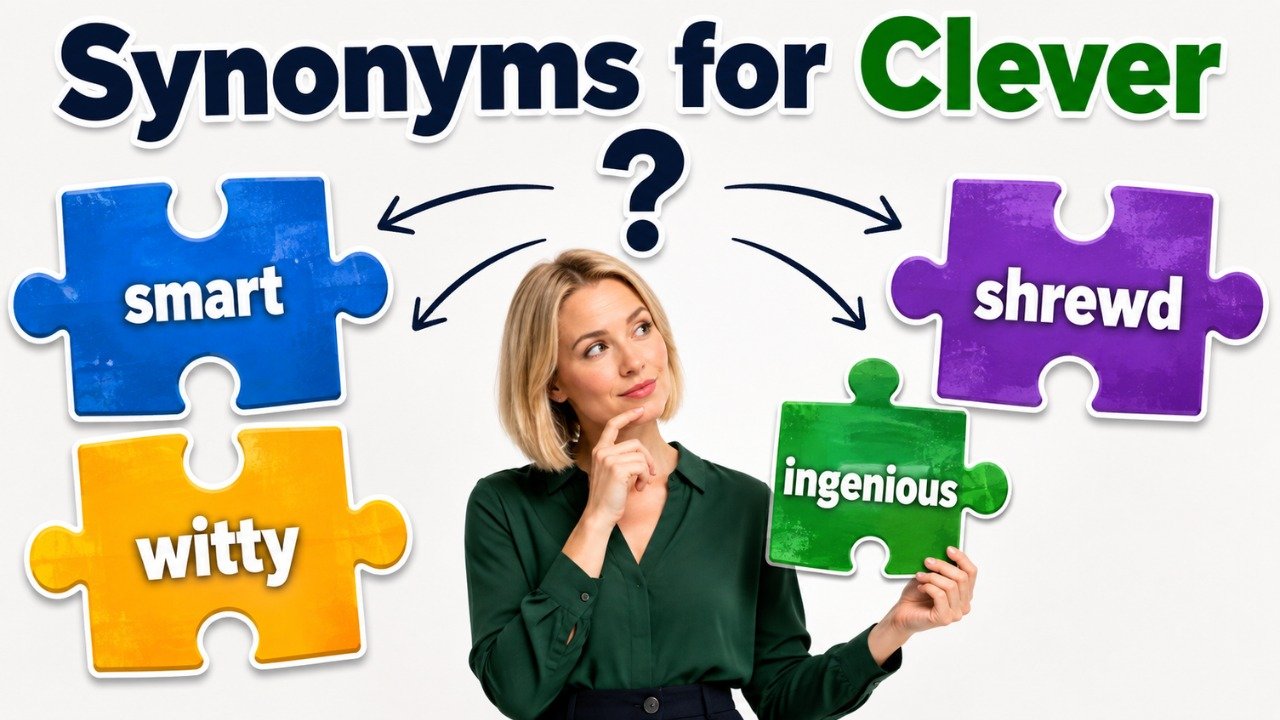
Quick Answer: The best synonyms for clever include intelligent, smart, bright, ingenious, astute, resourceful, witty, perceptive, shrewd, and inventive. Use intelligent in formal or academic writing, smart in casual conversation, ingenious for a creative idea, astute for sound judgment, and resourceful for practical problem solving. Witty describes clever language, while shrewd can suggest strategic or calculating behavior.
Pronunciation and Word Details
Word: Clever.
Pronunciation: /ˈklev.ər/
Part of Speech: Adjective.
Meaning: Quick to understand, learn, solve problems, or create effective ideas.
US Pronunciation:
UK Pronunciation:
What Does “Clever” Mean?
Clever means mentally quick, intelligent, inventive, or skillful. It is an adjective used to describe a person, idea, action, design, remark, or solution that shows intelligence or ability.
A clever person understands situations quickly and finds effective answers. A clever idea solves a problem in an original or efficient way. A clever remark may be witty, amusing, or thoughtfully expressed.
The word can also describe practical ability. Someone who is clever with tools, numbers, words, or technology knows how to use those things successfully.
In some contexts, clever suggests cunning behavior rather than admirable intelligence. A clever trick may be creative and harmless, but it may also be designed to deceive someone. The surrounding sentence usually reveals whether the meaning is positive, neutral, or negative.
Meaning, Tone, and Context of “Clever”
Clever usually has a positive or neutral tone. It praises quick thinking, creativity, practical skill, or effective problem solving.
In everyday conversation, clever is friendly and natural. People commonly use it to compliment a person, plan, joke, invention, design, or solution.
In formal writing, intelligent, ingenious, perceptive, analytical, or astute may communicate a more exact meaning. Clever can sometimes sound too general when the writer needs to identify a specific type of ability.
In academic contexts, clever may describe an effective argument or unusual approach. However, intelligent is usually better for mental ability, analytical for careful reasoning, and ingenious for creative problem solving.
Clever may also carry a negative tone when it describes manipulation, secrecy, or deception. Words such as cunning, crafty, sly, and calculating make this negative meaning clearer.
When and How to Use “Clever”
For Intelligence: Use clever to describe someone who learns, understands, or responds quickly.
Example: The clever student understood the difficult concept immediately.
For Creative Ideas: Use clever for an original idea that solves a problem effectively.
Example: She developed a clever way to organize the limited space.
For Problem Solving: Clever can describe a practical answer to a challenging situation.
Example: His clever solution reduced both the cost and the amount of waste.
For Practical Skill: Use clever when someone handles tools, materials, language, or tasks with ability.
Example: She is clever with her hands and can repair almost anything.
For Witty Language: Clever can describe a humorous, sharp, or thoughtful remark.
Example: His clever response made everyone smile.
For Effective Design: Use clever for a design that uses space, materials, or features efficiently.
Example: The small room included several clever storage ideas.
For Strategic Thinking: Clever may describe a plan based on careful judgment and awareness.
Example: The team made a clever decision to save its strongest resources for the final stage.
For Deceptive Behavior: Clever can sometimes imply cunning or dishonest intelligence.
Example: The clever fraud was difficult to detect at first.
Best Synonyms for Clever
Intelligent: Able to understand, learn, and think at a high level.
Example: She is an intelligent researcher who asks meaningful questions.
Smart: Quick to understand situations and make effective decisions.
Example: Choosing the simpler method was a smart decision.
Bright: Naturally quick at learning and understanding new information.
Example: He is a bright student with a strong interest in science.
Ingenious: Highly creative and effective in designing ideas or solutions.
Example: The engineer proposed an ingenious solution to the space problem.
Astute: Skilled at understanding situations and making accurate judgments.
Example: Her astute observations helped the team avoid a costly mistake.
Resourceful: Good at finding practical solutions with the available materials or information.
Example: The resourceful traveler repaired the broken strap with a piece of string.
Witty: Clever and amusing in speech or writing.
Example: Her witty comment made the serious discussion feel more relaxed.
Perceptive: Quick to notice and understand details, emotions, or hidden meanings.
Example: The perceptive teacher noticed that the student needed additional support.
Shrewd: Skilled at making practical or strategic judgments, especially in business or negotiations.
Example: The buyer made a shrewd offer at the right moment.
Inventive: Skilled at creating original ideas, methods, or objects.
Example: The inventive designer transformed simple materials into useful furniture.
50 Synonyms for Clever with Short Meanings
- Intelligent: Able to understand and learn quickly.
- Smart: Mentally quick and capable.
- Bright: Naturally quick at learning.
- Brilliant: Exceptionally intelligent or impressive.
- Sharp: Quick to notice, understand, or respond.
- Witty: Clever and amusing with words.
- Quick Witted: Able to respond intelligently without delay.
- Astute: Skilled at making accurate judgments.
- Shrewd: Practically intelligent and strategically aware.
- Ingenious: Highly creative at solving problems.
- Inventive: Able to develop original ideas.
- Resourceful: Skilled at finding practical solutions.
- Insightful: Showing a deep understanding of a subject.
- Perceptive: Quick to notice important details.
- Discerning: Able to recognize fine differences and quality.
- Knowledgeable: Possessing useful information and understanding.
- Capable: Having the ability to complete something successfully.
- Talented: Naturally skilled in a particular area.
- Gifted: Possessing exceptional natural ability.
- Skillful: Performing an activity with ability and control.
- Adept: Highly skilled at a particular task.
- Proficient: Competent and experienced in an activity.
- Savvy: Practically informed and aware.
- Wise: Showing experience and sound judgment.
- Sensible: Making reasonable and practical choices.
- Logical: Using clear and organized reasoning.
- Rational: Guided by reason rather than emotion.
- Thoughtful: Showing careful consideration and judgment.
- Analytical: Skilled at examining information carefully.
- Creative: Able to produce original ideas.
- Original: Fresh, unusual, and not copied.
- Imaginative: Full of creative and interesting ideas.
- Innovative: Introducing a new and effective method.
- Cunning: Clever at achieving goals, sometimes dishonestly.
- Crafty: Skilled at using indirect or deceptive methods.
- Sly: Secretively clever or misleading.
- Wily: Experienced at gaining advantages through clever methods.
- Artful: Skillful, subtle, or cleverly designed.
- Scheming: Secretly planning to gain an advantage.
- Calculating: Carefully planning actions for personal benefit.
- Strategic: Planned intelligently to achieve a goal.
- Adroit: Skillful and mentally quick.
- Nimble: Quick and flexible in thought or action.
- Alert: Ready to notice and respond quickly.
- Quick: Fast at understanding or reacting.
- Brainy: Informally describing someone highly intelligent.
- Intellectual: Relating to advanced thought and reasoning.
- Scholarly: Showing serious knowledge and careful study.
- Learned: Having extensive knowledge from study.
- Accomplished: Highly trained and successful in a skill.
Read Also:
Synonyms for Empathetic
Synonyms for Clever by Context
When Clever Means Intelligent
Intelligent, smart, bright, brilliant, sharp, brainy, intellectual, and knowledgeable describe strong mental ability.
Intelligent is the most neutral choice for formal writing. Smart is more conversational, while bright often describes someone who learns quickly. Brilliant expresses exceptional intelligence or achievement.
Example: She is an intelligent and thoughtful student.
Example: That was a smart response to a difficult question.
Example: Everyone recognized him as a bright young learner.
When Clever Means Creative
Ingenious, inventive, creative, imaginative, innovative, resourceful, and original describe the ability to produce fresh ideas.
Ingenious is especially suitable for a solution that is both original and effective. Inventive describes someone who regularly creates new methods or objects. Resourceful emphasizes solving problems with limited options.
Example: The team found an ingenious way to reuse the materials.
Example: Her inventive approach made the lesson easier to understand.
Example: The resourceful mechanic repaired the machine without ordering new parts.
When Clever Means Perceptive
Astute, perceptive, insightful, discerning, sharp, and analytical describe a person who understands important details.
Astute is useful for practical judgment. Perceptive focuses on noticing things that others may miss. Insightful describes a deep and meaningful understanding.
Example: His astute analysis revealed a serious risk.
Example: She made a perceptive comment about the character’s motivation.
Example: The report offered an insightful explanation of the problem.
When Clever Means Skillful
Skillful, adept, proficient, capable, talented, gifted, accomplished, and adroit describe practical or developed ability.
Skillful is a broad alternative. Adept and proficient suggest experience and competence. Gifted usually refers to natural ability, while accomplished suggests advanced skill developed through effort.
Example: She is a skillful editor with a strong eye for detail.
Example: He became proficient at repairing complex equipment.
Example: The accomplished musician performed the piece confidently.
When Clever Means Witty
Witty, quick witted, sharp, amusing, and artful can describe clever language or conversation.
Witty is the strongest replacement when a comment is both intelligent and funny. Quick witted emphasizes the ability to respond immediately.
Example: Her witty reply changed the mood of the conversation.
Example: The quick witted speaker answered every question confidently.
When Clever Means Cunning
Cunning, crafty, sly, wily, calculating, and scheming describe intelligence used to gain an advantage.
These words often have a negative tone. Cunning can occasionally express admiration for strategic ability, but crafty, sly, and scheming usually suggest secrecy or dishonesty.
Example: The cunning character persuaded everyone to trust his false story.
Example: They discovered the company’s crafty attempt to hide the additional charge.
Another Word for Clever
Intelligent is often the best general replacement for clever when describing mental ability. However, the most accurate alternative depends on the intended meaning.
Use ingenious for creative solutions, witty for amusing language, astute for strong judgment, resourceful for practical problem solving, and skillful for developed ability.
Original: Maya is a clever student.
Better Option: Maya is an intelligent student who understands new concepts quickly.
Original: That is a clever solution.
Better Option: That is an ingenious solution to a complicated problem.
Original: He made a clever comment.
Better Option: He made a witty comment that lightened the conversation.
Original: She made a clever business decision.
Better Option: She made an astute business decision based on current demand.
When Not to Use “Clever”
Clever can sound vague when a more precise word would explain the type of intelligence being discussed.
Avoid using it repeatedly in formal reports, essays, professional messages, or detailed descriptions. Choose a synonym that identifies whether the person is intelligent, creative, perceptive, skillful, witty, or strategic.
Weak: The researcher used a clever method and reached a clever conclusion.
Better: The researcher used an innovative method and reached an insightful conclusion.
Clever may also sound too casual when describing advanced academic ability.
Weak: The professor is very clever.
Better: The professor is highly knowledgeable and analytically skilled.
Do not use clever when you mean wise. A clever person thinks quickly, while a wise person makes sound decisions based on knowledge and experience.
Weak: It was clever of her to avoid making a rushed decision.
Better: It was wise of her to avoid making a rushed decision.
Be careful when clever could suggest dishonesty.
Weak: He used a clever plan to hide the truth.
Better: He used a deceptive plan to hide the truth.
Clever is also unsuitable when discussing factual correctness. Accurate or precise is usually clearer.
Weak: The report provides a clever description of the results.
Better: The report provides an accurate description of the results.
Words Commonly Confused With Clever
Clever vs Intelligent: Clever emphasizes quick thinking, creativity, or practical ability. Intelligent refers more broadly to the ability to understand, learn, and reason.
Clever vs Smart: Both words describe mental ability. Smart is more conversational and can also describe a sensible decision, while clever often emphasizes originality or quick thinking.
Clever vs Wise: Clever describes mental quickness. Wise describes sound judgment based on knowledge, maturity, and experience.
Clever vs Witty: Clever can describe many types of intelligence. Witty specifically describes intelligent and amusing language.
Clever vs Ingenious: Clever is broad, while ingenious describes something unusually creative, original, and effective.
Clever vs Skillful: Clever relates mainly to intelligence or inventiveness. Skillful refers to the ability to perform a task well.
Clever vs Cunning: Clever is usually positive or neutral. Cunning often suggests intelligence used for secretive, manipulative, or dishonest purposes.
Clever vs Perceptive: Clever suggests quick thinking. Perceptive emphasizes noticing and understanding details, feelings, or hidden meanings.
Which Synonym Should You Choose?
Choose intelligent when describing general mental ability in formal, professional, or academic writing.
Choose smart in casual speech when describing a person, choice, appearance, or effective decision.
Choose bright when describing someone who learns quickly or shows strong natural ability.
Choose brilliant when the intelligence, idea, or achievement is exceptional.
Choose ingenious when describing an original solution, invention, design, or method.
Choose inventive when someone regularly produces fresh ideas or creates new things.
Choose resourceful when a person solves practical problems with limited tools, time, or information.
Choose astute when discussing judgment, business awareness, negotiations, or careful observations.
Choose perceptive when someone notices emotions, details, patterns, or meanings that others overlook.
Choose analytical when discussing data, research, arguments, reports, or organized reasoning.
Choose witty when describing an intelligent and amusing remark, response, or writing style.
Choose skillful when the focus is practical ability rather than intelligence.
Choose wise when describing mature judgment based on experience.
Choose shrewd when describing practical or strategic decisions that protect someone’s interests.
Choose cunning, crafty, or sly when the intelligence involves secrecy, manipulation, or deception.
Real Life Examples of “Clever” in Sentences
Original: Sara is clever and learns new languages quickly.
Better Option: Sara is intelligent and learns new languages quickly.
Original: The team created a clever solution to the storage problem.
Better Option: The team created an ingenious solution to the storage problem.
Original: His clever reply made the audience laugh.
Better Option: His witty reply made the audience laugh.
Original: The clever manager noticed the change in customer behavior.
Better Option: The perceptive manager noticed the change in customer behavior.
Original: She was clever enough to use the remaining materials.
Better Option: She was resourceful enough to use the remaining materials.
Original: That was a clever investment decision.
Better Option: That was an astute investment decision.
Original: The child created a clever story about a hidden kingdom.
Better Option: The child created an imaginative story about a hidden kingdom.
Original: The technician developed a clever repair method.
Better Option: The technician developed an inventive repair method.
Original: He used a clever strategy to control the discussion.
Better Option: He used a calculating strategy to control the discussion.
Original: The clever artist could work with many different materials.
Better Option: The skillful artist could work with many different materials.
Synonym Groups and Usage Differences
Intelligence Group
Intelligent, smart, bright, brilliant, brainy, intellectual, scholarly, and learned relate to knowledge and mental ability.
Intelligent is neutral and formal. Smart is conversational. Bright often describes learning ability, while brilliant expresses exceptional intelligence.
Example: The bright student completed the advanced task without assistance.
Creativity Group
Ingenious, inventive, creative, imaginative, innovative, original, and resourceful relate to fresh ideas and solutions.
Ingenious emphasizes an unusually effective solution. Imaginative emphasizes creativity, while innovative focuses on introducing something new and useful.
Example: The inventor developed an ingenious device that required very little energy.
Judgment Group
Astute, shrewd, wise, sensible, discerning, perceptive, and insightful relate to understanding and decision making.
Astute and shrewd are useful for practical decisions. Wise emphasizes experience, while perceptive describes the ability to notice important details.
Example: Her astute questions revealed several weaknesses in the proposal.
Skill Group
Skillful, adept, proficient, capable, talented, gifted, accomplished, and adroit describe the ability to perform tasks successfully.
Gifted often refers to natural talent. Proficient suggests developed competence, while accomplished describes advanced ability and achievement.
Example: The adept technician completed the difficult repair safely.
Verbal Intelligence Group
Witty, quick witted, sharp, and artful describe intelligence expressed through language.
Witty combines intelligence with amusement. Quick witted describes someone who responds rapidly and effectively.
Example: His witty observation made a complicated subject easier to discuss.
Strategic Group
Strategic, shrewd, calculating, cunning, crafty, sly, wily, and scheming relate to gaining an advantage through planning.
Strategic is usually positive or neutral. Shrewd can express admiration, while calculating, crafty, and scheming often carry negative meanings.
Example: The negotiator made a shrewd decision to delay the final agreement.
Antonyms of Clever
The opposite of clever depends on whether clever refers to intelligence, creativity, skill, awareness, or strategy.
Unintelligent: Lacking strong understanding or reasoning ability.
Foolish: Showing poor judgment or a lack of sense.
Dull: Slow to understand or lacking mental sharpness.
Slow: Taking longer to understand or respond.
Naive: Lacking experience or awareness of possible problems.
Unwise: Showing poor judgment or decision making.
Inept: Lacking the ability to perform a task effectively.
Unskilled: Not trained or capable in a particular activity.
Unimaginative: Lacking original or creative ideas.
Unobservant: Failing to notice important details.
Careless: Acting without enough thought or attention.
Obvious: Easy to understand and lacking subtlety or ingenuity.
Comparison: Clever vs Related Words
Clever vs Intelligent
Clever emphasizes quick thinking, creativity, or practical problem solving. Intelligent describes a broader ability to understand, learn, reason, and process information.
Example With Clever: She found a clever way to reduce the amount of packaging.
Example With Intelligent: She is an intelligent student with strong reasoning skills.
Clever vs Smart
Clever often highlights originality or mental quickness. Smart is more casual and can describe intelligence, good decisions, appearance, or practical awareness.
Example With Clever: The hidden drawer was a clever design feature.
Example With Smart: Saving part of the income was a smart decision.
Clever vs Ingenious
Clever can describe any effective idea. Ingenious expresses a higher level of originality, creativity, and technical effectiveness.
Example With Clever: They found a clever method for organizing the documents.
Example With Ingenious: They designed an ingenious system that organized the documents automatically.
Clever vs Witty
Clever has a broad meaning involving intelligence or skill. Witty refers specifically to language that is both intelligent and amusing.
Example With Clever: She gave a clever answer to the difficult question.
Example With Witty: She gave a witty answer that made the audience laugh.
Clever vs Astute
Clever suggests mental speed or inventiveness. Astute emphasizes accurate understanding and strong practical judgment.
Example With Clever: He developed a clever way to attract attention.
Example With Astute: He made an astute observation about changing customer needs.
Clever vs Wise
Clever people think quickly and find solutions. Wise people make sound choices based on experience, knowledge, and careful judgment.
Example With Clever: She found a clever shortcut through the complicated process.
Example With Wise: She made the wise decision to review the agreement before signing it.
Clever vs Cunning
Clever is commonly positive, while cunning often suggests secretive or deceptive behavior.
Example With Clever: The student created a clever memory technique.
Example With Cunning: The thief used a cunning method to avoid detection.
Common Phrases and Expressions With Clever
Clever Idea: An original and effective thought or suggestion.
Clever Solution: A creative answer to a difficult problem.
Clever Person: Someone who understands and learns quickly.
Clever Design: A design that uses space, materials, or features effectively.
Clever Trick: A skillful action that may entertain, surprise, or deceive.
Clever Remark: An intelligent, thoughtful, or amusing comment.
Clever Use of Something: An effective and imaginative way of using a resource.
Clever With Words: Skilled at expressing ideas in an intelligent or amusing way.
Clever at Solving Problems: Quick and effective when finding answers.
Clever Way: An original or efficient method of doing something.
Common Mistakes to Avoid
One common mistake is using clever repeatedly when more precise synonyms are available. Repetition can make writing sound simple or vague.
Instead of calling a person, idea, solution, and comment clever in the same paragraph, use intelligent for the person, ingenious for the idea, resourceful for the solution, and witty for the comment.
Another mistake is treating clever and wise as exact synonyms. Clever refers to quick thinking or inventiveness, while wise refers to mature and reliable judgment.
Writers may also use clever when they mean accurate. A clever report is creatively designed or intelligently written. An accurate report contains correct facts and information.
Avoid choosing a positive synonym when the sentence describes deception. Cunning, crafty, calculating, or sly may express the negative meaning more clearly.
Do not assume that every synonym fits every noun. A witty remark sounds natural, but a witty machine does not. An ingenious machine is the appropriate choice.
Be careful with informal words such as brainy and smart in academic writing. Intelligent, analytical, insightful, or scholarly usually sound more professional.
Finally, avoid adding unnecessary intensifiers. Phrases such as extremely clever or very clever may be weaker than a precise word such as brilliant, ingenious, or astute.
Conclusion
The best synonyms for clever depend on the type of intelligence being described. Intelligent and bright suit general mental ability, while ingenious, inventive, and resourceful describe creativity and problem solving. Astute and perceptive emphasize judgment and awareness, while witty refers to clever language. Skillful and adept describe practical ability. When clever suggests manipulation, cunning, crafty, or calculating may be more accurate. Choosing precise synonyms for clever makes descriptions clearer, improves tone, and helps readers understand the exact quality you want to express.
FAQs About Synonyms for Clever
What Is the Best Synonym for Clever?
Intelligent is the best general synonym for clever. Ingenious is better for a creative solution, while witty is best for intelligent and amusing language.
What Is a Formal Synonym for Clever?
Intelligent, astute, perceptive, analytical, ingenious, and resourceful are suitable formal alternatives. The correct choice depends on the specific type of ability.
What Is a Stronger Word Than Clever?
Brilliant, ingenious, exceptional, or highly intelligent can sound stronger than clever. Ingenious is especially effective for an unusually creative solution.
Is Smart a Synonym for Clever?
Yes, smart is a common synonym for clever. Smart is more conversational, while clever often emphasizes quick thinking, creativity, or inventiveness.
What Is a Synonym for a Clever Idea?
Ingenious, inventive, innovative, creative, original, and imaginative can describe a clever idea. Ingenious is often the strongest choice for an effective solution.
Can Clever Have a Negative Meaning?
Yes. Clever may suggest manipulation or deception in certain contexts. Cunning, crafty, sly, calculating, and scheming express this negative meaning more clearly.
What Is the Difference Between Clever and Wise?
Clever describes quick intelligence, creativity, or problem solving. Wise describes good judgment based on knowledge, maturity, and experience.
