
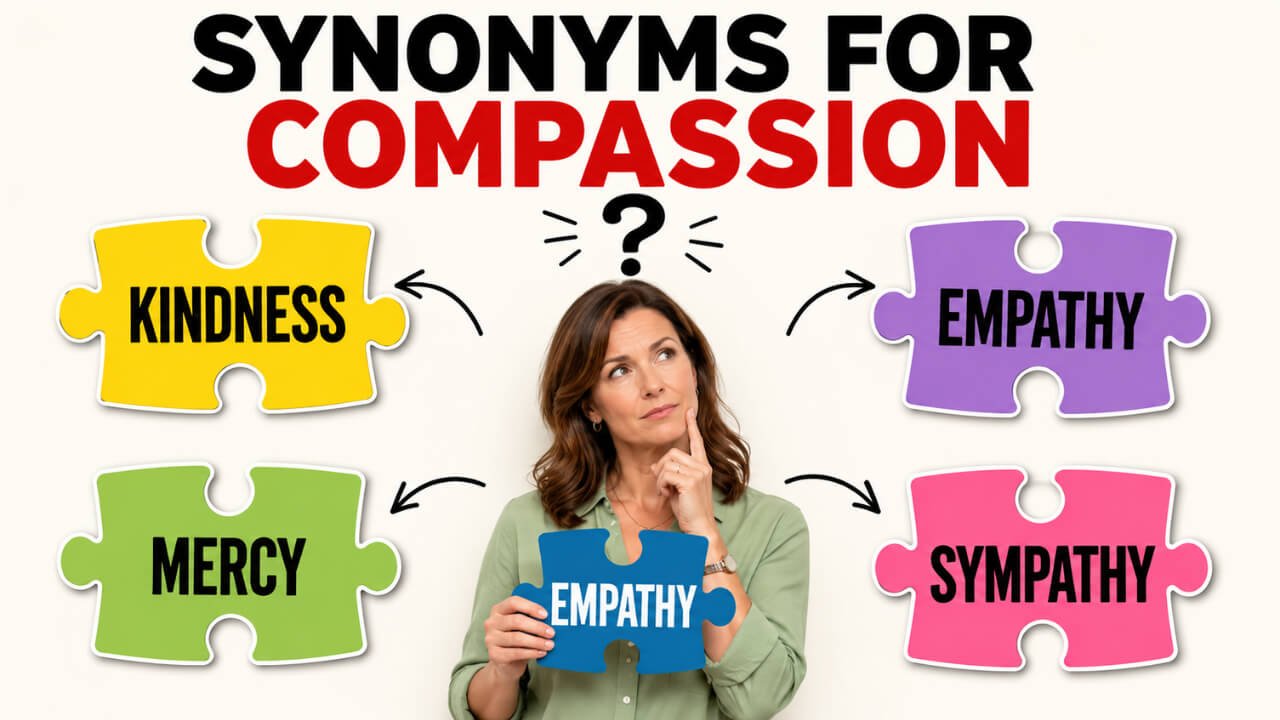
Quick Answer: The best synonyms for compassion include empathy, sympathy, kindness, mercy, concern, understanding, tenderness, benevolence, humanity, and pity. Use empathy when you mean sharing someone’s feelings, kindness when you mean caring action, mercy when you mean forgiveness, concern when you mean worry for someone’s pain, and benevolence when you want a more formal word for goodwill and care.
Pronunciation and Word Details
Word: Compassion.
Pronunciation: /kəmˈpæʃ.ən/.
Part of Speech: Noun.
Meaning: Compassion means a kind feeling of care, concern, and understanding for someone who is suffering or facing difficulty.
US Pronunciation:
UK Pronunciation:
What Does “Compassion” Mean?
Compassion means a deep feeling of care for someone who is suffering, along with a desire to help, comfort, or understand them. It is a noun used for emotional care, moral kindness, and human concern.
The word compassion can describe both a feeling and an action. You can feel compassion for someone in pain, show compassion through kind behavior, or speak with compassion when a person needs support. It often suggests warmth, patience, tenderness, and respect.
Meaning, Tone, and Context of “Compassion”
Compassion has a warm, respectful, and positive tone. It is more emotional than concern, more active than sympathy, and more caring than simple politeness. It usually means that a person notices suffering and wants to respond with kindness.
Compassion is common in everyday speech, essays, personal writing, spiritual writing, caregiving, leadership, counseling, and professional communication. In formal writing, it can show emotional intelligence and moral awareness. In personal writing, it expresses kindness, tenderness, and human connection.
When and How to Use “Compassion”
For Emotional Understanding: Use compassion when someone understands another person’s pain and responds with care.
Example: Her compassion helped the grieving family feel less alone.
For Kind Action: Use compassion when care leads to helpful behavior.
Example: The volunteer showed compassion by staying with the injured child.
For Forgiveness: Use compassion when someone responds gently instead of harshly.
Example: The teacher handled the mistake with compassion and patience.
For Human Suffering: Use compassion when writing about pain, loss, poverty, illness, fear, or hardship.
Example: The story asks readers to feel compassion for people living through crisis.
For Respectful Communication: Use compassion when the tone should be kind, thoughtful, and supportive.
Example: Speak with compassion when someone is already upset.
Best Synonyms for Compassion
Empathy: The ability to understand and share another person’s feelings.
Example: Her empathy made him feel truly heard.
Sympathy: A feeling of care or sadness for someone else’s trouble.
Example: We offered our sympathy after hearing about their loss.
Kindness: Gentle, helpful, and caring behavior toward others.
Example: A small act of kindness can comfort someone deeply.
Mercy: Compassion shown through forgiveness or gentle treatment.
Example: The leader showed mercy instead of punishment.
Concern: A feeling of worry, care, or interest in someone’s well being.
Example: His concern for the patient was clear in his voice.
Understanding: A patient and caring awareness of another person’s feelings or situation.
Example: She responded with understanding rather than judgment.
Tenderness: Soft, gentle, and loving care.
Example: He spoke with tenderness to the frightened child.
Benevolence: A formal word for kindness, goodwill, and desire to help others.
Example: Her benevolence inspired the whole community.
Humanity: The quality of being kind, caring, and sensitive to human suffering.
Example: The decision showed real humanity.
Pity: A feeling of sadness for someone who is suffering, though it can sometimes sound less equal or less respectful.
Example: He felt pity for the abandoned animal.
50 Synonyms for Compassion with Short Meanings
- Empathy: Shared understanding of another person’s feelings.
- Sympathy: Care or sadness for someone’s suffering.
- Kindness: Gentle and helpful treatment.
- Mercy: Forgiveness or gentle treatment toward someone.
- Concern: Careful worry about someone’s condition.
- Understanding: Patient awareness of another person’s feelings.
- Tenderness: Soft and gentle emotional care.
- Benevolence: Formal kindness and goodwill.
- Humanity: Caring concern for human suffering.
- Pity: Sadness for someone in pain or trouble.
- Care: Attention and kindness toward someone.
- Caring: Warm interest in another person’s well being.
- Consideration: Thoughtful attention to someone’s needs.
- Sensitivity: Awareness of other people’s feelings.
- Warmth: Friendly and caring emotional tone.
- Gentleness: Soft and kind behavior.
- Softness: Mild, tender, and caring feeling.
- Charity: Kindness and help for people in need.
- Goodwill: Friendly and helpful intention.
- Altruism: Selfless concern for others.
- Grace: Kindness shown with patience and dignity.
- Leniency: Gentle treatment instead of strict punishment.
- Forbearance: Patient self control toward someone’s faults.
- Patience: Calm understanding during difficulty.
- Tolerance: Willingness to accept differences or mistakes.
- Forgiveness: Letting go of anger toward someone.
- Support: Help and encouragement during hardship.
- Comfort: Care that reduces sadness or pain.
- Solace: Comfort during grief or distress.
- Reassurance: Words or actions that reduce fear.
- Encouragement: Support that gives hope or confidence.
- Helpfulness: Willingness to assist others.
- Thoughtfulness: Kind attention to another person’s needs.
- Generosity: Willingness to give time, help, or resources.
- Magnanimity: Noble kindness, especially after conflict.
- Tenderheartedness: A naturally soft and caring nature.
- Kindheartedness: A warm and caring character.
- Softheartedness: Strong emotional care for suffering.
- Warmheartedness: Friendly and sincere kindness.
- Fellow feeling: Shared emotional concern for others.
- Solidarity: Support for people facing difficulty.
- Love: Deep care, affection, and concern.
- Affection: Warm feeling of care or fondness.
- Devotion: Loyal care and commitment.
- Nurturance: Caring support that helps someone grow or heal.
- Protectiveness: Desire to keep someone safe.
- Heart: Emotional kindness and sincerity.
- Goodness: Moral kindness and care.
- Compunction: Uneasy regret that can lead to mercy or care.
- Gracefulness: Gentle kindness shown through calm and respectful behavior.
Read Also:
Synonyms for Celebrate

Synonyms for Compassion by Context
When Compassion Means Empathy
Use empathy, understanding, sensitivity, and fellow feeling when compassion means emotionally understanding what someone is going through.
Empathy: She showed empathy by listening without interrupting.
Understanding: His understanding made the conversation feel safe.
Sensitivity: The counselor handled the topic with sensitivity.
Fellow Feeling: The tragedy created a strong sense of fellow feeling.
When Compassion Means Kindness
Use kindness, care, caring, tenderness, gentleness, and warmth when compassion appears through soft and helpful behavior.
Kindness: Her kindness made the difficult day easier.
Care: The nurse treated every patient with care.
Tenderness: He spoke with tenderness during the painful conversation.
Warmth: Her warmth helped everyone feel welcome.
When Compassion Means Mercy
Use mercy, forgiveness, leniency, grace, and forbearance when compassion means gentle treatment instead of harsh judgment.
Mercy: The judge showed mercy because the situation was unusual.
Forgiveness: True forgiveness often begins with compassion.
Leniency: The coach used leniency with the nervous beginner.
Grace: She handled his apology with grace.
When Compassion Means Concern
Use concern, consideration, thoughtfulness, support, and reassurance when compassion means caring attention toward someone’s trouble or need.
Concern: His concern was clear when he checked on her again.
Consideration: The manager showed consideration during a family emergency.
Support: Friends offered support during the illness.
Reassurance: Her reassurance calmed the child.
When Compassion Means Human Goodness
Use humanity, benevolence, altruism, charity, goodwill, and generosity when compassion means moral kindness or care for people as a whole.
Humanity: The rescue effort showed humanity at its best.
Benevolence: His benevolence helped many families.
Altruism: Altruism is compassion expressed through selfless action.
Generosity: Their generosity brought relief to the shelter.
Another Word for Compassion
Another word for compassion is empathy, especially when you mean understanding and sharing another person’s pain. However, the best replacement depends on the sentence. Use kindness for actions, mercy for forgiveness, concern for worry, and benevolence for formal writing.
Original: She showed compassion to the lonely student.
Better Option: She showed kindness to the lonely student.
Original: His compassion helped him understand their fear.
Better Option: His empathy helped him understand their fear.
Original: The leader acted with compassion after the mistake.
Better Option: The leader acted with mercy after the mistake.
Original: The charity was built on compassion for struggling families.
Better Option: The charity was built on benevolence toward struggling families.
When Not to Use “Compassion”
Do not use compassion when a more exact word would make the meaning clearer. Compassion can sound too broad if you mean emotional understanding, simple kindness, forgiveness, or professional concern.
Weak: The report showed compassion for the numbers.
Better: The report showed careful concern about the numbers.
Weak: I have compassion with your answer.
Better: I agree with your answer.
Weak: She had compassion because the meeting started late.
Better: She was understanding because the meeting started late.
Weak: He showed compassion by giving a clear instruction.
Better: He showed helpfulness by giving a clear instruction.
Weak: The machine worked with compassion.
Better: The machine worked with precision.
Use compassion for people, animals, suffering, hardship, emotional pain, mercy, or care. Avoid using it for objects, technical accuracy, or simple agreement.
Words Commonly Confused With Compassion
Compassion vs Empathy: Compassion means caring about someone’s suffering and often wanting to help. Empathy means understanding or sharing another person’s feelings.
Compassion vs Sympathy: Sympathy means feeling sadness or concern for someone. Compassion is usually deeper and may lead to action.
Compassion vs Pity: Pity can mean sadness for someone’s suffering, but it may sound distant or superior. Compassion sounds warmer and more respectful.
Compassion vs Kindness: Kindness is helpful and gentle behavior. Compassion is the emotional care behind that behavior.
Compassion vs Mercy: Mercy is compassion shown through forgiveness, especially when someone has power to punish.
Compassion vs Concern: Concern means care or worry. Compassion is more emotional and often more personal.
Compassion vs Charity: Charity can mean giving help to people in need. Compassion is the feeling that may inspire that help.
Which Synonym Should You Choose?
Choose empathy when writing about shared feelings, emotional understanding, or personal pain.
Choose sympathy when writing about sadness, loss, grief, or polite emotional support.
Choose kindness when writing about gentle behavior, helpful actions, or everyday care.
Choose mercy when writing about forgiveness, punishment, judgment, or second chances.
Choose concern when writing about worry, attention, safety, health, or someone’s condition.
Choose understanding when writing about patience, acceptance, or a nonjudgmental response.
Choose tenderness when writing about soft emotional care, family, children, love, or comfort.
Choose benevolence when writing formal sentences about goodwill, generosity, or moral character.
Choose humanity when writing about moral values, human suffering, or ethical decisions.
Choose altruism when writing about selfless help, service, or action for others.
Real Life Examples of “Compassion” in Sentences
Original: She showed compassion when her friend was crying.
Better Option: She showed empathy when her friend was crying.
Original: The nurse treated the patient with compassion.
Better Option: The nurse treated the patient with tenderness.
Original: The teacher showed compassion after the student made a mistake.
Better Option: The teacher showed understanding after the student made a mistake.
Original: The judge listened with compassion.
Better Option: The judge listened with mercy.
Original: His compassion for animals was clear.
Better Option: His kindness toward animals was clear.
Original: The group acted with compassion after the storm.
Better Option: The group acted with generosity after the storm.
Original: Her compassion made the room feel calmer.
Better Option: Her warmth made the room feel calmer.
Original: Compassion is important in leadership.
Better Option: Humanity is important in leadership.
Original: He spoke with compassion during the difficult meeting.
Better Option: He spoke with sensitivity during the difficult meeting.
Original: The organization was known for compassion.
Better Option: The organization was known for benevolence.
Synonym Groups and Usage Differences
Empathy Group
Empathy, understanding, sensitivity, and fellow feeling focus on emotional awareness. These words are best when someone understands another person’s pain from the inside.
Example: Her empathy helped him feel understood.
Kindness Group
Kindness, care, tenderness, gentleness, and warmth focus on soft and helpful behavior. These words work well for everyday actions that comfort others.
Example: His kindness gave her hope during a hard week.
Mercy Group
Mercy, forgiveness, leniency, grace, and forbearance focus on gentle treatment when someone could be judged or punished.
Example: The coach showed mercy after the honest mistake.
Concern Group
Concern, consideration, thoughtfulness, support, and reassurance focus on attention to another person’s needs. These words are useful in family, workplace, health, and safety contexts.
Example: Her concern made him feel less alone.
Humanity Group
Humanity, benevolence, altruism, charity, goodwill, and generosity focus on moral goodness and care for others. These words are stronger in essays, speeches, and formal writing.
Example: Their generosity showed true humanity.
Antonyms of Compassion
Cruelty: A desire to cause pain or ignore suffering.
Indifference: Lack of care or interest.
Heartlessness: Lack of kindness or emotional concern.
Coldness: An unfriendly or uncaring attitude.
Insensitivity: Failure to notice or respect feelings.
Harshness: Severe or unkind treatment.
Selfishness: Concern only for personal benefit.
Apathy: No emotional interest or response.
Callousness: Hard and uncaring attitude toward suffering.
Mercilessness: Lack of mercy or forgiveness.
Comparison: Compassion vs Related Words
Compassion vs Empathy
Compassion includes care for someone’s suffering and often a wish to help. Empathy focuses more on understanding or sharing how someone feels.
Example With Compassion: She felt compassion for the injured worker and offered help.
Example With Empathy: She felt empathy because she had faced the same struggle.
Compassion vs Sympathy
Compassion is deeper and often more active. Sympathy is a feeling of sadness or concern for someone else’s pain.
Example With Compassion: His compassion led him to visit the sick neighbor.
Example With Sympathy: He sent a message of sympathy after the loss.
Compassion vs Kindness
Compassion is the feeling of care. Kindness is often the action that shows care.
Example With Compassion: Her compassion made her notice the child’s fear.
Example With Kindness: Her kindness made her sit beside the child.
Compassion vs Mercy
Compassion can apply to any suffering. Mercy usually appears when someone forgives, protects, or treats another person gently instead of harshly.
Example With Compassion: The doctor spoke with compassion to the worried family.
Example With Mercy: The official showed mercy and reduced the penalty.
Compassion vs Pity
Compassion sounds respectful and caring. Pity can sound sad but sometimes distant, weak, or superior if used carelessly.
Example With Compassion: She felt compassion for people who had lost their homes.
Example With Pity: He felt pity for the man sitting alone.
Common Phrases and Expressions With Compassion
Show Compassion: Act with care toward someone who is suffering.
Feel Compassion: Experience emotional concern for someone’s pain.
Have Compassion: Possess a kind and caring attitude.
Deep Compassion: Strong emotional care and concern.
True Compassion: Sincere care that is not fake or forced.
Human Compassion: Natural care for other people’s suffering.
Compassion for Others: Kind concern directed toward people in need.
Speak With Compassion: Use gentle, caring, and respectful words.
Act With Compassion: Behave in a helpful and caring way.
Compassion and Understanding: Kindness joined with patient awareness.
Common Mistakes to Avoid
One common mistake is using compassion when empathy is more accurate. If the sentence is about understanding feelings, empathy may be better.
Another mistake is using compassion for objects or technical results. Compassion describes human or animal suffering, emotional care, and moral kindness. It does not describe machines, numbers, or measurements.
Writers also repeat compassion too often in one paragraph. Use empathy, kindness, mercy, concern, or humanity when the context allows. Avoid using pity if you want a respectful tone, because pity can sometimes sound distant or superior. Choose the synonym that matches the exact feeling, action, or situation.
Conclusion
Understanding synonyms for compassion helps you choose warmer, clearer, and more accurate words in writing and speech. Use empathy for shared feelings, kindness for caring actions, mercy for forgiveness, concern for worry, tenderness for gentle care, and benevolence for formal goodwill. Compassion is a powerful word, but the best synonym depends on whether you mean emotion, action, forgiveness, support, or moral goodness. Choosing the right word makes your message more natural, respectful, and meaningful.
FAQs About Synonyms for Compassion
What is the best synonym for compassion?
The best synonym for compassion is empathy when you mean understanding another person’s pain. Kindness is best when you mean caring action.
Is empathy the same as compassion?
Empathy and compassion are related, but they are not exactly the same. Empathy means understanding feelings, while compassion adds care and often a desire to help.
What is a formal synonym for compassion?
A formal synonym for compassion is benevolence. It works well in essays, speeches, reports, and professional writing.
What is a simple synonym for compassion?
A simple synonym for compassion is kindness. It is clear, natural, and easy to use in everyday sentences.
Is pity a good synonym for compassion?
Pity can be a synonym, but it is not always the best choice. It may sound distant or superior, while compassion sounds warmer and more respectful.
What is the opposite of compassion?
The opposite of compassion can be cruelty, indifference, heartlessness, coldness, or apathy. The best antonym depends on the sentence.
How do I use compassion in a sentence?
You can say, “She showed compassion to the family during their difficult time.” This means she treated them with care, kindness, and understanding.
