
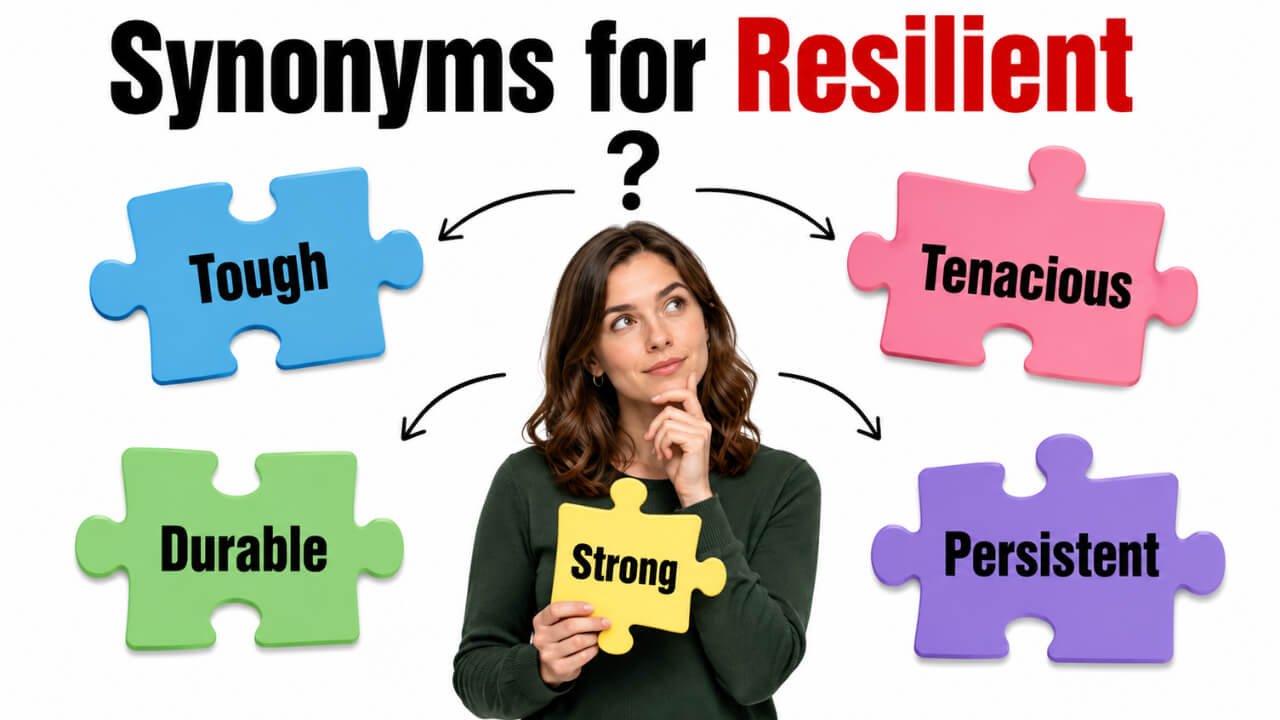
Quick Answer: Synonyms for resilient include strong, tough, hardy, durable, adaptable, flexible, enduring, persistent, tenacious, and sturdy. Use strong for general inner power, tough for hardship, durable for objects or systems, adaptable for change, flexible for adjustment, enduring for long lasting strength, and tenacious for determined effort. The best synonym depends on whether you mean emotional strength, physical toughness, quick recovery, or the ability to handle change.
Pronunciation and Word Details
Word: Resilient.
Pronunciation: /rɪˈzɪliənt/.
Part of Speech: Adjective.
Meaning: Able to recover quickly from difficulty, pressure, damage, stress, or change.
US Pronunciation:
UK Pronunciation:
What Does “Resilient” Mean?
Resilient means able to recover, adapt, or stay strong after difficulty. It is an adjective used for people, emotions, communities, materials, systems, teams, and plans.
A resilient person can face stress and keep going. A resilient material can bend or stretch and then return to its shape. A resilient business, team, or community can handle problems and recover. The word often shows strength, flexibility, patience, and the ability to continue after challenges.
Meaning, Tone, and Context of “Resilient”
Resilient has a positive, respectful, and encouraging tone. It is common in personal development, psychology, education, business, health, leadership, writing, and everyday conversation.
The word can sound formal or neutral depending on context. In professional writing, resilient often describes systems, strategies, markets, workers, or organizations. In emotional writing, it describes someone who stays hopeful after pain or pressure. In physical or technical contexts, it describes something that can resist damage or return to shape after force.
When and How to Use “Resilient”
For Emotional Strength: Use resilient when someone recovers from sadness, stress, failure, or hardship.
Example: She remained resilient after a difficult year.
For Adaptability: Use resilient when someone or something adjusts well to change.
Example: The team stayed resilient during the sudden schedule changes.
For Physical Toughness: Use resilient for materials, objects, or designs that can handle pressure or damage.
Example: The resilient fabric kept its shape after repeated use.
For Long Term Recovery: Use resilient when something returns to stability after a problem.
Example: The local economy proved resilient after the crisis.
For Personal Growth: Use resilient when describing someone who learns from setbacks instead of giving up.
Example: Resilient students often improve after making mistakes.
Best Synonyms for Resilient
Strong: Having power, courage, or emotional control.
Example: She is strong enough to handle the pressure.
Tough: Able to deal with difficulty, pain, or stress.
Example: He stayed tough during the hardest part of the project.
Hardy: Able to survive difficult conditions.
Example: These hardy plants grow well in cold weather.
Durable: Able to last for a long time without breaking.
Example: The company chose durable materials for the product.
Adaptable: Able to change when conditions change.
Example: Adaptable workers succeed in fast changing environments.
Flexible: Able to adjust without breaking or failing.
Example: A flexible plan helps the team respond to problems.
Enduring: Continuing for a long time despite difficulty.
Example: Her enduring courage inspired the whole group.
Persistent: Continuing even when progress is slow.
Example: His persistent effort helped him reach the goal.
Tenacious: Very determined and unwilling to give up.
Example: The tenacious athlete trained every day after the injury.
Sturdy: Strong, solid, and not easily damaged.
Example: The sturdy chair remained stable after years of use.
50 Synonyms for Resilient with Short Meanings
- Strong: Having power or inner strength.
- Tough: Able to handle hardship or pressure.
- Hardy: Able to survive difficult conditions.
- Durable: Able to last without damage.
- Adaptable: Able to adjust to change.
- Flexible: Able to bend or change easily.
- Enduring: Able to continue through difficulty.
- Persistent: Continuing despite obstacles.
- Tenacious: Firmly determined not to quit.
- Sturdy: Strong and solid.
- Robust: Strong, healthy, and effective.
- Resistant: Able to withstand damage or pressure.
- Buoyant: Able to recover emotionally and stay hopeful.
- Elastic: Able to stretch and return to shape.
- Springy: Able to bounce back after pressure.
- Rugged: Strong enough for rough conditions.
- Hardwearing: Able to handle frequent use.
- Long lasting: Able to remain useful for a long time.
- Stable: Not easily disturbed or damaged.
- Reliable: Able to perform well under pressure.
- Firm: Strong and steady.
- Solid: Strong, dependable, and not weak.
- Unshaken: Not emotionally or mentally disturbed.
- Unyielding: Not easily changed, weakened, or defeated.
- Steadfast: Loyal, firm, and steady.
- Resolute: Firmly decided and determined.
- Determined: Having a strong will to continue.
- Persevering: Continuing through difficulty.
- Indomitable: Impossible to defeat in spirit.
- Courageous: Brave in difficult situations.
- Brave: Ready to face danger or difficulty.
- Gritty: Showing courage and determination.
- Resourceful: Able to solve problems in difficult situations.
- Recovering: Returning to strength after difficulty.
- Rebounding: Coming back after a setback.
- Quick recovering: Able to regain strength quickly.
- Stress resistant: Able to handle stress well.
- Shock resistant: Able to withstand sudden impact or change.
- Damage resistant: Not easily harmed or broken.
- Weather resistant: Able to handle difficult weather.
- Pressure resistant: Able to perform under pressure.
- Toughened: Made stronger or harder to damage.
- Seasoned: Experienced and able to handle challenges.
- Tested: Proven through difficulty.
- Battle tested: Proven strong through serious challenges.
- Unbreakable: Very difficult to damage or defeat.
- Strong willed: Firm in decision and purpose.
- Self reliant: Able to depend on oneself.
- Hardy minded: Mentally strong in hard situations.
- Mentally strong: Able to handle stress and difficulty.
Read Also:
Synonyms for Night

Synonyms for Resilient by Context
When Resilient Means Emotionally Strong
Use these synonyms when describing people who recover from pain, stress, loss, failure, or pressure.
Strong: She stayed strong after the setback.
Tough: He became tougher after facing many challenges.
Buoyant: Her buoyant spirit helped her keep moving forward.
Unshaken: He remained unshaken during the criticism.
Mentally Strong: A mentally strong person can face pressure with calm thinking.
When Resilient Means Able to Adapt
Use these synonyms when something or someone adjusts well to change.
Adaptable: Adaptable employees learn new tools quickly.
Flexible: A flexible schedule helped the team manage delays.
Resourceful: Resourceful people find solutions when plans fail.
Versatile: A versatile worker can handle different tasks.
Stable: A stable system keeps working during change.
When Resilient Means Physically Tough
Use these synonyms for materials, products, objects, designs, or structures.
Durable: The durable bag survived years of travel.
Sturdy: The sturdy table did not move under pressure.
Rugged: Rugged shoes are useful on rough ground.
Hardwearing: Hardwearing fabric is good for daily use.
Shock Resistant: A shock resistant case protects the device from impact.
When Resilient Means Persistent
Use these synonyms when someone continues despite difficulty.
Persistent: Her persistent practice improved her writing.
Tenacious: The tenacious student kept studying after failing once.
Determined: He was determined to finish the race.
Persevering: Persevering workers keep trying even when results take time.
Resolute: She was resolute in her decision to improve.
Another Word for Resilient
Another word for resilient is strong, but the best replacement depends on the meaning. Use strong for general emotional power, durable for objects, adaptable for change, and tenacious for determination.
Original: She is a resilient leader.
Better Option: She is a strong leader.
Original: The resilient material returned to its shape.
Better Option: The elastic material returned to its shape.
Original: The company remained resilient during the crisis.
Better Option: The company remained stable during the crisis.
Original: He showed a resilient attitude after failure.
Better Option: He showed a determined attitude after failure.
When Not to Use “Resilient”
Do not use resilient when a more specific word is clearer. If you mean exact physical strength, use sturdy or durable. If you mean emotional courage, use strong or brave. If you mean continued effort, use persistent or tenacious.
Avoid repeating resilient too often in the same paragraph. It can also sound too formal in casual speech if a simpler word works better.
Weak: The resilient chair is resilient and has a resilient frame.
Better: The sturdy chair has a durable frame.
Weak: He is resilient because he always does his homework.
Better: He is persistent because he always does his homework.
Weak: The answer was resilient.
Better: The answer was strong and well supported.
Words Commonly Confused With Resilient
Resilient vs Strong: Resilient means able to recover after difficulty. Strong means having power, courage, or firmness.
Resilient vs Durable: Resilient can describe people, systems, emotions, and materials. Durable usually describes objects that last a long time.
Resilient vs Flexible: Resilient means able to recover. Flexible means able to adjust or bend easily.
Resilient vs Tough: Resilient often includes recovery. Tough often focuses on the ability to handle pain, pressure, or hardship.
Resilient vs Persistent: Resilient means bouncing back after problems. Persistent means continuing with effort despite difficulty.
Resilient vs Adaptable: Resilient means recovering from difficulty. Adaptable means changing successfully when conditions change.
Which Synonym Should You Choose?
Choose strong when writing about emotional power, confidence, or courage.
Choose tough when describing someone who can handle hardship, stress, or pain.
Choose durable when writing about products, tools, materials, furniture, or physical objects.
Choose adaptable when the focus is change, learning, or new conditions.
Choose flexible when the focus is adjustment, planning, or bending without breaking.
Choose persistent when the focus is repeated effort.
Choose tenacious when you want a stronger word for determination.
Choose sturdy when writing about something solid, safe, or physically strong.
Choose buoyant when describing a hopeful emotional recovery.
Choose robust when writing about systems, strategies, health, performance, or professional strength.
Real Life Examples of “Resilient” in Sentences
Original: She is resilient after every challenge.
Better Option: She is strong after every challenge.
Original: The resilient material did not tear easily.
Better Option: The durable material did not tear easily.
Original: The team was resilient during the difficult season.
Better Option: The team was determined during the difficult season.
Original: He has a resilient attitude toward failure.
Better Option: He has a persistent attitude toward failure.
Original: The community stayed resilient after the storm.
Better Option: The community stayed strong after the storm.
Original: The resilient system handled the sudden increase in demand.
Better Option: The robust system handled the sudden increase in demand.
Original: She gave a resilient response to criticism.
Better Option: She gave a calm and unshaken response to criticism.
Original: Resilient students learn from mistakes.
Better Option: Adaptable students learn from mistakes.
Original: The resilient plant survived the dry season.
Better Option: The hardy plant survived the dry season.
Original: His resilient spirit encouraged everyone.
Better Option: His indomitable spirit encouraged everyone.
Synonym Groups and Usage Differences
Emotional Strength Group
This group includes strong, tough, brave, courageous, buoyant, and mentally strong. Use these words for people who face pain, loss, pressure, or fear.
Example: Her strong spirit helped her recover after the loss.
Physical Strength Group
This group includes durable, sturdy, rugged, hardwearing, resistant, and shock resistant. Use these words for objects, materials, buildings, tools, or products.
Example: The rugged case protected the phone during travel.
Adaptability Group
This group includes adaptable, flexible, resourceful, stable, and versatile. Use these words when someone or something changes well under new conditions.
Example: A flexible plan made the project easier to manage.
Determination Group
This group includes persistent, tenacious, determined, persevering, resolute, and strong willed. Use these words when effort and refusal to quit are the main ideas.
Example: The tenacious writer kept improving the draft.
Recovery Group
This group includes rebounding, recovering, quick recovering, buoyant, and unshaken. Use these words when the main idea is coming back after a setback.
Example: The recovering business regained customer trust.
Antonyms of Resilient
Weak: Lacking strength or power.
Fragile: Easily broken or damaged.
Delicate: Easily harmed or affected.
Vulnerable: Open to damage, harm, or stress.
Rigid: Unable to bend, change, or adapt.
Inflexible: Not willing or able to adjust.
Unstable: Easily disturbed or changed.
Breakable: Easily damaged or destroyed.
Discouraged: Losing hope or confidence.
Defeated: Having lost strength, confidence, or success.
Exhausted: Too tired to continue strongly.
Helpless: Unable to act or recover effectively.
Comparison: Resilient vs Related Words
Resilient vs Strong
Resilient means able to recover after difficulty. Strong means having power, courage, or firmness.
Example With Resilient: She was resilient after losing the competition.
Example With Strong: She was strong enough to face the pressure.
Resilient vs Durable
Resilient can describe people, systems, emotions, or materials. Durable usually describes objects that last a long time.
Example With Resilient: The system was resilient after the outage.
Example With Durable: The backpack was durable enough for daily use.
Resilient vs Flexible
Resilient focuses on recovery. Flexible focuses on adjustment.
Example With Resilient: The team was resilient after the project failed.
Example With Flexible: The team was flexible when the deadline changed.
Resilient vs Tough
Resilient often suggests recovery and growth. Tough suggests strength during pressure or pain.
Example With Resilient: He was resilient after the injury.
Example With Tough: He was tough enough to finish the match.
Resilient vs Persistent
Resilient means able to bounce back. Persistent means continuing to try.
Example With Resilient: She stayed resilient after rejection.
Example With Persistent: She was persistent in sending applications.
Common Phrases and Expressions With Resilient
Resilient Person: Someone who recovers after difficulty.
Resilient Mindset: A way of thinking that handles setbacks well.
Resilient Spirit: Inner strength that does not give up easily.
Resilient Community: A group that recovers after hardship.
Resilient System: A system that keeps working or recovers after problems.
Resilient Economy: An economy that remains stable after pressure.
Resilient Material: A material that resists damage or returns to shape.
Resilient Team: A team that stays effective during challenges.
Resilient Leadership: Leadership that remains steady under pressure.
Resilient Response: A strong and calm reaction to difficulty.
Common Mistakes to Avoid
One common mistake is using resilient for every kind of strength. Resilient is best when recovery, adaptation, or resistance to pressure is involved. If you only mean physically strong, use sturdy, durable, or robust.
Another mistake is confusing resilient with persistent. Persistent means someone keeps trying. Resilient means someone recovers after problems. Also avoid overusing resilient in the same paragraph. Mix it with strong, tough, adaptable, durable, or tenacious when those words fit better.
Conclusion
Synonyms for resilient help you describe strength, recovery, flexibility, and determination with more accuracy. Use strong for emotional power, tough for hardship, durable for objects, adaptable for change, flexible for adjustment, persistent for steady effort, and tenacious for firm determination. Resilient is a useful word, but choosing the right synonym makes your writing clearer, more natural, and more specific for each situation.
FAQs About Synonyms for Resilient
What Are The Best Synonyms For Resilient?
The best synonyms for resilient are strong, tough, adaptable, durable, flexible, persistent, tenacious, hardy, sturdy, and enduring.
What Is Another Word For A Resilient Person?
Another word for a resilient person is strong. You can also use tough, determined, courageous, persistent, or mentally strong depending on the sentence.
Is Resilient A Positive Word?
Yes, resilient is a positive word. It describes someone or something that can recover, adapt, and stay strong after difficulty.
What Is A Formal Synonym For Resilient?
A formal synonym for resilient is robust. Other formal choices include durable, adaptable, stable, resistant, and enduring.
What Is A Casual Synonym For Resilient?
A casual synonym for resilient is tough. In everyday speech, you can also say strong, brave, or able to bounce back.
What Is The Opposite Of Resilient?
The opposite of resilient can be weak, fragile, delicate, vulnerable, rigid, unstable, or breakable depending on the context.
What Is The Difference Between Resilient And Strong?
Resilient means able to recover after problems. Strong means having power, courage, or firmness. A person can be strong, but resilient adds the idea of bouncing back after difficulty.
