
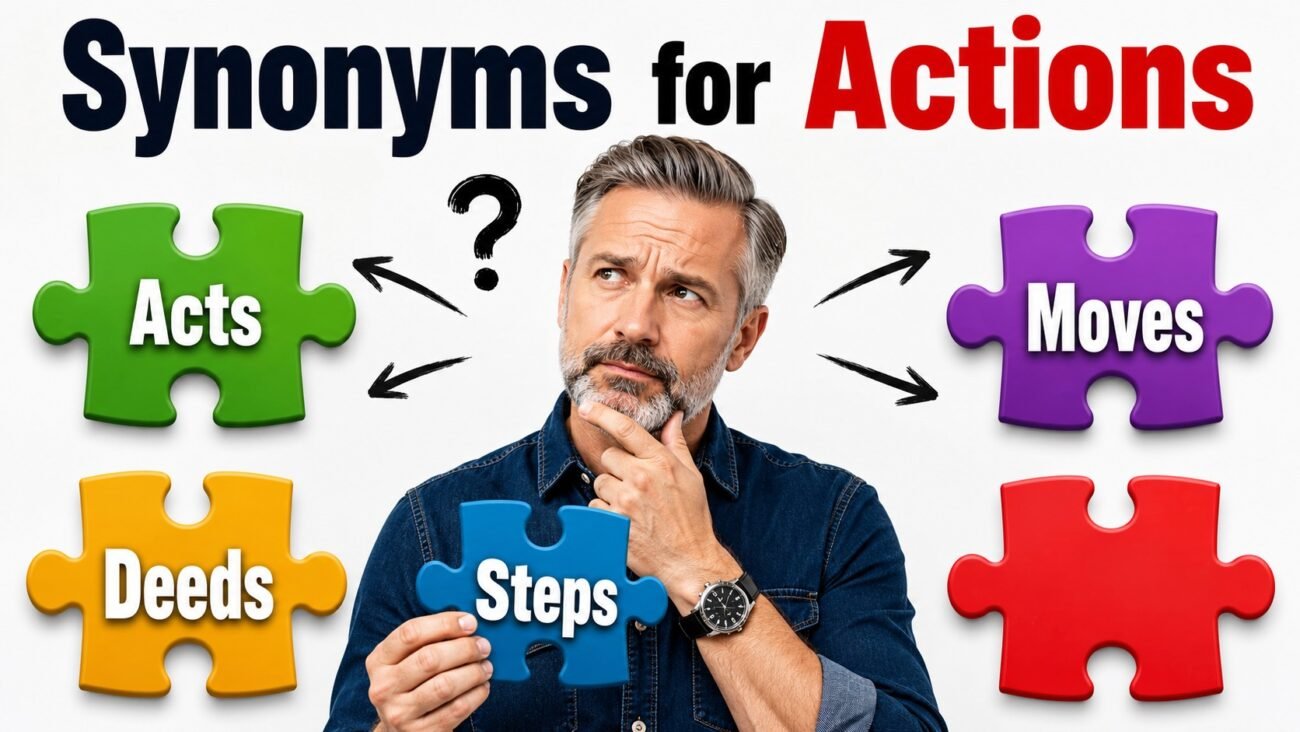
Quick Answer: Synonyms for actions include deeds, acts, activities, behavior, conduct, steps, measures, moves, efforts, and operations. Use deeds for moral or meaningful things someone does, acts for general things done, behavior for how a person acts, conduct for formal character or manner, steps for progress toward a goal, measures for planned responses, and operations for organized work or systems.
Pronunciation and Word Details
Word: Actions.
Pronunciation: /ˈækʃənz/.
Part of Speech: Noun.
Meaning: Actions are things that people, groups, animals, or systems do.
US Pronunciation:
UK Pronunciation:
What Does “Actions” Mean?
Actions means things that are done by a person, group, animal, organization, or system. It is the plural form of action and works as a noun. The word can describe physical acts, choices, behavior, steps, official responses, or practical efforts.
In sentences, actions can show what someone does, how someone behaves, or what steps are taken to reach a result. For example, kind actions show care, quick actions show urgency, and careless actions may cause problems. The word is common in everyday speech, essays, reports, business writing, and grammar lessons.
Meaning, Tone, and Context of “Actions”
Actions is a neutral and flexible word. It can sound simple in casual speech, serious in formal writing, and meaningful in emotional or moral contexts. The tone depends on the sentence.
In everyday English, actions often means things people do. In formal writing, it can refer to steps, measures, procedures, or official decisions. In grammar, actions are closely connected to verbs because verbs often express what someone or something does. In character based writing, actions can reveal values, attitude, effort, responsibility, and intention.
When and How to Use “Actions”
For Behavior: Use actions when describing how a person behaves or responds.
Example: Her actions showed patience during a stressful moment.
For Decisions: Use actions when choices lead to something being done.
Example: The manager reviewed the problem before taking further actions.
For Progress: Use actions when describing steps toward a goal.
Example: Small actions can create strong results over time.
For Responsibility: Use actions when discussing results, blame, or accountability.
Example: He accepted responsibility for his actions.
For Official Response: Use actions when talking about steps taken by a group or authority.
Example: The committee planned new actions to improve safety.
Best Synonyms for Actions
Acts: Things done by a person or group.
Example: His brave acts helped many people during the emergency.
Deeds: Actions that are often moral, meaningful, good, or bad.
Example: Her generous deeds made a lasting difference.
Activities: Things people do, especially for work, study, fun, or routine.
Example: The school planned several outdoor activities.
Behavior: The way someone acts in a situation.
Example: His behavior changed after the meeting.
Conduct: A formal word for a person’s behavior or manner of acting.
Example: The report praised her professional conduct.
Steps: Actions taken in a sequence to reach a result.
Example: We need clear steps to complete the project.
Measures: Planned actions taken to solve, prevent, or control something.
Example: New measures were introduced to reduce errors.
Moves: Actions or decisions made to gain progress or advantage.
Example: The company made smart moves during a difficult season.
Efforts: Actions done with energy, intention, or hard work.
Example: Their efforts improved the final result.
Operations: Organized actions or processes, often in business, systems, or work.
Example: Daily operations continued without delay.
50 Synonyms for Actions with Short Meanings
- Acts: Things done by someone.
- Deeds: Meaningful actions, often good or bad.
- Activities: Things people do.
- Behavior: The way someone acts.
- Conduct: Formal behavior or manner.
- Steps: Actions in a planned order.
- Measures: Planned actions for a purpose.
- Moves: Strategic actions or decisions.
- Efforts: Actions done with energy or intention.
- Operations: Organized work or processes.
- Tasks: Specific pieces of work.
- Duties: Required actions or responsibilities.
- Work: Actions done to complete something.
- Practices: Regular ways of doing things.
- Procedures: Fixed methods or official steps.
- Processes: Series of actions that produce a result.
- Responses: Actions taken as a reply or reaction.
- Reactions: Actions caused by an event or feeling.
- Decisions: Choices that lead to action.
- Choices: Options selected before acting.
- Initiatives: New actions started for improvement.
- Undertakings: Serious tasks or actions begun.
- Performances: Acts of doing or carrying out something.
- Doings: Informal word for things done.
- Maneuvers: Skillful or strategic actions.
- Interventions: Actions taken to improve or change a situation.
- Implementations: Actions that put plans into practice.
- Executions: Carrying out plans or tasks.
- Applications: Practical uses of ideas or methods.
- Motions: Physical actions or movements.
- Gestures: Actions that express meaning or feeling.
- Movements: Physical actions or changes in position.
- Attempts: Actions made to try something.
- Endeavors: Serious efforts or attempts.
- Pursuits: Actions followed to reach a goal.
- Campaigns: Organized actions for a purpose.
- Projects: Planned actions or pieces of work.
- Assignments: Tasks given to someone.
- Missions: Important tasks or purposeful actions.
- Programs: Organized sets of actions.
- Plans: Intended actions for the future.
- Methods: Ways of doing actions.
- Approaches: Ways of dealing with something.
- Tactics: Planned actions used to achieve a result.
- Strategies: Larger plans made through actions.
- Proceedings: Formal or legal actions.
- Lawsuits: Legal actions in court.
- Habits: Repeated actions or behavior patterns.
- Routines: Regular actions done repeatedly.
- Performative acts: Actions that express or create meaning.
Read Also:
Synonyms for Lazy

Synonyms for Actions by Context
When Actions Means Things Done
When actions means general things done by someone, use acts, deeds, activities, or doings. These words work well in everyday writing and simple explanations.
Example: His actions were helpful.
Better Option: His acts were helpful.
Example: Her actions showed kindness.
Better Option: Her deeds showed kindness.
When Actions Means Behavior
When actions means how someone behaves, use behavior, conduct, habits, or practices. These synonyms are useful when describing personality, manners, attitude, or character.
Example: His actions were respectful during the discussion.
Better Option: His conduct was respectful during the discussion.
Example: The child’s actions changed after guidance.
Better Option: The child’s behavior changed after guidance.
When Actions Means Steps or Measures
When actions means planned steps, use steps, measures, moves, or responses. These words are useful in reports, advice, problem solving, and formal decisions.
Example: The team took actions to fix the issue.
Better Option: The team took measures to fix the issue.
Example: We need actions before the deadline.
Better Option: We need clear steps before the deadline.
When Actions Means Work or Operations
When actions means organized work, use operations, tasks, procedures, processes, or projects. These words are useful in business, systems, education, and planning.
Example: The actions continued throughout the day.
Better Option: The operations continued throughout the day.
Example: Several actions were assigned to the team.
Better Option: Several tasks were assigned to the team.
When Actions Means Legal or Official Steps
When actions means legal, official, or formal steps, use proceedings, lawsuits, measures, or interventions. These words sound more precise in serious contexts.
Example: The family started legal actions.
Better Option: The family started legal proceedings.
Example: Officials took actions to protect the area.
Better Option: Officials took measures to protect the area.
Another Word for Actions
Another word for actions is acts. It is the most general replacement because it means things done by a person or group. However, the best alternative depends on the sentence. Use deeds for moral meaning, behavior for personal conduct, steps for progress, and measures for planned responses.
Original: His actions helped the community.
Better Option: His deeds helped the community.
Original: We must take actions to reduce waste.
Better Option: We must take measures to reduce waste.
Original: Her actions were polite and thoughtful.
Better Option: Her conduct was polite and thoughtful.
Original: The plan requires several actions.
Better Option: The plan requires several steps.
When Not to Use “Actions”
Do not use actions when a more specific word gives clearer meaning. Actions can sound weak if the sentence needs a word like behavior, steps, measures, operations, deeds, or decisions. It can also become repetitive if used too many times in one paragraph.
Weak: The actions of the workers during the actions were helpful.
Better: The workers’ efforts during the operation were helpful.
Weak: The school took actions for student safety.
Better: The school introduced safety measures for students.
Weak: His actions in class were not acceptable.
Better: His behavior in class was not acceptable.
Weak: We need more actions to finish the plan.
Better: We need more steps to finish the plan.
Words Commonly Confused With Actions
Actions vs Acts: Actions is broader and can describe behavior, steps, or decisions. Acts usually means specific things someone does.
Actions vs Deeds: Actions is neutral, while deeds often suggests moral value, such as good deeds or bad deeds.
Actions vs Activities: Actions can be any things done, while activities often means planned tasks, events, or things people do for work, school, or enjoyment.
Actions vs Behavior: Actions can be individual things done, while behavior describes someone’s overall way of acting.
Actions vs Conduct: Conduct is more formal than actions and often describes professional, social, or moral behavior.
Actions vs Measures: Measures are planned actions taken to solve, prevent, or control a problem.
Actions vs Operations: Operations are organized actions, usually in business, systems, services, or planned work.
Which Synonym Should You Choose?
Choose acts: When you mean simple things someone did.
Choose deeds: When the action has moral, kind, brave, harmful, or meaningful value.
Choose behavior: When you describe how someone acts in general.
Choose conduct: When writing formally about manners, character, or professional behavior.
Choose steps: When explaining a process or sequence.
Choose measures: When describing planned actions taken to fix or prevent something.
Choose moves: When the action is strategic or decision based.
Choose efforts: When you want to show hard work, attempt, or intention.
Choose operations: When writing about organized work, systems, or business activity.
Choose procedures: When the actions follow an official or fixed method.
Real Life Examples of “Actions” in Sentences
Original: Her actions showed that she cared.
Better Option: Her deeds showed that she cared.
Original: His actions during the meeting were respectful.
Better Option: His conduct during the meeting was respectful.
Original: The company took actions to improve service.
Better Option: The company took measures to improve service.
Original: We need actions to complete the task.
Better Option: We need steps to complete the task.
Original: Their actions helped the project succeed.
Better Option: Their efforts helped the project succeed.
Original: The actions of the machine were difficult to understand.
Better Option: The operations of the machine were difficult to understand.
Original: The teacher noticed the student’s actions.
Better Option: The teacher noticed the student’s behavior.
Original: The leader planned careful actions before speaking.
Better Option: The leader planned careful moves before speaking.
Original: Legal actions were taken after the complaint.
Better Option: Legal proceedings were started after the complaint.
Original: Daily actions helped build better habits.
Better Option: Daily routines helped build better habits.
Synonym Groups and Usage Differences
Behavior Group
Behavior, conduct, habits, and practices describe how someone acts. These words are useful when writing about personality, manners, discipline, character, or social situations.
Example: Her conduct remained calm and respectful.
Task Group
Tasks, duties, assignments, and work describe actions that must be completed. These words are useful in school, business, jobs, and project writing.
Example: Each team member received clear tasks.
Decision Group
Moves, decisions, choices, and strategies describe actions connected to planning and judgment. These words are useful when explaining leadership, competition, problem solving, or progress.
Example: His careful decisions improved the final outcome.
Official Response Group
Measures, interventions, proceedings, and procedures describe formal or planned actions. These words are useful in reports, rules, safety, legal writing, and official communication.
Example: New measures were introduced after the review.
Moral Deed Group
Deeds, acts, efforts, and gestures describe actions with emotional, moral, or personal meaning. These words are useful when writing about kindness, courage, respect, or harm.
Example: Her small gestures made everyone feel welcome.
Antonyms of Actions
Inaction: Lack of action or movement.
Inactivity: State of not doing anything active.
Idleness: Lack of useful activity or effort.
Stillness: Absence of movement.
Delay: Waiting too long before acting.
Hesitation: Pause before taking action.
Avoidance: Staying away from action or responsibility.
Passivity: Allowing things to happen without acting.
Neglect: Failure to take needed action.
Rest: A pause from action or effort.
Comparison: Actions vs Related Words
Actions vs Acts
Actions is broader and can describe behavior, steps, decisions, and responses. Acts usually means specific things done by someone.
Example With Actions: Her actions changed the mood of the room.
Example With Acts: Her kind acts made everyone feel included.
Actions vs Deeds
Actions is neutral, while deeds often has moral meaning. Deeds can be good, bad, brave, generous, or harmful.
Example With Actions: His actions affected the whole team.
Example With Deeds: His good deeds earned respect.
Actions vs Behavior
Actions can refer to separate things someone does. Behavior describes a pattern or way of acting.
Example With Actions: His actions after the mistake were responsible.
Example With Behavior: His behavior at school improved.
Actions vs Conduct
Conduct is more formal than actions. It is often used in professional, academic, legal, or official contexts.
Example With Actions: Her actions were honest.
Example With Conduct: Her conduct was professional.
Actions vs Measures
Actions can be general, while measures are planned steps taken to solve or prevent something.
Example With Actions: The group discussed future actions.
Example With Measures: The group approved safety measures.
Actions vs Operations
Actions can refer to anything done. Operations refer to organized work, systems, or processes.
Example With Actions: Their actions supported the plan.
Example With Operations: Their operations continued smoothly.
Common Phrases and Expressions With Actions
Take Actions: Do something to solve or address a situation.
Actions Speak Louder Than Words: What someone does matters more than what someone says.
Positive Actions: Helpful or good things done.
Corrective Actions: Steps taken to fix a problem.
Legal Actions: Formal steps taken through law.
Immediate Actions: Things done quickly without delay.
Planned Actions: Steps decided before doing something.
Human Actions: Things done by people.
Future Actions: Things that will be done later.
Responsible Actions: Careful things done with good judgment.
Common Mistakes to Avoid
One common mistake is using actions when a more specific synonym is better. For example, use behavior when describing how someone acts, measures when describing planned responses, and steps when explaining a process.
Another mistake is repeating actions too often in the same paragraph. Replace it with acts, efforts, choices, steps, conduct, or operations when the meaning is clear. Avoid using actions for every type of movement or decision. Choose the synonym that matches the context, tone, and purpose of the sentence.
Also avoid confusing actions with activities. Activities usually means planned or regular things people do, while actions can include behavior, decisions, responses, and results.
Conclusion
Synonyms for actions help you write with better clarity, tone, and precision. Use acts for general things done, deeds for meaningful or moral actions, behavior for how someone acts, conduct for formal situations, steps for progress, measures for planned responses, and operations for organized work. The best word depends on whether you are writing about people, choices, duties, results, official responses, or everyday behavior.
FAQs About Synonyms for Actions
What are the best synonyms for actions?
The best synonyms for actions are acts, deeds, activities, behavior, conduct, steps, measures, moves, efforts, and operations.
What is another word for actions in formal writing?
A strong formal word for actions is measures when you mean planned steps. Conduct is also formal when you mean behavior.
What is another word for actions in everyday speech?
Acts, things done, activities, steps, and moves work well in everyday speech, depending on the sentence.
What is the difference between actions and behavior?
Actions are things someone does, while behavior is the overall way someone acts. Behavior often describes a pattern.
What is the difference between actions and deeds?
Actions is a general word. Deeds often suggests moral meaning, such as good deeds, brave deeds, or harmful deeds.
Can actions mean legal steps?
Yes, actions can mean legal steps. In legal context, proceedings or lawsuits may be more specific alternatives.
Which synonym should I use for planned actions?
Use measures, steps, procedures, plans, or strategies for planned actions. Measures is best when the actions are taken to solve or prevent a problem.
