
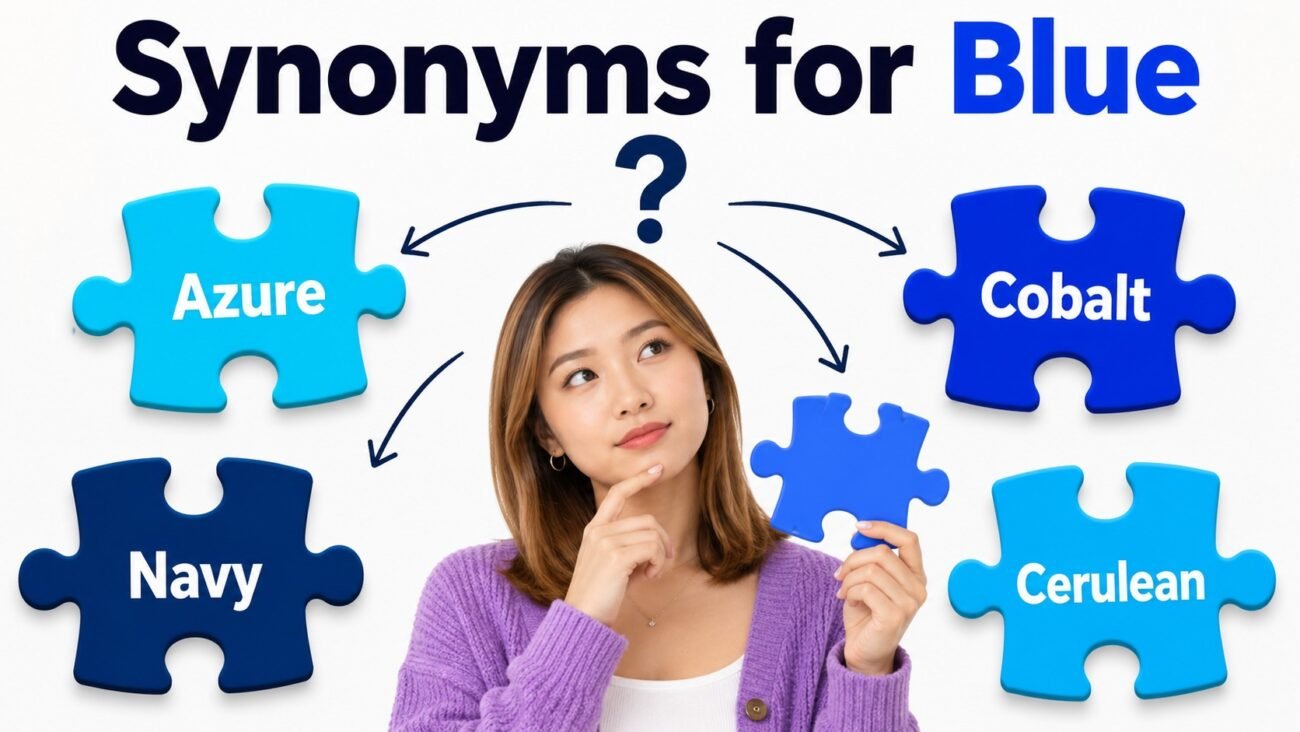
Quick Answer: The best synonyms for blue include azure, sky blue, sapphire, cobalt, navy, cerulean, turquoise, aqua, indigo, and sad. Use azure or cerulean for a bright, clear blue color, navy for a dark formal shade, sapphire for a rich jewel toned blue, aqua or turquoise for a blue green shade, and sad or melancholy when “blue” means emotionally down. The best synonym depends on whether you are describing color, mood, style, nature, design, clothing, or emotion.
Pronunciation and Word Details
Word: Blue
Pronunciation: /bluː/
Part of Speech: Adjective and noun
Meaning: Blue means a color between green and violet, or a sad and low emotional state.
US Pronunciation:
UK Pronunciation:
What Does “Blue” Mean?
Direct Answer: “Blue” means a cool color seen in the sky and ocean, and it can also mean feeling sad or emotionally low.
“Blue” works as both an adjective and a noun. As an adjective, it describes the color of something.
Example: She wore a blue dress.
As a noun, it can name the color itself.
Example: Blue is his favorite color.
In emotional language, “blue” can describe sadness.
Example: He felt blue after hearing the bad news.
The meaning depends on context. In design, art, fashion, and nature writing, “blue” usually refers to color. In conversation or emotional writing, it may mean sad, gloomy, or downcast.
Meaning, Tone, and Context of “Blue”
Tone: “Blue” is simple, neutral, and common in everyday English.
When used as a color word, “blue” feels clear and easy to understand. It can describe light, dark, soft, deep, bright, cool, or muted shades. In writing about design, clothing, rooms, weather, flowers, water, or art, “blue” is a direct and natural word.
Color Context: The room had soft blue walls.
Nature Context: The lake looked blue in the morning light.
Style Context: He chose a dark blue suit.
When used for emotion, “blue” sounds casual and slightly gentle. It is less direct than “sad” and less serious than “depressed.” Because of that, it often works well in conversation, storytelling, songs, and personal writing.
Emotional Context: She felt a little blue on a rainy evening.
When and How to Use “Blue”
For Color: Use “blue” when describing objects, clothing, places, art, nature, or design.
Example: The blue curtains made the room feel calm.
For Shade Description: Use “blue” with another word when you need a more specific color.
Example: She chose a pale blue notebook.
For Mood: Use “blue” when describing mild sadness or a low emotional feeling.
Example: He felt blue after his friend moved away.
For Creative Writing: Use “blue” when you want a calm, cool, emotional, or visual tone.
Example: The blue evening settled over the quiet street.
For Everyday Speech: Use “blue” when a simple word is better than a technical color name.
Example: I bought a blue shirt yesterday.
Best Synonyms for Blue
Azure: A bright, clear blue, often like the sky.
Example: The painting showed an azure sky above the hills.
Sky Blue: A light blue like a clear daytime sky.
Example: She painted the nursery sky blue.
Sapphire: A rich, deep blue like the gemstone.
Example: Her ring had a sapphire shine.
Cobalt: A strong, vivid blue shade.
Example: The artist used cobalt paint for the ocean.
Navy: A very dark blue, often used for formal clothing.
Example: He wore a navy jacket to the dinner.
Cerulean: A bright blue shade often linked with the sky or sea.
Example: The water looked cerulean under the sunlight.
Turquoise: A blue green shade often linked with clear water.
Example: The bracelet had turquoise stones.
Aqua: A light blue green shade that feels fresh and bright.
Example: The bathroom tiles were aqua.
Indigo: A deep blue with a purple tone.
Example: The evening sky turned indigo.
Sad: Emotionally unhappy or low.
Example: She felt sad after the farewell.
50 Synonyms for Blue with Short Meanings
- Azure: Bright clear blue.
- Sky Blue: Light blue like the sky.
- Sapphire: Rich deep blue.
- Cobalt: Strong vivid blue.
- Navy: Very dark blue.
- Cerulean: Bright sky like blue.
- Cyan: Bright blue with a green tone.
- Aqua: Light blue green shade.
- Turquoise: Blue green color.
- Teal: Dark blue green shade.
- Indigo: Deep blue with purple tone.
- Royal Blue: Strong bright blue.
- Powder Blue: Soft pale blue.
- Baby Blue: Gentle light blue.
- Steel Blue: Grayish blue shade.
- Ice Blue: Very pale cool blue.
- Pale Blue: Light and soft blue.
- Light Blue: Blue with a bright soft tone.
- Dark Blue: Deep blue shade.
- Deep Blue: Strong dark blue.
- Midnight Blue: Very dark blue like night.
- Ocean Blue: Blue like deep water.
- Sea Blue: Blue linked with the sea.
- Cornflower Blue: Soft medium blue.
- Slate Blue: Muted blue with gray tone.
- Denim Blue: Casual cloth like blue.
- Blue Gray: Blue mixed with gray.
- Prussian Blue: Dark intense blue.
- Electric Blue: Very bright striking blue.
- Arctic Blue: Cold pale blue.
- Frost Blue: Icy soft blue.
- Marine Blue: Blue linked with sea style.
- Ultramarine: Deep vivid blue.
- Aquamarine: Pale blue green shade.
- Blue Green: A mix of blue and green.
- Bluish: Slightly blue in color.
- Blue Toned: Having a blue shade or effect.
- Sad: Feeling unhappy.
- Melancholy: Quiet and thoughtful sadness.
- Gloomy: Dark, dull, or sad.
- Downcast: Looking or feeling low.
- Unhappy: Not happy or pleased.
- Sorrowful: Full of sadness.
- Miserable: Very unhappy.
- Low: Feeling emotionally down.
- Dejected: Sad because of disappointment.
- Despondent: Feeling without hope.
- Heartbroken: Deeply sad from emotional pain.
- Cheerless: Without joy or brightness.
- Moody: Emotionally changeable or gloomy.
Read Also:
Synonyms for During
Synonyms for Blue by Context
When Blue Means a Light Color
Use these synonyms when you want to describe a soft, pale, fresh, or gentle blue shade.
Sky Blue: Best for a light, bright shade like the daytime sky.
Example: The sky blue blanket made the room feel peaceful.
Powder Blue: Best for a soft and delicate blue.
Example: She wore a powder blue scarf.
Baby Blue: Best for a gentle and sweet light blue.
Example: The invitation had a baby blue border.
Ice Blue: Best for a cool and very pale blue.
Example: Her dress had an ice blue glow.
When Blue Means a Dark Color
Use these synonyms when you want a deeper, stronger, richer, or more serious blue shade.
Navy: Best for a very dark blue, especially in clothing or design.
Example: He chose a navy coat for the event.
Midnight Blue: Best for a very dark blue that feels close to black.
Example: The car had a midnight blue finish.
Indigo: Best for a deep blue with a purple tone.
Example: The sky turned indigo after sunset.
Deep Blue: Best for a strong and rich dark blue.
Example: The lake looked deep blue in the distance.
When Blue Means Bright or Vivid Color
Use these synonyms when the color is bold, clear, sharp, or eye catching.
Cobalt: Best for a strong and vivid blue.
Example: The vase was painted cobalt.
Electric Blue: Best for a very bright and striking blue.
Example: The sign had electric blue letters.
Royal Blue: Best for a rich and bold blue shade.
Example: She selected a royal blue dress.
Cerulean: Best for a clear and lively blue.
Example: The artist filled the canvas with cerulean waves.
When Blue Means Blue Green
Use these synonyms when the color has both blue and green in it.
Turquoise: Best for a bright blue green shade.
Example: The water looked turquoise near the shore.
Aqua: Best for a light and fresh blue green shade.
Example: The walls were painted aqua.
Teal: Best for a darker blue green shade.
Example: He bought a teal notebook.
Aquamarine: Best for a pale blue green shade.
Example: Her necklace had an aquamarine shine.
When Blue Means Sad
Use these synonyms when “blue” describes emotion, not color.
Sad: Best for a clear and simple emotional meaning.
Example: He felt sad after the goodbye.
Melancholy: Best for quiet, thoughtful sadness.
Example: The song had a melancholy feeling.
Downcast: Best for someone who looks or feels low.
Example: She seemed downcast after the meeting.
Gloomy: Best for a dark or unhappy mood.
Example: The gloomy weather matched his mood.
Another Word for Blue
Best Single Replacement: The best single replacement for “blue” is azure when describing a bright color, navy when describing a dark shade, and sad when describing emotion.
The right choice depends on meaning. If the sentence is about color, choose a shade word. If the sentence is about mood, choose an emotion word. A color synonym will not work in an emotional sentence, and an emotional synonym will not work when describing an object.
Original: She wore a blue dress.
Better Option: She wore a navy dress.
Original: The sky looked blue after the rain.
Better Option: The sky looked azure after the rain.
Original: He felt blue all morning.
Better Option: He felt sad all morning.
Original: The water was blue and clear.
Better Option: The water was turquoise and clear.
When Not to Use “Blue”
Do not use “blue” when a more specific shade would help the reader picture the color clearly. “Blue” is useful, but it can sound too general in design, fashion, art, and product descriptions.
Weak: She bought a blue bag.
Better: She bought a cobalt bag.
Weak: The room had blue walls.
Better: The room had soft sky blue walls.
Do not use “blue” for emotion in formal or serious writing if the meaning could sound too casual.
Weak: The report says many workers felt blue.
Better: The report says many workers felt unhappy.
Do not use a color synonym when the sentence means sadness.
Weak: He felt azure after the bad news.
Better: He felt sad after the bad news.
Do not use a sadness synonym when the sentence means color.
Weak: She wore a sad dress.
Better: She wore a blue dress.
Words Commonly Confused With Blue
Blue vs Azure: “Blue” is a general color word. “Azure” is a bright, clear blue, often like the sky.
Blue vs Navy: “Blue” can be any shade of blue. “Navy” means a very dark blue.
Blue vs Cobalt: “Blue” is general. “Cobalt” means a strong and vivid blue.
Blue vs Cyan: “Blue” is broader. “Cyan” is a bright blue with a green tone.
Blue vs Turquoise: “Blue” is a main color. “Turquoise” is a blue green shade.
Blue vs Indigo: “Blue” is general. “Indigo” is a deep blue with a purple tone.
Blue vs Sad: “Blue” can mean sad in casual language. “Sad” is more direct and clear.
Blue vs Melancholy: “Blue” can describe a low mood. “Melancholy” suggests quiet, thoughtful sadness.
Which Synonym Should You Choose?
Choose azure when writing about a bright and clear blue sky, sea, or visual scene.
Choose sky blue when describing a light and simple blue shade.
Choose sapphire when you want a rich, deep, elegant blue.
Choose cobalt when you need a strong, vivid, artistic blue.
Choose navy when writing about dark blue clothing, uniforms, furniture, or formal style.
Choose cerulean when you want a polished word for a bright blue shade.
Choose aqua when the color is light blue green and fresh.
Choose turquoise when the color is a clearer blue green shade.
Choose indigo when the shade is deep blue with a purple feeling.
Choose sad when “blue” means emotionally unhappy.
Choose melancholy when the sadness is quiet, reflective, or poetic.
Real Life Examples of “Blue” in Sentences
Original: She painted the door blue.
Better Option: She painted the door cobalt.
Original: The sky was blue after the storm.
Better Option: The sky was azure after the storm.
Original: He wore a blue suit.
Better Option: He wore a navy suit.
Original: The water looked blue in the sunlight.
Better Option: The water looked turquoise in the sunlight.
Original: Her bedroom had blue curtains.
Better Option: Her bedroom had powder blue curtains.
Original: The evening turned blue and quiet.
Better Option: The evening turned indigo and quiet.
Original: I felt blue after the long day.
Better Option: I felt sad after the long day.
Original: The poem has a blue mood.
Better Option: The poem has a melancholy mood.
Original: The bottle had a blue label.
Better Option: The bottle had a sky blue label.
Original: His face looked blue in the cold light.
Better Option: His face looked bluish in the cold light.
Synonym Groups and Usage Differences
Light Blue Group
This group describes soft, bright, or pale blue shades. These words are useful for calm, gentle, clean, or airy descriptions.
Useful Words: Sky blue, baby blue, powder blue, ice blue, pale blue.
Example: The baby blue walls made the room feel open and peaceful.
Dark Blue Group
This group describes deep, serious, or rich shades of blue. These words are common in fashion, design, evening scenes, and formal settings.
Useful Words: Navy, midnight blue, indigo, deep blue, dark blue.
Example: The midnight blue sky made the city lights stand out.
Bright Blue Group
This group describes strong and vivid blues. These words are useful in art, advertising copy, product descriptions, and visual writing.
Useful Words: Cobalt, electric blue, royal blue, ultramarine, cerulean.
Example: The cobalt vase became the focus of the room.
Blue Green Group
This group describes colors that sit between blue and green. These words are useful for water, jewelry, interiors, clothes, and natural scenery.
Useful Words: Aqua, turquoise, teal, aquamarine, cyan.
Example: The turquoise water looked clear and bright.
Emotional Blue Group
This group describes sadness, low mood, or emotional heaviness. These words should be used when “blue” means feeling unhappy.
Useful Words: Sad, melancholy, gloomy, downcast, dejected.
Example: She felt downcast after the farewell.
Antonyms of Blue
The opposite of “blue” depends on the meaning. For color, opposites may include warm colors such as orange, yellow, red, or golden. For emotion, opposites may include happy, cheerful, joyful, or upbeat.
Orange: A warm color often seen as opposite to blue in visual contrast.
Yellow: A bright warm color that contrasts with blue.
Red: A strong warm color unlike cool blue.
Golden: A warm yellow tone that contrasts with blue.
Warm: Having a color feeling closer to red, orange, or yellow.
Happy: Feeling pleasure or joy.
Cheerful: Bright, positive, and happy.
Joyful: Full of joy.
Upbeat: Positive and lively.
Hopeful: Feeling that good things may happen.
Bright: Full of light, energy, or positive feeling.
Comparison: Blue vs Related Words
Blue vs Azure
“Blue” is the general color. “Azure” is a brighter and more specific blue, often used for skies, water, and polished descriptions.
Example With Blue: The sky was blue in the morning.
Example With Azure: The sky was azure in the morning.
Blue vs Navy
“Blue” can be light, medium, or dark. “Navy” means a very dark blue and often sounds formal.
Example With Blue: He wore a blue jacket.
Example With Navy: He wore a navy jacket.
Blue vs Cobalt
“Blue” is broad and simple. “Cobalt” is bold, vivid, and artistic.
Example With Blue: The bowl was blue.
Example With Cobalt: The bowl was cobalt.
Blue vs Turquoise
“Blue” is a main color. “Turquoise” is a blue green shade that often feels bright, fresh, and natural.
Example With Blue: The sea looked blue.
Example With Turquoise: The sea looked turquoise.
Blue vs Sad
“Blue” can mean sad in a casual way. “Sad” is more direct and clearer in serious writing.
Example With Blue: He felt blue after the news.
Example With Sad: He felt sad after the news.
Blue vs Melancholy
“Blue” is a simple casual mood word. “Melancholy” sounds deeper, softer, and more reflective.
Example With Blue: The song made her feel blue.
Example With Melancholy: The song had a melancholy tone.
Common Phrases and Expressions With Blue
Blue Sky: A clear sky or open possibility.
Deep Blue: A strong dark blue shade.
Dark Blue: A blue shade close to navy.
Light Blue: A pale or soft blue shade.
Sky Blue: A bright light blue like the sky.
Navy Blue: A very dark blue.
Blue Green: A shade between blue and green.
Feeling Blue: Feeling sad or low.
Out of the Blue: Suddenly or unexpectedly.
True Blue: Loyal, faithful, or dependable.
Common Mistakes to Avoid
One common mistake is using “blue” too generally when a specific shade would be more helpful. In visual writing, a clear shade word can make the image stronger.
Weak: The flowers were blue.
Better: The flowers were pale blue.
Another mistake is confusing color meaning with emotional meaning. A color synonym does not work when “blue” means sad.
Incorrect: She felt cobalt after the argument.
Correct: She felt sad after the argument.
Do not use “blue” for a serious emotional condition if the sentence needs a clearer word. “Blue” is often casual and mild.
Weak: The patient felt blue for many months.
Better: The patient felt deeply unhappy for many months.
Avoid repeating “blue” too often in the same paragraph.
Weak: The blue chair sat near the blue wall under the blue painting.
Better: The navy chair sat near the pale blue wall under the cobalt painting.
Also avoid choosing a fancy color word when a simple word is better. In basic instructions, “blue” may be clearer than “cerulean” or “ultramarine.”
Conclusion
Learning synonyms for blue helps you write with more color, feeling, and precision. Use azure, sky blue, or cerulean for bright shades, navy, indigo, or midnight blue for dark shades, and aqua, teal, or turquoise for blue green tones. When “blue” describes emotion, choose sad, melancholy, gloomy, or downcast. The best synonym depends on whether you are describing appearance, mood, style, nature, or tone.
FAQs About Synonyms for Blue
What is the best synonym for blue?
The best synonym for “blue” depends on the context. Use “azure” for a bright sky like blue, “navy” for dark blue, “turquoise” for blue green, and “sad” when blue means unhappy.
What is a fancy word for blue?
A fancy word for blue is “azure,” “cerulean,” “sapphire,” or “ultramarine.” These words work well in creative writing, design descriptions, and visual details.
What is another word for dark blue?
Another word for dark blue is “navy.” Other good options include “midnight blue,” “indigo,” “deep blue,” and “dark blue.”
What is another word for light blue?
Another word for light blue is “sky blue.” Other useful options include “baby blue,” “powder blue,” “pale blue,” and “ice blue.”
What does blue mean as an emotion?
As an emotion, “blue” means sad, unhappy, gloomy, or emotionally low. It is usually a casual and mild way to describe sadness.
Is blue a noun or adjective?
“Blue” can be both a noun and an adjective. As an adjective, it describes something, as in “blue shirt.” As a noun, it names the color, as in “Blue is calming.”
What is the opposite of blue?
For color, common opposites or strong contrasts include “orange,” “yellow,” “red,” and “golden.” For emotion, opposites include “happy,” “cheerful,” “joyful,” and “upbeat.”
